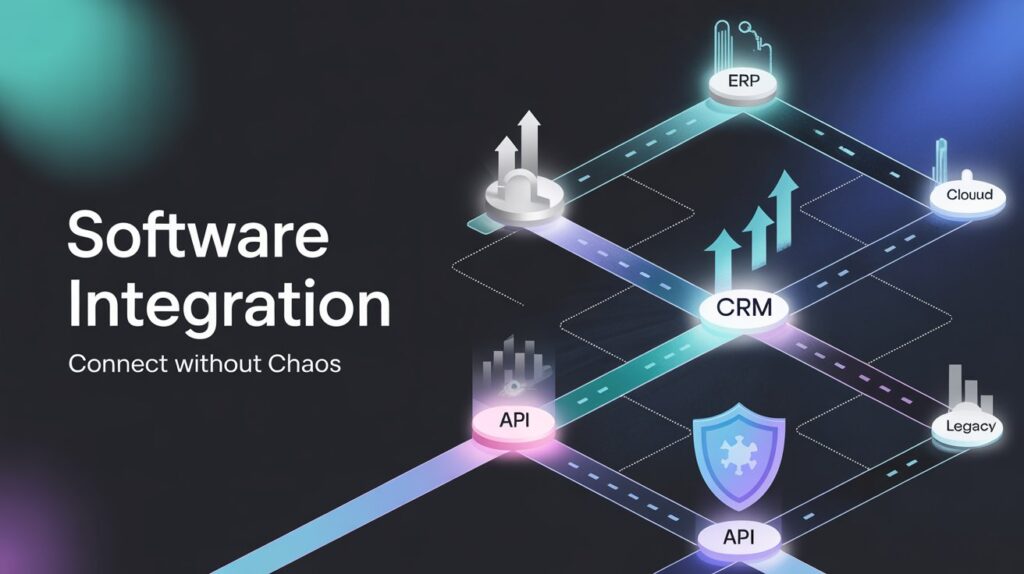
I’ve helped organizations design and implement software integrations across industries for years. The reality in 2026 is that almost every company is now a “system of systems.” Very few businesses run on a single platform anymore. Success depends on how well these systems talk to each other — and most organizations are still doing it poorly.
Poor integration creates data silos, manual workarounds, inconsistent customer experiences, and technical debt that slows everything down. Good integration, on the other hand, becomes a genuine competitive advantage.
This in-depth guide shares what actually works in 2026: modern integration patterns, technology choices, governance practices, and how to avoid the most common (and expensive) mistakes.
Why Software Integration Matters More Than Ever
In 2026, companies typically run:
- Core ERP or industry-specific systems
- CRM and customer experience platforms
- Marketing automation and analytics tools
- Finance and HR systems
- Supply chain and logistics platforms
- AI/ML models and data platforms
- Legacy systems that still power critical operations
When these systems don’t integrate well, the business suffers. When they do integrate well, data flows freely, processes become automated, and decision-making improves dramatically.
Common Integration Mistakes
- Point-to-point spaghetti integrations — Every new system creates multiple direct connections to existing ones. This becomes unmanageable very quickly.
- Underestimating data quality issues — Bad data in one system pollutes everything downstream.
- Choosing technology before understanding the problem — Many teams pick an integration platform before clearly defining what needs to be integrated and why.
- Ignoring governance and ownership — Who owns the integration? Who is responsible when something breaks?
- Treating integration as a one-time project — Integration is ongoing. New systems, new requirements, and changing business needs are constant.
Modern Integration Patterns That Work Well
Here are the approaches that deliver the best results today:
1. API-Led Connectivity (Recommended for most organizations)
- Build reusable APIs for systems
- Layer business logic and orchestration on top
- Expose clean, governed interfaces to the rest of the organization
- Tools: MuleSoft, Boomi, Workato, Apigee, Azure API Management, AWS API Gateway
2. Event-Driven Architecture
- Systems publish events when something important happens
- Other systems subscribe to events they care about
- Excellent for real-time synchronization and decoupling systems
- Tools: Kafka, Azure Event Grid, AWS EventBridge, Google Pub/Sub
3. Integration Platform as a Service (iPaaS)
- Low-code/no-code platforms for connecting cloud and on-premise systems
- Great for citizen integrators and faster delivery
- Tools: Workato, Boomi, Zapier (for simpler needs), Make, n8n
4. Data Integration & ETL/ELT
- For moving and transforming large volumes of data
- Especially important for analytics, data warehouses, and AI initiatives
- Tools: Fivetran, Stitch, Airbyte, dbt, Azure Data Factory, AWS Glue
5. Composable Architecture
- Treat capabilities as modular building blocks
- Use APIs and events to compose new experiences quickly
- Increasingly popular for digital transformation initiatives
How to Approach Integration Strategically
Step 1: Map Your Integration Landscape
- Inventory all systems that need to connect
- Identify current integration points (many will be manual or brittle)
- Understand data flows and dependencies
Step 2: Define Clear Integration Principles
- Decide on your preferred patterns (API-led, event-driven, etc.)
- Establish standards for APIs, data formats, error handling, and security
- Define ownership and governance model
Step 3: Prioritize Ruthlessly
- Start with high-value, high-pain integrations
- Look for “integration hubs” — systems that connect to many others
- Focus on business outcomes, not just technical connectivity
Step 4: Build for Reusability and Governance
- Create reusable integration assets (APIs, connectors, data models)
- Implement proper monitoring, logging, and alerting
- Establish clear ownership and support processes
Step 5: Plan for Evolution
- Integration requirements will change
- Build flexibility into your architecture
- Regularly review and retire outdated integrations
Technology Recommendations for 2026
| Need | Recommended Approach | Popular Tools |
|---|---|---|
| Complex enterprise integration | API-led + iPaaS | MuleSoft, Boomi, Workato |
| Real-time event-driven | Event-driven architecture | Kafka, Azure Event Grid, AWS EventBridge |
| Data movement & analytics | Modern data integration | Fivetran, Airbyte, dbt |
| Simple workflow automation | Low-code automation | Zapier, Make, n8n, Power Automate |
| API management & governance | API management platform | Apigee, Azure API Management, Kong |
The best approach is often a combination of these tools, chosen based on specific use cases rather than trying to force everything into one platform.
Governance and Best Practices
Successful integration programs in 2026 typically have:
- A clear Integration Center of Excellence or governance body
- Well-defined API and integration standards
- Strong data governance (especially for shared data)
- Proper monitoring and observability across all integrations
- Clear ownership and support models
- Regular integration health checks and cleanup of technical debt
Final Thoughts
Software integration in 2026 is both more important and more complex than ever. The organizations that do it well treat integration as a strategic capability, not just a technical necessity.
They invest in the right architecture and governance. They prioritize based on business value. They build for reusability and long-term maintainability. They combine modern tools intelligently rather than chasing the latest trend.
If your organization is struggling with fragmented systems, manual data movement, or integration bottlenecks, the solution isn’t just “buy a better integration tool.” The solution starts with clarity on what you’re trying to achieve, disciplined architecture, and the right governance model.
Get those foundations right, and technology choices become much easier — and much more effective.
The companies winning in 2026 aren’t necessarily the ones with the most sophisticated technology stacks. They’re the ones whose systems work together seamlessly to deliver value to customers and employees.
That’s the real power of great software integration.