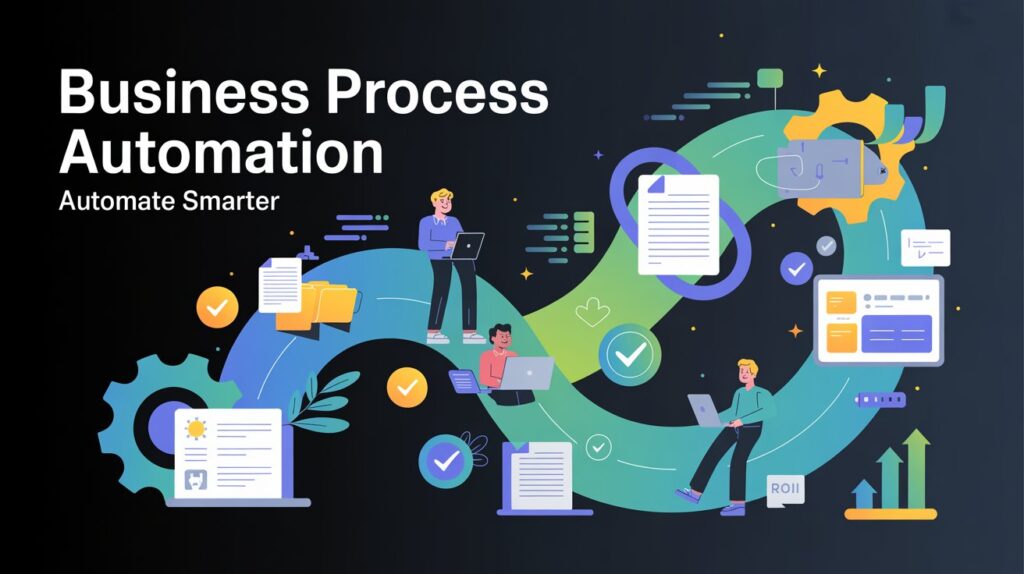
I’ve helped organizations across industries implement business process automation for years. The pattern is clear: companies that treat automation as a strategic capability win big. Those that treat it as a technology project or a cost-cutting exercise often end up with fragmented tools, disappointed employees, and disappointing ROI.
In 2026, automation is more powerful than ever. AI, intelligent document processing, low-code platforms, and process mining have changed what’s possible. But the fundamentals of successful automation haven’t changed — and many organizations are still getting them wrong.
This in-depth guide shares what actually works in 2026: the right mindset, the right approach, the technologies worth investing in, and the common traps to avoid.
Why Business Process Automation Matters More Than Ever
Organizations face intense pressure to:
- Reduce operational costs
- Improve speed and accuracy
- Free employees from repetitive work
- Scale operations without proportional headcount growth
- Deliver better customer and employee experiences
Well-executed automation delivers on all of these. Poorly executed automation creates technical debt, employee frustration, and wasted investment.
The 2026 Automation Landscape
Key shifts happening right now:
- AI is becoming mainstream in automation — Not just rules-based bots, but intelligent agents that can understand context, make decisions, and handle exceptions.
- Process mining and discovery are table stakes — You can no longer afford to guess which processes to automate.
- Low-code and citizen development are accelerating — Business users are building automations, which is both an opportunity and a governance challenge.
- End-to-end automation is the new goal — Not just task automation, but entire workflows across systems and departments.
- ROI expectations are higher — Leadership wants clear, measurable returns, not just “efficiency gains.”
The Right Way to Approach Automation
Successful organizations follow a structured, value-driven approach:
1. Start with Process Discovery and Prioritization
Don’t automate what you don’t understand. Use process mining tools to:
- Discover actual processes (not just documented ones)
- Identify bottlenecks, variations, and exceptions
- Quantify time, cost, and error rates
- Prioritize processes based on volume, pain, and automation potential
High-value targets in 2026:
- Invoice processing and accounts payable
- Customer onboarding and KYC
- Claims processing
- Order-to-cash and procure-to-pay
- HR processes (onboarding, offboarding, payroll)
- IT service management and ticket handling
2. Choose the Right Automation Technologies
Match the technology to the problem:
| Technology | Best For | When to Use |
|---|---|---|
| Robotic Process Automation (RPA) | Rule-based, repetitive tasks | High-volume, structured processes |
| Intelligent Document Processing | Unstructured documents & forms | Invoices, contracts, claims, applications |
| AI Agents & Intelligent Automation | Decision-making & exceptions | Processes requiring judgment |
| Workflow & Low-Code Automation | End-to-end process orchestration | Cross-system, multi-step workflows |
| Process Mining & Analytics | Discovery and optimization | Understanding and improving processes |
The winning approach in 2026 is often a combination of these technologies.
3. Build the Right Foundation
Before scaling automation, invest in:
- Strong governance and Center of Excellence (CoE)
- Clear automation standards and best practices
- Security, compliance, and auditability
- Change management and employee communication
- Measurement framework (what gets measured gets managed)
4. Start Small, Prove Value, Then Scale
Begin with 3–5 high-impact, lower-complexity processes. Deliver quick wins. Use the results and learnings to build momentum and justify further investment.
5. Focus on People, Not Just Technology
The biggest barrier to automation success is often people — fear of job loss, resistance to change, lack of skills.
Successful organizations:
- Communicate transparently about the “why”
- Involve employees in identifying processes to automate
- Retrain and redeploy people into higher-value work
- Celebrate automation wins publicly
Common Mistakes to Avoid
- Automating broken processes — Automating inefficiency just makes you inefficient faster.
- Starting with technology instead of business value — “We have RPA licenses, so let’s use them” is a terrible strategy.
- Ignoring exceptions and edge cases — Real processes are messy. Plan for them.
- Underinvesting in governance — Shadow automation creates risk and fragmentation.
- Treating automation as a one-time project — It should be a continuous capability.
- Not measuring the right things — Focus on business outcomes (cost, time, quality, experience), not just number of bots deployed.
What Good Looks Like in 2026
Organizations getting automation right typically see:
- 30–70% reduction in time spent on targeted processes
- Significant improvement in accuracy and compliance
- Employees redeployed to higher-value, more strategic work
- Clear, measurable ROI within 6–12 months
- A growing pipeline of automation opportunities identified by the business itself
Final Thoughts
Business process automation in 2026 is a powerful lever — but only if you approach it strategically.
The organizations winning today are not the ones with the most bots or the fanciest AI. They are the ones that:
- Start with real business problems
- Understand their processes deeply before automating
- Combine the right technologies intelligently
- Invest in people and governance alongside technology
- Treat automation as a continuous journey, not a one-time project
If your organization is serious about automation, take an honest look at where you are today. Are you automating tactically or strategically? Are you solving real problems or just chasing technology trends?
The answers will determine whether automation becomes a source of competitive advantage — or just another expensive initiative that underdelivers.
The tools and technologies available in 2026 are better than ever. The question is whether your approach is good enough to match them.
Automate with purpose. Automate with discipline. Automate for outcomes, not activity.
That’s how you win with business process automation in 2026.