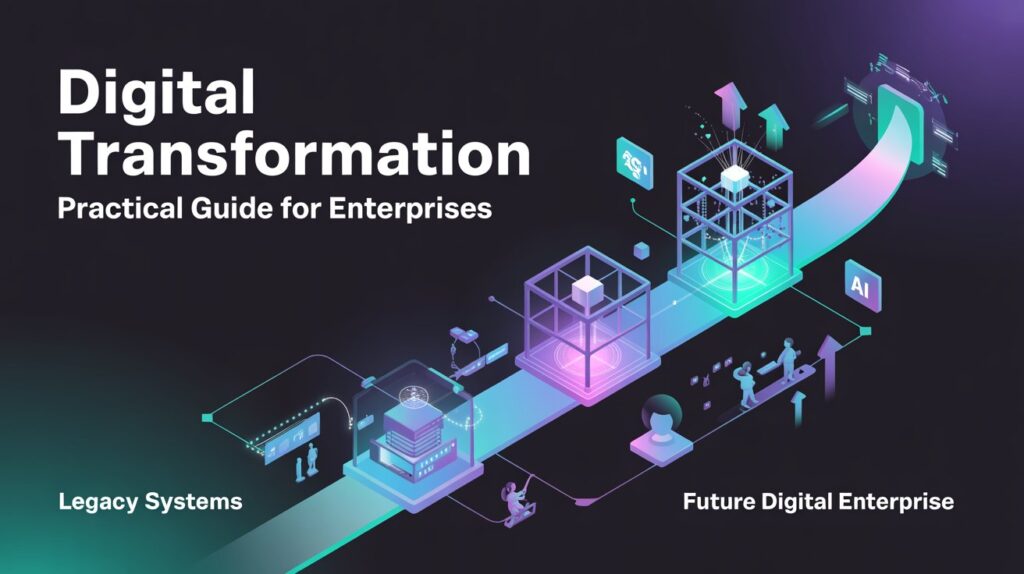
I’ve advised companies across North America, Europe, India, the Middle East, and Southeast Asia on digital transformation initiatives over the past five years. The ones that succeed don’t just adopt new technology — they fundamentally rethink how they operate, serve customers, and create value in a digital-first world.
Many organizations still approach digital transformation as a technology project. They buy new tools, migrate to the cloud, or implement AI — and then wonder why results are disappointing. The truth is that technology is only one part of the equation. Culture, processes, talent, and strategy matter just as much — if not more.
In 2026, digital transformation is no longer optional. It’s a survival imperative. This in-depth guide gives you a realistic, battle-tested framework for executing digital transformation successfully — with clear stages, common pitfalls, and what actually works in today’s environment.
What Digital Transformation Really Means
Digital transformation is the strategic integration of digital technology into all areas of a business, fundamentally changing how it operates and delivers value to customers. It’s not about digitizing existing processes — it’s about reimagining them.
Key shifts happening right now:
- AI is moving from experimental to core operational infrastructure
- Customer expectations for seamless, personalized experiences are at an all-time high
- Data is becoming a primary competitive asset (and a regulatory minefield)
- Talent models are shifting toward hybrid, global, and AI-augmented teams
- Cybersecurity and compliance are now board-level priorities
Why Most Digital Transformation Initiatives Still Fail
Research consistently shows that 60–70% of digital transformation projects fail to meet their objectives. The main reasons in 2026 are:
- Technology-first mindset (instead of business-outcome-first)
- Lack of executive sponsorship and cultural change
- Underestimating the complexity of legacy systems
- Poor change management and employee resistance
- Trying to do too much at once without clear priorities
- Insufficient focus on data quality and governance
- Ignoring the human side of transformation
The 5-Stage Digital Transformation Framework
Here’s a practical, proven framework that works across industries and company sizes:
Stage 1: Assess & Align (2–3 months)
- Conduct a honest current-state assessment (technology, processes, talent, culture)
- Define clear business outcomes (not just technology goals)
- Secure visible executive sponsorship
- Identify quick wins and long-term bets
- Build a compelling transformation narrative
Key Output: A Transformation Vision Document + Executive Alignment
Stage 2: Prioritize & Design (2–4 months)
- Map customer and employee journeys
- Identify high-impact processes to redesign
- Select technology platforms strategically (not because they’re trendy)
- Design target operating model (people, processes, technology)
- Create a phased roadmap with clear milestones
Key Output: Prioritized Transformation Roadmap + Business Case
Stage 3: Build Foundations (4–8 months)
- Modernize core platforms and infrastructure
- Establish data foundations and governance
- Build internal capabilities (talent, skills, change management)
- Launch pilot initiatives in selected areas
- Create feedback loops and iteration mechanisms
Key Output: Working pilots + foundational capabilities
Stage 4: Scale & Embed (6–12 months)
- Roll out successful pilots across the organization
- Drive cultural and behavioral change
- Optimize and automate processes at scale
- Measure and communicate results relentlessly
- Build continuous improvement muscle
Key Output: Measurable business impact at scale
Stage 5: Optimize & Future-Proof (Ongoing)
- Continuously monitor emerging technologies
- Evolve the operating model
- Institutionalize innovation and experimentation
- Build resilience and adaptability
Critical Success Factors in 2026
1. Leadership & Culture
Transformation fails without visible, consistent leadership. Leaders must model new behaviors and actively sponsor change.
2. Talent & Skills
You can’t transform without the right people. Invest in upskilling, hiring strategically, and creating a culture that attracts digital talent.
3. Data as a Strategic Asset
Clean, accessible, governed data is the foundation of modern digital capabilities. Many organizations still underestimate this.
4. Customer-Centricity
Every transformation initiative should ultimately improve customer experience or operational efficiency (ideally both).
5. Agile Governance
Traditional project management doesn’t work for transformation. You need agile governance that balances speed with risk management.
6. Change Management
This is often the most underfunded and underestimated part. Invest in communication, training, and support.
Technology Priorities
While technology is not the only factor, these areas are particularly important right now:
- Cloud & Infrastructure Modernization — Move beyond lift-and-shift to cloud-native architectures
- Data & Analytics Platforms — Build unified, real-time data capabilities
- AI & Automation — Move from pilots to production at scale
- Cybersecurity & Trust — Embed security into every layer
- Low-Code/No-Code Platforms — Accelerate citizen development and reduce IT bottlenecks
- Integration & APIs — Create a composable, connected technology ecosystem
Common Pitfalls to Avoid
- Starting with technology instead of business outcomes
- Trying to transform everything at once
- Underinvesting in change management and communication
- Ignoring legacy systems and technical debt
- Failing to measure and communicate early wins
- Treating transformation as a one-time project instead of a capability
Real-World Lessons from Successful Transformations
Example 1: Global Manufacturing Company
Shifted from siloed legacy systems to a modern cloud platform with real-time data. Focused heavily on change management and upskilling. Achieved 35% improvement in operational efficiency within 18 months.
Example 2: Financial Services Firm
Built a customer-centric digital experience layer on top of existing core systems (instead of ripping and replacing everything). Delivered measurable customer satisfaction improvements while managing risk.
Example 3: Healthcare Provider
Started with internal process automation and employee experience before tackling patient-facing transformation. Built internal capabilities and momentum that made larger initiatives more successful.
Final Thoughts
Digital transformation in 2026 is both more urgent and more achievable than ever before. The tools, platforms, and talent models available today make it possible to move faster and more intelligently than in previous years.
But technology alone won’t save you. The organizations that succeed are those that treat transformation as a strategic, human-centered journey — not a technology project.
They start with clear business outcomes. They build capabilities, not just systems. They lead with empathy and communication. They measure what matters and learn continuously.
If your organization is embarking on (or struggling with) digital transformation, take an honest look at where you are today. Ask the hard questions:
- Are we solving real business problems or just adopting technology?
- Do we have the leadership, culture, and talent to succeed?
- Are we moving at the right pace — not too slow, but not so fast that we break things?
The answers will tell you where to focus next.
The future belongs to organizations that can adapt, learn, and deliver value in a digital world. The question is not whether you will transform — it’s whether you will do it intentionally, effectively, and in a way that creates lasting competitive advantage.
Start where you are. Use what you have. Do what you can.
And do it with clarity, courage, and a relentless focus on outcomes.
That’s how real digital transformation happens in 2026.