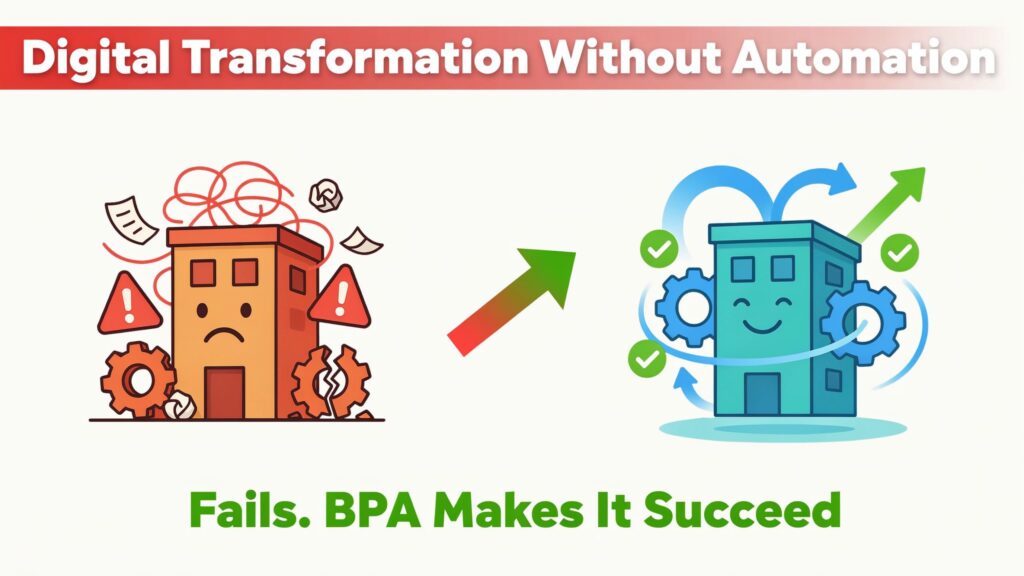
Business process automation is the quiet backbone that decides whether your digital transformation becomes a real business change or just another expensive IT project. When you put automation at the center of your plan, you give your digital tools solid processes to stand on and dramatically improve your odds of success.
Over the last decade, many companies have poured millions into new apps, cloud platforms, data lakes, and AI pilots, only to watch their “digital transformation” stall or quietly fade away. McKinsey’s research shows that around 70% of large-scale transformations fail to meet their goals, while Gartner finds that only 48% of digital initiatives actually hit their business targets. That failure rate is shocking when you think about how much time, money, and effort go into these programs.
Here’s the uncomfortable truth you need to face: most digital transformations fail not because the technology is bad, but because the underlying business processes are weak, manual, and fragmented. When your processes are chaotic, any new system you add simply automates the chaos or moves it into a shiny new interface. Business process automation (BPA) fixes this by redesigning and automating full workflows end to end, across teams and systems.
So the core thesis of this article is simple: BPA is not a “nice-to-have” add‑on to digital transformation, it is the essential foundation that makes your transformation real, repeatable, and scalable. If you want your digital projects to produce results instead of PowerPoint slides, you have to start by automating the way work actually flows through your business.
In the rest of this guide, you’ll see why most digital transformations fail, what BPA really is (and isn’t), eight clear reasons it’s essential, real-world ROI examples, and a practical roadmap you can follow to weave automation into your own digital strategy.
Why most digital transformations fail
When digital transformation stalls, the root causes tend to look surprisingly similar across industries: a technology‑first mindset, ignored or undocumented processes, and siloed initiatives that never connect into a single way of working. McKinsey points out that many digital strategies focus on buying tools instead of changing how the business actually operates, which means the day‑to‑day work barely changes even after big investments. The result is “digital veneers”—new interfaces sitting on top of old manual processes.
Gartner’s survey of thousands of CIOs and business leaders shows that barely half of digital initiatives meet or exceed their business outcome targets, despite rising budgets and pressure to modernize. Their research also highlights common failure patterns: unclear goals, lack of integration between systems, and low investment in the skills and capabilities needed to sustain new ways of working. In other words, even when new platforms are installed, the human and process side is left behind.
Another recurring problem is the “siloed pilot” trap: teams run local experiments with analytics, chatbots, or RPA in one department, but never connect those efforts across the whole value chain. McKinsey describes how many transformations stall because they tackle isolated use cases instead of redesigning core customer journeys and internal processes end to end. You might see a few small wins, but the overall customer experience and cost structure barely move.
The missing piece in most of these failed or stalled efforts is thoughtful process automation—using BPA to map, standardize, and automate the actual flows of work that support your customers and your employees. Until you address how orders are handled, how onboarding works, how approvals move, and how data travels across your systems, “digital transformation” will stay a slogan instead of a daily reality in your business.
What business process automation really means
Business process automation is the practice of using software to redesign and automate whole business processes, not just individual tasks. That includes defining clear steps, integrating multiple systems, enforcing business rules, and ensuring that data moves cleanly from one part of the process to another. The goal is simple: turn messy, manual workflows into structured, repeatable flows that run with minimal human effort and fewer errors.
It helps to separate BPA from related ideas you’ve probably heard:
-
Workflow automation focuses on designing and running sequences of tasks, such as routing approvals, sending notifications, or updating records in a specific order.
-
Robotic process automation (RPA) uses software “robots” to mimic human clicks and typing on screens, usually for repetitive, rules‑based tasks in legacy systems that don’t have APIs.
-
BPA (sometimes called process automation or digital process automation) sits above both—it orchestrates entire end‑to‑end processes and may use RPA, workflow engines, AI, and integrations as building blocks.
Analyst firms describe modern BPA platforms as the core of “hyperautomation”—combining RPA, AI, workflow orchestration, integrations, and data fabric to automate whole workflows rather than isolated tasks. Gartner notes that hyperautomation has become a staple discipline for 90% of large enterprises, precisely because end‑to‑end automation is now essential for resilience and operational excellence. In practical terms, this means BPA is no longer optional; it’s becoming the standard way serious companies design and run their digital operations.
8 reasons BPA is essential for digital transformation
1. Creates a strong digital foundation
Digital tools are only as good as the processes they support. When you use BPA to map and improve your core workflows before or alongside new technology investments, you give every new system a clear role in a clean process. This prevents you from simply digitizing broken steps and creates a foundation where future tools can plug in without major rework.
Case studies from companies like Coca‑Cola Europacific Partners and Hapag‑Lloyd show that once end‑to‑end processes were automated, they could scale digital operations across sales, finance, HR, and logistics without redesigning everything for each new tool. That strong foundation made later digital upgrades faster, cheaper, and less risky because the underlying processes were already stable and automated.
2. Enables true end‑to‑end visibility
Many digital programs fail because leaders cannot see what is really happening across the full customer journey or internal process chain. BPA platforms integrate data from multiple systems into a single flow, so you can track work from start to finish—who did what, where delays happen, and which steps cause errors.
In the TechConsult Pro case, a detailed process audit and automation program gave the firm clear visibility into 47 processes, with metrics on time, error rates, and friction points. That visibility let them focus automation on the 38 processes that were high‑value automation candidates, rather than guessing or following hype. For you, similar visibility means better decisions and fewer blind spots in your transformation.
3. Accelerates the speed of transformation
One reason digital transformation feels slow is that every new change requires manual process updates, retraining, and patchwork fixes across teams. When processes are automated and centrally managed, you can adjust rules, steps, and integrations in one place, and those changes propagate quickly across the entire workflow.
Gartner forecasts that by 2026, around 30% of enterprises will automate more than half of their network activities, up from under 10% in mid‑2023, driven by the need to respond faster to change. A Fast Company analysis of hyperautomation trends highlights that end‑to‑end automation lets organizations change how work is done at speed, instead of rewriting dozens of local procedures whenever something shifts. For you, this means less time spent on manual updates and more time pushing new digital capabilities into production.
4. Reduces costs and improves efficiency
Process automation has some of the clearest, hard‑number ROI you’ll see in any digital initiative. In one documented case, TechConsult Pro reduced manual process time dramatically and achieved $2.3 million in ROI over 18 months by automating about 80% of their client workflows. Their operational efficiency rose by 347%, with large savings from reduced manual work, fewer errors, and faster billing.
Across seven real‑world case studies compiled by Mingma, organizations such as Coca‑Cola Europacific Partners, Hapag‑Lloyd, and Australia Post reported hundreds of thousands of hours saved, double‑digit cost reductions, and payback periods as short as three months for well‑targeted automation. Typical patterns included 25–45% cost reduction in high‑volume processes, 3–4x productivity gains in 24/7 operations, and payback within 6–18 months. If you’re under pressure to “do more with less,” BPA is one of the most direct levers you can pull.
5. Enhances customer experience
Your customers don’t see your internal systems; they feel your processes. Slow onboarding, confusing steps, missing updates, or repeated data requests all come from manual or fragmented workflows behind the scenes. When you automate and streamline these flows, customers experience faster service, clearer communication, and fewer glitches.
TechConsult Pro cut client onboarding time from 14 days to 4 days and reduced client confusion about next steps from 67% to 8% after automating their onboarding workflow. Their client satisfaction scores during onboarding jumped from 6.2 to 9.1 out of 10, purely because the process became predictable, guided, and well‑communicated. Similar stories appear in postal and logistics case studies, where automation leads to faster deliveries, more accurate tracking, and smoother resolution of issues. If you want your digital transformation to be “felt” by customers, you have to start with process automation.
6. Improves compliance and risk management
Manual processes are fragile: people skip steps, forget checks, or improvise when they are busy. That creates compliance gaps, audit issues, and operational risk that can quietly undermine your digital ambitions. BPA lets you bake rules, approvals, and documentation into the flow itself so that required checks happen automatically and exceptions are flagged.
Appian and other process automation vendors emphasize that modern BPA platforms use business rules, integrations, and data fabric to ensure that compliance and governance requirements are enforced consistently across processes. Case studies in regulated sectors like energy and postal services show how automation improved regulatory reporting, reduced error‑prone manual data handling, and strengthened control over critical activities. For you, this means fewer unexpected risks when you roll out new channels or services.
7. Empowers data‑driven decision making
You can’t make good decisions about your transformation if your process data is scattered across spreadsheets, emails, and different tools. BPA centralizes process data and often ties directly into analytics and BI platforms. That means you can see trends in cycle times, error rates, capacity, and customer satisfaction in one place and use those insights to guide your next automation or digital investments.
In TechConsult Pro’s case, an AI‑powered predictive analytics layer on top of their automated processes helped forecast revenue, detect churn risk, and plan capacity based on real operational data. Fast Company reports that hyperautomation, which extends BPA with AI and machine learning, is projected to grow from about $15.5 billion in 2025 to $38.3 billion by 2030, largely because it enables smarter, data‑driven decisions from operational flows. When your processes are automated, every step becomes a data point you can learn from.
8. Supports sustainable scalability
Many companies hit a growth ceiling because their manual processes simply cannot handle more volume without hiring heavily or burning out teams. Process automation breaks this limit by letting “digital workers” handle high‑volume tasks around the clock while people focus on exceptions and higher‑value work. This allows you to grow without linearly increasing headcount and without losing quality.
The Hapag‑Lloyd case study shows how just two digital workers process around 750,000 items monthly, with high accuracy on complex tasks like invoice disputes, freeing people for more strategic work. Australia Post reported 18,000 hours saved annually and a 15% reduction in operational costs after making automation a core part of its digital transformation. For your business, BPA becomes the engine that can carry growth instead of letting success overload your teams.
Real‑world impact: success vs failure
To see the difference BPA makes in practice, let’s compare companies that built strong process automation into their digital plans with those that did not.
TechConsult Pro, a 150‑employee consulting firm, was drowning in manual, paper‑heavy processes that consumed about 40% of billable time and created delays and inconsistent delivery. After a structured process audit, they identified 38 out of 47 workflows as automation candidates and built an automation architecture using Microsoft’s Power Platform, integrating CRM, document management, finance, and communication tools. In 18 months, they automated around 80% of targeted processes, generated $2.3 million in ROI, increased operational efficiency by 347%, and significantly improved client satisfaction.
Coca‑Cola Europacific Partners implemented intelligent automation across sales, finance, HR, operations, IT, supply chain, and logistics, deploying around 60 digital workers and 450 automations. Over several years, they recovered about 580,000 hours of manual work, saved roughly €17 million, and reduced error rates in key processes by 80%, with some order processing times dropping from 10 minutes to seconds. This level of automation turned digital tools into real operational power rather than isolated projects.
On the other side, McKinsey documents how many digital transformations stall when companies focus on flashy front‑end experiences or analytics without fixing core processes like onboarding, order handling, and approvals. These programs often suffer from resourcing issues, lack of clarity about what is being transformed, and fragmented efforts that don’t change the daily work of teams. In such stories, organizations have modern apps and dashboards, but performance and customer experience barely move because the underlying processes are still manual and broken.
The lesson is clear for you: the companies that win treat BPA as the heart of their transformation, not as a side project. Those that skip process automation end up with expensive technology sitting on top of old habits.
How to integrate BPA into your digital transformation strategy
You don’t need to automate everything at once. You do need a simple, practical plan that connects BPA to your wider digital goals. Here’s a step‑by‑step approach you can adapt.
Step 1: Assess current processes and transformation maturity
Start by mapping how work actually happens today in your most important areas—sales, service, onboarding, finance, operations. Use simple tools: process walks, interviews, time tracking, and a rough “value stream” from the customer’s first contact to the final outcome. At the same time, look at your transformation maturity: are you in manual chaos, basic automation (a few scripts and tools), integrated automation (systems talking to each other), or intelligent automation (AI and analytics driving decisions)?
LUWAI’s case study shows a practical audit approach: they shadowed key employees, mapped workflows, measured error rates and delays, and used a scoring model to classify processes as quick wins, high‑impact targets, or manual‑only. You can do a lighter version of this: list your top 20–30 processes, rate them on volume, pain, and impact, and identify which ones are ready for automation.
Step 2: Prioritize processes for automation
Once you see your process landscape, don’t try to automate everything. Use a simple prioritization matrix: high‑impact / low‑complexity processes are your “quick wins,” while high‑impact / high‑complexity ones become strategic projects. Low‑impact processes can wait.
In TechConsult Pro’s project, quick wins included invoice processing, client onboarding, status reporting, and document generation—each with strong ROI and relatively simple changes. Strategic projects covered end‑to‑end project management and resource allocation, which needed more design but offered big returns. Mingma’s ROI framework suggests focusing first on high‑volume, repetitive processes with clear cost and error problems, since these routinely show payback within 6–18 months.
Step 3: Choose the right automation approach (no‑code + AI)
You don’t need to build everything from scratch. Modern BPA stacks often mix low‑code / no‑code tools (like Power Automate, Zapier, n8n, or dedicated process platforms) with RPA and AI services. Gartner’s hyperautomation guidance emphasizes combining technologies—workflow engines, RPA, AI, document processing, and integration platforms—to automate processes end to end.
For you, that typically means:
-
Use workflow and BPA platforms to orchestrate the overall process and integrate systems.
-
Use RPA when you have legacy tools without APIs that still matter.
-
Use AI for reading documents, classifying emails, predicting churn or risk, and surfacing insights from process data.
Start small with platforms that fit your existing stack (for example, Power Platform if you use Microsoft 365, or cloud BPA tools that integrate easily with your CRM and ERP).
Step 4: Build a phased automation roadmap
Successful companies don’t do “big bang” automation; they roll out changes in waves. LUWAI’s framework used phases: assessment and planning, foundation building, iterative implementation through agile sprints, then scaling and optimization. You can mirror that with a simple roadmap:
-
Phase 1 (0–3 months): Audit and quick wins—automate 3–5 high‑impact, low‑complexity processes.
-
Phase 2 (3–12 months): Strategic processes—tackle end‑to‑end workflows in key customer journeys or finance operations.
-
Phase 3 (12+ months): Intelligence and scaling—add AI, predictive analytics, and expand automation patterns across departments.
Make sure this roadmap is tied to your wider digital strategy, not separate from it. For example, if your digital goal is “faster customer onboarding,” your roadmap should highlight the onboarding process, related approvals, access setup, and communication workflows as automation targets.
Step 5: Measure success with clear KPIs
You should treat BPA like any serious investment: define what success looks like in numbers before you start. Mingma’s article suggests simple automation KPIs: hours saved, cost reduction, error reduction, speed‑to‑revenue (such as shorter order‑to‑cash cycles), and payback period. LUWAI’s invoice automation case measured time savings, error reduction, faster payments, and net financial benefit, achieving a 342% annual ROI with an 11‑day payback period for that process alone.
For your roadmap, pick 3–5 KPIs per process, such as:
-
Average cycle time (before vs after automation).
-
Error rate or rework rate.
-
Customer satisfaction or NPS tied to that process.
-
Cost per transaction.
-
Payback period on automation investment.
Track these metrics continuously and share results with your teams so they see the impact of new ways of working.
Step 6: Establish governance and continuous improvement
Automation is not a one‑off project; it’s a new way of running your business. Successful companies set up clear ownership, rules, and improvement loops around their BPA efforts. Cartus, for example, built a center of excellence with subject matter experts and expanded from a small RPA pilot to 26 bots in daily production, backed by governance and standards.
For you, this can be simple:
-
Assign a small cross‑functional “automation council” to oversee priorities, design standards, and risk checks.
-
Define guidance on which processes can be changed, how exceptions are handled, and how new automations are rolled out and documented.
-
Run regular reviews (monthly or quarterly) to look at metrics, gather user feedback, and refine workflows based on real data.
Over time, this turns BPA from a project into a continuous improvement engine for your digital operations.
Best practices and common pitfalls
Looking across multiple case studies and research, a few best practices stand out. First, successful organizations start with business problems, not technology—asking “which processes hurt us most?” before asking “which tool should we buy?”. They invest early in change management and training so people understand why processes are changing and how automation will help them, not replace them.
They also design for scale from the beginning: using modular architectures, common integration patterns, and shared standards so each new automation fits into a bigger system. And they measure everything, using weekly or monthly reviews to tune flows and extend automation where it works best.
On the pitfall side, LUWAI and Mingma highlight recurring mistakes: trying a “big bang” approach instead of iterative phases, automating bad processes without fixing them first, underestimating edge cases, and neglecting human oversight. McKinsey’s work on transformation failures adds cultural issues—resistance to change, lack of leadership commitment, and low investment in capability building—as major reasons initiatives fall short. If you avoid these traps and keep your focus on clear business outcomes, BPA will support your transformation instead of becoming another abandoned project.
The future: hyperautomation and intelligent processes
Looking toward 2027 and beyond, BPA is set to become even more powerful as part of broader hyperautomation and intelligent automation trends. Gartner reports that hyperautomation—combining process automation with AI, machine learning, events, and RPA—is now a main discipline for the vast majority of large enterprises. Their surveys show most organizations deploying or planning to deploy hyperautomation tools like RPA, AI, and chatbots, with finance and related industries among those most impacted.
Analyses of the hyperautomation market suggest rapid growth, with estimates of the market nearly doubling between the mid‑2020s and 2030 as more companies move from task‑level automation to interconnected intelligent systems. Industry guides point to trends like low‑code process platforms, AI‑driven process mining, and agentic automation that can handle ambiguity and exceptions, all sitting on top of solid BPA foundations. For you, this means that investing in BPA today is not just about fixing current problems—it’s about building the skeleton that future AI‑driven systems will rely on.
Final Words
If you take only one idea from this article, let it be this: digital transformation without strong, automated processes is like building a skyscraper on sand. The data shows that most transformations fail, and the cases show that BPA is the difference between a glossy front‑end and a genuinely transformed business. When you redesign and automate the way work flows through your company, technology finally has something solid to amplify.
Here’s a simple action plan you can start on:
-
Pick one critical customer journey or internal process (for example, onboarding, order‑to‑cash, or invoicing) and map it end to end with your team.
-
Use the prioritization matrix to mark which steps are high‑volume, repetitive, and error‑prone, and estimate rough ROI based on hours and error costs.
-
Choose a BPA/automation stack that fits your current tools and begin with 2–3 quick wins in that process, using low‑code and integrations wherever possible.
-
Define 3–5 clear KPIs and track them before and after automation, then share the results widely to build momentum.
-
Set up a small governance group to oversee further automation and expand gradually into strategic end‑to‑end workflows.
If you follow these steps, you’re no longer “doing digital” in name only—you’re deliberately building automated, intelligent processes that can carry your transformation forward for years. And that is how you turn buzzwords into results in your own business.