**This post is sponsored by Semrush. When you purchase through links in this article, we may earn an affiliate commission from Semrush.**
A strange thing has been happening to websites over the past year.
Many businesses are still ranking on the first page of Google for the keywords they have worked hard to earn. Their impressions continue to grow, and technically, nothing looks broken. Yet traffic keeps slipping month after month.
For a long time, the first instinct was to blame the SEO strategy. Maybe the content needed updating. Maybe competitors had built better backlinks. Maybe another Google algorithm update had changed everything again.
But the reality is much bigger than that.
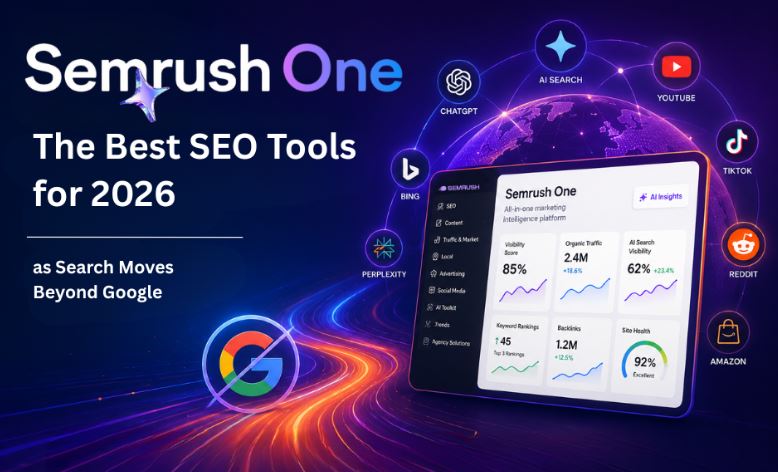
People are no longer relying on one place to find answers. They still use Google, but they are also asking questions in ChatGPT, Perplexity, Gemini, and Google’s own AI search experiences. In many cases, they get the information they need without ever clicking through to a website.
That explains why so many marketers are seeing higher impressions but fewer visitors. Search is not disappearing. It is simply expanding into places that traditional SEO tools were never designed to measure.
The real question in 2026 is no longer which tool helps you rank higher on Google.
It is which tool helps your business stay visible wherever people are searching.
Search Visibility Means More Than Rankings
One statistic captures the shift better than almost anything else. Around 60 percent of Google searches now end without a click because users receive the information directly in search results or AI-generated summaries.
For businesses, this changes what success looks like.
Ranking first is still valuable, but it is no longer enough. If your competitors are consistently being mentioned inside AI-generated answers while your brand is absent, you could lose potential customers before they even reach your website.
This is why newer SEO platforms are beginning to focus on total search visibility instead of rankings alone. They help businesses understand not only how they perform in traditional search engines but also how they appear across AI-powered search experiences.
Among the available options, Semrush stands out because it combines both worlds in a single platform instead of treating AI visibility as a separate product.
1. Semrush
Best for: Businesses and marketing teams that want one platform for traditional SEO and AI visibility.
Most SEO platforms have spent years helping marketers improve rankings. That remains important, but today’s search landscape demands a broader perspective.
Semrush was built around that idea.
Instead of only tracking keywords and backlinks, it also helps businesses understand how they appear across AI-powered platforms such as ChatGPT, Google AI Overviews, Gemini, and Perplexity. This gives marketing teams a clearer picture of their overall online presence instead of focusing solely on search engine rankings.
One feature that makes a real difference is the AI Visibility Toolkit. It measures how often your brand appears in AI-generated answers, monitors competitor mentions, tracks citations, and highlights whether your business is being represented accurately. These insights are becoming increasingly valuable as AI assistants influence more buying decisions.
At the same time, Semrush continues to offer one of the most comprehensive SEO datasets available. It includes access to 27.5 billion keywords across 142 databases, a backlink index containing more than 43 trillion links, historical data dating back to 2012, and an AI prompts database covering more than 239 million prompts.
Another advantage is convenience. Instead of switching between separate SEO software and AI monitoring tools, everything lives inside one workflow. That saves time and makes reporting much simpler for agencies and in-house marketing teams alike.
No platform is perfect, though. Semrush has a higher starting price than some entry-level competitors, and beginners may need time to become familiar with its wide range of features.
For businesses that depend on organic traffic, having SEO and AI visibility in one place can make the investment worthwhile.
2. Ahrefs
Best for: SEO professionals who prioritize backlink analysis and technical SEO.
Ahrefs has earned a strong reputation over the years for its backlink database and Site Explorer. Many SEO specialists rely on it to analyze competitors, discover link opportunities, and evaluate website authority.
Its keyword research tools are also excellent, making it a popular choice for experienced marketers.
Where Ahrefs currently falls behind is AI visibility. While it has introduced features related to AI search, businesses looking for integrated monitoring across multiple AI platforms will likely need additional tools to fill the gaps.
If your primary focus remains technical SEO and backlink research, Ahrefs continues to be one of the strongest options available. If you want to manage traditional search and AI discovery together, Semrush offers a more complete workflow.
3. Moz Pro
Best for: Small businesses and beginners learning SEO.
Moz remains one of the easiest SEO platforms to learn. Its interface is approachable, and many newcomers appreciate the educational resources that accompany the software.
For local businesses or smaller websites with straightforward SEO needs, Moz still provides useful keyword research, rank tracking, and site auditing features.
The trade-off is scale. Its databases are smaller than those offered by larger competitors, and it currently lacks the AI visibility capabilities that many growing businesses are beginning to need.
That does not make Moz a poor choice. It simply means its strengths are different. Businesses just starting with SEO may appreciate its simplicity, while larger teams often outgrow it as their reporting and research become more advanced.
Choosing the Right Tool for the Next Stage of Search
There is no single SEO platform that fits every business.
Some marketers care most about backlinks. Others want a straightforward platform that helps them improve local rankings. Those remain perfectly reasonable priorities.
But if your website has experienced the frustrating combination of growing impressions and declining traffic, it is worth asking a different question.
Are people still finding your business, just in places you are not measuring?
As AI-generated search continues to become part of everyday browsing, businesses need tools that provide visibility across the entire search journey rather than one channel alone.
That is where Semrush offers a meaningful advantage. It combines proven SEO capabilities with tools designed for the next generation of search, helping businesses understand not only where they rank but also how AI platforms talk about their brand.
The rules of search have changed, but the opportunity is still there for businesses willing to adapt.
If you want to prepare your marketing strategy for where search is heading instead of where it has been, now is an excellent time to explore Semrush. Its combination of traditional SEO insights and AI visibility tools can help you understand your online presence more completely and make better decisions before your competitors do.