Every SaaS team has more good feature ideas than capacity. Successful companies don’t rely on gut feel or the loudest stakeholder. They use simple, repeatable frameworks to rank ideas by value, effort, and strategic fit.
The best teams rarely use just one framework. They pick the right one for the decision in front of them—ranking a large backlog, scoping a fixed release, deciding what belongs in an MVP, or understanding which gaps actually matter to customers. In 2026, the strongest product organizations treat prioritization as a decision system rather than a single scoring ritual. They combine frameworks, feed them with usage and revenue data, and deliberately design against the common failure modes: everything turning into a “Must,” confidence being ignored, and scores quietly reflecting internal bias instead of customer or commercial reality.
This article covers the ten frameworks most commonly used by strong SaaS product teams and shows exactly when and how to apply each one.
Why Frameworks Matter (and Why Most Teams Misuse Them)
Without a shared framework, prioritization becomes political. Ideas win because of seniority, recency, or who can argue longest in a meeting. The loudest customer or the most persuasive executive sets the roadmap. Over time this produces inconsistent decisions, eroded trust, and a backlog that no longer reflects strategy.
The most common mistakes are predictable. Teams treat frameworks as interchangeable scorecards rather than tools matched to a specific decision. They ignore confidence, so a low-data idea with a high impact estimate outranks a proven, high-confidence improvement. And with MoSCoW especially, “Must” lists expand until the framework loses all meaning—every stakeholder’s priority becomes non-negotiable.
Successful teams avoid these traps by matching the framework to the decision type and the data they actually have. Early-stage teams with limited instrumentation lean on lightweight methods. Mature products with solid usage and revenue data can afford more quantitative ranking. Release scoping under a fixed date requires a different lens than continuous backlog ranking. The framework is useful only when the team understands what question it is answering and what evidence it requires.
The Top 10 Frameworks
1. RICE (Reach, Impact, Confidence, Effort)
RICE is the most widely used quantitative framework for ranking larger backlogs when a team has reasonable data. It scores each idea as:
RICE Score=Reach×Impact×ConfidenceEffort\text{RICE Score} = \frac{\text{Reach} \times \text{Impact} \times \text{Confidence}}{\text{Effort}}
Reach is the number of users or accounts affected in a given period. Impact is usually scored on a scale (0.25, 0.5, 1, 2, 3) representing the effect on the target metric. Confidence is expressed as a percentage to discount speculative estimates. Effort is typically person-weeks or a relative size.
It works best when you have usage data, conversion funnels, or revenue attribution that can inform Reach and Impact. Strong SaaS teams use it to rank a prioritized backlog of 20–100 items, especially for product improvements and growth initiatives where the relative value of features is not obvious. The Confidence multiplier is the key practical safeguard: it forces the team to distinguish between “we believe this will move the metric” and “we have evidence.”
Strengths include transparency and the ability to incorporate real data. Limitations appear when Reach or Impact estimates are poorly calibrated, when Effort is systematically under- or over-estimated by different squads, or when the team treats the formula as more precise than the inputs. In practice, successful teams review the top-scoring items as a group and adjust for strategic fit that the formula cannot capture.
2. ICE (Impact, Confidence, Ease)
ICE is a lighter, faster cousin of RICE. It scores Impact, Confidence, and Ease (the inverse of Effort) on simple 1–10 scales and multiplies or averages them. There is no separate Reach term, so it is quicker to run and less data-hungry.
It is ideal for growth experiments, early-stage products, and teams that need to prioritize dozens of ideas in a workshop without extensive instrumentation. Many seed-to-Series B SaaS companies use ICE for weekly or bi-weekly experiment ranking because it can be completed in a single meeting and still surfaces the high-confidence, high-impact, low-effort opportunities.
The main strength is speed and low process overhead. The limitation is reduced precision on larger backlogs where Reach varies dramatically; an idea that affects every user looks the same as one that affects a small segment unless the team manually adjusts. In 2026, teams that have grown past pure experimentation often keep ICE for rapid growth bets while moving core product work to RICE.
3. Value vs Effort Matrix
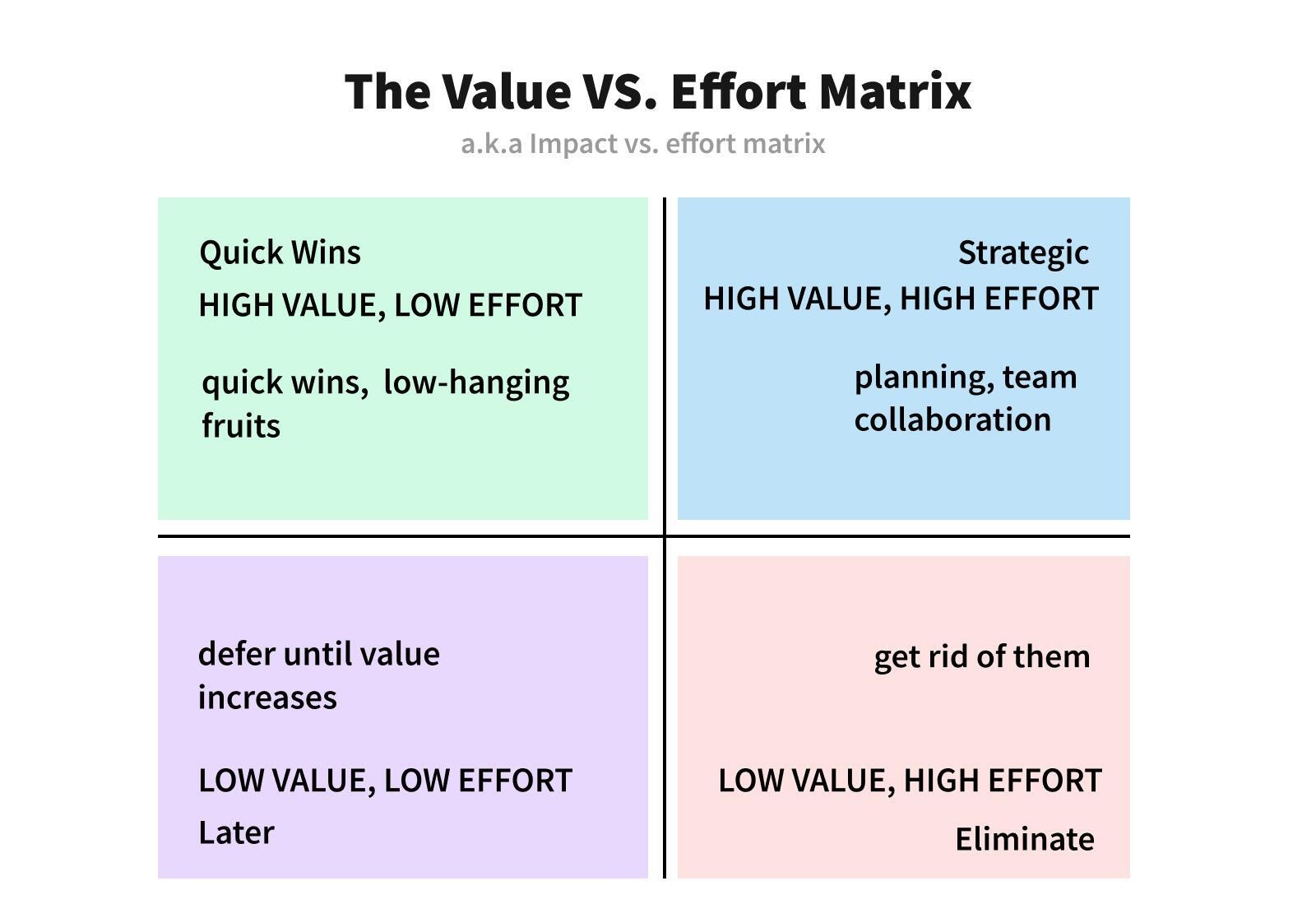
This is the simplest visual framework: plot ideas on a 2×2 grid with Value on one axis and Effort on the other. High-value, low-effort items are obvious quick wins; high-value, high-effort items become strategic bets; low-value items are deprioritized or discarded.
It is best for initial triage, workshops with mixed stakeholders, and situations where you need a shared picture rather than a precise ranking. Many product teams start here before applying a more quantitative method to the high-value quadrant. It requires almost no data and produces an immediate, intuitive outcome.
Strengths are clarity and speed. Limitations include subjectivity in placing items and the absence of any explicit confidence or reach factor. Successful teams treat the matrix as a conversation tool, not a final decision tool, and follow it with RICE or ICE on the shortlist.
4. MoSCoW (Must, Should, Could, Won’t)
MoSCoW categorizes work for a specific release or MVP into Must have, Should have, Could have, and Won’t have (this time). It is primarily a scoping tool rather than a ranking tool. Teams use it when they have a fixed timeline, fixed capacity, or a clear definition of “done” for a launch.
It works best for release planning, MVP definition, and situations where stakeholders need a hard conversation about what will not be included. The “Won’t” category is as important as the “Must” category; it creates explicit agreement on deferred work.
The classic failure mode is Must inflation. Without discipline, every stakeholder’s priority becomes a Must and the framework collapses. Strong SaaS teams counter this by capping Musts at a fixed percentage of capacity (commonly 50–60%), requiring evidence or clear strategic rationale for Must status, and reviewing the list after the first planning pass. In 2026 practice, MoSCoW is almost always applied after a ranking framework has already ordered the candidate features.
5. Kano Model
The Kano Model classifies features according to their effect on customer satisfaction: Basic (expected; their absence creates dissatisfaction), Performance (more is better; linear satisfaction), and Delighter (unexpected features that create disproportionate satisfaction). Attractive features can also decay into Basics over time as expectations rise.
Teams typically gather input through surveys that ask how customers would feel if a feature were present and how they would feel if it were absent. The model is most useful during discovery and when deciding the character of a release rather than pure ranking. It helps product teams avoid over-investing in performance features while neglecting basics, or shipping delighters that do not address core dissatisfaction.
Strengths include a direct link to customer emotion and satisfaction. Limitations include survey design sensitivity and the fact that classification can shift with market maturity. Successful SaaS companies use Kano selectively on key journeys or when entering a new segment, then combine the insights with a ranking framework such as RICE so that delighters are not pursued at the expense of high-reach basics.
6. Opportunity Scoring
Opportunity Scoring prioritizes features by the gap between how important a need is to customers and how satisfied they currently are with existing solutions. It is typically calculated as:
Opportunity Score=Importance+(Importance−Satisfaction)\text{Opportunity Score} = \text{Importance} + (\text{Importance} – \text{Satisfaction})
Both Importance and Satisfaction are usually measured on a 1–10 scale through customer surveys or interviews. High importance combined with low satisfaction produces the largest opportunity scores.
It is most useful during discovery when the goal is to identify which problems are worth solving rather than which solutions to build. Mature SaaS companies with established user bases apply it to key jobs-to-be-done or segments where they want to reduce churn or expand usage. It forces the team to quantify the pain rather than relying on feature requests.
Strengths include a clear customer-centric signal and the ability to surface underserved needs that internal stakeholders may overlook. Limitations appear when survey response rates are low, when importance ratings are inflated by leading questions, or when the team jumps straight to features without validating the underlying opportunity. In practice, strong teams use Opportunity Scoring to shortlist problem areas, then apply RICE or a Value vs Effort matrix to evaluate specific solutions.
7. Weighted Scoring
Weighted Scoring lets a team define its own criteria (for example, revenue impact, strategic alignment, technical risk, competitive differentiation, and customer effort) and assign relative weights that sum to 100%. Each feature is scored against those criteria, and the weighted sum produces a final ranking.
It is best for complex strategic decisions involving multiple stakeholders with different priorities—such as choosing among large platform investments or balancing growth, retention, and expansion bets. Series B and later SaaS companies often use it when a simple impact/effort score is insufficient and the decision involves trade-offs that pure quantitative frameworks cannot capture.
The main strength is flexibility and the ability to make criteria and weights explicit. The main limitation is the risk of biased weighting: if weights are set by the loudest voices rather than by strategy and data, the output simply formalizes politics. Successful teams mitigate this by agreeing on weights in advance, calibrating scores with revenue or usage data where possible, and reviewing the top results for strategic coherence rather than accepting the ranking blindly.
8. WSJF (Weighted Shortest Job First)
WSJF comes from the Scaled Agile Framework and prioritizes by Cost of Delay divided by Job Size (or Effort). Cost of Delay is typically the sum of user-business value, time criticality, and risk reduction / opportunity enablement. The resulting score favors work that delivers the most economic value in the least time.
It is especially useful when sequencing matters and when delaying a feature has a measurable commercial cost—common in B2B SaaS with sales-driven roadmaps, regulatory deadlines, or large enterprise deals. Teams that already think in terms of cost of delay find WSJF more intuitive than pure impact scoring.
Strengths include an explicit focus on economic sequencing and the ability to compare very different types of work. Limitations include the difficulty of estimating Cost of Delay accurately and the tendency for teams to inflate time-criticality scores. In 2026, SaaS product organizations that use WSJF usually do so for portfolio-level or release-train decisions rather than day-to-day backlog ranking, and they combine it with RICE or Weighted Scoring for the underlying value estimates.
9. Story Mapping
Story Mapping organizes work around the user journey rather than a flat prioritized list. The horizontal axis represents the sequence of user activities; the vertical axis represents priority within each activity. The team can then draw a release line to define the minimum set of stories that deliver a complete, usable flow.
It is best for scoping an MVP, designing a major new workflow, or ensuring that a release delivers end-to-end value instead of a collection of disconnected features. Product teams working on complex multi-step experiences (onboarding, configuration, analytics setup, or marketplace flows) use it to avoid shipping partial journeys that leave users stuck.
Strengths include shared understanding of the user experience and a natural way to identify the thinnest slice that still delivers value. Limitations include the time required to build and maintain the map and the fact that it does not, by itself, quantify commercial impact. Strong teams use Story Mapping to define the shape of a release, then apply MoSCoW or RICE within the map to decide what sits above or below the release line.
10. Hybrid / Layered Approaches
The most effective SaaS teams rarely rely on a single framework. They layer them according to the decision at hand. A common sequence is:
- Value vs Effort matrix for rapid initial triage of a large idea set.
- RICE or ICE for quantitative ranking of the shortlist.
- Kano or Opportunity Scoring when customer insight is needed to interpret or adjust the scores.
- MoSCoW or Story Mapping to scope a specific release once the ranking is clear.
- Weighted Scoring or WSJF for larger strategic or portfolio decisions.
This layered approach reduces the failure modes of any single method. The matrix prevents premature precision, RICE adds data and confidence, customer frameworks correct internal bias, and MoSCoW or Story Mapping forces hard scoping conversations. In 2026 practice, product leaders treat the frameworks as complementary tools in a decision system rather than competing methodologies. The combination is documented so that new team members understand which tool is used for which type of decision and what evidence is required at each step.

How to Choose the Right Framework
Match the framework to product stage, team size, data availability, and the specific decision you need to make.
Early-stage or resource-constrained teams with limited instrumentation should start with ICE or a Value vs Effort matrix. Both require minimal data and can be run in a single workshop. Once the product has meaningful usage and revenue data, move core ranking to RICE so that Reach and Confidence become explicit. For any fixed-deadline release or MVP, apply MoSCoW (or Story Mapping followed by MoSCoW) after the ranking step so that scope conversations are grounded in a pre-ordered list rather than open negotiation.
When the primary question is “which customer problems matter most,” use Opportunity Scoring or the Kano Model before solution ranking. When multiple stakeholders must agree on criteria that go beyond simple impact and effort, use Weighted Scoring. When the economic cost of delaying work is material and sequencing is the main decision, consider WSJF.
A practical decision matrix looks like this:
- Limited data, rapid experiments → ICE or Value vs Effort
- Data-rich backlog ranking → RICE
- Fixed timeline release or MVP → MoSCoW or Story Mapping + MoSCoW
- Customer problem discovery → Opportunity Scoring or Kano
- Multi-criteria strategic choice → Weighted Scoring
- Cost-of-delay sequencing → WSJF
- Ongoing mature product organization → Hybrid (triage → rank → customer insight → scope)
The goal is not to find the single best framework but to select the lightest tool that still produces a defensible decision given the information and constraints you have.
Practical Tips from Successful SaaS Teams
Score as a team, not in isolation. Individual scoring introduces bias; a short calibration discussion after independent scoring improves consistency and surfaces assumptions.
Revisit scores when material new data arrives—usage metrics, win/loss analysis, or revenue attribution—rather than treating the first ranking as permanent.
In MoSCoW exercises, explicitly cap the percentage of capacity allocated to Must items (many teams use 50–60%) and require a written rationale for any Must that does not score highly on the preceding ranking framework.
When incorporating customer input, weight it by revenue contribution or strategic segment importance so that the needs of high-value accounts are not drowned out by volume of requests from lower-value users.
Document the key assumptions behind Reach, Impact, and Confidence scores. This makes later review possible and reduces the tendency to defend original estimates after reality has changed.
After shipping, review outcomes against the original scores. Over time this improves the team’s calibration and reveals systematic over- or under-estimation patterns.
Conclusion
The best feature prioritization framework is the one your team will actually use consistently. Most successful SaaS companies rely on RICE or ICE for ranking larger backlogs, MoSCoW (often paired with Story Mapping) for release scoping, and one customer-research method such as Kano or Opportunity Scoring when deeper insight is required. Hybrid use is the norm rather than the exception.
Start with the simplest framework that fits your current data and decision type. Stay consistent long enough for the team to develop shared calibration, then layer additional methods as the product and available evidence mature. The frameworks themselves are straightforward; the discipline to apply them without letting politics, Must inflation, or ignored confidence undermine the process is what separates effective prioritization from elaborate theater.
FAQs
What’s the best feature prioritization framework for a SaaS startup?
ICE or a Value vs Effort matrix. Both are fast, require little data, and can be run by a small team in a single session. Move to RICE once you have reliable usage or revenue signals.
RICE vs ICE vs MoSCoW — which one should we use?
Use RICE or ICE to rank the backlog; use MoSCoW to decide what actually fits in a specific release. They answer different questions and work well together.
How do successful SaaS companies prioritize features?
They combine a quantitative ranking method (usually RICE or ICE) with a scoping method (MoSCoW or Story Mapping) and periodically apply a customer-insight framework (Kano or Opportunity Scoring). Decisions are made by the team with documented assumptions.
Is the Kano Model still useful in 2026?
Yes, especially for understanding which features are true basics versus delighters in mature categories. It is most valuable during discovery or when entering a new segment, not as a daily ranking tool.
How do you stop everything from becoming a “Must have”?
Cap Musts at a fixed share of capacity, require them to rank highly on a prior framework such as RICE, and treat the Won’t category as a real outcome of the conversation rather than an afterthought.
Should we use one framework or combine several?
Combine them. Most strong teams triage with a simple matrix, rank with RICE or ICE, and scope releases with MoSCoW or Story Mapping. Using only one method leaves important decision types poorly served.
What’s the easiest framework for a small product team?
Value vs Effort matrix for visual triage, or ICE if you want a quick numerical ranking. Both can be completed in under an hour with minimal preparation.
How do you prioritize when you don’t have much data?
Use ICE or Value vs Effort and treat Confidence as a first-class input. Explicitly discount ideas with weak evidence rather than pretending all estimates are equal.
What’s the biggest mistake teams make with feature prioritization?
Letting the framework become a political exercise—either by ignoring confidence, allowing Must lists to grow without constraint, or weighting criteria to favor predetermined outcomes.
How often should we re-score our backlog?
Re-score when significant new data arrives or when the strategic context changes. For most teams this means a light review monthly or quarterly and a fuller re-ranking after major releases or market shifts, rather than continuous re-scoring of every item.