AI search is already a primary discovery channel for B2B software buyers in 2026, and SaaS companies that treat it as “just more SEO” are quietly losing shortlist visibility at the exact moment decisions are being made. The teams that are winning are building answer‑ready content, citation authority, and product proof that AI systems can confidently recommend, not just rank.
In 2026, your next buyer is increasingly starting in a chat window, not a search box.
Forrester’s 2026 Buyers’ Journey Survey found that 94% of B2B buyers used AI tools during their most recent purchase process, and AI assistants are now the single most meaningful information source across discovery, comparison, and internal business case building. G2’s 2026 research shows that 51% of B2B software buyers now start their research with an AI chatbot more often than Google, and 71% rely on AI chatbots somewhere in their software evaluation.
At the same time, AI and traditional search have both gone heavily “zero‑click”: up to 93% of AI Mode sessions and 60% of Google searches now end without a website visit, meaning the answer inside the AI result often is the buying touchpoint. Several analyses of B2B AI traffic show that while AI‑sourced visitors are still a small slice of total web traffic (around 1%), they convert 5–23× better than standard organic search — because buyers arrive with a shortlist and intent already formed.
For SaaS companies, this is not a theoretical trend. It decides who gets named in “best tools for X,” “alternatives to Y,” and “which product should we choose?” prompts — and therefore who even reaches a demo or trial. This article walks you through how leading SaaS teams are adapting their content, product, and distribution strategies to win in AI‑mediated discovery, without abandoning Google but without clinging to a 2015 playbook.
The New Discovery Landscape in 2026
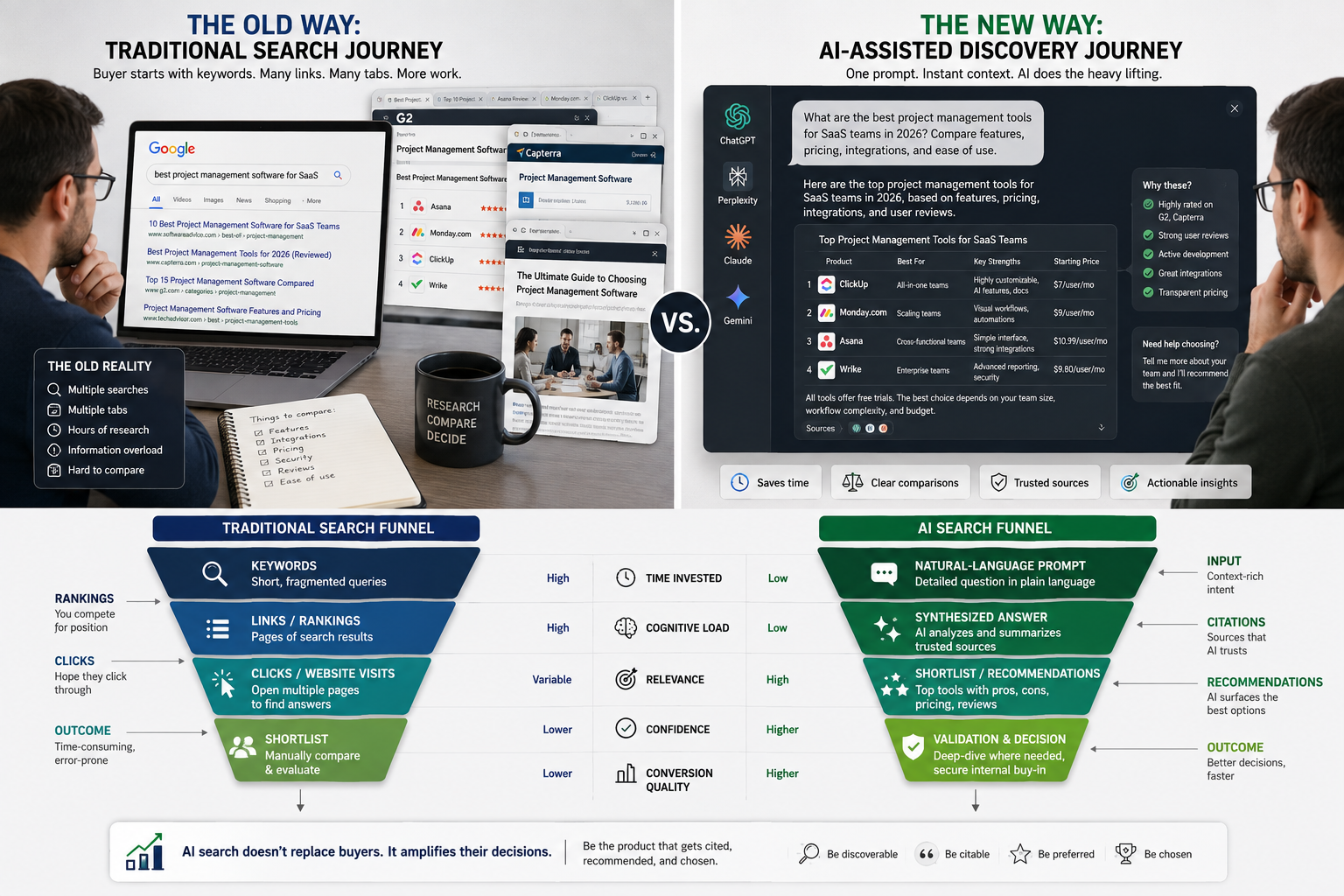
B2B buyer research has split into two starting points: traditional search and AI search, with AI rapidly becoming the default for software decisions. In practice, buyers use AI assistants to generate shortlists, compare vendors, check reviews, and build internal business cases before any vendor knows they exist.
Surveys of B2B software buyers show that roughly one in three now shortlist vendors based primarily on AI‑generated answers and citations, and a similar share discover vendors they had never heard of before through AI research alone. Google still matters — about 80% of buyers use it somewhere in the journey — but it is increasingly used after an AI tool has framed options and preferences.
Traditional SEO was built around ranking links on a results page and earning clicks; AI search is built around synthesizing information into a single, conversational answer and naming 3–5 products as recommendations. In this “answer economy,” the key unit of visibility is not your position on page one, but whether your product is cited and positively described inside the AI‑generated response.
This matters more for SaaS than many other categories because:
-
SaaS buying is comparison‑heavy: buyers explicitly ask AI tools to weigh trade‑offs between 4–8 products on features, pricing, integrations, and security.
-
Evaluation cycles are long and risk‑sensitive: buyers spend more time on proof, compliance, and internal alignment, and AI assistants are now embedded in that internal work.
-
Category awareness is fluid: research shows that 30–33% of buyers end up choosing a vendor they first encountered via AI search, not via brand marketing.
If you are only optimizing for Google’s SERP, you are increasingly invisible at the moment when shortlists are formed and business cases are written.
How AI Search Actually Surfaces SaaS Products
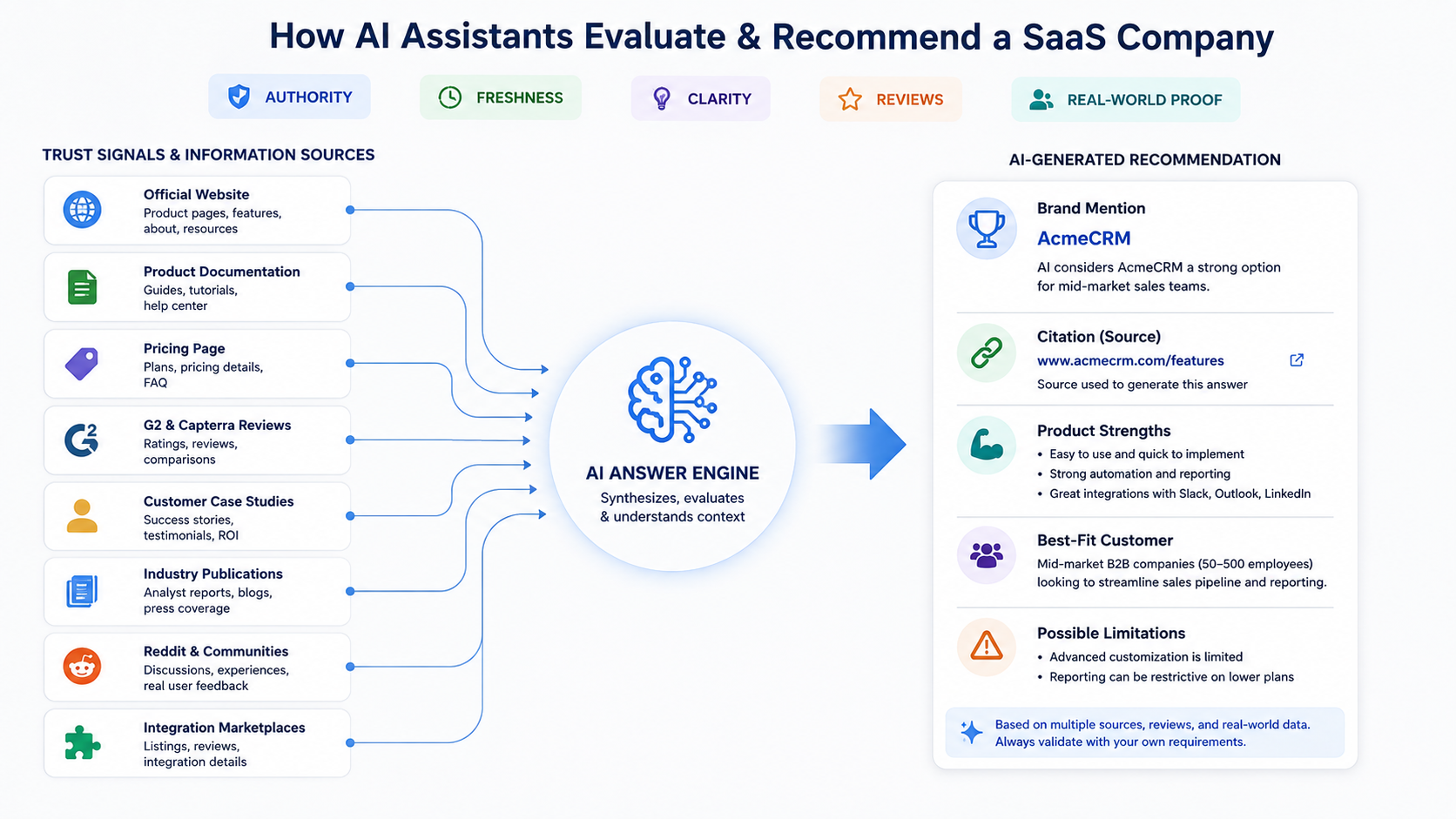
AI systems do not “crawl and rank” in the same way Google does. They infer answers from a mix of structured data, text content, and off‑site signals, then synthesize those into recommendations. Several 2025–2026 studies and practitioner playbooks converge on a few core drivers of whether a SaaS product is surfaced and cited.
What influences recommendations and citations
Across ChatGPT, Claude, Perplexity, Gemini, and Google AI Overviews, four patterns show up repeatedly:
-
Authority and brand mentions. Analyses of hundreds of millions of AI citations show brand mention frequency across authoritative sources (analyst reports, review sites, industry blogs) correlates far more strongly with citation rates than raw backlink counts.
-
Clarity and answer‑friendly structure. Answer engines heavily favor pages where the first 1–2 sentences under each heading directly answer a buyer question in plain language, with minimal fluff.
-
Structured information and schema. JSON‑LD schema like SoftwareApplication, Product, FAQPage, and HowTo helps AI systems understand entities, pricing, features, FAQs, and relationships, increasing the odds that your page is used as a structured source.
-
Freshness and real usage signals. Visible “last updated” dates, recent statistics, and active reviews/playbook content are strong positive signals; stale pricing pages and outdated benchmarks are negative signals that push models toward more current competitors.
The role of docs, comparisons, reviews, and third‑party mentions
AI engines do not just read your homepage; they triangulate your product from multiple surfaces:
-
Official docs and technical content. API docs, integration guides, security pages, and implementation playbooks are heavily used when answering deeper technical questions — especially in categories like devtools, security, and data platforms.
-
Comparison and “vs” content. When buyers ask “best tools for X” or “Tool A vs Tool B,” AI models strongly prefer pages that contain comparison tables, explicit pros/cons, and named alternatives; if your brand is absent from that comparison graph online, you are unlikely to be recommended.
-
Review sites and marketplaces. Research from G2 and multiple AEO agencies shows that G2, Capterra, and similar review platforms are among the most frequently cited sources in software‑related AI answers. Strong, recent reviews with clear use cases often feed directly into how AI describes your strengths and weaknesses.
-
Third‑party blogs, communities, and analyst content. Reddit, industry blogs, YouTube channels, and analyst reports frequently show up in AI citation traces, and brands mentioned favorably on those URLs see measurably higher AI visibility.
Limitations and unpredictability
Today’s AI systems are powerful but imperfect.
-
Citation volatility is real: some audits show brand AI visibility swinging 30–36% in a matter of weeks for companies that do not actively manage facts, schema, and off‑site mentions.
-
Models occasionally hallucinate features, pricing, or integrations when sources conflict, particularly for younger products with sparse documentation.
-
Engine coverage is uneven: tools like ChatGPT and Claude drive most measurable AI referrals today, while Perplexity and Gemini are important but still smaller in B2B.
Your goal is not to “control” AI answers fully (that’s impossible), but to make it easy and low‑risk for these systems to use your content and third‑party proof as the backbone of their recommendations.
Winning Strategies SaaS Companies Are Using
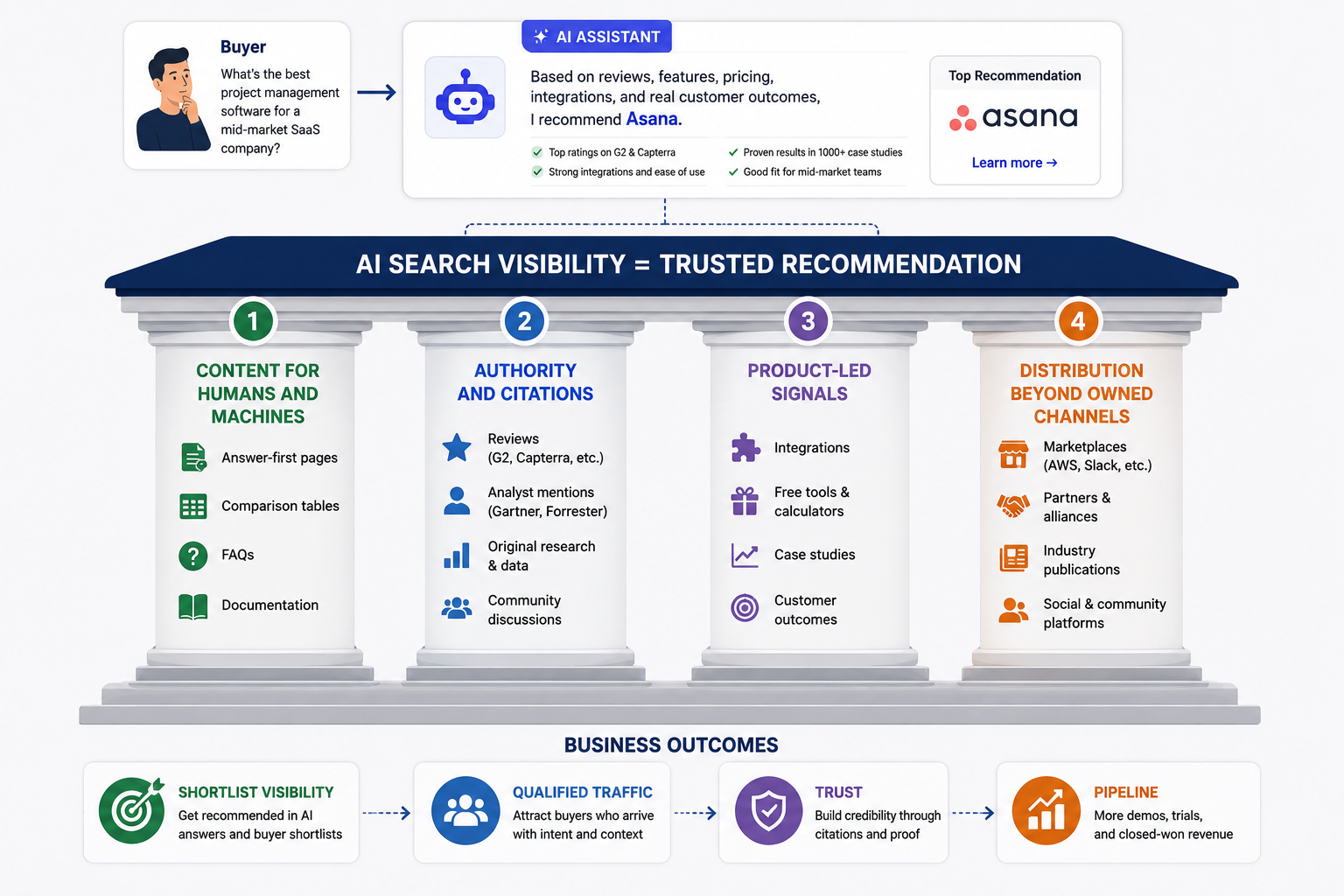
Leading SaaS teams treat AI search as a new distribution and reputation layer — not a separate universe. The most effective playbooks cluster into four pillars.
A. Content Built for Machines and Humans
The core shift is from keyword‑stuffed blog posts to clear, answer‑oriented content that both humans and models can parse quickly. AEO (Answer Engine Optimization) research across B2B SaaS highlights a consistent pattern in pages that are heavily cited:
-
Lead every page with a direct, extractable answer.
-
Start with 120–180 words that answer the page’s main question (“What is X?”, “When should you use Y?”) in the first 30 words, then briefly explain context.
-
Avoid long preambles. In audits of B2B SaaS content, this “answer‑first lede” is the most quoted paragraph in AI answers.
-
-
Write headings as buyer prompts, not clever slogans.
-
Use H2s like “What is AI search for SaaS?” or “How long does AEO take to show results?” — the exact phrasing buyers type into ChatGPT and Google.
-
Start each section with a crisp 1–2 sentence answer before diving into detail.
-
-
Use comparison and alternative pages deliberately.
-
Build “Tool A vs Tool B vs Tool C” pages with structured tables that compare pricing, integrations, compliance, and support.
-
For each major competitor, have a “YourProduct vs Competitor” page that honestly acknowledges trade‑offs while framing your strengths. These pages are disproportionately represented in AI answers to “best tools” and “alternatives to” prompts.gracker+1
-
-
Go deep on use cases and implementation.
-
Create use‑case pages for each ICP segment (e.g., “Workflow automation for mid‑market finance teams”) with concrete outcomes and data.
-
Publish implementation guides and FAQs that show you understand edge cases; AI engines lean on detailed, practical content when answering complex prompts.
-
-
Maintain technical documentation with citation in mind.
-
Keep API docs, integration guides, and security overviews up to date, with clear versioning and dates.
-
Link these docs from public pages, not just behind login, so AI crawlers can reference them safely.
-
Done well, this content still reads naturally for humans, but it also gives AI answer engines clear, well‑structured blocks to extract and quote.
B. Authority & Citation Strategy
You can’t brute‑force trust in AI; you earn it by showing up consistently in the sources models already lean on. B2B AEO playbooks describe this as “citation strategy” — shaping where and how your brand is mentioned across the web.
-
Map and prioritize the sources your category’s AI answers cite.
-
Use manual testing and AI visibility tools to see which URLs are referenced most often in answers to your key prompts (e.g., Reddit threads, specific blogs, G2 category pages).
-
Focus PR, partnerships, and guest content on those specific surfaces rather than generic press releases.
-
-
Earn and maintain strong review footprints.
-
G2’s “Answer Economy” report shows review platforms are central to how AI chatbots justify software recommendations, and changes in ratings or review volume can shift which vendors are surfaced.
-
Make G2, Capterra, and niche directories part of your go‑to‑market motion: invite the right customers to leave detailed reviews that mention use cases, integrations, and outcomes.
-
-
Publish original data and opinionated research.
-
Studies of AI citations show proprietary benchmarks and surveys are among the most frequently referenced content types.
-
Run at least one small but credible study per year in your category (e.g., “2026 workflow automation trends”), publish an honest methodology, and make the data easy to quote and link.
-
-
Show up in communities where prompts originate.
-
AI answers often pull from Reddit, vendor‑agnostic Slack communities, and YouTube explainers.
-
Participate as an operator (not just a marketer): share detailed playbooks, answer real questions, and let those threads become high‑signal sources about your product.
-
-
Actively manage “canonical facts” about your brand.
-
Keep company profiles (LinkedIn, Crunchbase, vendor directories) aligned on headcount, funding, pricing model, and positioning; conflicting information increases hallucination risk.
-
Update key facts promptly when things change — buyers now see these facts echoed back at them by AI, not just by your sales deck.
-
Authority in AI search is less about having the biggest backlink graph and more about being the most consistently and credibly referenced entity across the surfaces that answer engines trust.
C. Product‑Led Signals
AI search is not only reading content; it increasingly responds to buyer prompts that imply product experience, integrations, and real‑world fit. Winning teams are feeding the models with public proof of product quality and outcomes.
-
Make your integrations and ecosystem unambiguous.
-
Maintain a public integrations directory with clear names, categories, and short descriptions of what each integration does.
-
Use structured data to mark these up (e.g., ItemList or SoftwareApplication schema), so AI engines can confidently state “This tool integrates with Salesforce, HubSpot, and Slack.”
-
-
Offer free tools, calculators, and resources with clear value.
-
B2B SaaS visibility studies show that free calculators, checklists, and diagnostic tools often rank among the most cited resources in AI answers because they solve narrow problems well.
-
Examples: ROI calculators, workflow templates, compliance checklists. Make them easy to embed and reference; AI engines love pointing buyers to concrete tools.
-
-
Surface proof points that models can read.
-
Publish case studies with specific metrics (“cut approval times by 62%,” “reduced churn by 18%”) and sourced statistics; AEO audits suggest that having 5+ attributed data points per article strongly correlates with higher AI citation rates.
-
Include quotes from customers and experts that can stand alone inside an answer; AI systems frequently lift these into their narratives.
-
-
Align product messaging with the prompts buyers actually use.
-
Use AI visibility tools or manual testing to gather the exact language buyers use in prompts (“simple workflow automation,” “enterprise‑grade approvals with audit trail”).
-
Reflect that language in your positioning, FAQs, and product copy so models see strong semantic overlap and match your product to the right queries.
-
In short, build a public product surface that makes it easy for an AI assistant to say, “For this situation, here’s what this product does, who it’s for, and what results it tends to deliver.”
D. Distribution Beyond Owned Channels
AI discovery is shaped as much by what others say about you as by what you publish yourself. Forward‑thinking SaaS teams are expanding their distribution strategy to cover the ecosystems that feed AI training and retrieval.
-
Invest in review sites, directories, and marketplaces as first‑class channels.
-
Given how often AI answers cite G2 category pages, marketplace listings, and curated “best tools” articles, these surfaces are now part of your discovery infrastructure.
-
Keep listings fully updated, use clear positioning, and ensure screenshots, feature lists, and pricing match your main site to avoid conflicting information.
-
-
Show up in practitioner‑led content.
-
Analyst blogs, practitioner newsletters, and long‑form guides are frequently scraped and used as sources in AI engines.
-
Sponsor or collaborate on content that names your product alongside competitors in honest comparisons; models pick up on these multi‑vendor narratives.
-
-
Build partner ecosystems that echo your story.
-
Encourage implementation partners, agencies, and integration partners to publish their own content about how they use your product.
-
These third‑party pages often carry high trust and can significantly strengthen how AI systems describe your solution.
-
-
Monitor and respond to how AI describes your product.
-
Use AI visibility platforms — such as Otterly AI, Peec AI, Scrunch AI, and similar tools — to track whether and how your brand appears in answers across ChatGPT, Perplexity, Claude, Gemini, and AI Overviews.
-
When you find outdated or inaccurate descriptions, update your own content and key third‑party sources; over time, models will re‑sync to the better data rather than direct “appeals” to the AI itself.
-
Distribution in 2026 means making sure that when a buyer asks an AI assistant about your category, enough high‑quality signals exist across the web that your product is a safe, credible recommendation.
Measurement & Experimentation in an Opaque Channel
AI search is notoriously hard to measure compared with SEO — but you can get directional data that’s good enough to drive decisions.
How to track AI visibility and referral impact
Most teams use a mix of three approaches:
-
AI visibility tools. Platforms like Otterly AI, Peec AI, RankScale, Profound, and Scrunch AI query AI engines with buyer prompts and report on brand mentions, citations, sentiment, and competitor presence.
-
Manual prompt testing. Regularly ask ChatGPT, Claude, Perplexity, and Gemini “best tools for [your category],” “alternatives to [competitor],” and “which tool should we choose if…” and note whether you appear, how you’re described, and which sources are cited.
-
Analytics and attribution. Some tools (e.g., Scrunch AI, GA4‑connected platforms) help attribute traffic that comes after an AI session, but even simple UTM discipline and correlation between AI visibility changes and pipeline can be informative.
Practical experiments teams are running
Operators don’t wait for perfect measurement; they run controlled experiments:
-
Rewrite 10–20 pillar pages with answer‑first structure, comparison tables, and schema, then track changes in AI citations over 8–12 weeks.
-
Launch a focused review campaign in one category (e.g., “workflow automation for finance”) and watch for shifts in how AI tools talk about your product versus competitors.
-
Publish one high‑quality benchmark report, seed it into communities and PR, and monitor whether AI answers start quoting your data.
Leading indicators vs vanity metrics
Traditional SEO conditioned teams to chase rankings and raw traffic. In AI search, better leading indicators include:
-
Share of voice in AI answers for core prompts (percent of answers that mention you).
-
Citation frequency and diversity (how many different pages and domains about you are being cited).
-
Sentiment and accuracy (whether AI descriptions match your actual positioning and capabilities).
Treat these as inputs to pipeline and revenue, not ends in themselves. The goal is to be consistently named and accurately described when your ICP asks AI systems for help.
Common Mistakes to Avoid
Most SaaS teams are still early in their AI search journey, and a few patterns are already clearly counter‑productive.
-
Treating AI search as “just more SEO.”
-
Answer Engine Optimization (AEO) requires different content structure, schema, and off‑site authority than classic keyword‑first SEO.
-
If your response is simply “write more blog posts and add some AI keywords,” you will likely see little change in citations.
-
-
Over‑optimizing for legacy keywords that no longer match behavior.
-
AI prompts look like real questions and scenarios, not “workflow automation SaaS pricing” short phrases.
-
Optimizing around legacy head terms without addressing the underlying buyer questions leads to good SEO dashboards and poor AI visibility.
-
-
Ignoring brand consistency across AI answers.
-
When your website, reviews, and third‑party profiles tell different stories about pricing, ICP, and capabilities, AI engines synthesize a muddled picture.
-
You need a canonical narrative and set of facts that are reflected everywhere, or you will see fragmented and sometimes wrong AI descriptions.
-
-
Waiting for perfect measurement before acting.
-
Studies show AI adoption in B2B purchase research has already reached near‑universal levels; waiting for flawless instrumentation is effectively choosing to be under‑represented in answers while competitors move.
-
Use directional visibility data and clear experiments rather than holding back for an ideal attribution model that may never arrive.
-
Conclusion
AI search is not “killing” Google; it is quietly moving the starting point of many buying journeys into tools like ChatGPT, Claude, Perplexity, and Gemini. Traditional search still matters, but increasingly as a supporting channel behind AI‑mediated shortlists and business cases, not the sole gatekeeper.
SaaS companies that win in 2026 are treating AI platforms as a new distribution and reputation layer: they build answer‑ready content, earn citations across trusted third‑party sources, expose clear product proof, and actively monitor how AI systems talk about them. The shift is already underway, and the data shows it is accelerating faster than previous buyer behavior changes; the real question for your team is how quickly you adapt your content, product, and go‑to‑market strategy to be recommended, not just ranked.
FAQs
Is Google still worth prioritizing if buyers are moving to ChatGPT?
Yes — but its role is changing. Research shows that while about half of B2B software buyers now start with AI chatbots more often than Google, roughly 80% still use Google somewhere in their buying journey. Practically, this means you still need a strong SEO foundation, but you should treat it as a support channel that reinforces and supplies content to AI answers, not the only discovery battlefield.
How do I even know if ChatGPT or Perplexity is recommending my product?
You can combine manual testing with AI visibility tools. AI visibility platforms like Otterly AI, Peec AI, RankScale, and Scrunch AI repeatedly query major engines with buyer prompts and report whether, how often, and in what context your brand is mentioned. On top of that, you and your team can regularly ask ChatGPT, Claude, Gemini, and Perplexity “best tools for X” and “alternatives to Y” to see how you show up and which sources are cited.
What kind of content actually gets cited by AI tools in 2026?
AEO studies across B2B SaaS consistently find that answer‑first pages, comparison tables, FAQ sections with FAQPage schema, and content containing multiple sourced statistics and expert quotes are heavily over‑represented in AI citations. AI engines favor content that directly answers specific buyer questions in the first sentence, uses structured data, and links out to credible third‑party sources that they already trust.
Should we create separate content just for AI search?
You don’t need a completely separate content universe, but you do need to adapt how you structure and maintain existing content. The most effective teams retrofit key product, pricing, comparison, and use‑case pages with answer‑first sections, tables, FAQPage schema, and fresh statistics rather than building “AI‑only” microsites. Think of it as making your current content extractable and citable instead of adding a new silo.
How important are reviews and G2/Capterra mentions for AI recommendations?
Very important. G2’s 2026 research shows that AI chatbots lean heavily on review platforms to justify their shortlists, and changes in ratings or review volume can materially shift which vendors buyers see first. AEO practitioners consistently list review sites and marketplaces among the highest‑value off‑site surfaces for earning citations in AI answers.
Can we influence how AI describes our product, or is it completely out of our control?
You cannot script answers directly, but you can strongly influence the inputs models rely on. Keeping your own site accurate and answer‑oriented, aligning profiles and pricing across directories, earning detailed reviews, and updating third‑party content all shape the corpus that AI systems draw from. Over time, consistent, high‑quality signals across those surfaces will pull AI descriptions toward your intended narrative.
What’s the biggest difference between traditional SEO and optimizing for AI search?
Traditional SEO optimizes for ranking and clicks; AI search optimization (AEO/GEO) optimizes for citations and recommendations. In AI search, the main question is “Does the answer engine name and describe us correctly when a buyer asks about our category?” — not “Are we in position 1 for a specific keyword?”
Are there tools that help track our visibility inside ChatGPT and similar platforms?
Yes. Platforms such as Otterly AI, Peec AI, RankScale, Scrunch AI, Profound, and various AI‑visibility modules in larger SEO suites (e.g., Semrush AI Visibility, Ahrefs Brand Radar) track brand mentions and citations across ChatGPT, Claude, Perplexity, Gemini, and AI Overviews. They differ in depth and price, but all give you directional data on how often you’re appearing and in what context.
How should product marketing and SEO teams work together on this?
The most successful teams build a shared AEO strategy instead of treating AI search as a side project. Product marketing owns the buyer‑question map, positioning, and comparison narratives, while SEO and web teams own answer‑first structure, schema, and technical readiness. Both share responsibility for off‑site authority — reviews, analyst coverage, community content — and monitor AI visibility metrics together as a leading indicator of pipeline.
Is this more critical for early‑stage SaaS or for established players?
It matters for both, but in different ways. Analyses of B2B SaaS AI citation rates show that category leaders capture the highest share of AI mentions, yet smaller companies increasingly get discovered and chosen via AI research despite lower brand awareness. For early‑stage SaaS, AEO is a way to punch above your weight in discovery; for established players, it’s essential defense against losing consideration to newer entrants that show up more cleanly in AI answers.