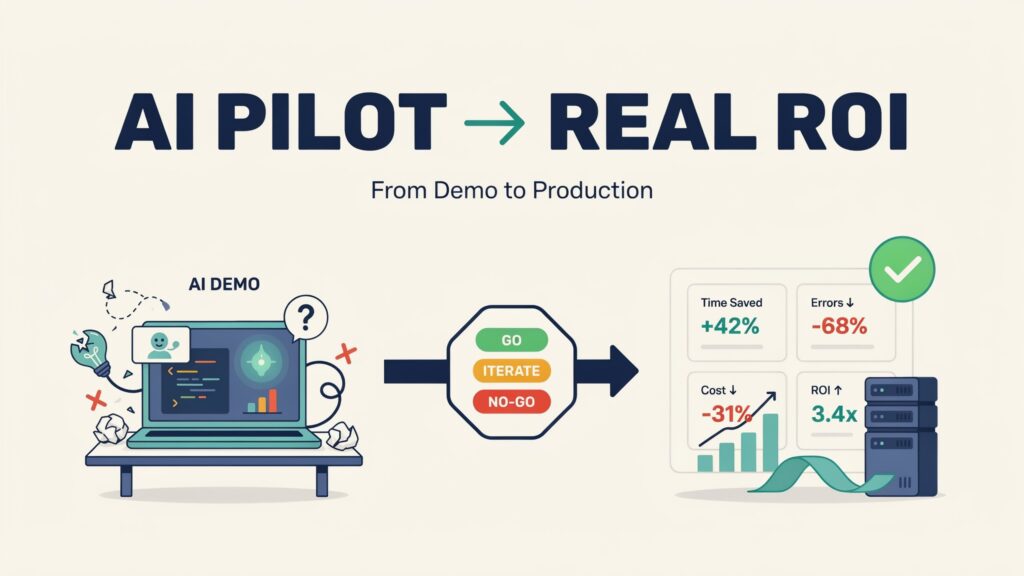
A successful AI pilot in 2026 is a tightly scoped, business-owned experiment with clear ROI metrics, clean-enough data, and a pre-agreed path to production or shutdown. If you treat it as a tech demo or “AI exploration,” it will almost certainly stall, no matter how impressive the model looks in the demo.
Most AI pilots in enterprises still fail to deliver measurable financial impact: multiple 2025–2026 studies put the failure rate for generative AI pilots at around 90–95%, with most never reaching production or moving a visible line on the P&L. The common failure pattern is not that the models are weak, but that organizations run AI pilots without a clear workflow, owner, success metric, or route from proof-of-concept to real adoption.
In 2026, copilots and agents are mature enough that you can deploy useful automation quickly, but expectations for rapid ROI are high and data readiness, governance, and change management gaps kill otherwise promising initiatives if they’re not handled up front. This guide gives you a practical, step-by-step framework to run AI pilots that move from “cool demo” to production impact, with explicit decision points where you either scale, iterate, or shut down cleanly.
From Demo to ROI, Not Science Fair
Most AI pilots die quietly: they produce prototypes, demos, or internal showcases that look impressive, generate some excitement, and then fade out without ever changing how work gets done or how money is made or saved. MIT’s widely cited research on enterprise AI found that roughly 95% of generative AI pilots deliver no measurable impact on financial performance, and follow-up analyses show that the difference between the few that succeed and the many that stall is almost never the model – it’s problem choice, scoping, ownership, and integration into real workflows.
In 2026, with corporate licenses for tools like Microsoft 365 Copilot, specialized agents, and LLM platforms already purchased in many organizations, the real leverage point is not “trying AI” but running disciplined business experiments that start with a specific bottleneck, capture before-and-after metrics, and have a named owner empowered to change processes when the pilot works. This article walks through a practical, operator-focused framework you can use to run AI pilots that either earn the right to scale or are shut down quickly and cleanly, without wasting months of budget and goodwill.
Why Most AI Pilots Fail
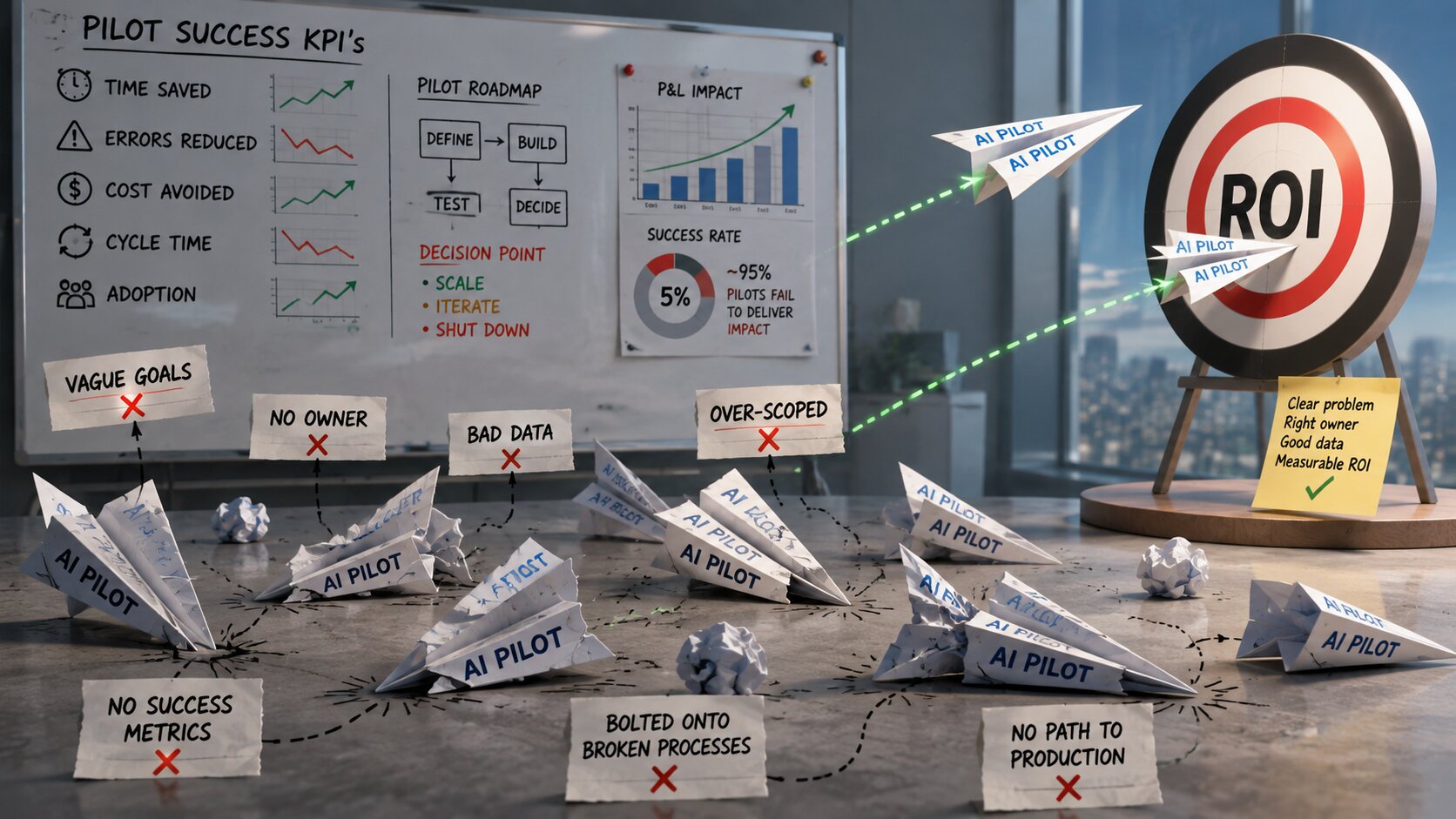
AI pilots most often fail because they start with a vague mandate like “explore AI” or “see what GenAI can do,” rather than a specific workflow problem and a quantifiable business outcome. Research from MIT, Gartner, and multiple consulting studies shows that projects without agreed success metrics defined before kickoff have dramatically lower success rates, while pilots scoped to clear operational or financial KPIs are several times more likely to reach production.
A second cluster of failure modes comes from organizational issues: no single owner with authority to change processes, over-ambitious scope designed for novelty instead of revenue or cost, and pilots run as technology projects inside IT without deep involvement from business units or end users. Finally, many pilots ignore data and process reality, bolting AI onto broken workflows, skipping data hygiene, and underestimating governance and scaling constraints, so trust collapses at the first serious error or costs explode when moving from pilot volume to production volume.
Step-by-Step Pilot Framework
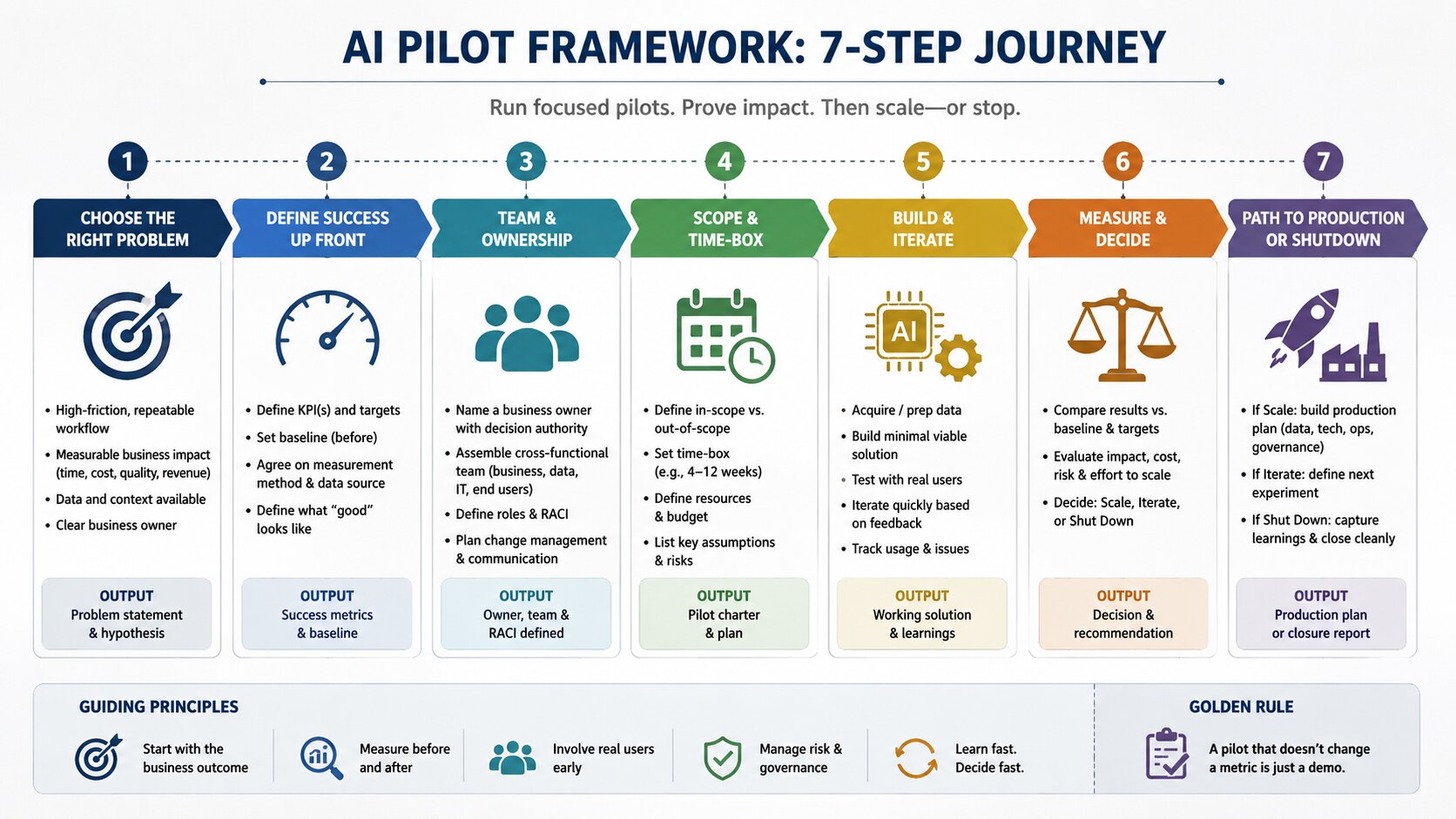
This framework is designed to be practical for 2026: assume you have access to at least one copilot or LLM platform, that your data is partially ready but not perfect, and that leadership expects meaningful results in 4–12 weeks, not an open-ended research project. Each step includes specific decision points so you can tell, quickly and honestly, whether your pilot deserves to move forward or should be reshaped or stopped.Step 1: Choose the Right Problem
Your first AI pilot should attack a high-friction, repeatable workflow where success can be measured in hard numbers like time saved, errors reduced, or cost avoided, not in abstract “insights” or vague productivity claims. Strong candidate problems typically share four traits: they are painful and visible to the business, have existing data or documents you can access, are limited enough in scope to change in one team or function, and have a clear owner whose P&L or KPIs would benefit from improvement.
To evaluate and prioritize use cases, create a short list (5–10 ideas) and score each on pain level, data availability, measurability, and organizational readiness, then pick the top one or two for pilots instead of spreading effort thinly. Bad first pilots are usually chosen for flash – like front-office “AI assistant” experiments that generate content but don’t touch core workflows – while good ones often sit in “boring” back-office domains such as finance operations, HR case handling, or compliance document review where genuine labor cost or cycle time can be cut.
Decision point: if you cannot articulate in one sentence what problem you are solving, who owns it, and what concrete business metric will move when you succeed, stop and re-choose the use case before writing a single prompt or buying another license.
Step 2: Define Success Before You Start
Define success in numbers before the pilot begins: for example, “reduce time to prepare a monthly finance report from 3 days to 1 day,” “cut contract review errors by 40%,” or “increase self-service resolution rate in customer support by 20%.” Studies show that AI projects with quantified success metrics set up front have several times higher success rates than those without, and failed pilots almost always lacked a shared definition of what “good” looks like.
You should set both outcome metrics (the main business KPI, like hours saved or cost avoided) and leading indicators (usage, quality scores, user satisfaction) plus guardrails such as maximum acceptable error rates or response times. Equally important is agreeing on kill criteria: for example, “if by week 6 we haven’t achieved at least 20% time savings in the test group and error rates are not improving, we stop or re-scope,” which prevents sunk-cost drag and keeps the pilot honest.
Decision point: write the success and kill criteria down, get sign-off from the economic buyer and the business owner, and only proceed when everyone agrees on the numbers; if any stakeholder refuses to commit to metrics, treat that as a structural risk to the pilot.
Step 3: Assemble the Right Team and Ownership
A successful AI pilot has a single accountable business owner (often a director or VP) whose metrics are directly affected, supported by a small cross-functional team including technical support and representatives from the end-user group. Research suggests that pilots owned exclusively by IT or innovation teams, without strong business-unit engagement, suffer low adoption and stall even when the technology works well.
At minimum, define a clear RACI: one person accountable for outcomes, one or two people responsible for day-to-day build and operations, consulted stakeholders for data, security, and compliance, and specified end users who will test and provide feedback. External vendors or consultants can be valuable for initial design and build – and studies show external partnerships sometimes reach deployment more often than purely internal efforts – but you must ensure capability transfer so the organization can operate and evolve the solution without permanent dependency.
Decision point: if there is no named business owner with authority to change processes and no plan to build internal capability alongside any external help, expect the pilot to remain an orphaned experiment rather than a production asset.
Step 4: Scope Tightly and Time-Box
In 2026, an effective AI pilot usually runs for 4–12 weeks, long enough to build and iterate but short enough to maintain executive attention and avoid bloated budgets. Rather than trying to automate an entire end-to-end process, pick a well-defined slice of the workflow – for example, document summarization in claims handling, initial draft generation for standard emails, or triage classification for HR tickets – where AI can demonstrably add value without requiring full system redesign immediately.
Be explicit about what is in scope (one team, one geography, one set of document types) and what is out of scope (all edge cases, rare scenarios, global rollouts) during the pilot, and list the data, integration, and access requirements so the technical team can plan realistically. Many pilots fail because data readiness work, integration complexity, or governance reviews are discovered late; Gartner predicts that a large share of AI projects through 2026 will be abandoned due to underlying data not being in shape to support them, making early scoping of data tasks critical.
Decision point: create a one-page pilot charter with timelines, scope boundaries, and data/integration prerequisites; if you cannot secure the needed data access and integration commitments up front, narrow the scope until you can or cancel the pilot.
Step 5: Build, Test, and Iterate
For most organizations in 2026, the fastest route to value is to start with existing platforms – enterprise copilots, agent frameworks, or LLM tools – and configure or lightly extend them, rather than building fully custom models from scratch. Use a practical build approach: design prompts, workflows, and integrations that embed AI inside the process (e.g., directly within the CRM or ticketing system) so users encounter it as part of their normal work, not as a separate experimental tool.
Human-in-the-loop design is non-negotiable for pilots that touch customers, regulators, or critical decisions: the AI should draft, summarize, classify, or recommend, and humans should review, approve, or correct, at least until error rates and trust justify automation of specific steps. Effective pilots set up feedback loops with real users from day one – collecting corrections, satisfaction scores, and qualitative feedback – and use that data to refine prompts, workflows, and guardrails every week, not just at the end of the pilot.
Decision point: if users are bypassing the tool, leaving it unused, or spending more time correcting it than it saves, treat that as a signal to fix workflow fit or shut the pilot down rather than forcing adoption.
Step 6: Measure, Review, and Decide
Run measurement like a small, rigorous experiment: compare the pilot group to a control group or to baseline metrics, and track both quantitative outcomes (time, errors, cost) and qualitative signals (trust, satisfaction, resistance). Avoid vanity metrics such as “number of prompts run” or “documents processed” and focus on whether the pilot moved the metric tied to the P&L or key operational KPI; multiple analyses have shown that measuring activity instead of value is a major reason organizations can’t tell winning pilots from losing ones.
Your review cadence should be frequent enough to keep momentum – often weekly operational checkpoints and a more formal review at mid-point and end – where you decide whether to continue as-is, iterate scope or design, or stop. Honest evaluations also capture lessons for the next pilot: what worked in workflow design, where data readiness was lacking, how governance or security slowed or helped, and what kind of training and change management produced real adoption.
Decision point: at the end of the pilot window, classify outcomes into Go (meets or exceeds success criteria, with manageable risks), No-Go (fails success criteria or introduces unacceptable risk or cost), or Iterate (shows promise but needs scoped changes); then act within a defined timeframe instead of letting the pilot drift.
Step 7: Path to Production or Clean Shutdown
Many of the most expensive failures in 2026 are pilots that technically succeed but then languish because there is no plan for what happens next: no clear scaling pathway, no budget, no owner for productionizing, and no change management plan. Before you even start the pilot, sketch a lightweight production roadmap: what additional integrations, governance reviews, infrastructure hardening, and training would be needed if success criteria are met, and who will own each part.
Scaling requires more than flipping a switch: you need robust monitoring, cost controls (especially under consumption-based pricing), updated processes, formal documentation, and adoption programs so the tool becomes part of the operating model, not an optional extra. Equally important is a clean shutdown path: if the pilot is a No-Go, communicate clearly, archive learnings, and retire the tool so it doesn’t linger as a half-supported system that drains attention and undermines trust in future AI efforts.
Decision point: if there is no agreed production owner, budget envelope, and timeline by the time the pilot ends, delay scaling until those exist, otherwise you risk a “successful” pilot that dies in the gap between prototype and real deployment.
Tooling and Vendor Choices in 2026
In 2026, you generally have three broad options: use existing enterprise copilots (like Microsoft 365 Copilot), deploy specialized agents or vertical solutions (e.g., for customer service or compliance), or commission custom builds on LLM platforms and orchestration frameworks. Existing copilots are ideal when your use case lives inside standard office workflows (email, documents, spreadsheets), specialized agents fit well for domain-specific flows with pre-built integrations, and custom builds are justified when your processes or data are unique enough that off-the-shelf tools cannot handle them.
Evaluation must go beyond the demo: many pilots are sold on impressive one-off demos that don’t reflect how the tool will behave with messy, enterprise data and real edge cases. Assess vendors and platforms on grounding quality (how they connect to and validate against your data), governance capabilities, integration maturity, cost transparency under real usage volumes, and ability to transfer capability to your team, not just on UX gloss or marketing claims.
Data privacy, security, and cost controls are non-negotiable: check where data is stored, how prompts and outputs are logged, what access controls exist, and how you can cap or monitor variable costs so pilots don’t blow budgets once adoption increases.
Governance and Risk Without Drag
Good governance for AI pilots does not mean multi-month committees; it means lightweight guardrails that clarify who approves what, which data can be used, and how risks are handled before problems arise. Many organizations see pilots stall because security, compliance, or risk teams are brought in late, discovering issues only after technical work is done; involving them early with a focused checklist prevents surprises while keeping velocity.
Handling sensitive data requires clear classification rules, minimum anonymization or masking standards, and controlled environments where pilots can safely access necessary information; Gartner and others have highlighted data readiness and governance gaps as core reasons AI projects are abandoned through 2026. With leadership, manage expectations by framing pilots as experiments with defined hypotheses and success metrics, not guaranteed victories, and by committing to rapid, transparent decisions at each stage so sponsors see progress even when the outcome is to shut down and redirect resources.
Scaling What Works, Killing What Doesn’t
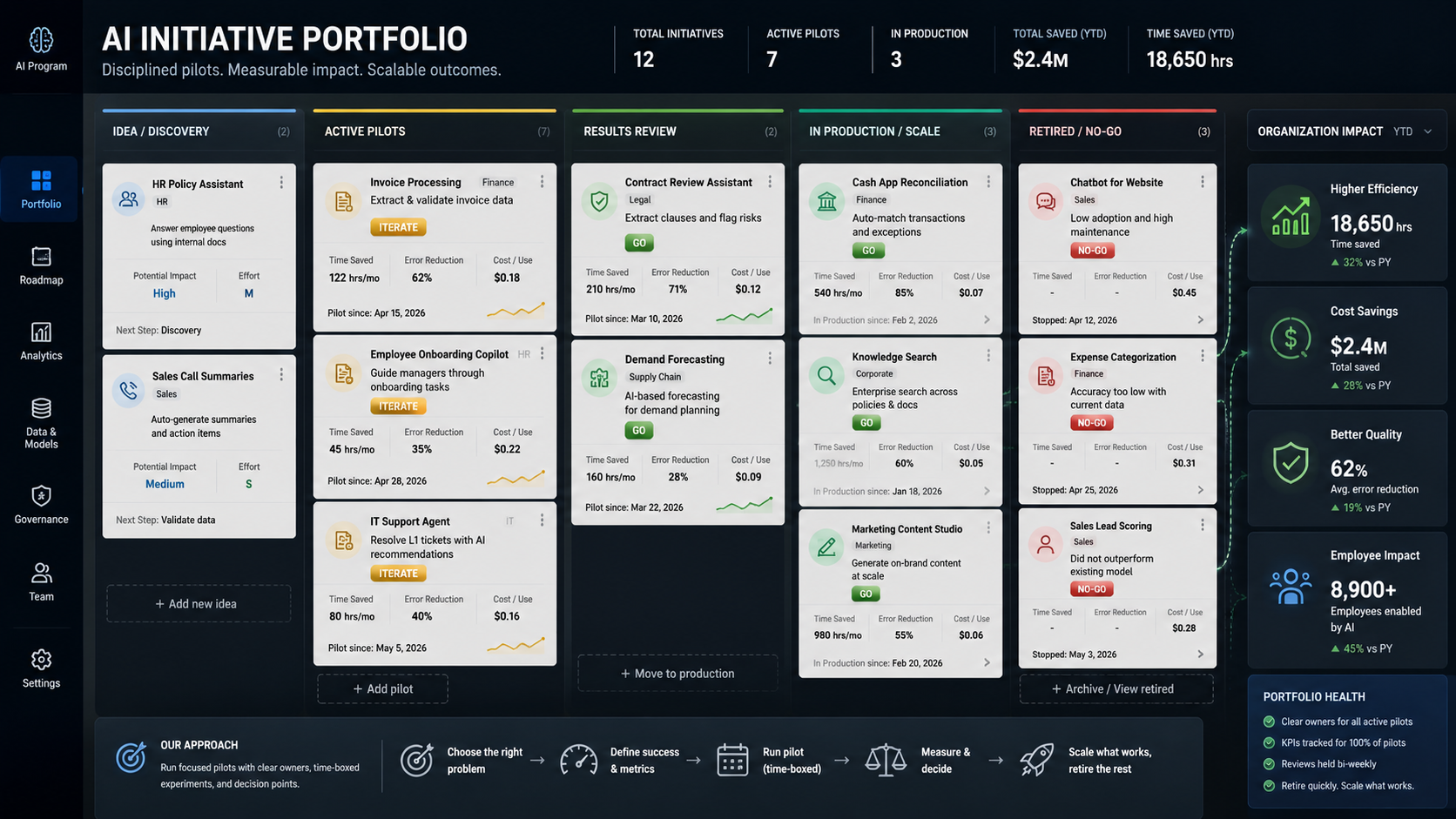
Turning one successful pilot into a repeatable program means standardizing how you select problems, define metrics, build teams, manage governance, and run reviews, so every new pilot follows a proven pattern instead of reinventing the process. Over time, you should build internal capability for AI enablement – people who understand workflows, data, and change management – even if you continue to use vendors for specialized technology, so the organization doesn’t stay permanently dependent on external consultants whose departure can leave working systems unsupported.
A portfolio approach is useful: run a small number of tightly scoped pilots at any given time, diversify across domains (front office and back office), and apply consistent Go/No-Go rules, so capital flows into high-ROI areas and weak pilots are retired quickly.
FAQs
How do I choose the first AI use case so we don’t waste time?
Start with a painful, high-volume workflow where success can be measured in time saved, errors reduced, or cost avoided and where data is already available or can be made available without heroic integration work. Avoid “flashy” marketing or innovation use cases chosen for visibility rather than ROI, and instead target back-office or operational bottlenecks where automation or augmentation can change real outcomes on the P&L.
How long should a real AI pilot take in 2026?
Most effective AI pilots now run for 4–12 weeks: long enough to build, integrate, and iterate, but short enough to keep sponsors engaged and costs under control. Longer timelines often indicate over-scoping or unclear goals, while excessively short pilots tend to produce demos rather than robust, evaluated workflows, so design your experiment to fit within this window with clear mid-point review gates.
What’s the difference between a successful pilot and just a good demo?
A good demo shows that the model can do something impressive once; a successful pilot proves that AI improves a specific workflow’s metrics over time, with real users, clean data, and acceptable risks. If you can point to a before-and-after change in a defined KPI, with adoption by the target team and a path to production, you have a successful pilot; if you only have a prototype people like to watch, you have a demo.
Do we need data scientists on the pilot team or can business teams lead?
In many 2026 pilots, business teams lead and data scientists or ML engineers support as needed, especially when using mature copilots or agent platforms that abstract away modeling details. What you cannot skip is technical support for data access, integration, and governance, but ownership of problem definition, workflow design, and success metrics should sit firmly with business leaders whose metrics will move.
How much should we budget for a first AI pilot?
Budgets vary widely, but the most resilient pattern is to cap initial pilots at a modest, experimental level – often the equivalent of a few full-time people for 2–3 months plus platform costs – and to tie any expansion to hitting agreed success metrics. Be careful with consumption-based pricing: several studies note that costs at production scale can be multiples of pilot estimates, so include cost-per-transaction or per-user assumptions in your success criteria and model worst-case scenarios before scaling.
What are the biggest red flags that a pilot is going to fail?
Red flags include vague goals like “explore AI,” no agreed success metrics or kill criteria, no single owner with authority, poor or unowned data, and pilots chosen for novelty instead of solving a real bottleneck. Another warning sign is measuring activity (prompts, drafts, documents) instead of value (time, errors, cost), which makes it impossible to know whether the pilot is working and often hides failure until budgets or trust are exhausted.
Should we build custom or start with existing tools like Copilot or specialized agents?
In 2026, the default is to start with existing enterprise copilots or specialized agents where possible, because they can deliver value faster and with less risk, especially for common office and customer-service workflows. Custom builds make sense when your processes, constraints, or data are unique enough that off-the-shelf tools cannot meet requirements, but they should still be scoped as pilots with clear ROI metrics and a plan for long-term maintenance and capability transfer.
How do we measure ROI when some benefits are soft (like employee time saved)?
Translate “soft” benefits into quantified proxies: hours saved, tasks completed per person, cycle time reductions, or avoided hiring, then connect those to labor cost or capacity gains. For example, if an AI tool reduces report preparation time by 50% across 10 analysts, you can calculate the equivalent labor hours and cost saved, even if you don’t immediately reduce headcount, and track whether that time is redeployed to higher-value work.
What happens if the pilot works but the rest of the company isn’t ready to adopt it?
This scenario is common and usually reflects missing change management, training, or governance pathways rather than a technical problem. If the pilot hits its metrics but adoption stalls, treat that as a signal to invest in communication, incentives, and process redesign so AI is integrated into standard workflows, and to clarify ownership and budget for scaling, rather than leaving the tool as a local success that never spreads.
How many pilots should we run at the same time?
For most organizations, running a small portfolio of 2–5 well-scoped pilots at once is more effective than launching many experiments simultaneously, because it concentrates attention and enables proper measurement and governance. Use a portfolio view to diversify across domains but apply strict Go/No-Go criteria and retire weak pilots, so your AI program becomes a sequence of disciplined bets rather than a loose collection of disconnected experiments.
You can turn this framework into a repeatable internal playbook: every AI pilot starts with a sharp problem, quantified metrics, named owner, realistic scope, and an explicit production or shutdown path. The companies that win with AI in 2026 are not those who run the most experiments, but those who treat each pilot as the first step in an operating-model shift, scaling only what proves real value and killing the rest quickly and cleanly.