I still remember the day my friend Raj called me in a panic. He had this “brilliant” idea for a mobile app that would change how people manage their daily expenses. Six months and $45,000 later, he had a beautiful app that nobody wanted to download. The problem wasn’t the idea. The problem was that he skipped almost every important step in proper product development.
That story repeats itself thousands of times every year. Brilliant ideas die not because they were bad, but because they were rushed from mind to market without a real development process. If you’re reading this, you probably have an idea that keeps you up at night. This guide is written for you.
Why Most Product Ideas Fail (And Why Yours Doesn’t Have To)
Let’s start with some uncomfortable truth.
According to CB Insights, 42% of startups fail because there’s no market need for their product. Another 29% run out of cash. These aren’t just statistics — they’re warnings. The difference between a product that flops and one that becomes the next big thing often comes down to how systematically you develop it.
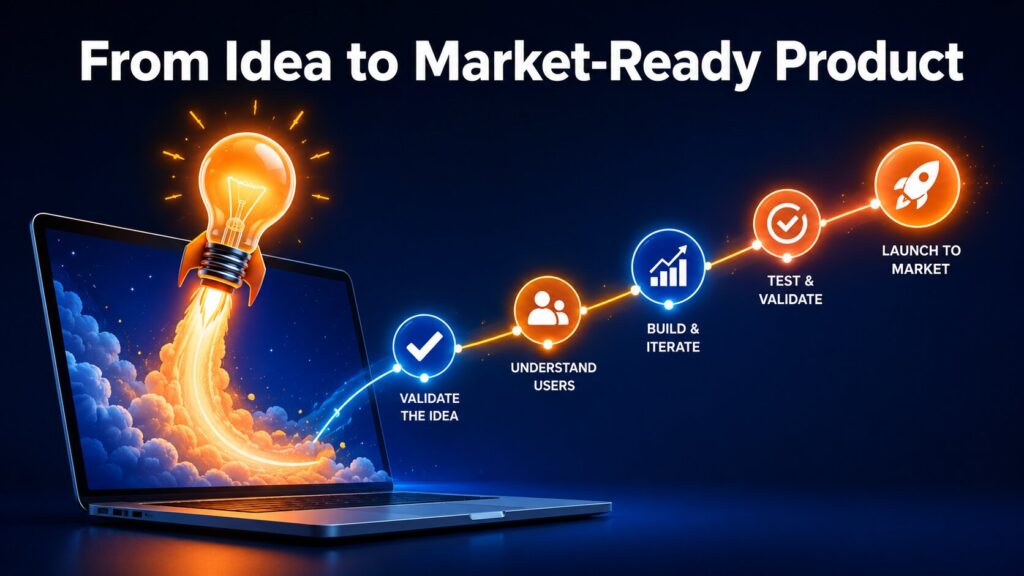
Product development isn’t just “building something.” It’s a disciplined journey that combines creativity, validation, technical excellence, and business thinking.
Phase 1: Idea Validation – Don’t Fall in Love Too Quickly
The first rule of product development: Kill your darlings early.
Before writing a single line of code, you need to prove that people actually want what you’re thinking of building.
Practical steps you should take:
- Problem Interviewing Talk to at least 50 potential customers. Not surveys — real conversations. Ask them about their current pain points, not your solution. I’ve seen founders change their entire direction after 15 thoughtful interviews.
- Landing Page Test Create a simple one-page website describing your product with a “Sign up for early access” button. Drive targeted traffic using Google or LinkedIn ads. If less than 10% of visitors click the button, your idea needs rethinking.
- Competitor Deep Dive Study every existing solution, including indirect competitors. What are they missing? Where do users complain the most in reviews?
Real example: Dropbox didn’t start by building a full product. They made a simple video showing how the product would work. The waiting list exploded from 5,000 to 75,000 overnight. That’s validation done right.
Phase 2: Defining Your Product – The Foundation That Matters Most
This is where serious product development begins.
Create a clear Product Requirement Document (but keep it lean). Include:
- Target user personas (be extremely specific)
- Core problem you’re solving
- Key features (categorized as Must-have, Should-have, Could-have)
- Success metrics (what does victory look like in 6 months, 12 months, 3 years?)
The MoSCoW Method works brilliantly here:
- Must have – Without these, the product fails
- Should have – Important but not critical
- Could have – Nice to have if time permits
- Won’t have – Explicitly out of scope (this prevents scope creep)
One of the biggest mistakes I see is trying to build too many features. The most successful products usually start surprisingly simple.
Phase 3: MVP Development – Build the Smallest Thing That Works
MVP stands for Minimum Viable Product, but I prefer calling it Minimum Lovable Product.
Your goal isn’t to build something that barely works. It’s to build something that solves the core problem so well that early users fall in love with it.
Technical considerations at this stage:
- Choose the right technology stack (one that allows fast iteration)
- Focus on scalability from day one, but don’t over-engineer
- Implement proper analytics from the beginning (you’ll thank yourself later)
- Design for speed — both in development and in user experience
I recommend using no-code/low-code tools for certain parts during MVP if it helps you reach the market faster. Tools like Bubble, FlutterFlow, or Adalo have matured significantly.
Phase 4: Design That Actually Converts
Great design isn’t about making things pretty. It’s about making things intuitive.
Work with a designer who understands both psychology and your industry. Focus on:
- User flows that feel natural
- Visual hierarchy that guides attention
- Accessibility standards (this also improves SEO and broadens your market)
- Mobile-first approach (even for web products)
Remember: Users form their opinion about your product in the first 8 seconds. Make them count.
Phase 5: Development – Where Execution Happens
This is where many teams get lost.
Best practices I strongly recommend:
- Use Agile methodology with 2-week sprints
- Daily standups (even if remote)
- Continuous integration and deployment
- Automated testing (unit + integration)
- Code reviews as non-negotiable
If you’re working with a development team (in-house or outsourced), maintain transparency. Tools like Jira, Linear, or ClickUp help, but the real communication happens in regular demos and feedback sessions.
Phase 6: Testing – Beyond Just Finding Bugs
Quality Assurance is not a checkbox.
Modern product testing includes:
- Functional testing
- Performance testing (under load)
- Security testing
- Usability testing with real users
- Beta testing with a small group of target customers
I always insist on at least 3 rounds of proper user testing before launch. The feedback you get will be worth gold.
Phase 7: Launch Strategy – It’s Not Just “Going Live”
The launch is a marketing moment, not just a technical one.
Successful launch components:
- Pre-launch email list building
- Content marketing that educates your audience
- Strategic partnerships
- Launch day PR and social amplification
- Customer onboarding flow that’s incredibly smooth
Remember Slack’s launch? They didn’t just release software. They created a movement around better team communication.
Phase 8: Post-Launch Iteration – The Real Product Development Begins
This is what separates successful products from failures.
After launch, you enter the most important phase: continuous improvement based on real data.
Set up proper analytics. Track:
- Activation rate
- Retention curves
- Feature usage
- Customer feedback (both qualitative and quantitative)
Then prioritize improvements using a combination of user feedback, business impact, and development effort.
Real-World Success Stories
Instagram: Started as Burbn, a complicated location-based app. After validation, they pivoted to photo sharing and became a unicorn.
Airbnb: The founders literally took professional photos of listings themselves in the early days to improve quality. That small attention to detail made a massive difference.
Notion: Grew slowly and deliberately, focusing on power users first before expanding to everyone.
Common Pitfalls to Avoid
- Falling in love with your first solution
- Building in isolation (no user feedback)
- Perfectionism (waiting for everything to be perfect)
- Ignoring unit economics early on
- Changing direction too frequently (pivot wisely, not randomly)
The Human Side of Product Development
Behind every successful product is a team that faced setbacks, arguments, tight deadlines, and moments of doubt. The best product leaders I’ve worked with combine vision with humility. They’re confident enough to push forward but humble enough to change course when data says so.
Getting Professional Help
If you’re not a technical founder, partnering with the right product development team can dramatically increase your chances of success. Look for partners who:
- Have experience in your industry or similar products
- Show genuine interest in your vision
- Have a transparent process
- Can provide strategic input, not just coding
- Understand both technology and business
Final Thoughts
Turning an idea into a successful product is one of the most rewarding journeys you can take. It requires equal parts creativity, discipline, customer obsession, and persistence.
The process I’ve outlined here isn’t theoretical. It’s distilled from working with dozens of founders and building multiple successful products. Some became market leaders. Some had to pivot. All of them learned.
If you have an idea that genuinely solves a problem, don’t let it stay in your head. Start validating it this week. Take that first small step.
The world needs more products built with care, intelligence, and genuine problem-solving intent.