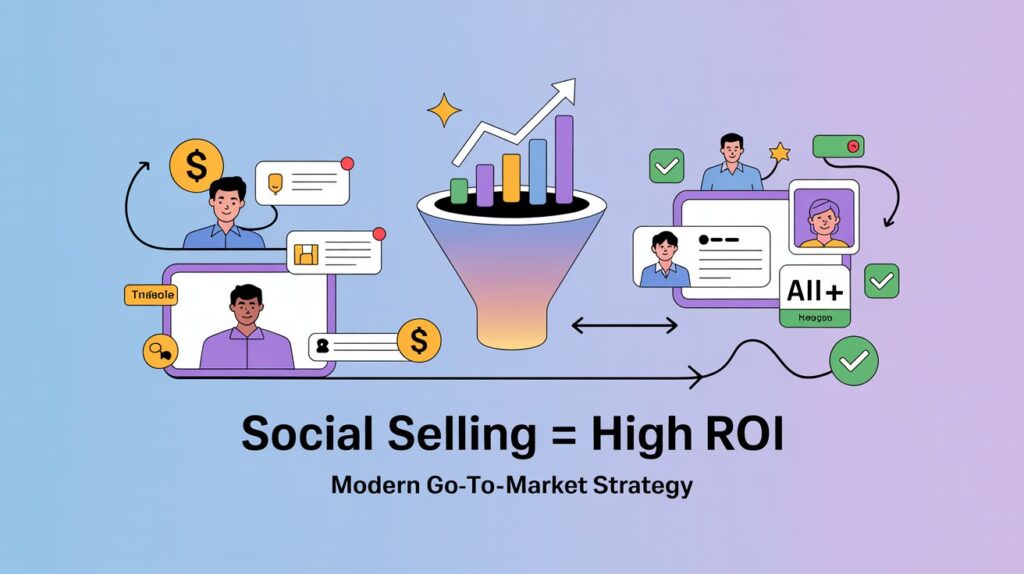
Right now, social selling is not a “nice extra” in enterprise sales anymore. Sales reps who use social selling generate about 45% more opportunities and are roughly 51% more likely to hit quota than reps who ignore it. On top of that, social outreach on platforms like LinkedIn can get response rates around 42%, which is almost double what many teams see from cold calls or cold email alone. At the channel level, social ads are delivering strong returns: cross-platform data for 2025 shows average social media ROAS around 4.2:1, with LinkedIn B2B campaigns often higher, and independent benchmarks put LinkedIn at roughly 113–121% ROAS for B2B paid programs.
Why is this happening? Your buyers have moved. Today, between about 55% and 75% of B2B buyers say they use social media to research vendors, read reviews, and look for proof before they talk to a sales team. More than 80% of C‑level and VP‑level buyers say social content influences their purchase decisions, and many will quietly follow you or your executives for weeks before filling out a form. At the same time, traditional GTM motions—big trade shows, one‑to‑many cold outbound, and broad paid search—are getting more expensive, while response rates and conversion rates are getting tougher.
In 2026, the reality is simple: if you sell into mid‑market or enterprise accounts, mature social integration is no longer optional. It is one of the highest‑ROI levers in GTM when you treat it as a system, not as random posting. When you combine thought leadership, social selling, paid social, employee advocacy, and communities, social stops being “marketing’s job” and becomes a shared engine that supports demand gen, sales, customer success, and expansion.
In this article, you will see what the data actually says about social ROI in enterprise sales, how buyer behavior has shifted, and how you can build a social‑first GTM engine in a structured way. You will get practical frameworks for platform choice, content, social selling, paid amplification, and measurement, plus templates and a 90‑day rollout plan you can plug into your own team. You will also see real examples from SaaS, services, and industrial companies that are already getting pipeline and revenue from social in complex deals.
The data: Why social delivers superior ROI in enterprise GTM
If you strip away the hype and look only at numbers, social looks very different from five years ago. It is no longer just an awareness channel; it is tied directly to meetings, pipeline, and revenue in many enterprise GTM setups.
Social selling lifts: opportunities, quota, and win rates
Recent roundups of social selling statistics show a clear pattern:
-
Social sellers create around 45% more opportunities than non‑social sellers.
-
Reps who use social selling are about 51% more likely to achieve quota.
-
Up to 78% of social sellers outperform peers who do not use social media.
Other research and vendor data show that teams with strong social selling adoption see win rates lift by around 16% and often report larger average deal sizes, because buyers feel like they “know” the seller before they get into deep evaluation. When your reps show up in someone’s feed with useful comments and posts long before they send a message, the first outreach feels warm, not cold.
Platform ROI and why LinkedIn stands out
If you look at paid performance, social as a whole is strong. One 2025 analysis of global social media advertising puts average ROAS at about 4.2:1 across platforms. Within that, B2B‑focused LinkedIn consistently runs hotter:
-
Some ROAS studies list LinkedIn B2B at around 6.8:1, one of the best performers across major social platforms.
-
A Dreamdata benchmark report shows LinkedIn ads as the only major B2B platform delivering positive ROAS at roughly 113–121%, ahead of Google Search and Meta.
-
LinkedIn now captures close to 40% or more of B2B paid social budgets in some reports, showing where GTM leaders are actually putting their money.
More general ROI studies also find that social media marketing often delivers between about 3.8:1 and 5.78:1 ROI, with B2B programs using LinkedIn reporting especially strong returns and higher lead value per dollar spent than other platforms.
Social vs email, events, and search: CPL, CAC, and revenue influence
Cost‑per‑lead and CAC benchmarks help you see how social fits in the overall GTM mix. B2B CPL studies show:
-
Trade shows and in‑person events often have the highest CPL, around 800–881 per lead on average.
-
Paid LinkedIn advertising frequently sits in the 400 range per lead in some datasets, with wide ranges based on industry and offer.
-
Cross‑channel reports list social media ads in general (across major platforms) at around 50–150 per lead, competitive with email marketing and sometimes better than paid search for mid‑funnel leads.
Cold email and cold calling can look cheaper on paper, but response and meeting rates tell another story. Benchmarks from sales and outreach tools show:
-
Cold email reply rates hovering anywhere from about 3–15% depending on quality, with low single‑digit meeting rates.
-
Cold calling dial‑to‑meeting rates around 2–3% on average.
-
Social DMs and social outreach pulling roughly 2x the response rate of cold email in some multi‑campaign analyses, with response rates in the low double digits.
When you factor in rep time and the number of touches needed to create one qualified opportunity, social outreach can produce a lower effective cost per meeting than phone‑only or email‑only playbooks, especially if your team uses multi‑channel sequences where social warms up the relationship first.
On the revenue side, some ROI studies find that:
-
Companies using social media in a structured way see about 2.8x higher lead generation ROI than those not using social.
-
Social media can drive roughly 31% of B2B revenue growth in programs that combine social with account‑based tactics.
-
B2B email nurtured from social leads has dramatically higher ROI and conversion rates than pure cold email lists.
Employee advocacy adds another layer. Case studies from advocacy platforms show that when you turn your employees into regular social sharers, you can reduce paid media spending by up to 91% while keeping or growing reach, because your employees’ networks outperform brand pages in engagement.
Measurement challenges and how leaders solve them
The main pushback you may hear is: “We can’t attribute social clearly.” That is fair. Enterprise buying journeys are long and multi‑touch, and social often plays early and mid‑funnel roles that do not show up in last‑click reports.
High‑performing teams address this by:
-
Using multi‑touch attribution models rather than last‑click only.
-
Tracking account‑level influence (for example, opportunities where someone from the buying group engaged with social content).
-
Logging social‑sourced and social‑influenced activities properly in the CRM (custom fields, UTMs, and campaign tags).
-
Comparing win rates, deal size, and cycle time for accounts with social engagement versus those without.
When you look through that lens, social’s influence on pipeline, win rates, and CAC becomes much easier to see.
The enterprise GTM evolution: from traditional to social‑first
Long enterprise sales cycles and large buying committees have always required trust, education, and multiple touches. The difference today is where that trust and education are happening.
How buyer behavior has shifted
Modern B2B buyers behave a lot like consumers. Studies show:
-
Around 55% of all B2B buyers use social media as a research tool, and in some verticals (like IT) the number jumps to 70–86%.
-
About 75% of B2B buyers say social media influences their purchase decisions, and 84% of C‑level and VP‑level buyers say they are directly influenced by social content.
-
A large share of buyers read user reviews and speak with existing customers, often discovered or validated via social channels.
On top of that, younger buyers (Millennials and Gen Z) now make up most of the B2B buyer base and buying committees, and they are digital‑first by habit. Forrester research notes that social media is now one of the most meaningful digital interactions for buyers, often outranking even vendor websites in perceived impact.
The impact of remote and hybrid selling
The pandemic pushed many enterprise GTM teams into remote and hybrid selling: video calls, virtual events, and asynchronous communication became normal. Buyers learned to run large parts of the evaluation process without in‑person meetings. Social media then became the ambient channel around all of this—where they follow your leaders, see case studies, and join conversations while they are still problem‑aware and solution‑curious, long before the RFP.
For you, that means social is often the first and most frequent place a buying committee sees your story. This is true whether you are proactive (posting and engaging) or not (buyers seeing other people talk about you).
Social as a GTM multiplier
The strongest enterprise teams no longer treat social as “just marketing.” Instead, they use it as a multiplier for:
-
Demand generation: distributing content, reports, and webinars to targeted accounts and roles.
-
Sales enablement: giving reps assets and narratives they can use in their social outreach and follow‑ups.
-
Customer success: sharing customer stories, best practices, and product tips that keep customers engaged and expanding.
-
Advocacy: activating employees and happy customers to share their experiences and perspectives.
In this model, social becomes a shared environment where prospects, customers, and your team interact. That is why a social‑first GTM does not mean “we do only social.” It means you design email, events, search, and sales around a social backbone, not the other way around.
Core strategies: building a high‑ROI social GTM engine
To turn social into a real GTM engine, you need a clear structure. Below are the core building blocks you can plug into your own motion.
Platform prioritization
For most enterprise B2B teams, LinkedIn is your main stage. It gives you:
-
Accurate firmographic targeting (industry, role, seniority, company size) for both organic and paid plays.
-
Native tools like Sales Navigator for account research and social selling.
-
A user base where decision‑makers expect to consume business content and interact with vendors.
If you have limited time and resources, you can safely make LinkedIn the core and use other platforms to support specific jobs:
-
YouTube: long‑form education, product explainers, webinars, implementation walkthroughs.
-
X (Twitter): real‑time industry conversation, especially in tech, finance, and policy‑heavy sectors.
-
Reddit, Discord, and niche communities: practitioner‑level discussions and deep technical credibility, especially for developer‑led products.
-
Short‑form platforms (TikTok, Instagram Reels, YouTube Shorts): top‑of‑funnel awareness and employer brand, especially when your target buyers skew younger.
You do not need to be everywhere. Start where your ICP actually spends time, then expand deliberately.
Content and thought leadership framework
The easiest way to burn out your audience is to only post about your product. High‑ROI teams follow an 80/20 rule:
-
Around 80% of content: insight, education, and help.
-
Around 20% of content: direct promotion and offers.
For enterprise buyers, useful content usually looks like:
-
Clear explanations of problems and trade‑offs in their world.
-
Benchmarks, frameworks, and “how‑to” guides they can take to their internal stakeholders.
-
Real stories from similar companies (with numbers, not just logos).
-
Thoughtful takes from your executives on where the market is heading.
Format matters as much as the message. Across platforms, short video, carousels, and strong text posts tend to get the most reach and engagement. You can build your content system around a few anchor assets (like a yearly report, a webinar, or a deep article) and slice them into multiple posts over weeks.
A simple weekly LinkedIn mix you can test:
-
2–3 posts from executives: lessons, mental models, or observations about your space.
-
1–2 customer stories or “before/after” snapshots with real outcomes.
-
1 deep carousel or long text post breaking down a problem and your approach.
-
Daily comments from sales and CS on relevant posts (yours and others) to show up in feeds.
Over time, this builds mental availability: when your buyer hits a trigger event, your company is the one they remember.
Social selling playbook
Social selling is where your GTM engine turns attention into pipeline. To make it work at scale, give your reps a clear playbook instead of vague advice like “post more.”
Core elements you can include:
-
Profile and positioning
Help reps turn their profiles into mini landing pages for your ICP. That means:-
Headlines focused on the customer outcome (“Helping finance teams cut month‑end close times in half”) rather than titles alone.
-
About sections that tell a simple story: who they help, what problems they solve, and what outcomes they drive.
-
Featured section with key assets (case studies, webinars, posts).
-
-
Network building
Set weekly targets for new connections in your ICP and key accounts: buyers, champions, and influencers. Encourage reps to add value (comments, relevant content) before and after connecting. -
Insight‑led outreach
Instead of generic pitches, have reps:-
Comment thoughtfully on prospects’ posts.
-
Share relevant assets with a short note on why it may help.
-
Use trigger events (job changes, funding, product launches) to start conversations.
-
-
Account‑based social (ABM 2.0)
For your top accounts, map out the buying group (IT, ops, finance, executives) and plan a mix of content and outreach for each role. Social selling then becomes one layer in your account‑based program, not a separate activity. -
Cadence integration
Build social steps into your cadences: profile views, connection requests, public comments, and DMs alongside email and phone. Multi‑channel workflows regularly show 50–60% higher response rates than single‑channel outreach.
Social selling statistics only become real for you when you bake them into process: training, targets, and dashboards.
Paid social amplification
Paid social lets you put your best content in front of the exact people you want to reach instead of waiting for the algorithm. For enterprise GTM, LinkedIn is usually your paid backbone.
Based on current benchmarks:
-
Average social media ROAS sits around 4.2:1 across platforms.
-
LinkedIn B2B campaigns often outperform this, with ROAS around 6.8:1 in some datasets and net‑positive return in large, multi‑company benchmarks.
To use paid social for GTM, you can:
-
Build campaigns around high‑value content (reports, webinars, “how we did X” case studies) rather than only demo CTAs.
-
Target by company list and buying roles to support your ABM work.
-
Separate cold and warm audiences so you can retarget engaged visitors with stronger calls to action.
-
Run campaigns long enough (60–90 days) to match your typical sales cycle instead of stopping after two weeks.
Paid social is not just a lead gen machine. In enterprise contexts, it is also a way to increase your share of voice inside target accounts and to keep your narrative in front of the whole buying group.
Community and advocacy
Social becomes much more powerful when you are not the only one talking.
Employee advocacy
Tools and programs that make it easy for employees to share approved content have shown:
-
Up to 91% reductions in paid media spend while maintaining reach for some B2B brands.
-
Higher engagement and click‑through rates on employees’ posts compared with corporate pages.
You do not need a complex setup. Start with a weekly internal “content pack” and make sharing optional but easy, then scale up.
Customer advocacy and communities
B2B buyers rely heavily on social proof:
-
Over three quarters of B2B buyers read reviews and often speak with current users before buying.
If you can invite your happiest customers to:
-
Share their stories on LinkedIn.
-
Co‑host webinars or live sessions.
-
Join customer communities (Slack, Teams, LinkedIn groups).
…you are creating public proof that is far more persuasive than your own marketing.
Private communities can also lower expansion CAC and improve retention, because customers learn from each other and from your team in one place.
Measurement and optimization
To get record ROI, you must measure social like a revenue channel, not like a “brand campaign.”
Key metrics you can track:
-
Social‑sourced pipeline: opportunities created where the first meaningful touch was social.
-
Social‑influenced pipeline: opportunities where someone from the buying committee engaged with your social content along the way.
-
SQLs and meetings generated from social selling and social ads.
-
Win rate and average deal size for accounts with social touchpoints versus those without.
-
Sales cycle length for socially engaged accounts versus baseline.
A simple ROI formula you can use:
Social ROI = (Revenue attributed to social − Total social cost) ÷ Total social cost.
Your total cost should include media spend, tools, and an estimate of team time.
Templates you can adapt today
You can build three simple templates in a spreadsheet or project tool:
-
Content calendar
Columns: Date, platform, owner, audience, topic, format (video, carousel, text), funnel stage, CTA, and key metric. -
Engagement playbook
For each persona: common problems, typical objections, relevant content, outreach examples, and follow‑up rules. -
ROI tracker
Rows by month and channel; columns for spend, leads, meetings, pipeline, revenue, and calculated ROI.
These structures help you move from “posting” to operating a real GTM engine.
Real‑world success stories and benchmarks
To make this concrete, here are three typical patterns from enterprise companies that have leaned into social.
Example 1: Enterprise SaaS (IT operations)
A global SaaS company selling into IT and operations used to rely heavily on trade shows and paid search. Rising event costs and longer buying cycles pushed them to invest in social.
They did three things:
-
Built thought leadership for their CTO and VP of Product on LinkedIn, with weekly posts about reliability, automation, and real incidents.
-
Launched a regular series of short “how we solved this” videos on LinkedIn and YouTube.
-
Trained the sales team on social selling and made LinkedIn activity a visible part of their scorecards.
Within a year, internal analysis showed that:
-
Opportunities where at least one buying committee member had engaged with social content closed at higher rates and with shorter cycles than those without social touchpoints.
-
LinkedIn ads moved into their top two paid channels by pipeline contribution, with ROAS in line with 2–3x benchmarks they had seen in external studies.
For new reps, social became the fastest way to warm up target accounts before outreach. Prospects often opened calls with “I saw your post about X,” which is very different from “who are you again?”
Example 2: Global professional services firm
A consulting firm with a heavy event and relationship‑driven model started to feel pressure: in‑person conferences were expensive, and many buyers preferred virtual engagement. The firm launched an employee advocacy program focused on partners and practice leaders.
They:
-
Gave partners simple posting templates and content they could adapt.
-
Ran short training sessions on LinkedIn basics and how to avoid sounding overly promotional.
-
Used an advocacy tool to suggest posts and track reach.
Over time, they saw:
-
Social reach and engagement grow by several multiples without a matching increase in paid spend.
-
Stronger inbound leads from posts where partners shared specific client outcomes or frameworks.
-
Hiring benefits, as candidates mentioned partners’ posts as one reason they applied.
This pattern matches external cases where employee advocacy cut paid media spend by up to 91% and drove better engagement than brand accounts.
Example 3: Industrial and manufacturing company
An industrial manufacturer selling to engineers and procurement teams used to rely on trade fairs, distributors, and technical print catalogs. When travel budgets tightened, they invested in:
-
Detailed application videos on YouTube showing their products in real environments.
-
LinkedIn posts from application engineers breaking down real problems and solutions.
-
Account‑based LinkedIn campaigns targeting OEMs with case study snippets and demo offers.
The results:
-
Inbound inquiries from global accounts that referenced specific videos and LinkedIn posts.
-
Social‑sourced pipeline that, while smaller in volume than dealer‑sourced pipeline, had higher deal sizes and better close rates, more than paying for the LinkedIn CPL.
This story is now common: even in “old” industries, buyers are researching you online long before they ask for a quote.
What leaders doing this well have in common
Across these and other cases, leaders:
-
Treat social selling as a core skill, with training and expectations, not “extra credit.”
-
Put real faces (founders, execs, experts, customers) on social, not just polished brand campaigns.
-
Use AI to help with social listening, content repurposing, and outreach, but keep humans in control of judgment and tone.
-
Measure social at the pipeline and revenue level, so it has a seat at GTM reviews and planning.
Implementation roadmap: 90‑day plan to transform your GTM
You do not need a huge re‑org to make this work. Here is a practical 90‑day plan you can adapt.
Phase 1 (Days 1–30): Audit and alignment
-
Audit your current footprint
-
Review your company and product pages on LinkedIn and other key platforms.
-
Look at executive and sales profiles: do they clearly state who they help and how?
-
Pull basic performance data: posting frequency, reach, engagement, and any known social‑sourced leads.
-
-
Map GTM and social gaps
-
List your ICP segments and main buyer roles.
-
Map your current channels (email, events, search, partners) against the buying journey.
-
Identify where social is already present and where it is missing (discovery, evaluation, expansion).
-
-
Align leaders
-
Bring marketing, sales, and customer success leaders together.
-
Agree on 2–3 clear goals for social over the next 6–12 months (for example, “20% of pipeline influenced by social” or “every target account sees us weekly on LinkedIn”).
-
Decide who owns content, social selling enablement, and measurement.
-
Phase 2 (Days 31–60): Content engine and sales enablement
-
Build a simple content calendar
-
Plan 6–8 weeks of posts around your top themes and ICP pain points.
-
Balance formats: text posts, carousels, short videos, and links to deeper content.
-
-
Activate executives
-
Pick 2–5 leaders who are willing to post weekly.
-
Help them draft posts for the first month so they can find their voice faster.
-
Encourage them to reply to comments and interact with other voices in your space.
-
-
Train your sales team on social selling basics
-
Run a 60–90 minute session covering profile optimization, connection habits, commenting, and basic outreach templates.
-
Add a small set of social activity metrics into your sales reporting (for example, “meaningful interactions per week”).
-
-
Pilot employee advocacy
-
Start with a small volunteer group.
-
Share a weekly content pack with 3–5 pieces they can personalize and post.
-
Ask for feedback on what feels natural to share.
-
Phase 3 (Days 61–90): Paid amplification and measurement loop
-
Launch a focused LinkedIn campaign
-
Pick a clear offer: a report, webinar, or “how we did X” case study.
-
Build one campaign targeting a tight list of accounts and roles.
-
Run at a modest but real budget for at least 60 days.
-
-
Set up tracking and dashboards
-
Add UTMs to your social links.
-
Add CRM fields for social source and influence.
-
Build a simple dashboard showing social‑sourced and social‑influenced pipeline and revenue.
-
-
Create a measurement rhythm
-
Hold bi‑weekly reviews to look at which content and plays are driving meetings and opportunities.
-
Adjust topics, formats, and targeting based on what you learn.
-
-
Document your playbook
-
Capture what is working into a living document: platform priorities, content guidelines, social selling workflows, and reporting standards.
-
Roll this out to more reps and teams as you see traction.
-
Common pitfalls and how to avoid them
-
Chasing vanity metrics
If you optimize only for followers and likes, you will drift away from the buyers who actually matter. Tie success to pipeline and revenue, not just engagement. -
Inconsistent execution
Posting in big bursts and then going silent kills momentum. Set realistic cadences (even 2–3 quality posts per week) and support your team with drafts and prompts. -
Weak executive buy‑in
If leaders do not show up on social, the rest of the team will not take it seriously. Bring them data and make it easy for them to start. -
Under‑investing in creative and production
Poor visuals and unclear writing hurt your message. Reserve budget for simple but solid creative support.
Budget guidance
There is no magic number, but current benchmarks suggest that many B2B teams:
-
Allocate around 20–40% of digital performance spend to social, with LinkedIn taking a large share for B2B.
-
Keep 10–20% of social spend for experiments (new formats, creators, communities).
-
Invest in at least one social analytics or listening tool and one advocacy or scheduling tool to reduce manual work.
Future outlook: AI, social commerce, and emerging trends
AI and platform changes are going to shape how you run social GTM over the next few years.
AI for personalization and execution
AI is already baked into:
-
Platform algorithms that decide who sees your content and ads.
-
Tools that help you draft posts, repurpose long content into short snippets, and personalize outreach at scale.
-
Sales tools that flag high‑intent accounts and suggest next steps based on engagement patterns.
Benchmarks show AI‑augmented sellers are several times more likely to hit quota, and this advantage will extend to social as those tools get better at context and timing. For you, that means you can spend more time on judgment (what to say, who to prioritize) and less on manual production.
Social as a revenue channel
Platforms are adding more direct revenue and lead tools: native lead gen forms, “book a demo” buttons, and integrations with calendars and CRMs. As these mature, more of your pipeline can start directly in social, not just on your site.
For B2B, this looks less like “buy now” buttons and more like:
-
One‑click demo requests.
-
Embedded forms for gated content.
-
Integrated event registrations.
If you set up your systems well, these can reduce friction and help you capture demand in the moment, while still supporting complex, multi‑stakeholder deals.
Trends and risks for 2027+
A few trends to watch:
-
Channel blending
Buyers will expect a consistent experience across social, email, communities, and events, so your GTM story needs to be coherent across all of them. -
Privacy and tracking changes
As third‑party tracking gets harder, first‑party data and direct relationships (followers, community members, subscribers) will become more valuable. -
Platform shifts
LinkedIn will likely stay central for B2B, but younger buyers are already spending more time in visual and community‑driven environments, so you will need to experiment while still keeping your measurement tight.
The companies that treat social as a strategic asset—investing in AI‑assisted workflows, communities, and solid attribution—will adapt faster than those stuck in 2015 GTM habits.
Conclusion
If you sell into enterprises today, you cannot afford to ignore social. The numbers are too strong: social sellers create more opportunities and are much more likely to hit quota, LinkedIn and other social platforms are delivering strong ROAS, and a clear majority of B2B buyers use social to research and validate their decisions. At the same time, traditional channels like events‑only GTM and pure cold outbound are getting more expensive and less effective when they stand alone.
The good news is that you do not need to overhaul your entire GTM at once. In the next 90 days, you can:
-
Audit your social footprint.
-
Align your GTM leaders on a small set of social‑driven goals.
-
Launch a focused content engine and train your reps on social selling.
-
Run a targeted LinkedIn campaign with real measurement.
If you start there, you will quickly see where social drives the most impact in your pipeline. From that point, you can scale into advocacy programs, communities, and more advanced AI‑driven plays.
If you take only one step after reading this, pick one key segment and build a simple, linked system around it: a weekly executive post, a sales social selling cadence, and a single LinkedIn campaign that all point at the same story. Once you see that small system move real opportunities, you will have the proof you need to make social a central, high‑ROI pillar of your enterprise GTM.