Artificial intelligence has quietly become the engine under the hood of influencer marketing, and the numbers are hard to ignore. In 2025, global influencer spend is estimated at around 32.55 billion dollars, driven in part by brands baking AI into every layer of their creator programs. Around 60 percent of marketing professionals say they are already using AI in this space, from finding creators to tracking performance. And some of the most eye‑catching case studies—like Hyundai’s virtual influencer Kenza Layli delivering roughly 20 times return on ad spend for a new car launch, or H&M’s campaign with AI character Kuki boosting ad recall 11‑fold—show what happens when you mix creators with AI at scale.
You can think of this as the shift from “influencer marketing by gut” to “influencer marketing by system.” For years, brands and agencies built lists in spreadsheets, scrolled Instagram by hand, and made choices based on vibe, not hard data. Today, AI systems scan hundreds of millions of profiles, measure audience authenticity, forecast engagement, and even write personalized outreach messages for you. For you as a brand or a creator, that means less time on admin and more time on the work that actually moves people.
But there’s an important nuance here: AI is not replacing human influence. It is changing how fast you can find the right people, how well you can predict results, and how precisely you can measure impact—but the posts that actually touch hearts still need a human voice, human stories, and human trust. The most effective setups in 2026 are hybrid: humans on camera and in DMs, AI running discovery, analysis, and boring workflows in the background.
In this article, you’ll see what’s already working (with real data and case studies you can benchmark against), how the landscape is likely to evolve between 2026 and 2028, and what you can practically do this year to get ahead instead of playing catch‑up.
Why AI adoption exploded in 2025–2026
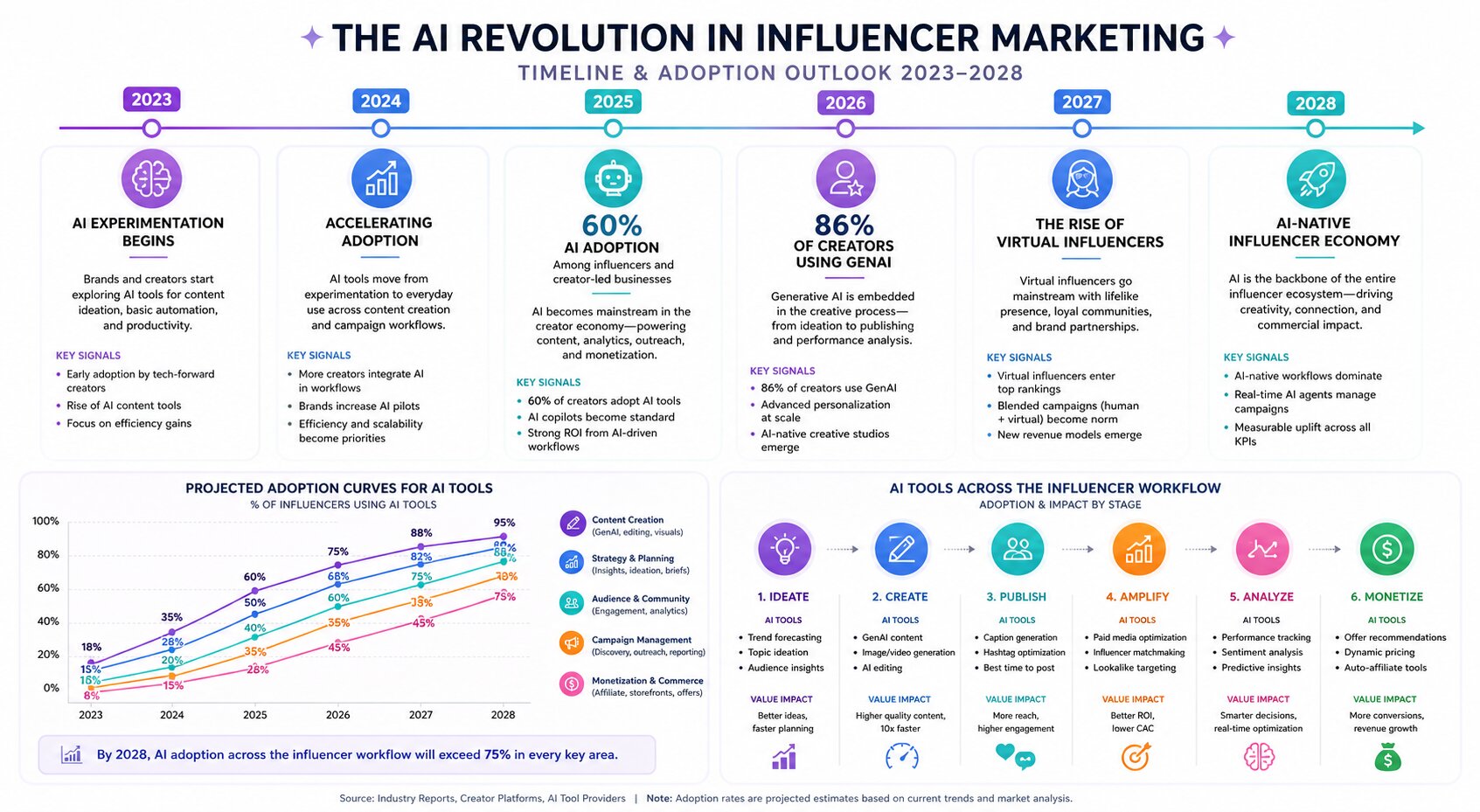
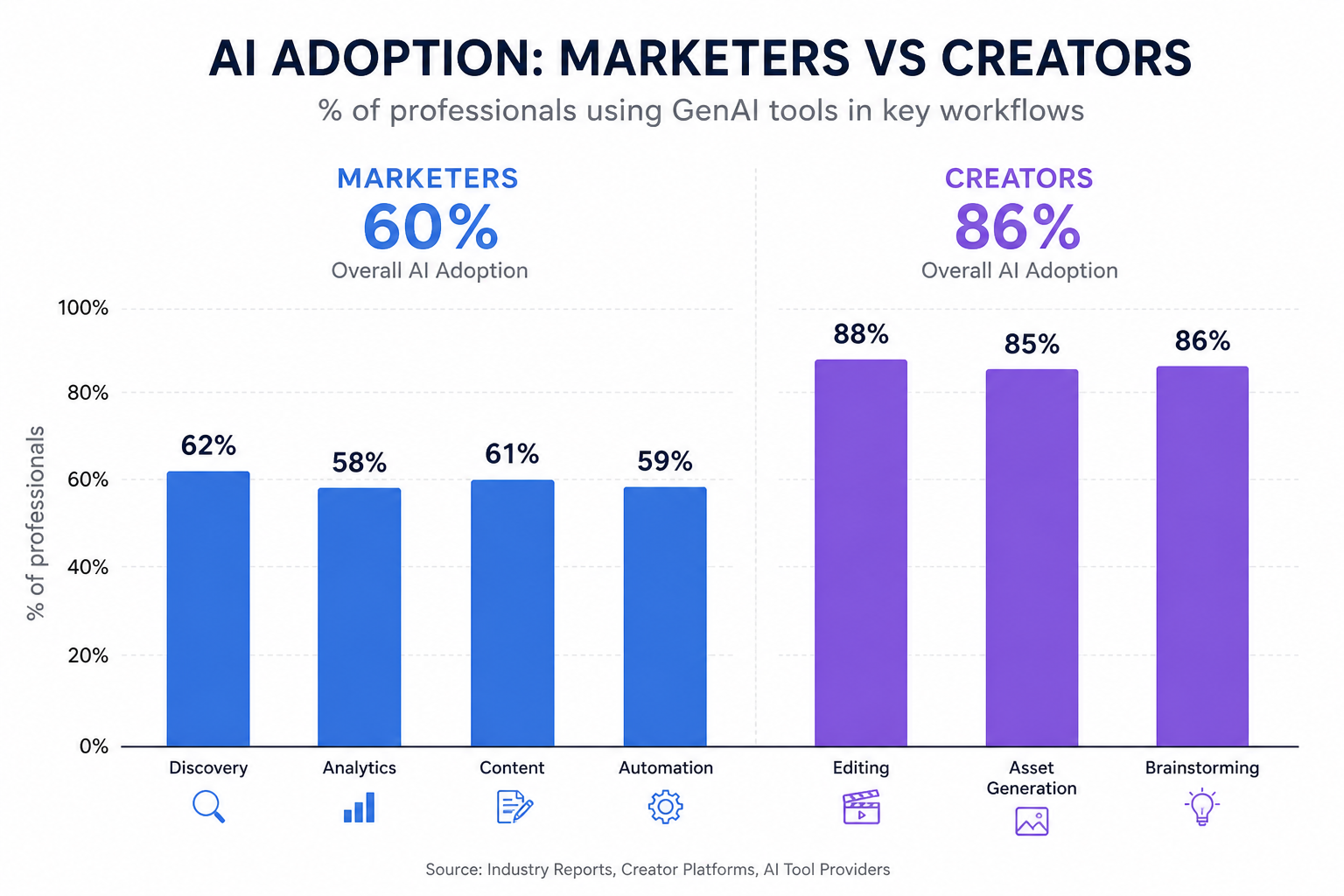
By early 2025, roughly 60 percent of marketing professionals worldwide reported using AI in influencer marketing, and adoption has climbed sharply since 2020 as AI tools became easier to plug into existing stacks. One detailed dataset shows 60.2 percent of marketers already using AI for creator identification and campaign optimization, with usage heavily concentrated in areas that were once painful and manual.
Where marketers are using AI today
The top use cases you see repeated across studies and platform reports are:
-
Creator discovery and vetting. More than half of AI users employ it to discover influencers, scan their followers, and score brand fit at scale.
-
Predictive analytics. Tools forecast engagement, conversions, and even cost per acquisition before you spend a rupee or a dollar on a campaign.
-
Content optimization. AI helps test hooks, captions, formats, and posting times, moving brands away from guessing based on “what worked last time.”
-
Workflow automation. Platforms now auto‑generate contracts, schedule content, automate outreach, and consolidate reporting into one view.
One 2025 analysis found that brands using AI‑driven analytics reported around 2.3 times higher conversion rates and cut manual coordination time by about 60–70 percent compared with old workflows. Another guide on automation tools notes that AI outreach can push creator response rates from around 15 percent to roughly 45 percent because messages are tailored to each influencer’s content and audience.
The problems AI is actually solving
If you have run influencer campaigns yourself, you will recognise these pain points:
-
Finding authentic fits. AI helps you look past follower counts by examining audience demographics, interests, quality of engagement, and even past purchasing behaviour.
-
Fraud and fake followers. Studies suggest that up to 20 percent of influencer audiences can be fake, and AI-based quality reports now flag suspicious patterns in seconds.
-
Scaling without losing your mind. Instead of manually emailing hundreds of creators, AI agents handle first outreach, follow‑ups, contract generation, and status tracking so your small team can run campaigns at “big brand” scale.
-
Measuring real ROI. New attribution and commerce tools tie creator posts directly to website visits, sales, and repeat purchases instead of vague awareness metrics.
Human vs AI: who does what now?
Marketers are clear about what they still want humans to handle. While around 60 percent already use AI in influencer workflows, most still see it as a way to save time, improve targeting, and measure performance—not to replace creators or strategist roles. On the creator side, Adobe’s 2025 survey of 16,000 creators found that 86 percent actively use generative AI, mainly for editing, asset generation, and brainstorming, while 81 percent said it helps them make content they otherwise could not.
So the current balance looks something like this: AI does the heavy lifting on data and repetitive tasks; humans still bring the taste, stories, and real‑world experiences that followers trust. For you, the practical question is not “AI or humans?”—it’s “Which parts of your process should AI handle so you and your creators can do your best work?”
Proven use cases: How brands are winning today
This is where things get exciting for you because the use cases below are not theory—they are backed by real campaigns with measurable results.
AI‑powered creator discovery and matching
Old way: You or your team searched hashtags, scrolled feeds, and relied on guesswork and your network.
New way: Tools like Modash, HypeAuditor, and others analyse hundreds of millions of profiles, using natural language, visual search, and audience filters to surface creators who actually match your brief.
-
Semantic and visual search. Modash, for example, lets you describe the creator you want in plain language (e.g., “Indian dads who make funny finance reels”) and uses AI to scan bios, captions, and visuals to find relevant profiles.
-
Brand‑fit scoring. These platforms combine filters like audience location, engagement rate, growth trends, past collaborations, and fake‑follower checks into a “fit score” so you can prioritise outreach.
-
Lookalike discovery. Once you have a top performer, AI can surface “twins” with similar content, audiences, and performance to help you scale what already works.
A beauty ecommerce brand, Care to Beauty, used such a data‑driven approach and reported a 75 percent reduction in time spent analysing profiles and a 10x increase in influencer‑attributed sales during a key Black Friday period. That shift turned their influencer program from a soft awareness tactic into a measurable growth channel.
What this means for you:
You can stop guessing and start treating creator selection like media buying: define your target, let AI shortlist candidates, then add your human judgement on top.
Predictive analytics and campaign forecasting
AI models can now forecast engagement, reach, conversions, and sometimes even RoAS (return on ad spend) before a campaign goes live. That sounds like science fiction, but it’s built on real‑world data from thousands of past posts, audience behaviours, and commerce events.
Platforms like indaHash and The Cirqle use AI to:
-
Estimate engagement and click‑through rates for each creator on your list.
-
Predict cost per acquisition and likely revenue based on past campaigns with similar audiences and formats.
-
Identify creators whose audiences show “high purchase intent” for your category.
One case study from The Cirqle describes beauty retailer Lookfantastic using predictive scoring to prioritise niche influencers, then boosting their content with paid media; the result was about 11x RoAS and lower CPMs. Another example shows Therabody more than doubling RoAS (from 2.2x to 4.5x) by using similar predictive models to pick and amplify fitness creators.
For you, the big shift is this: instead of launching a campaign and hoping the numbers work out, you can model likely outcomes upfront, move budget toward creators with better predicted RoAS, and justify spend to finance and leadership with actual scenarios rather than “influencer magic.”
Content creation and optimisation
On the content side, AI is already “inside the toolbox” for most creators you might work with. Adobe’s global research found that 86 percent of creators use generative AI in their workflows, primarily for editing, upscaling, creating new assets, and ideation.
Here’s how that shows up in real campaigns:
-
Brainstorming and scripting. Creators use AI chat tools to turn your brief into hook ideas, video outlines, and caption drafts, then add their own voice and personal stories on top.
-
A/B testing hooks and captions. Some platforms automatically test different intros, thumbnails, or captions and push the winner harder via paid amplification or whitelisting.
-
Generative assets. Brands like Unilever used Nvidia’s generative AI tools to remix more than 100 influencer posts for a Dove launch into multiple platform‑specific variations, driving over 3.5 billion social impressions and bringing in 52 percent first‑time buyers.
For you as a brand or creator, the power move is to treat AI as your content studio assistant, not the star. Let it help you produce more variations, tailor content for each platform, and keep testing new angles—while your real personality stays front and centre.
Performance measurement and attribution
For years, the hardest question in influencer marketing has been: “Did this actually drive revenue, or did we just get likes?”
That’s changing fast. Influencer platforms now pair unique links, discount codes, shoppable tags, and advanced attribution models to connect creator content to site traffic, add‑to‑carts, and purchases.
A few important shifts you should know about:
-
Full‑funnel visibility. By 2026, major social platforms have in‑app shopping and detailed product tagging, letting brands see not just views but add‑to‑cart and purchase data tied to creators.
-
Multi‑touch attribution. Rather than giving all credit to the last click, AI models spread credit across different creator touchpoints along the journey.
-
Incremental lift measurement. Some brands now combine influencer data with experiments and modelling to estimate how much extra revenue the creator activity generated versus a baseline.
A 2026 analysis of influencer attribution notes that brands can now track creator‑driven revenue across assisted conversions, repeat purchases, and halo effects, bringing influencer reporting closer to what CFOs expect from paid media or email. When you can answer “how much money did each creator bring in over three months?” your budget conversations change.
Fraud detection and authenticity verification
Influencer fraud—fake followers, bought engagement, pods, and now AI‑generated deepfake content—can quietly eat your budget if you don’t watch for it.
AI‑powered platforms like HypeAuditor, Stormy AI, and others apply machine learning to:
-
Flag sudden, unnatural spikes in followers or engagement.
-
Estimate what share of an audience is likely fake or inactive.
-
Detect suspicious comment patterns or bot‑like behaviour.
HypeAuditor has highlighted that up to 20 percent of some influencer audiences may be fake, underscoring why automated fraud checks are now standard for serious brands. Another review calls Stormy AI a “gold standard” for brands that are risk‑averse because its quality reports detect fake followers and engagement fraud within seconds.
For you, this has two big benefits:
-
You waste less budget on empty reach.
-
You protect your brand from the reputational hit of partnering with shady accounts.
You still need a human eye on creator behaviour and values, but AI can screen out the worst options long before you even reach out.
Virtual and AI influencers & digital twins
Virtual influencers went from quirky experiments to serious media assets within a few years. You now see AI‑generated characters working with fashion, beauty, auto, and tech brands at scale.
Some key examples you can learn from:
-
Hyundai x Kenza Layli. Hyundai used Moroccan AI influencer Kenza Layli to promote its Kona SUV, delivering about 20x ROI by using an always‑available virtual persona who could create content in multiple languages without traditional production costs.
-
H&M x Kuki. H&M’s Instagram campaign using AI character Kuki achieved an 11x increase in ad recall and a 91 percent decrease in cost per person remembering the ad, compared with traditional approaches.
-
BMW x Lil Miquela. BMW partnered with CGI influencer Lil Miquela for the launch of its all‑electric iX2, using her to bridge digital and physical worlds and reach millions of younger, tech‑savvy fans.
-
Aitana López. Spain’s AI influencer Aitana López works with brands like Amazon and Razer and reportedly earns up to around €10,000 per month from brand deals and subscriptions, despite being entirely virtual.
Pros for you:
-
Zero scheduling or travel conflicts.
-
Full control over messaging and visual style.
-
24/7 content creation and localisation.
Cons to watch:
-
Emotional connection is still weaker than with real people, as some experts note virtual influencers are better at awareness and recall than at driving deep trust and purchase intent.
-
You must handle disclosure and ethics carefully so audiences do not feel misled.
Many brands are now exploring “digital twins” of real influencers—AI clones that can generate simple content or personalised messages while the real person focuses on hero pieces and live interactions.
Workflow automation and personalisation at scale
Influencer marketing used to be notorious for chaotic spreadsheets and endless email threads. By 2026, a typical “automation stack” can handle much of the busywork.
Automation tools can:
-
Build your creator list based on AI discovery and vetting.
-
Send personalised outreach and follow‑ups in your brand voice.
-
Auto‑generate briefs and contracts based on campaign settings.
-
Track deliverables, approvals, and payments in a single dashboard.
-
Create audience quality scores so you know which creators to prioritise.
InfluenceFlow’s 2026 guide describes a workflow where you set goals and KPIs, the platform searches its database, launches personalised outreach, organises replies, creates contracts, and tracks performance—while AI crafting messages can 3x response rates compared with generic templates. Tools like HypeAuditor, CreatorIQ, and newer AI‑native platforms auto‑fill contract details, keep versions in sync, and align approvals and compliance so you are not chasing files in your inbox.
On top of that, AI agents are starting to handle first‑touch outreach and negotiation, stepping aside only when a creator is serious and a human conversation is needed. That means your team can run more campaigns with the same headcount—and focus your energy on creative strategy and relationship building instead of admin.
Emerging models: the hybrid future taking shape
Put these use cases together and you start to see new models emerging—especially if you are planning your strategy for the next 2–3 years.
Human + AI creator teams
Creators themselves now run their own “mini stacks”: generative AI for ideas and editing, analytics tools for performance, and automation for collabs and admin. Many B2B and B2C brands are co‑creating content with experts who lean on AI to turn raw knowledge into high‑impact posts faster. In practice, that might mean your subject‑matter expert records a rough video, while AI helps your partner creator script, subtitle, and repurpose it for different platforms.
Brand‑owned AI ambassadors
Some companies are building in‑house AI characters to front product lines or act as always‑on customer guides, inspired by examples like Aitana López and Kenza Layli. These brand‑owned personas can appear in content, answer basic questions in chat, and star in creative campaigns while staying 100 percent on brand.
Nano and micro‑influencers supercharged by AI
Reports show brands increasingly prefer micro and mid‑tier creators because they deliver stronger engagement for the cost. AI discovery tools make it easy for you to find hundreds of niche creators and give them plug‑and‑play creative guidance, affiliate links, and personalised offers, turning what used to be one “hero influencer” campaign into a wide network of creator‑driven distribution.
AI agents managing partnerships
Agent‑style AI systems are already handling outreach, reminders, rate comparisons, and basic negotiation terms before a human manager steps in. As these agents connect with your internal tools—legal templates, finance approvals, product inventory—you can expect more of the operational side of influencer marketing to run on autopilot, with you stepping in mainly for creative calls and exceptions.
2026–2028 predictions: what’s next
These predictions are grounded in the trends you have just seen: rising AI adoption, better attribution, virtual influencers, and creators leaning into generative tools. The years attached are estimates, not guarantees—but they give you a realistic planning horizon.
2026: AI becomes standard, not special
By 2025, about 60 percent of marketers said they used AI in influencer marketing, and nearly all major platforms have launched AI features across discovery, analytics, and workflow. It is reasonable to expect adoption to move toward the 70–80 percent range by the end of 2026, especially in mid‑size and large brands that already invest heavily in creators.
You can expect:
-
AI as default for discovery and vetting. Manual scouting survives only for very niche or high‑touch collaborations; most everyday campaigns start with AI‑generated shortlists and fraud checks.
-
“Influecreators” and hybrid campaigns. Creators who combine strong on‑camera presence with serious AI chops—content repurposing, data literacy, and automation—become your most valuable partners because they can deliver more assets and better performance with the same budget.
-
Full‑funnel attribution becomes table stakes. With social commerce data maturing and AI attribution models normalised, you will be under pressure to show revenue, not just reach, for your creator programs.
If you are still running influencer campaigns without clear tracking and AI support by 2026, you will likely struggle to defend budgets internally.
2027: personalised video at scale and tighter rules
As AI video and voice tech keep improving, expect 2027 to be the year when personalised influencer videos at scale move from impressive pilot to common tactic. Tools will let you generate thousands of short clips where an AI clone of a trusted influencer greets people by name, references past behaviour, or speaks to specific segments, all with that creator’s consent and revenue share.
At the same time, regulators and platforms are already pushing for clearer AI disclosures across ads and content. By 2027, it is realistic to expect:
-
Mandatory AI and sponsorship labels for virtual influencers and synthetic content in many regions, to reduce deception and deepfake harms.
-
Creator marketplaces with AI auto‑matching. More platforms will roll out marketplaces where brands upload a brief and AI recommends, shortlists, and even pre‑negotiates with suitable creators.
For you, this means you will be able to run hyper‑targeted video campaigns with familiar faces, but you must treat disclosure and consent as non‑negotiable, or risk regulatory and reputational damage.
2028: autonomous optimisation and possible AI fatigue
By 2028, it is likely that many influencer campaigns will run with continuous AI optimisation, much like programmatic ads today. AI will:
-
Shift budget in real time toward top‑performing creators and posts.
-
Auto‑adjust creative variants, hooks, and calls to action based on live data.
-
Pause underperforming collaborations and suggest replacements based on predictive models.
Virtual influencers will be fully mainstream in fashion, beauty, gaming, and parts of tech, especially for awareness and recall campaigns where brand control and consistency matter more than human nuance.
But there is also a real risk of AI fatigue. Consumers are already split: one study found that while 80 percent of advertisers were positive about AI, only 48 percent of consumers shared that enthusiasm. As more feeds fill with polished AI‑assisted content, you may see a swing back toward raw, imperfect, “too human to be fake” creators, particularly in categories where trust and vulnerability matter.
For you, the takeaway is simple: use AI to enhance authenticity, not to smooth out every edge. The brands that win will be the ones who keep human creators deeply involved while letting AI handle the invisible work behind the scenes.
Wildcards you should watch
-
Deepfake and identity theft. Fraudsters are already using AI to fake engagement; abusing faces and voices is the next step, and you will need strong verification and legal frameworks.
-
Platform algorithm shifts. If algorithms start favouring AI‑generated content or, conversely, demoting synthetic media, your strategy will need fast adjustments.
-
New ethics codes. Industry bodies may introduce guidelines around how you use creator data, how you disclose AI usage, and how you share value when you clone a creator’s likeness.
Challenges, risks and ethical considerations
Even though AI can make your campaigns smarter, it also introduces new risks you cannot ignore.
-
Over‑reliance leading to generic content. If you let AI write everything, your creator posts will start to look and sound the same as everyone else’s, which kills the uniqueness that makes influencer marketing work.
-
Transparency and disclosure. Viewers should know when they are interacting with a bot, watching heavily AI‑generated content, or seeing a virtual influencer, especially as deepfake quality improves.
-
Data privacy and bias. AI tools learn from past data; if that data is skewed, your campaigns may unintentionally ignore certain communities or reinforce stereotypes, and you also need to ensure tracking respects privacy rules.
-
Job displacement fears. While most creators say AI helps them grow, there is real concern among marketing staff that automation will reduce demand for some roles. Your challenge is to use AI to upgrade jobs (more strategy, less manual work) instead of silently replacing people.
-
Brand safety with virtual influencers. With virtual characters, the risk is not a “scandal” in their personal life but misalignment between their narrative and your values, or backlash if audiences feel tricked.
A healthy rule of thumb for you: if a use of AI would feel creepy or misleading if you saw it as a consumer, don’t do it—no matter how tempting the short‑term metrics look.
How to get started in 2026
If you are reading this and thinking, “Where do I even begin?” here’s a simple, practical framework you can run over the next 90 days.
Step 1: Audit your current influencer process
Ask yourself and your team:
-
How are we finding creators today?
-
How do we vet authenticity and audience quality?
-
What parts of our workflow still run on spreadsheets and manual emails?
-
What can we actually see in our reports beyond reach and likes?
Compare your answers to what AI‑enabled teams can do—faster discovery, predictive forecasts, automated outreach, and real revenue tracking. The gap you see is your roadmap.
Step 2: Pick one or two AI‑native tools
You don’t need a massive stack to start. For most brands or serious creators, a simple setup might look like this:
-
Discovery and fraud detection: A platform like Modash or HypeAuditor to search, vet, and score creator audiences.
-
Campaign management and analytics: A tool from Sprout, Sprinklr, or similar to track posts, revenue, and ROI in one view.
-
Automation & outreach: A system like InfluenceFlow or an AI‑powered outreach platform to personalise emails and manage follow‑ups at scale.
Give yourself a 60–90‑day test window and treat it like an experiment, not a forever marriage.
Step 3: Re‑allocate budget with data in mind
Based on the case studies we covered, AI‑supported teams often see 2–3x better performance when they lean into micro/mid‑tier creators, predictive selection, and content amplification.
You can try something like:
-
Keep your overall influencer budget steady.
-
Shift 10–20 percent of it into AI‑assisted experiments (AI discovery, predictive scoring, or virtual influencer tests).
-
Reserve a slice for boosting high‑performer posts via paid media once the data identifies them.
Step 4: Lock in a few core KPIs
To keep things simple, focus on:
-
Creator‑level RoAS or revenue. How much sales or revenue each partner drives over a fixed period.
-
Cost per incremental customer. Especially where attribution can separate baseline sales from creator‑driven lift.
-
Audience quality scores. So you can compare “cheap reach” to “costly but high‑intent reach.”
-
Response and onboarding speed. How fast you can go from idea to live content now that AI handles more of the admin.
You can always add more metrics later, but these four will tell you if AI is actually making you money and saving you time.
Step 5: Run quick‑win experiments
Here are a few low‑risk experiments you can start this quarter:
-
Use AI discovery to find 10 new micro‑influencers in a niche you under‑serve and compare their performance to your current roster.
-
Let AI draft first‑round outreach and follow‑ups, and compare reply rates with your old templates.
-
Ask 2–3 trusted creators to use generative tools to deliver extra content variations from a single shoot, then test them as whitelisted ads.
-
Pilot a virtual influencer or character for one specific awareness campaign, with very clear disclosure, and measure impact on recall and cost per impression.
Document what you learn, good or bad, and feed that back into your 2027 planning.
Conclusion
AI is not just a shiny add‑on to influencer marketing anymore—it is quietly rewriting the rules of how you pick creators, plan campaigns, create content, and prove results. The data is clear: adoption is already widespread, creators themselves rely on GenAI at scale, and the best‑performing brands now treat influencer marketing like a measurable, optimisable growth channel rather than a “nice to have.”
But underneath all the dashboards, predictive models, and virtual ambassadors, one thing has not changed: people still buy from people they trust. Virtual influencers can drive awareness and recall, yet the deepest loyalty still comes from human stories, lived experience, and creators who show up consistently over time. The real winners between now and 2028 will be the brands and creators who use AI to amplify that authenticity—not to replace it with something smoother but emptier.
If you take one next step after reading this, make it this: audit your current influencer process and choose one AI‑powered use case to test in the next 90 days—whether that’s smarter discovery, better measurement, or simple outreach automation. Once you’ve seen what it can do for a single campaign, you will be in a much better position to design the influencer marketing machine you want for 2026–2028, rather than reacting to everyone else’s.