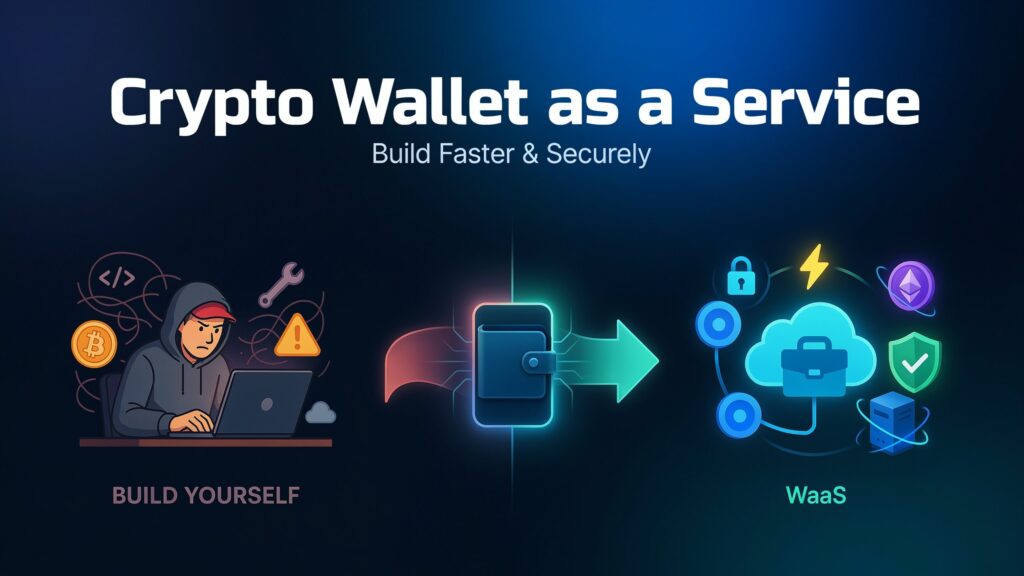
Any business adding crypto to its product such as payouts, trading, custody, or a branded app wallet eventually hits the same wall: building secure wallet infrastructure in-house is slow, expensive, and easy to get wrong. That’s the gap wallet as a service (WaaS) fills, and it’s why most crypto wallets for businesses today run on top of a specialized provider rather than custom code.
What Is Crypto Wallet as a Service (WaaS)?
Wallet as a Service is infrastructure that allows users and companies to store, send, and receive cryptocurrencies without having to manage the wallet infrastructure themselves.
A WaaS provider runs the cryptographic engine and node infrastructure — sometimes the custody layer too — while the business handles branding and customer experience on top.
How WaaS Works
Most providers fall into one of three models. Custodial wallets keep keys on the provider’s servers; the business gets convenience but inherits the provider’s compliance posture. MPC (multi-party computation) wallets split a private key into shards distributed across multiple parties, so no single party ever holds the complete key as transactions are signed collaboratively through a cryptographic protocol.
Non-custodial WaaS runs orchestration while the client retains signing authority entirely. Behind any of these sits a ledger that tracks balances in real time, a transaction orchestration layer that validates and routes signing requests, and a policy engine that enforces spend limits and approval rules.
WaaS follows a consistent pipeline under the hood. Integration happens via API or SDK: wallet creation, address generation, and signing requests all flow through that interface rather than manual key handling.
When a transaction is initiated, the orchestration layer checks it against the policy engine — spend limits, whitelisted addresses, approval thresholds — before it reaches signing. Only cleared requests get signed, whether via MPC ceremony, custodial signing server, or a request pushed to the client’s own infrastructure.
Once signed, the transaction broadcasts to the relevant chain. Multi-chain platforms handle node connectivity, fee estimation, and nonce management per network, abstracting away differences like EVM vs. UTXO chains. The ledger updates in real time, reconciling on-chain confirmations with internal balances.
Webhooks notify the business’s systems of status changes (pending, confirmed, failed), enabling automated downstream workflows. Providers also log every signing request and approval for audit and compliance purposes.
Features and Benefits
The strongest crypto wallets for businesses share a few traits: multi-chain support so the wallet doesn’t need separate integration work per blockchain, SOC 2 or ISO 27001 certification as a baseline security signal, predictable pricing (per-wallet, per-transaction, or monthly active wallet fees rather than open-ended development costs), and a policy engine for role-based approvals. It also includes such features as security, scalability, AML, KYC compliance, support for multiple cryptocurrencies and tokens.
The benefit case is straightforward — faster time to market, lower security risk than building in-house, and infrastructure that scales from hundreds to millions of wallets without a corresponding rise in engineering overhead.
The benefits list also consists of:
- reduced cost of developing and maintaining infrastructure for storing cryptocurrencies;
- scalability that makes it easy to adapt the service to increasing transaction volumes and user numbers, providing flexibility and the ability to respond quickly to changes;
- compliance with AML regulatory requirements that helps businesses operate in different jurisdictions without violations.
Top WaaS Providers
Wallet-as-a-Service has become its own category distinct from custody or exchange infrastructure, with providers differentiating mainly on key-management model and how much technical control they hand back to the integrating team.
When evaluating providers, a few criteria consistently matter most. Security comes first — the underlying key-management architecture (MPC, HSM, or custodial), audit history, insurance coverage, and track record on past incidents. Scalability matters just as much: whether the platform can handle growing transaction volume and wallet counts without added latency or manual overhead.
API and integration quality — documentation, SDK maturity, and how cleanly the provider fits into existing infrastructure — often determines how fast a business can actually launch. Multi-currency support, meaning the breadth of supported chains and assets and how quickly new networks get added, shapes long-term flexibility.
And regulatory compliance, including licensing, jurisdictional coverage, and built-in AML/KYC or travel-rule tooling, is what ultimately determines whether a provider is usable for an institutional client at all.
The platforms below span that range, from enterprise-grade MPC incumbents to API-first toolkits for engineering teams.
1. Fireblocks
Fireblocks is the incumbent enterprise platform in this space, used by major banks, exchanges, and fintechs for treasury operations and wallet orchestration at institutional scale.
Its MPC-based signing and policy-based access controls give compliance teams audit trails they already recognize, and the platform has processed trillions of dollars in cumulative transaction volume. It’s the safest enterprise choice, though contracts are typically annual and not self-serve.
2. WhiteBIT
WhiteBIT’s Wallet-as-a-Service offering generates business crypto wallets across more than 330 assets and 80+ networks, bundled with fiat on- and off-ramps and API access on a white-label basis. Rather than pricing wallet generation, AML verification, and liquidity routing separately, as several providers do, WhiteBIT folds these into a single integration price.
Clients in fintech have used it to add wallet functionality without standing up a new platform, and because it sits on WhiteBIT’s existing exchange infrastructure, wallets can connect directly to trading and liquidity without a separate integration step.
3. Cobo
Cobo supports a range of operating models, from full custody to MPC and hybrid designs, letting teams decide how much key responsibility to retain internally. Its policy engine and multi-chain support are paired with SOC 2 certification and a free trial program, which makes it accessible to teams that want to test integration depth before committing to an enterprise contract.
4. BitGo
Known originally for pioneering multi-signature custody, BitGo’s wallet infrastructure pairs offline cold storage with customizable transaction policies (whitelists, multi-approval workflows) and scales from startups to large institutions. It’s a common choice for businesses that want wallet infrastructure and qualified custody from the same provider.
5. Dfns.
Dfns protects keys through MPC across cloud, hybrid, or on-premises HSM deployments, and replaces private key handling with auth credentials so a lost device doesn’t mean lost funds. Its programmable policy engine and support for 50+ blockchains make it a fit for engineering teams building custom wallet experiences who want flexible, API-first infrastructure rather than an off-the-shelf product.
Conclusion
The right crypto WaaS provider depends less on feature lists than on your custody model, expected chain coverage, and how much control your team wants to retain over keys. Map those three variables first, then shortlist providers — the businesses getting the most out of crypto wallets are matching infrastructure to their actual operating model, not chasing the longest feature list.