Square gave a CBD seller one flat set of terms and an account that was open within minutes of signing up. The accounts that take CBD today work in the opposite order, with an underwriter reviewing the business, its products, and its paperwork before the first card is accepted.
Square is ending hemp and CBD sales on its platform, and it pointed to the federal redefinition of hemp that takes effect in November as the reason [1]. For most sellers, that leaves two pieces of the old setup to replace: the checkout on the web store and the card reader at the counter. Each replacement now goes through that review.
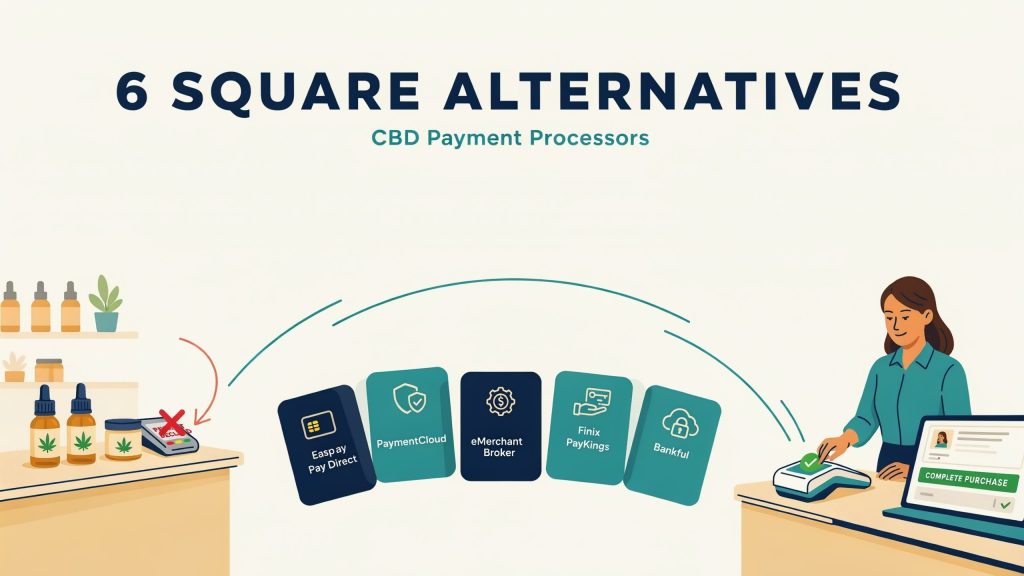
All six providers below accept hemp-derived CBD merchants, and each of them can take over the web checkout.
| Provider | Replaces online checkout | Replaces the counter | Documents it asks for |
| Easy Pay Direct | Yes, through its own gateway | Yes, countertop terminals and tap-to-pay | Not stated |
| PaymentCloud | Yes, with a choice of gateways | Yes, countertop and mobile readers | Processing statements, certificate of analysis, supplier list |
| eMerchantBroker | Yes | No | Identification, bank and processing statements, tax number |
| Finix | Yes | Yes, payment terminals | Business documentation and product records |
| PayKings | Yes | Yes, storefront hardware | Certificates of analysis, prior statements if any |
| Bankful | Yes | No | Not stated |
What the Square Setup Covered
The Online Checkout
On Square, the checkout on a web store and the account behind it came from a single signup. A replacement usually splits that into two decisions. One is the gateway, the software layer between the checkout page and the processor. The other is the merchant account that settles the money into the seller’s bank.
The industry calls a web sale card-not-present, since the card itself is not at hand, and underwriters look at those sales more closely. Saved cards and recurring orders need a plan of their own, and the new provider should explain how it will bring them over before the seller commits.
The Counter
The counter is simpler to describe and slower to replace. The seller needs a terminal that is tied to the new merchant account, and the terminal has to come from the provider or be approved by it. Market stalls and pop-up tables count as part of the counter, and each one needs a reader tied to the same account before it can take a card.
What changes from Square is the order of events. The business is reviewed first, the terms are set second, and the hardware is set up against the approved account after that.
1. Easy Pay Direct
What it replaces: the online checkout and the counter.
Easy Pay Direct [2] runs its own gateway and pairs it with a dedicated merchant account. Its CBD program covers “CBD, hemp, and hemp-derived product businesses” where legally compliant, and its retail line adds countertop terminals, point-of-sale systems, chip cards and tap-to-pay.
It also offers offshore and international CBD accounts, which it says it arranges “when they make sense.” That gives a seller a second route if a domestic bank turns down the file, although an offshore account comes with its own terms that deserve a close reading.
The account model is the clearest break from Square. Where Square put every seller on the same terms, Easy Pay Direct places each merchant account with one of more than 30 banking partners, and the match is made during underwriting. Two sellers with similar products can therefore end up at different banks, each with its own reserve terms. It is worth asking which bank will carry the account, since that bank decides who can change the account’s terms later.
2. PaymentCloud
What it replaces: the online checkout, the counter and phone orders.
PaymentCloud’s CBD accounts cover online sales, countertop and mobile readers in a shop, and phone orders taken through a virtual terminal. That is a secure web page where staff type in a card number a customer reads out over the phone. For a seller whose customers still call in their orders, that third channel is part of the replacement. The program also takes a wide range of sellers, from hemp extractors and wholesalers to smokable hemp and vape retailers. Recurring billing and invoicing come with the same account, so a seller with subscription customers can move them without adding a separate billing service.
The program may be behind the news. It still cites the 2018 Farm Bill and hasn’t addressed the change Square cited, so a seller should ask how PaymentCloud will run it once that change takes effect.
3. eMerchantBroker
What it replaces: the online checkout only.
eMerchantBroker [3] works for BMO Harris Bank as that bank’s registered independent sales organization and merchant service provider. An independent sales organization signs up and supports merchants on behalf of a bank, while the bank and its processor underwrite and carry the account. With Square, the company that took the application also made the decision, and here those roles belong to different parties. Because the bank makes the underwriting call, a question about reserve terms or a frozen payout may have to go through eMerchantBroker to the bank before anyone can answer it.
eMerchantBroker takes CBD supplements, vitamins, creams and topicals. The application asks for a chargeback ratio under 2%, an operating website and the documents listed in the table.
Pricing comes after the file is reviewed. It depends on the merchant’s industry, past processing history, average ticket and average volume, and there are no upfront setup fees.
4. Finix
What it replaces: the online checkout and the counter.
On price, Finix works differently from Square. Square charged sellers a flat rate, while Finix prices CBD on interchange-plus, which passes the card networks’ own fees through at cost and shows Finix’s markup as a separate amount. A seller can then see what each sale costs and which part of that cost the processor controls. Finix’s CBD payment processing [4] covers card sales online and in person, with payment terminals for settings “from storefronts to pop-ups.” Finix also flags that a 2025 law changed how hemp is measured and limited, with new limits arriving in late 2026.
Finix treats CBD as Restricted for merchants that sign with it directly, which means enhanced due diligence. For platforms and independent software vendors, CBD is Prohibited, so a seller cannot reach Finix through a software company’s bundled processing.
5. PayKings
What it replaces: the online checkout and the counter.
PayKings speaks to Square sellers directly, calling Square a platform that “Prohibits hemp.” It sells storefront hardware alongside its gateway, so a seller can replace the counter and the web checkout from one account.
For CBD it wants certificates of analysis showing 0.3% THC or less [5], and prior processing statements only if the seller has them. Chargeback alerts come with the account, and a seller should ask which card brands’ disputes those alerts will reach.
6. Bankful
What it replaces: the online checkout only.
Bankful’s cheapest software plan has no monthly fee, though it carries a $50 monthly minimum, and card rates come separately from the processing bank. That keeps the fixed cost low for a seller whose web sales are small or uneven. It offers no in-person product, so a seller with a counter would need a second provider for that half.
Where to Start With the Checkout and the Counter
The half that carries more of the seller’s card revenue is the one to replace first, since that is where a gap between accounts costs the most. For a web-led brand, the checkout is the priority, and the saved cards and subscriptions should move with it. For a shop where most sales happen at the register, the terminal comes first, and the web store can follow once the new account is approved and running.
Where the counter matters as much as the web store, one application to a provider that covers both halves saves a second underwriting review and keeps both channels in one set of reports. Bankful and eMerchantBroker fit a seller who can run the counter on a separate account or does not need one.
The product list sent to the underwriter should match the catalog the seller intends to carry going forward, because the provider approves the products it is shown.
Where These Figures Come From
- [1] https://weedweek.com/industry-news/newsbrief-square-done-with-hemp-payments-report-says/
- [2] https://www.easypaydirect.com/
- [3] https://emerchantbroker.com/
- [4] https://finix.com/industry/cbd
- [5]https://csgmidwest.org/2026/06/04/farm-bill-loophole-has-led-to-a-booming-industry-for-hemp-derived-products-and-a-mix-of-state-laws-a-new-federal-framework-is-coming-soon/