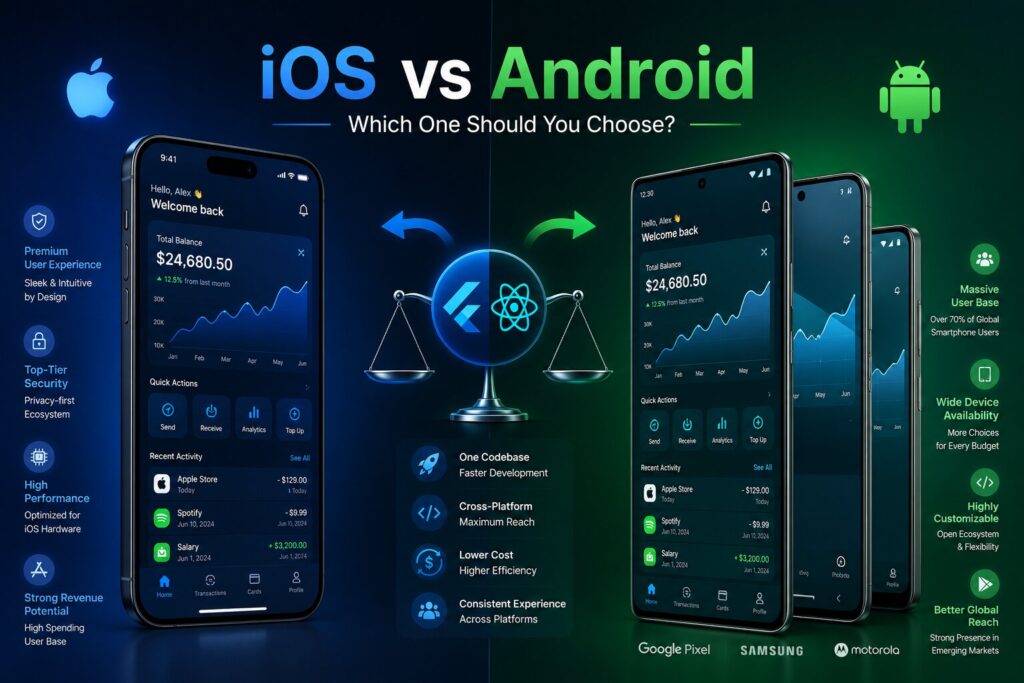
I’ve had countless conversations with founders and product leaders who were stuck on one question: “Should we build for iOS, Android, or both?”
One SaaS founder spent six months building only for iOS, only to discover that 75% of his target users were on Android. Another team tried to launch on both platforms simultaneously and burned through their entire seed round with delayed launches and quality issues.
In 2026, the mobile app landscape has matured, but the decision is more nuanced than ever. This guide gives you a clear, data-driven framework to choose the right platform strategy for your app.
The Current Global Mobile Reality (2026)
- Android holds approximately 71–73% of the global smartphone market.
- iOS commands 26–28%, but generates significantly higher revenue per user.
- iOS users tend to have higher disposable income and higher app spending.
- Android dominates in emerging markets and offers broader reach.
- Cross-platform tools have become remarkably powerful, changing the old rules.
The choice is no longer purely technical — it’s strategic.
Detailed Platform Comparison in 2026
| Factor | iOS Development | Android Development | Cross-Platform (Flutter/React Native) |
|---|---|---|---|
| Market Reach | Smaller but premium | Much larger (global scale) | Both platforms from one codebase |
| Revenue Potential | Higher (users spend more) | Volume-driven | Combines both |
| Development Speed | Faster (one hardware ecosystem) | Slower (device fragmentation) | Fastest |
| Cost | Lower for single platform | Higher due to fragmentation | Most cost-effective |
| Performance | Excellent & consistent | Good but varies by device | Very close to native now |
| App Store Approval | Strict but predictable | More lenient | Same as native |
| Design Standards | Strict Human Interface Guidelines | Material Design (more flexible) | Unified design possible |
| Monetization | Strong in-app purchases & subscriptions | Strong in ads & freemium | Flexible |
| Update Control | Users update faster | Slower OS fragmentation | Good |
When to Choose iOS First
Go iOS-first if:
- Your target audience is in North America, Western Europe, Australia, or high-income segments.
- Your app is premium, productivity, health, or finance-focused.
- You want faster time-to-market and easier quality control.
- You’re building a consumer app where emotional experience and polish matter most.
- Revenue per user is more important than total user count.
Many successful startups launch on iOS first to prove the concept with high-value users, then expand to Android.
When to Choose Android First (or Only)
Android makes more sense when:
- You need maximum reach in Asia, Latin America, Africa, or emerging markets.
- Your app is utility, marketplace, social, or content-driven.
- You rely on advertising or freemium models.
- You want to test ideas with a massive audience quickly.
- Hardware integration (sensors, cameras, foldables) is important.
The Cross-Platform Revolution in 2026
This is the biggest shift. Tools like Flutter (Google) and React Native (Meta) have matured to the point where many apps are nearly indistinguishable from native.
Best use cases for cross-platform:
- MVP development
- Startups with limited budget
- SaaS and B2B applications
- Apps with complex backends but standard UI
- Teams that want one codebase and faster iterations
Performance gap: In 2026, the difference is negligible for 90% of apps. Only games, AR/VR, or highly specialized apps truly need fully native development.
Recommended Strategy Framework
Step 1: Define Your Goals
- Is it user growth, revenue, or validation?
- Who is your primary user? (demographics + geography)
Step 2: Analyze Your Audience Use tools like Google Analytics, Sensor Tower, or App Annie to check device usage in your target markets.
Step 3: Consider Your Budget & Timeline
- Tight budget & timeline → Cross-platform (Flutter preferred in 2026)
- Generous budget & premium experience → Native (or Flutter + native modules)
Step 4: Plan for the Future Most successful apps eventually go cross-platform or dual-platform. Plan your architecture accordingly.
Step 5: Hybrid Approach (Often the Smartest) Many teams now use:
- Flutter or React Native for 80–90% of the app
- Native modules for performance-critical features
- This gives you speed + quality
Real-World Examples (2026 Perspective)
- Notion and Linear use cross-platform approaches successfully.
- Instagram and Uber maintain native apps for maximum performance but started simpler.
- Many fintech and health apps launch iOS-first then expand.
Technical Considerations in 2026
Flutter has become the default choice for most new projects due to:
- Excellent performance
- Beautiful, consistent UI
- Strong Google backing
- Growing ecosystem
React Native remains strong for teams with heavy JavaScript/TypeScript expertise.
Native SwiftUI (iOS) and Jetpack Compose (Android) are still preferred for apps that need bleeding-edge performance or deep platform integration.
Budget & Timeline Expectations
- Cross-platform MVP: $35K–$90K | 3–5 months
- Native single platform: $45K–$120K | 4–7 months
- Both platforms (native): $80K–$200K+ | 6–10 months
Final Decision Guide
Choose Cross-Platform if you want speed, cost efficiency, and broad reach.
Choose iOS First if you target premium users and need fast validation.
Choose Android First if volume and global emerging markets are your priority.
Go Native for Both only if you have strong funding and need maximum performance (e.g., gaming, AR).
The Smartest Move Most Founders Miss
Don’t think in terms of “iOS vs Android.” Think in terms of phased rollout.
Start with the platform that gives you the best learning speed and ROI, then expand. The technology exists today to make this transition smooth.