Most startup pricing pages are still copy-paste jobs: grab a competitor, tweak the numbers a bit, and ship it so you can “come back later.” Later usually means 12–18 months, several releases, and an angry finance update when your margins look worse at scale than they did at $5k MRR.w
That approach is now expensive. In 2026, AI features carry real variable infrastructure cost: tokens, GPU minutes, API calls, and storage that scale with usage, not headcount. Buyers know this, they compare plans side by side before they ever book a demo, and they’ve seen enough “unlimited AI” promises die in the fine print to be suspicious of anything that looks too generous.
At the same time, most SaaS categories have shifted away from pure per-seat pricing. Around 60–85% of vendors now run some usage-based component, and hybrid models—base subscription plus usage or credits—are the fastest-growing setup, especially for AI-heavy products. If your value metric is wrong or your tiers hide the real ceiling, you cap expansion before you ever hire a salesperson and invite ugly surprises when power users show up.
This guide is written from the perspective of someone who has shipped pricing, watched conversion drop, modelled AI costs, and raised prices afterward. It covers the models that actually work for startups in 2026, how to choose based on what you’re building, and how to keep your first pricing page simple enough to ship fast—without digging a hole you’ll regret at $1M ARR.
What Changed About SaaS Pricing in 2026
Two big shifts define 2026 pricing: AI turned usage into a real cost driver, and buyers got more demanding about fairness and predictability. Pure “all-you-can-eat” subscription is no longer the default, especially once you add generative features.
First, seat-only models struggle when the value comes from AI usage, not headcount. If one analyst can run 100x more AI queries than another, charging the same per seat breaks the link between price and cost; that’s why infrastructure and AI-native tools lean toward usage metrics like tokens, API calls, or queries rather than logins. The result is a broad move from user-based to usage-based metrics, with hybrid structures (fixed base plus variable component) emerging as the practical middle ground.
Second, hybrid models are spreading from data platforms into mainstream SaaS. Reports across 2025–2026 show that roughly 60%+ of SaaS companies now have some usage-based element, and hybrid base-plus-meter is the single largest category for AI-enabled products. The typical pattern: a platform fee for access plus included usage and an overage rate for extra events, credits, or resolutions.
Third, outcome pricing—charging per resolution, per successful transaction, or per agent that replaces human work—is rising in support and vertical AI, but it is operationally heavy for early-stage teams. You need attribution, good telemetry, and clear definitions of “done” before you start billing per outcome; most startups are not there at launch.hub.
Finally, buyers want two things that can seem contradictory: a clear monthly option and a predictable ceiling. Procurement likes knowing the minimum spend and the maximum possible bill; the winning hybrids combine visible base pricing with guardrails around usage so heavy customers pay more, but nobody feels bait-and-switched by surprise consumption spikes.
The Core Models Startups Should Consider
You do not need a PhD thesis on pricing to launch. You need to understand the few models that exist, pick the one that matches your product’s value and cost structure, and avoid obviously bad fits.
Flat-Rate Pricing
Flat rate is one price for the whole product—often per workspace or per company—regardless of users or usage. It’s attractive because it’s simple to explain, easy to bill, and great for early learning when your product is narrow and usage doesn’t vary much.
The downside: zero expansion. If your customer doubles usage or adds three teams, the price doesn’t move. That’s fine at 10 customers and fatal at 100 if your infrastructure cost scales with usage. Flat rate works best for very focused workflow tools with low marginal cost and clear caps on how “big” a customer can get inside your product.
Per-Seat Pricing
Seat-based pricing charges a fixed amount per user per month or year. It still works when your value scales with people—collaboration tools, project management, shared docs—where more teammates actually means more utility.
The strengths: it’s familiar to buyers, predictable for finance, and simple to quote; many established tools from Salesforce to Figma still run seat-based models for precisely these reasons. The weakness is a hard ceiling: revenue is capped by headcount, and any AI or compute-heavy value you add sits underneath a metric that doesn’t see it.
Usage / Credits Pricing
Usage-based pricing charges per unit of consumption—API calls, tokens, messages, events, or compute minutes. Credit systems are just a friendlier wrapper around usage: you include a pool of credits and charge for overages above that pool.
The good news: price scales with value and cost. Heavy users pay more, light users pay less, and your margins track actual consumption. The bad news: revenue becomes variable, forecasting is harder, and buyers can feel exposed if they don’t understand what drives the meter. Usage-based models demand decent metering, good billing infrastructure, and customer-facing dashboards so people can see and control what they’re burning.
Hybrid Pricing
Hybrid pricing combines a platform fee with included usage and an overage rate—a base plus meter. In 2026 this is often the best default for AI-heavy products because it gives you a predictable revenue floor and a mechanism to capture upside from heavy consumption.
The typical structure:
-
Base subscription (per seat or per workspace) that covers core features and a minimum usage allowance.
-
Included usage (events, queries, credits) sized for a normal customer.
-
Overage pricing once usage crosses the included pool.
Done well, hybrid pricing balances stability (buyers know the minimum) with alignment (heavy use costs more). Done badly—metering on obscure metrics, poorly communicated thresholds—it becomes a tax instead of a fair trade and kills trust.
Freemium vs Free Trial
Freemium and free trial are not pricing models on their own, but they define how people enter your funnel. Data from PLG benchmarks suggests freemium converts roughly 2–5% of signups to paid but pulls more visitors into signup, while time-boxed free trials convert closer to 15–20% of signups but attract fewer people up front.
Use freemium when free usage genuinely helps distribution—collaborative tools, viral content, or when your free tier seeds data that makes the paid product better. Avoid it when your marginal cost is high or your support burden is non-trivial; “free” users can drain margin and attention if you’re not careful.
Free trials work best when your product has a sharp “aha” moment that can be hit in 7–14 days and when implementation doesn’t require a lot of help; otherwise users don’t see enough value before the trial ends.
Outcome Pricing
Outcome pricing charges for results—tickets resolved, leads qualified, transactions completed, or agents replacing an FTE. It is powerful because it aligns your revenue with business value (solve more problems, pay more), and it’s particularly attractive in support and vertical AI.
But it’s risky before you can measure outcomes cleanly. You need attribution, agreed definitions of success, and systems to prevent disputes over what “counts.” For most startups, outcome pricing is something you evolve into after you’ve proven your workflow and data, not something you launch with on day one.hub.
Recommended Strategy by Startup Type
Different products deserve different pricing stories. If you’re building a simple workflow tool, you do not need the same complexity as an AI infrastructure platform.
Simple B2B Workflow Tool
If you’re shipping a straightforward workflow tool—tasks, CRM-lite, internal dashboards—start with 2–3 tiers and a value metric that’s either per workspace or per seat, depending on whether access or team size matters more.
A good default:
-
Starter: limited seats/workspaces, core features, priced low enough for small teams.
-
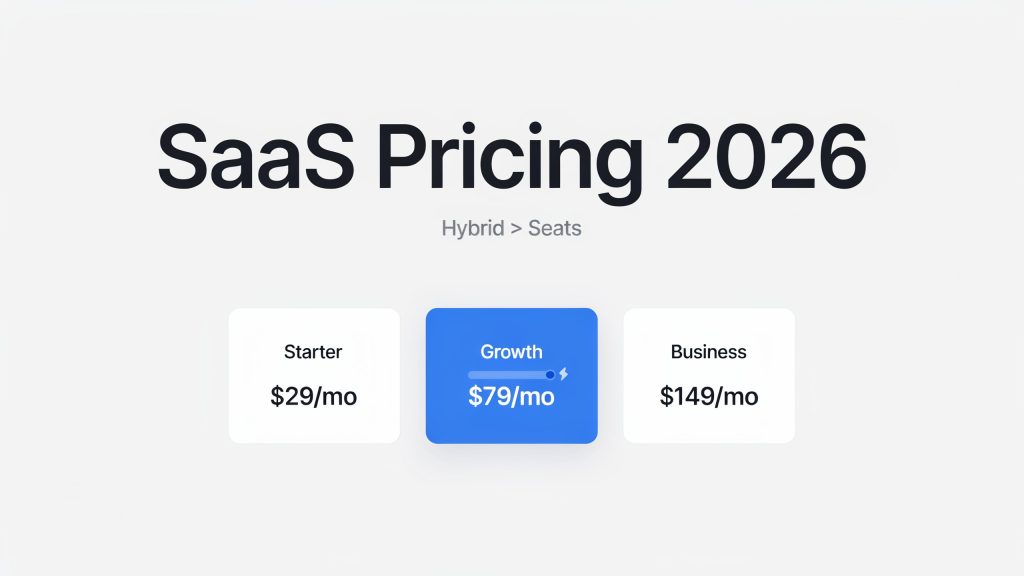
Growth (hero): more seats/workspaces, key integrations and automation, priced to be the obvious choice.
-
Business: advanced security, admin, and support for companies that care about compliance.
Pick either “per seat” or “per workspace” but not both; extra dimensions confuse buyers and your own reporting.
AI Product with Variable Compute
If your product includes serious AI inference or other variable compute, never hide that inside a cheap “unlimited” seat. Model your per-inference cost, including tokens, GPU, and vendor API pricing, and then design a hybrid structure that protects your margin.
A practical pattern:
-
Base platform fee per account or per team that covers non-variable pieces (UI, storage, support).
-
Included AI credits sized for a typical team.
-
Clear overage rate per extra credit or per action, with usage dashboards visible in the product.
You can charge per seat on top of that if access is part of the value, but the AI meter should sit on the actual cost driver—tokens, calls, or minutes—not on headcount.blog.
PLG / Self-Serve Products
For PLG, you want pricing that users understand without talking to you: visible monthly price, annual discount, and a clear hero tier for most teams.
Key moves:
-
Show both monthly and annual prices; don’t hide the monthly behind a toggle or require login to see it.
-
Offer a modest annual discount (often 15–25%) to reward committed customers without destroying your ability to raise prices later.
-
Make the Growth tier the hero plan—position it visually, pack it with the features most teams care about, and tune the spread so Starter feels cramped and Business feels “for later.”
PLG works best when the pricing page is an honest reflection of how you expect most customers to buy, not a teaser for “contact sales” buried beneath.
Sales-Led / Mid-Market
If your deals are sales-led, especially mid-market and enterprise, you still want published starting points even if the final contract is customized.
A workable pattern:
-
Publish “starting from” prices for core tiers (e.g., “Business starting at $X/month for Y seats”).
-
Reserve an Enterprise tier for custom contracts, with descriptions around SLAs, security, and scale rather than fixed numbers.
-
Use your price page as an anchor in negotiations, then layer on bespoke usage commitments or volume pricing as needed.
This keeps you from being a pure black box while giving your reps flexibility to match the deal to the account.
Bootstrapped vs Funded
Bootstrapped founders generally need cash-flow predictability more than aggressive land-and-expand designs; funded teams can tolerate more variance if expansion and NRR are strong.
If you’re bootstrapped:
-
Favor simpler models (flat, per-seat, or modest hybrid) with clear minimums so you’re not surprised by usage spikes.
-
Avoid freemium that carries real marginal cost, and be willing to raise prices earlier if you see margins compress.
If you’re funded:
-
You can lean harder into usage-based components that drive high net revenue retention—115–140% is common for successful usage-based products.
-
Design tiers to let customers ramp up usage easily, even if it makes forecasting noisier; investors care more about growth and NRR than perfect predictability.
How to Design Tiers That Convert
Three tiers still convert best: Starter, Growth, Enterprise/Business. This is not an accident; it taps into how people make choices.
Three Tiers, One Hero
Structure your page with three clear options:
-
Starter: entry-level, lower price, limited usage or seats.
-
Growth (hero): your main plan, visually highlighted and tuned to be the default choice.
-
Business/Enterprise: higher price, advanced features, often “contact sales.”
Humans tend to avoid extremes; a well-designed middle plan catches most signups. The trick is to make Starter obviously constrained and Enterprise clearly for bigger needs, without turning Starter into a fake plan nobody should buy.
Price Spread and Value Metrics
Your price spread should create real separation. If Starter is $29 and Growth is $39 with tiny differences, buyers either stay cheap or get confused. A better pattern is something like 1x / 2–3x / 5–10x, with meaningful differences in limits and features at each level.
Value metrics are what you charge on: seats, contacts, projects, messages, credits, outcomes. Good value metrics:
-
Closely correlate with value (more of it means more benefit).
-
Are easy for customers to understand and measure.
-
Are not trivially gamed by users trying to “cheat” the system.
Bad value metrics feel like taxes (e.g., charging for admin users who never log in) or punish growth in ways that don’t reflect real cost (e.g., charging per read-only dashboard viewer).
What Belongs in Each Tier vs Add-Ons
Keep your tiers focused on core access and limits. Use add-ons for things that:
-
Are expensive to deliver (premium support, dedicated environments).
-
Only matter to a subset of customers (advanced compliance, special integrations).
-
Create meaningful incremental cost or complexity for you.
This lets you keep the core hero plan clean while monetizing heavy requirements separately.
Annual vs Monthly Packaging
Offer both annual and monthly billing. Buyers want to know the monthly equivalent even if they pay annually; hiding the monthly price erodes trust.
A reasonable annual discount is in the 15–25% range; too high and you lock in low prices that hurt when costs rise. Make sure your tooling can handle annual renewals, proration, and upgrades cleanly before you get fancy—complex billing with poor execution is worse than simple billing done well.
Pricing Operations Founders Ignore
The biggest pricing mistakes are operational, not strategic. Founders obsess over tiers and models but ignore the boring parts that protect margin and reduce pain.
Cost Floor
Your cost floor is the minimum you can charge without losing money: AI, APIs, infra, support, and everything else that scales with usage or accounts. In an AI product, you should know your average cost per action or per active user before you publish any flat tier.
If your “Starter” plan lets a customer burn more compute than they pay for, you will regret it later. Model the worst-case heavy usage and make sure your base and overage rates cover it.
Grandfathering vs Forcing Upgrades
At some point you will raise prices. The choice is whether to grandfather existing customers indefinitely, grandfather them temporarily, or move everyone to new plans.
-
Full grandfathering keeps churn low but drags your average price down over time.
-
Forced migrations improve revenue but risk backlash and churn if the jump is big.
-
Middle ground (time-limited grandfathering or gentle increases) often works best: give customers clear notice, explain the cost changes, and offer options to adjust usage or tiers.
When to Raise Price vs Add a Higher Tier
You don’t need to raise prices every time your product improves. Sometimes you just need a higher tier that captures value for customers who truly want more.
Raise prices when:
-
Your margins are consistently shrinking due to cost increases.
-
Your product is significantly more valuable than when you set the original price.
Add a higher tier when:
-
A subset of customers needs advanced capabilities, and you can package those cleanly.
-
You see accounts bumping against limits and inventing workarounds.
Billing Complexity
Do not pick a pricing model your stack can’t invoice cleanly. If your metering is flaky or your billing provider can’t represent your new hybrid structure, you’ll spend more time fighting invoices than building product.
Start with the simplest version of the model you can operationalize. You can always add more nuance once your billing and telemetry are solid.
Simple Experiments
Pricing is an experiment. You should run lightweight tests regularly:
-
Page tests: change copy, positioning, and tier names to see how conversion moves.
-
Sales calls: ask prospects what they expected to pay and what feels expensive.
-
Willingness-to-pay interviews: structured conversations with customers about ranges and tradeoffs.
Treat each change as a hypothesis: explain internally what you expect, make the change, watch the data, and decide whether to keep it. Pricing that never changes is almost always wrong after a year of learning.
Conclusion
The best 2026 startup pricing strategy is simple enough to explain in one sentence, aligned with how customers get value, and revisited every quarter. Hybrid base-plus-usage models are winning for AI-heavy products because they balance predictable revenue with fair treatment of heavy users, but plain tiered seat pricing still works for classic collaboration tools.
Your job is not to find the perfect model once; it’s to avoid obvious traps, anchor your pricing in real cost and value metrics, and keep tuning as you learn. Start cleaner than you think, resist the urge to promise “unlimited” anything you can’t afford, and add usage meters, outcome pricing, and enterprise complexity only after you see real buying patterns and have the operational muscle to support them.
FAQs
What’s the best pricing model for a new SaaS in 2026?
For most new SaaS products, launch with 2–3 simple tiers and either per-seat or per-workspace pricing, depending on whether team size or access drives value. If you have material AI or usage cost, add a basic hybrid layer—platform fee plus included usage and overage—rather than pretending everything is “unlimited.”
Should we charge per seat or by usage if we have AI features?
Use seats when collaboration and access are the main value drivers; use usage when AI work and compute are the main costs. In 2026, the pragmatic answer for AI products is usually a hybrid: charge per account or per team for access, then meter AI-heavy actions via credits or usage limits.
Is freemium still worth it or does it just create unpaid work?
Freemium still works when free usage fuels distribution and doesn’t crush your margins—think viral tools and low-cost workflows. It’s dangerous when each free user carries real marginal cost (AI, support) or when your team ends up spending time on accounts that never intend to pay.
How many pricing tiers should a startup launch with?
Three tiers—Starter, Growth, Business/Enterprise—remain the sweet spot for clarity and conversion. Two tiers often feel too constrained, and more than three usually overcomplicates the page for early-stage buyers.
How do I know if we’re underpricing?
Signals you’re underpricing include high win rates with no pushback on price, customers telling you it’s “cheap,” and usage or support intensity that’s much higher than what you modeled per dollar of revenue. Compare your effective ARPU and margins to peers in your category using public pricing data and benchmarks.
When should we raise prices without wrecking churn?
Raise prices when your product is clearly more valuable than when you set the old price, your costs have increased, and you can explain the change honestly. Minimize churn by giving advance notice, offering options (downgrade, adjust usage), and avoiding shock jumps that double or triple bills overnight.
Do we grandfather old customers or move everyone?
There’s no universal rule, but many companies adopt time-limited grandfathering: keep existing customers on old prices for a fixed period, then migrate them with clear communication and, if needed, transitional discounts. Fully grandfathering forever keeps churn low but drags your average price down as you grow.
How much cheaper should annual be than monthly?
Most SaaS products offer annual discounts in the 15–25% range relative to monthly billing. Too small and customers don’t care; too large and you lock in low prices that hurt when costs rise or when you need to adjust pricing.
What’s a good value metric if seats don’t make sense?
Pick a metric tightly tied to value and cost: contacts, messages, projects, transactions, or AI credits, depending on your product. Avoid obscure metrics that feel like taxes, and make sure customers can see and understand how their usage maps to that metric.
How do we price AI so power users don’t destroy our margins?
Model your per-action or per-token cost, set a base fee that covers typical usage, and then meter heavy usage via credits or overage rates that keep gross margins healthy. Provide dashboards and alerts so customers can manage their consumption instead of discovering the impact only when the invoice arrives.