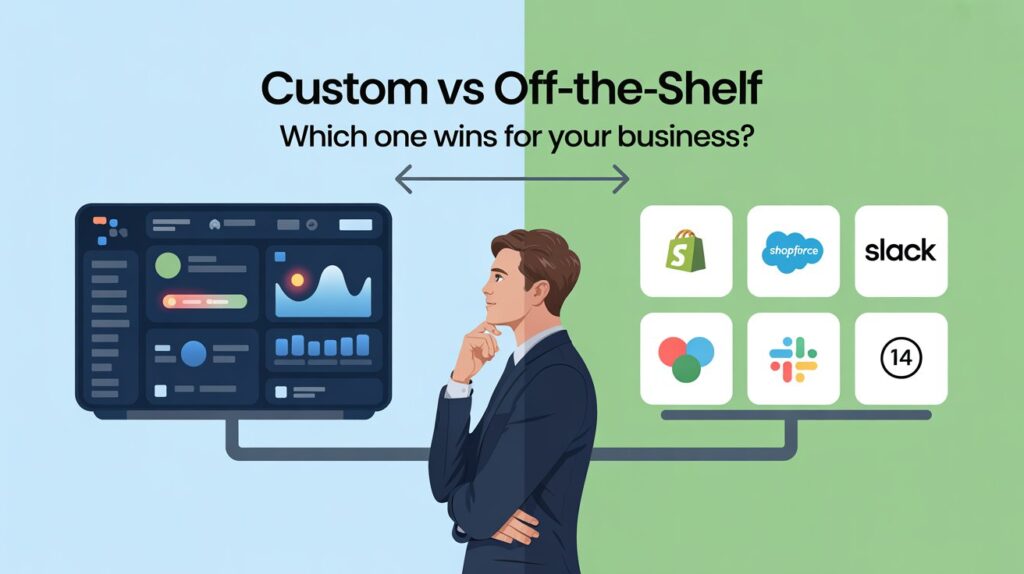
I still remember the conversation with the CEO of a mid-sized logistics company. He was frustrated. They had spent $180,000 on a popular off-the-shelf logistics platform, only to discover six months later that it couldn’t handle their unique cross-border compliance requirements. The workarounds were costing them time, money, and sanity.
On the other side of the table, a fintech startup founder told me they had tried building everything from scratch. Eighteen months and nearly a million dollars later, they still didn’t have a working product.
Both companies faced the same fundamental question that thousands of businesses ask every year:
Should we buy existing software or build custom software?
There is no universal answer. But by the end of this article, you’ll know exactly which path makes sense for your situation in 2026.
The Real Difference That Matters
Off-the-shelf software (also called commercial off-the-shelf or COTS) is ready-made. Think Salesforce, Shopify, QuickBooks, Slack, or SAP.
Custom software development means building something tailored specifically for your business processes, users, and goals.
The choice isn’t just about cost. It’s about control, speed, competitive advantage, and long-term flexibility.
When Off-the-Shelf Solutions Make Perfect Sense
Off-the-shelf is often the smarter choice when:
- Your business processes are fairly standard (accounting, basic CRM, HR, project management)
- You need to launch quickly
- Budget is a major constraint
- You don’t need deep competitive differentiation in that particular area
- Your team lacks technical expertise or bandwidth to manage custom development
Real success story: A boutique e-commerce brand I worked with launched on Shopify in just 3 weeks. Within 4 months they were generating six-figure revenue. Building a custom platform would have delayed them by 9–12 months and cost 8–10x more.
When Custom Software Development Becomes the Clear Winner
Custom development shines when:
- Your industry has unique workflows or strict compliance needs
- You want a genuine competitive advantage
- Integration with existing systems is complex
- You need specific performance, security, or scalability requirements
- You plan to scale dramatically or pivot frequently
- Data privacy and ownership are critical (especially post-2025 regulations)
Another real example: A healthcare diagnostics company tried using generic CRM and practice management tools. None could handle their specialized testing workflows and real-time regulatory reporting. After switching to a custom platform, their operational efficiency improved by 47% and they reduced compliance risks dramatically.
Detailed Comparison (2026 Perspective)
| Factor | Off-the-Shelf | Custom Software Development |
|---|---|---|
| Initial Cost | Low to Medium | High |
| Time to Launch | Days to weeks | 3–9 months |
| Customization | Limited (plugins & configurations) | Unlimited |
| Scalability | Good for standard needs | Designed exactly for your growth |
| Ongoing Cost | Subscription fees (can add up) | Maintenance & updates (predictable) |
| Ownership & Data | Limited control | Full ownership |
| Integration | Pre-built but rigid | Seamless with anything |
| Competitive Edge | Low (everyone can buy the same tool) | High |
| Maintenance | Vendor dependent | You control the roadmap |
| Security & Compliance | Good but generic | Built specifically for your needs |
Hidden Costs You Need to Consider
Many businesses only look at the sticker price. Here’s what they often miss:
Off-the-shelf hidden costs:
- Expensive add-ons and premium plugins
- Cost of workarounds and manual processes
- Training and change management
- Vendor price increases every year
- Limited support response times
Custom software hidden costs:
- Initial development investment
- Need for ongoing maintenance (budget 15–20% per year)
- Requirement for strong project management
- Longer time before seeing ROI
How to Make the Right Decision – A Practical Framework
Step 1: Audit Your Current Processes
List every workflow. Mark which ones are standard and which are unique to your business.
Step 2: Define Your Non-Negotiables
What must the solution do that no existing tool does well? Be brutally honest.
Step 3: Run a Cost-Benefit Analysis
Calculate 3-year total cost of ownership for both options.
Step 4: Consider Hybrid Approach
(Often the smartest move in 2026) Many successful companies use both:
- Off-the-shelf for standard functions (email, accounting, HR)
- Custom software for core competitive processes (unique customer experience, proprietary algorithms, specialized operations)
This is called “composable architecture” and it’s becoming the gold standard.
Step 5: Think About Future-Proofing
Will your needs stay the same in 2–3 years? If there’s any chance of major change, lean toward custom or at least flexible platforms.
Technology Trends Making Custom Development More Attractive in 2026
- AI-powered development tools have reduced custom development time by 40–60%
- Low-code platforms allow faster iteration
- Cloud-native architectures make scaling easier and cheaper
- Better outsourcing and dedicated team models have lowered risks
Questions You Should Ask Before Deciding
- Does this area give us a real competitive advantage?
- How painful are the limitations of existing tools right now?
- Can we afford to wait 4–8 months for a custom solution?
- Do we have (or can we hire) the right people to manage a custom project?
- What happens if the off-the-shelf vendor changes pricing or features?
My Personal Recommendation by Business Type
- Early-stage startups: Start with off-the-shelf + no-code tools. Move to custom once you have proven product-market fit.
- Growing SMEs: Hybrid model is usually ideal.
- Enterprises & established businesses: Custom software for core systems, off-the-shelf for supporting functions.
- Highly regulated industries (fintech, healthcare, legal): Custom is often worth the investment.
Final Thoughts
The question is no longer “custom vs off-the-shelf.” The real question is: Where does your business need to be truly exceptional?
Build custom software where it creates unfair advantage or solves problems that generic tools simply cannot touch. Use battle-tested off-the-shelf solutions everywhere else.
The companies winning in 2026 are not choosing one or the other. They’re choosing wisely — combining the speed of existing tools with the power of custom development exactly where it matters most.
Take a moment right now. Look at your most critical business processes. Ask yourself honestly: Is this area good enough to stay generic, or does it deserve to be built exactly the way your business needs it?
The answer will guide your next smart move.