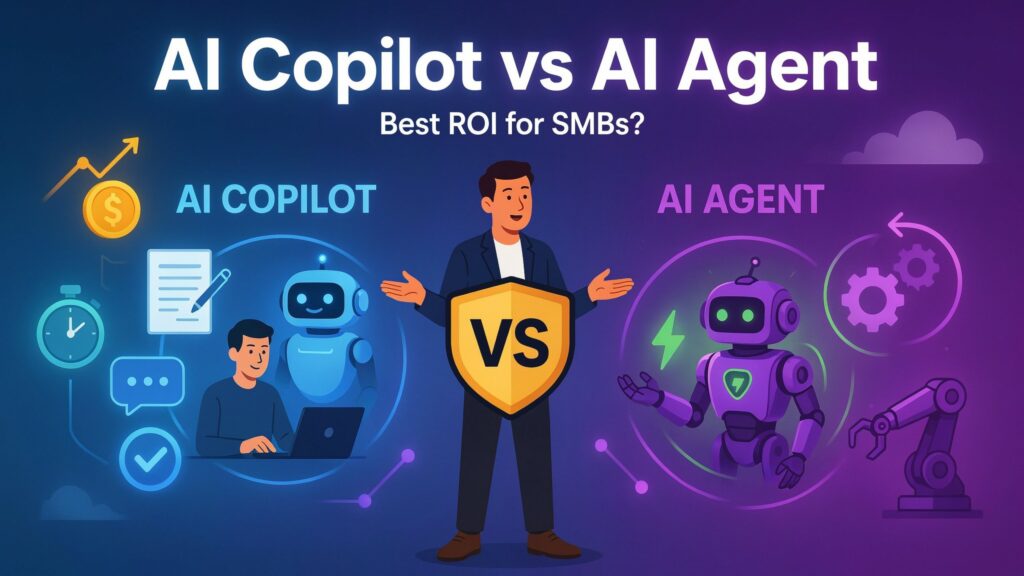
Many small and mid-sized businesses are stuck between two AI promises. Copilots claim to make every employee faster. Agents promise to run whole workflows with little human input. In 2026 the real question is not which is more advanced — it’s which one actually pays for itself faster with limited resources. This article cuts through the marketing and shows where each wins for SMBs.
Vendors still sell both as transformative. Copilot platforms (Microsoft 365 Copilot, Google Gemini for Workspace, various vertical tools) position themselves as productivity multipliers that sit inside the tools people already use. Agentic offerings range from specialized process bots to broader “autonomous” platforms that claim to handle end-to-end work. The hype cycle has matured: specialized agents have gotten cheaper and more reliable on narrow tasks, no-code builders have improved, and expectations for true autonomy have risen. At the same time, plenty of unproven agent projects still burn budget without delivering measurable results. For a 20- to 200-person company with constrained IT capacity and tight cash flow, the decision is practical, not philosophical. You need faster payback, lower risk of failed projects, and clarity on where human judgment must stay in the loop. The rest of this piece defines the two approaches cleanly, compares them on the dimensions that matter to SMBs, and shows the ROI patterns that have emerged by mid-2026.
Clear Definitions: What Each Actually Does
An AI copilot works alongside a human. It suggests, drafts, summarizes, retrieves information, or accelerates a single task or short sequence of steps. The human remains in control of every meaningful decision and final output. You open a document and the copilot offers a first draft. You paste meeting notes and it extracts action items. You ask it to research a competitor and it returns a structured summary with sources. The tool reduces friction and cognitive load, but the person still owns the work.
An AI agent takes a defined goal and executes multi-step work across tools with minimal ongoing supervision. It plans the sequence, acts (sending emails, updating records, calling APIs, checking status), evaluates intermediate results, and continues until the goal is met or it needs to escalate. A well-scoped agent might receive an invoice PDF, extract data, match it to a purchase order, flag discrepancies, and post the approved entry to the accounting system. Another might qualify inbound leads against scoring rules, enrich the record, route it, and schedule a follow-up. The agent does the work within the boundaries you set; the human monitors exceptions and outcomes rather than every step.
The key difference in one sentence: copilots help people work faster; agents do the work (within defined boundaries).
This distinction is sharper in 2026 than it was two years earlier. Early “agents” were often just copilots with more steps and higher failure rates. Today the better specialized agents can maintain state, use tools reliably, and recover from common errors on constrained processes. Broad general-purpose agents that claim to handle any workflow remain less reliable and more expensive to operate safely. For SMBs the practical test is simple: does the system require a human to approve or edit most outputs (copilot), or does it complete the process end-to-end with only exception handling (agent)?
Side-by-Side Comparison for SMBs
Cost structure differs in ways that matter at small scale. Copilots typically run on per-user licenses. Microsoft 365 Copilot and similar tools add a fixed monthly fee per seat on top of existing productivity suites. Usage is largely predictable once seats are assigned. Agents more often follow consumption or hybrid models—charges for API calls, tokens, tool invocations, or successful task completions. A narrowly scoped agent can be inexpensive if volume is modest; an ambitious multi-tool agent can generate surprising bills when it retries or explores. For a 40-person company, a broad copilot rollout might cost several thousand dollars a month in licenses. A focused agent on invoice processing or lead triage might cost far less in absolute terms but requires careful monitoring of usage.
Implementation effort and time-to-value favor copilots for most teams. Turning on a productivity copilot is often a matter of licensing, basic configuration, and light training. Users start seeing value in days. Agents demand clearer process definition, system access (APIs, credentials, permissions), error-handling rules, and usually some testing with real data. Even with improved no-code builders, a reliable agent on a non-trivial process still takes weeks rather than days for most SMBs. Time-to-first-value is therefore shorter for copilots; time-to-measurable process ROI can be shorter for well-chosen agents once they are live.
Technical requirements and risk also diverge. Copilots sit inside familiar environments and inherit existing security and access controls. Risk is mainly about data leakage through prompts or over-reliance on imperfect suggestions. Agents need broader system connectivity and decision authority within their scope. That raises the stakes around authentication, audit trails, and what happens when the agent acts on incomplete or wrong information. In 2026 the better platforms have improved guardrails, but the residual risk remains higher for anything that posts transactions or contacts customers without a human in the loop.
Scalability and maintenance follow similar patterns. Adding more copilot seats is straightforward. Scaling an agent usually means handling higher volume, more edge cases, and ongoing maintenance of the process logic as business rules or upstream systems change. Many SMBs discover that the agent that worked cleanly on 50 invoices a week needs attention when volume triples or when a supplier changes invoice formats.
Typical failure modes are instructive. Copilot projects most often under-deliver because adoption is uneven, people treat suggestions as gospel, or the organization never measures the actual time saved. Agent projects fail more dramatically: unclear process ownership, dirty or inaccessible data, over-ambition (trying to automate judgment-heavy work), and insufficient exception handling. In both cases the underlying process design often turns out to be the real constraint.
Here is a simple comparison:
| Dimension | AI Copilot | AI Agent |
|---|---|---|
| Cost model | Mostly per-user licenses | Usage / consumption or hybrid |
| Time to first value | Days | Weeks |
| Human role | Always in the loop | Exception handling and oversight |
| Best fit | Knowledge work, drafting, research, meetings | Well-defined, high-volume, multi-step processes |
| Technical lift | Low | Medium to high |
| Main risk | Over-reliance, uneven adoption | Incorrect actions, runaway costs, process brittleness |
| Maintenance | Light | Ongoing process and integration upkeep |
ROI Reality Check: Where Each Wins in 2026
The cleanest way to judge ROI is by matching the tool to the work rather than chasing the more impressive technology. Patterns from SMB deployments in 2025–2026 are consistent enough to guide decisions.
Knowledge work and daily productivity—writing, research, meeting notes, email drafting, slide creation—still favor copilots. A sales manager using a copilot to turn rough notes into a polished proposal or a operations lead summarizing a 45-minute call into action items sees time savings almost immediately. These gains are incremental (often 10–25% on specific tasks) but spread across many employees with low implementation cost. Broad rollouts of Microsoft 365 Copilot or equivalent tools commonly show payback in two to four months when adoption is tracked and light training is provided. The limitation is that company-level ROI remains harder to isolate; individual productivity rises, yet overall headcount or output metrics move more slowly.
Repetitive multi-step processes tell a different story. Invoice handling, lead qualification and enrichment, support ticket triage, order status updates, and basic data reconciliation are where specialized agents deliver clearer and often faster ROI. When the process is rule-based, data is reasonably clean, and system access exists, a well-scoped agent can run with limited supervision. Many SMBs report payback in three to eight weeks on focused agents: reduced manual hours, fewer errors, and faster cycle times that free people for higher-value work. The key is specialization. A purpose-built invoice agent that extracts, matches, and posts is far more reliable and cheaper to run than a general “do anything” agent platform. In 2026 the cost of these narrow agents has dropped while reliability on constrained tasks has improved, making the economics more attractive than two years earlier.
Customer-facing or high-stakes work usually benefits from a hybrid. An agent can handle routine inbound support classification, basic order inquiries, or initial lead scoring. When the case involves exceptions, judgment, or relationship risk, a human takes over with a copilot assisting on research, drafting replies, or surfacing relevant history. Pure agent deployments in these areas still carry higher residual risk of awkward or incorrect customer interactions. Companies that measure both resolution time and customer satisfaction tend to keep humans in the loop on anything that affects revenue or reputation.
Real-world patterns reinforce the distinction. Focused agents on clearly measured processes frequently show 3–8 week payback because the before-and-after metrics (hours spent, error rates, cycle time) are straightforward. Broad copilot rollouts often take longer to demonstrate company-level ROI; the benefits are real but diffuse, and many organizations never instrument the savings properly. Over-ambitious agent projects that attempt to automate judgment-heavy or poorly documented workflows continue to underperform or get canceled. The winners in 2026 are the teams that treat agents as process automation tools with AI inside, not as autonomous employees.
Decision Framework for SMBs
Five practical questions cut through the noise:
- Is the task high-volume and rule-based, or does it require frequent judgment and context?
- How much error tolerance do you have? (Financial postings and customer messages have low tolerance; internal drafts have higher.)
- Do you have reasonably clean data and reliable system access (APIs, permissions, consistent formats)?
- Can you measure success in weeks with clear before-and-after metrics, or will results only appear over quarters?
- What is your risk appetite and internal capacity for oversight, exception handling, and ongoing maintenance?
Recommendation hierarchy for most SMBs in 2026:
- Start with copilots for broad productivity gains across knowledge work. The barrier is low and value appears quickly.
- Deploy targeted agents on one or two painful, measurable, rule-based processes where volume justifies the effort.
- Avoid buying expansive “agentic” platforms that function mainly as expensive copilots with extra marketing language. Prefer specialized tools or carefully scoped builds that solve a specific operational bottleneck.
- Expand only what proves itself with hard numbers. Treat every deployment as a pilot with explicit success criteria and a kill switch.
This sequence keeps capital and attention focused. It also matches the reality that most SMBs still lack deep AI engineering capacity and cannot afford multi-quarter science projects.
Implementation Tips & Common Pitfalls
Pilot either option with tight scope and real metrics. For copilots, start with one team or department, track time saved on specific tasks for 30–45 days, and gather qualitative feedback on quality and friction. For agents, pick a single high-volume process, document the current steps and exception rates, define success thresholds (for example, 90% straight-through processing with less than 5% escalations), and run the agent in shadow mode or with human approval before full autonomy.
Governance and human oversight are non-negotiable. Even the best 2026 agents need clear escalation paths, audit logs, and someone accountable for reviewing exceptions and process changes. Copilots need light guidelines on data sensitivity and when to trust versus verify suggestions.
Many agent projects fail for predictable reasons: the underlying process was never standardized, ownership of the workflow was unclear, data quality was worse than assumed, or the scope was expanded too quickly into judgment-heavy territory. Over-ambition remains the most common killer. Cost control is simpler with copilots (fixed seat licenses) but requires active monitoring of usage and retries with agents. Set budget alerts and review consumption weekly during the first months.
Conclusion
For most SMBs in 2026, the highest ROI path is not choosing one technology over the other. It is using copilots for leverage across knowledge work and agents for specific operational leverage on well-defined processes. Pick the tool that matches the job, measure ruthlessly from day one, and expand only what proves itself with clear numbers. The companies that treat AI as a set of practical tools rather than a strategic bet on autonomy continue to extract value faster and with fewer expensive failures. Start narrow, stay honest about the limitations, and let results—not vendor roadmaps—drive the next step.
FAQs
What’s the real difference between an AI copilot and an AI agent in plain English?
A copilot sits next to you and helps you finish tasks faster—drafting, summarizing, researching. An agent takes a goal and tries to complete the whole multi-step job with only occasional human checks.
Which one gives faster ROI for a 20–50 person company?
Usually a focused agent on one painful, rule-based process (invoices, lead triage, order updates). Broad copilots deliver value too, but the payback is often slower and harder to measure at company level.
Is Microsoft Copilot still worth it in 2026 or should I look at specialized agents?
It remains a solid starting point for productivity across Office tools if your team already lives in that ecosystem. For operational processes, specialized agents typically deliver sharper ROI.
How much should an SMB realistically budget for either option?
Copilot seat licenses often run a few tens of dollars per user per month. A well-scoped agent can start lower in absolute cost but requires monitoring of usage-based charges and some implementation effort. Budget for pilot costs, training, and 3–6 months of measurement before scaling.
Can I start with copilots and later move to agents, or is that a waste of money?
It is usually the smarter sequence. Copilots build familiarity and surface process pain points. Those insights make later agent projects more targeted and successful.
What kinds of tasks are still too risky for AI agents in 2026?
Anything involving significant financial authority, complex customer negotiations, legal commitments, or highly variable judgment without strong guardrails and human escalation.
Do I need technical people on staff to run AI agents successfully?
For specialized, no-code or low-code agents on clean processes, a capable operations or IT generalist is often enough. Complex multi-system agents still benefit from someone who understands integrations and exception handling.
Why do so many companies say their agent projects failed or got canceled?
Poor process design, unclear ownership, dirty data, over-ambition, and lack of clear success metrics. The technology is rarely the sole reason.
Is there a hybrid approach that works better than pure copilots or pure agents?
Yes. Agents handle the routine, high-volume steps; copilots assist humans on the exceptions and complex cases. This combination appears frequently in support, sales operations, and finance workflows.
How do I measure ROI properly so I know if the investment is actually working?
Define baseline metrics before launch (hours spent, error rates, cycle time, cost per transaction). Track the same numbers after deployment. For copilots also sample time-on-task and quality of outputs. Review results at 30 and 60 days and be willing to stop what is not delivering.