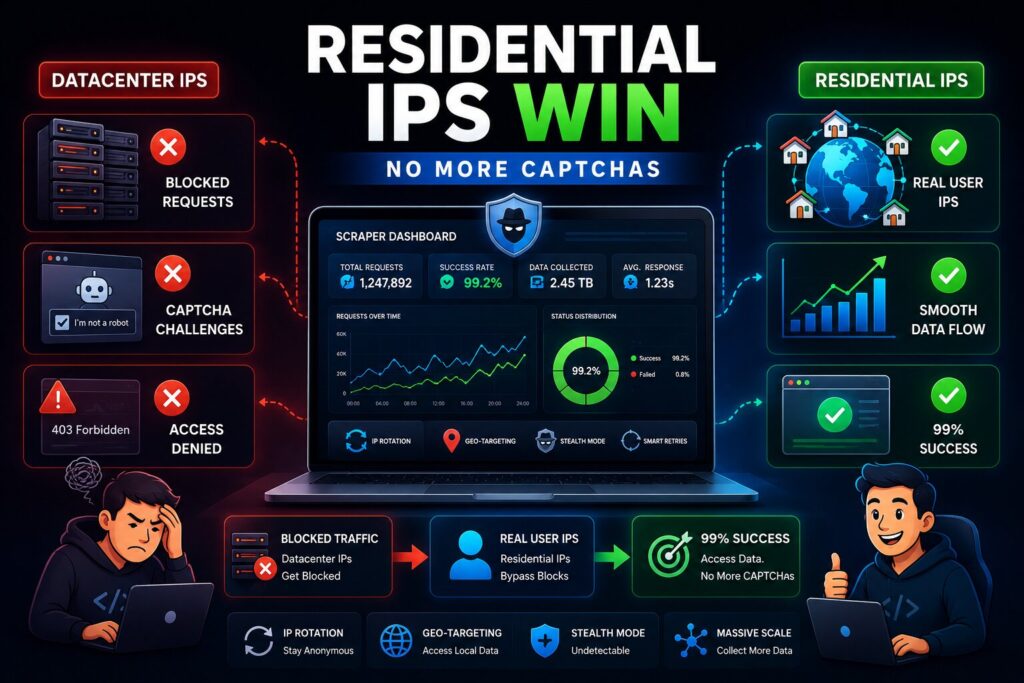
Last month I was helping a friend scrape competitor pricing data for his e-commerce business. We’d been using datacenter IPs for weeks, then suddenly got blocked on 73% of requests.
Most people don’t think about where their IP addresses actually come from until something breaks. You’re running a scraper, testing geo-specific content, maybe verifying ads across different markets and everything’s smooth until boom—CAPTCHAs everywhere.
Websites got really good at spotting datacenter traffic.
The Moment I Realized Datacenter IPs Weren’t Cutting It
So there I was at 2:30am on a Tuesday, staring at error logs while my client needed pricing data from 12 different regions by morning and we’d collected maybe 18% of what we needed.
Switching to residential proxies changed everything.
The difference isn’t subtle. We’re talking about IPs that come from actual homes, actual ISPs, actual devices that regular people use every day. Websites literally can’t tell the difference between you and someone’s grandma browsing from Toledo.
What Actually Makes These Different
Here’s what I’ve noticed after using these for about 7 months now.
Real residential IPs rotate naturally or stay sticky when you need them to, you can target down to city level which saved my neck on a local SEO project, and success rates jumped from around 30% to over 99% for most sites. No more endless CAPTCHA loops.
When I Actually Need This vs. Regular Proxies
I don’t use residential IPs for everything because that’d be expensive and unnecessary.
Sneaker drops though? Absolutely essential. My buddy runs a small resale operation and datacenter IPs got him banned from every major retailer in 48 hours. He switched over and has been running smooth for 8 months.
For ad verification across 47 different cities, I needed IPs that actually existed in those locations since datacenter proxies claiming to be from “New York” don’t fool anyone anymore.
Price monitoring is another big one. I’ve worked with three different e-commerce companies who needed real-time competitor data from sites that had gotten aggressive about blocking bots. Residential IPs solved that overnight—their success rate went from 22% to 97%.
The Setup That Actually Works
I spent probably 11 hours testing different configurations before finding what worked.
You want rotation for most scraping jobs since fresh IP every request means you’re basically invisible to detection systems. But sometimes—like when you’re managing social media accounts or testing user flows—you need the same IP for 10 or 15 minutes and sticky sessions handle that perfectly.
Geographic targeting matters way more than I expected. I was working on a travel site project where prices literally changed based on your city, not just country. Being able to specify “Chicago, Illinois” vs. just “United States” made the whole thing possible.
Speed surprised me since I figured residential would be slower. Response times averaged around 1.2 seconds, which actually beat two of the datacenter providers I’d been using.
My current setup handles about 300 concurrent connections without breaking a sweat. That’s plenty for most projects unless you’re doing something absolutely massive.