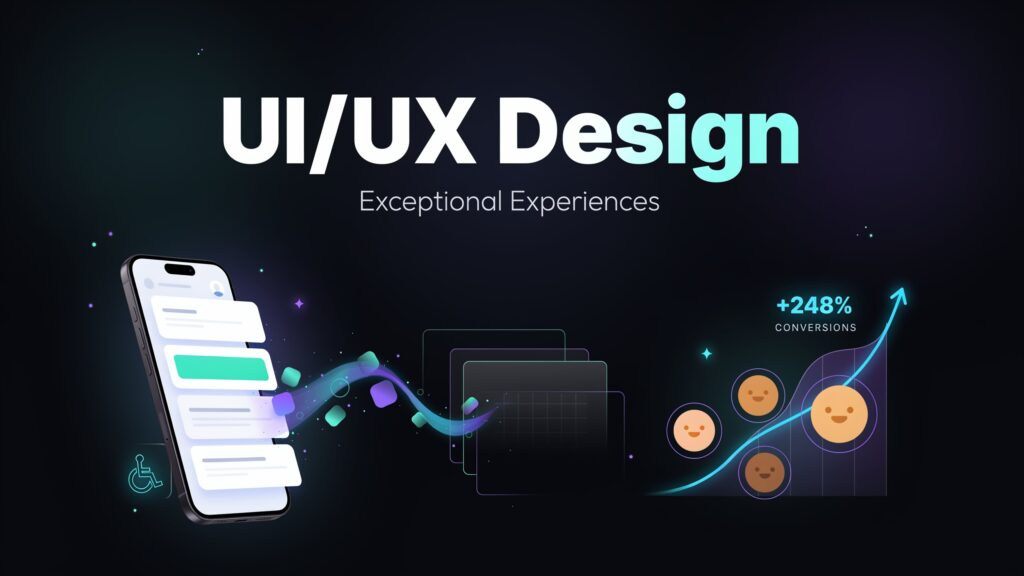
I’ve collaborated with design teams and reviewed hundreds of interfaces over the years — from early-stage startup MVPs to enterprise platforms used by millions of people daily. The pattern is unmistakable: products with superior UI/UX don’t just look better — they convert better, retain users longer, reduce support costs, and become natural competitive advantages.
In 2026, user expectations are higher than ever. Attention spans are short, alternatives are abundant, and users have grown accustomed to delightful, intuitive experiences powered by AI and modern design systems. Mediocre design is no longer acceptable — it’s a silent business killer.
This comprehensive guide explores what world-class UI/UX design looks like in 2026, the principles and processes that deliver results, key trends, and how to build or work with design capabilities that create lasting value.
Why UI/UX Design Is a Strategic Advantage in 2026
Great design directly impacts the bottom line:
- Higher conversion rates (often 20–100%+ improvements)
- Better user retention and engagement
- Reduced customer support tickets
- Stronger brand perception and trust
- Faster adoption of new features
- Competitive differentiation in crowded markets
Poor design, on the other hand, leads to frustration, abandonment, and negative reviews that spread quickly on social platforms and app stores.
In 2026, design is no longer just “making things pretty.” It’s a core business function that blends psychology, technology, accessibility, and measurable outcomes.
Key Trends Shaping UI/UX
1. AI-Powered Personalization and Adaptive Interfaces
Interfaces that adapt to user behavior, context, and preferences in real time.
2. Advanced Micro-Interactions and Motion Design
Subtle animations and feedback that feel natural and delightful without being distracting.
3. Inclusive and Accessible Design by Default
WCAG 2.2+ compliance, support for diverse abilities, cultural considerations, and global audiences.
4. Design Systems at Scale
Mature, component-based systems that ensure consistency while allowing flexibility.
5. Immersive Experiences (AR/VR/Mixed Reality)
Where appropriate, especially for training, visualization, and complex workflows.
6. Ethical and Sustainable Design
Reducing cognitive load, dark patterns avoidance, and mindful use of resources.
7. Voice, Gesture, and Multimodal Interfaces
Beyond traditional screens.
The Modern UI/UX Design Process
Phase 1: Research & Discovery (Understand)
- User interviews, surveys, and analytics review
- Competitive analysis
- Journey mapping and empathy mapping
- Accessibility and inclusivity audits
- Business goal alignment
Phase 2: Ideation & Information Architecture
- Wireframing (low-fidelity)
- User flow optimization
- Content strategy and information hierarchy
- Collaboration workshops with stakeholders
Phase 3: Visual Design & Prototyping
- High-fidelity mockups
- Interactive prototypes (Figma, Framer, or Adobe XD)
- Design system implementation
- Micro-interactions and animation
Phase 4: Testing & Validation
- Usability testing (moderated and unmoderated)
- A/B testing and multivariate experiments
- Accessibility testing
- Performance and device testing
Phase 5: Implementation & Iteration
- Handoff to developers with clear specifications
- Post-launch monitoring and iteration
- Continuous improvement based on real usage data
The best teams run this as an iterative, collaborative process rather than a linear waterfall.
Essential Principles for Exceptional UI/UX
- User-Centered, Not Designer-Centered — Always validate assumptions with real users.
- Clarity Over Cleverness — Intuitive interfaces win over flashy ones.
- Consistency with Flexibility — Strong design systems with smart customization.
- Performance as Design — Fast loading and smooth interactions are part of the experience.
- Accessibility as a Baseline — Not an afterthought.
- Emotional Connection — Design that evokes trust, delight, and confidence.
- Measurable Outcomes — Tie every design decision to business or user metrics.
Tools and Technologies in 2026
- Design: Figma (dominant), FigJam, Framer, Webflow
- Prototyping & Animation: Principle, Lottie, Rive
- Hand-off & Collaboration: Figma Dev Mode, Zeplin, Storybook
- Testing: UserTesting, Maze, Hotjar, FullStory
- Design Systems: Zeroheight, Storybook + custom components
- AI Assistance: Tools for generating variations, accessibility checks, and content
Building or Working with a Strong Design Team
For internal teams:
- Hire T-shaped designers (broad skills + deep expertise)
- Invest in ongoing training and design systems
- Foster close collaboration between design, product, and engineering
- Establish clear design critique processes
When working with external design agencies or consultants:
- Choose partners with proven experience in your industry
- Look for collaborative processes, not “throw over the wall” deliverables
- Insist on knowledge transfer and design system ownership
- Start with a discovery phase before full design
Common UI/UX Mistakes to Avoid
- Designing in isolation from users and business goals
- Prioritizing aesthetics over usability and accessibility
- Overloading interfaces with too many features
- Ignoring mobile-first or responsive design
- Skipping proper testing and iteration
- Inconsistent design across platforms
- Treating design as a one-time project instead of an ongoing capability
Real-World Examples
Global SaaS Platform: Redesigned their core workflow with extensive user research and iterative testing. Resulted in 47% increase in task completion rate and significantly higher customer satisfaction scores.
E-commerce Brand: Implemented personalized, adaptive interfaces with subtle AI-driven recommendations. Saw conversion rate improvements of over 35% in key segments.
Enterprise Software Company: Focused on simplifying complex workflows through better information architecture and progressive disclosure. Reduced training time for new users by 60% and support tickets dramatically.
Final Thoughts
UI/UX design in 2026 is both an art and a science. The most successful designs combine deep user empathy, technical understanding, business acumen, and relentless iteration.
The best designers and teams don’t fall in love with their initial ideas — they fall in love with solving real problems in ways that feel effortless and delightful to users.
Whether you’re building a new product, modernizing an existing one, or improving an internal tool, investing in thoughtful UI/UX design consistently delivers outsized returns. It’s one of the highest-leverage areas in product development.
If your current interfaces feel dated, confusing, or underperforming, the solution starts with better research, clearer processes, and a commitment to putting users first while keeping business outcomes in clear view.
Design isn’t decoration. It’s strategy made visible. It’s empathy turned into interfaces. It’s one of the most powerful ways to create competitive advantage in 2026.
Build with intention. Test with humility. Iterate relentlessly.
That’s how exceptional user experiences — and exceptional businesses — are created.