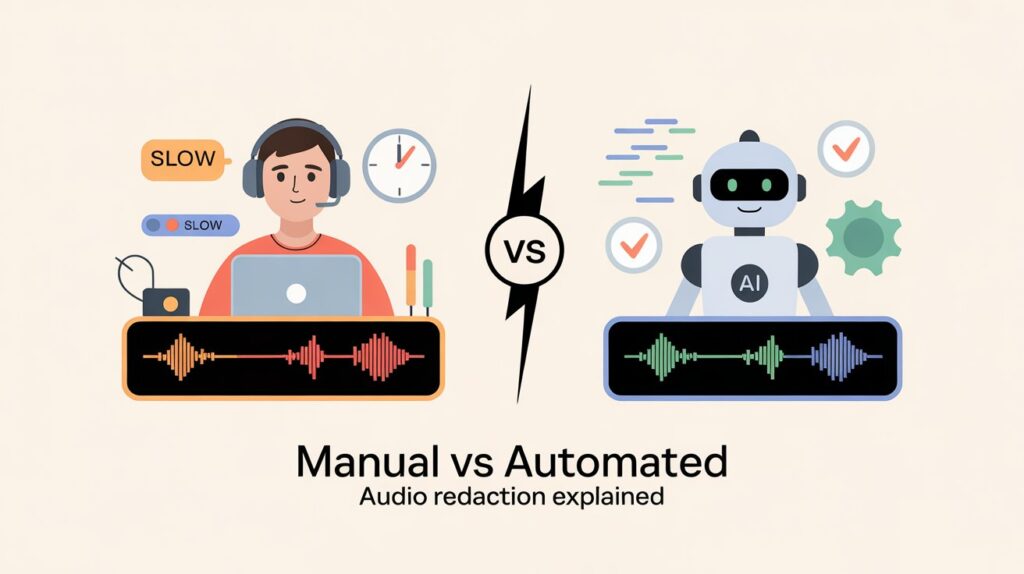
Audio redaction used to be a niche task—something handled case by case, usually under time pressure. Today it’s a frontline operational need. Body-worn cameras, jail calls, interview rooms, dispatch recordings, and public records requests have turned “just bleep it out” into a repeatable process that has to hold up under scrutiny.
The core question most agencies and legal teams wrestle with is simple: should you redact manually, automate it, or combine both? The answer depends less on ideology and more on risk, volume, turnaround expectations, and the kind of audio you’re dealing with.
What Audio Redaction Actually Involves (and Why It’s Harder Than It Sounds)
At a high level, audio redaction means removing or obscuring protected content while preserving everything else. In practice, that “protected content” can include:
- Personally identifiable information (PII) like names, addresses, phone numbers, dates of birth
- Medical details (HIPAA-adjacent issues often show up in calls and interviews)
- Information about juveniles, victims, or witnesses
- Sensitive investigative details
- Credentials or system identifiers (think badge numbers, CAD references, internal IDs)
The tricky part is that audio isn’t clean, structured data. People interrupt each other. They talk over sirens. They whisper, shout, use nicknames, or spell things out. And the context matters: a single word might be harmless in one moment and disclosive in another.
Manual Audio Redaction: High Control, High Cost
Manual redaction is exactly what it sounds like: a human listens, identifies sensitive segments, and edits them out or masks them (bleep, tone, silence, or voice transformation). When done well, it’s precise and defensible.
Where Manual Redaction Shines
Manual workflows are still the gold standard for certain scenarios:
- Complex, low-volume audio.
If you have a small number of highly sensitive recordings—say, a high-profile interview with multiple protected parties—manual effort can be justified because you need judgment, not just detection. - Context-driven decisions.
A human can decide whether “Mike” is just a first name in passing or a clue that identifies a protected witness. That sort of nuance is hard to fully codify. - Court-facing confidence.
When redactions may be challenged, a carefully documented manual process can feel safer—especially if you can show who reviewed what and why.
The Tradeoffs You Can’t Ignore
Manual redaction tends to break down when volume rises. A few common pain points:
- Time: Real-time listening is the baseline, but meticulous redaction often takes multiple passes (identify → redact → review).
- Fatigue and inconsistency: Humans miss things, especially at the end of a long queue or in noisy audio.
- Cost: Skilled reviewers aren’t cheap, and turnover is real.
- Backlogs: Public records timelines don’t care that your team is understaffed.
Manual redaction isn’t “bad.” It’s just inherently linear: more minutes of audio means more human hours.
Automated Audio Redaction: Speed and Scale, with New Kinds of Risk
Automated redaction typically relies on speech-to-text (ASR), entity detection, and rules that identify what should be masked—then applies redaction to the audio segments aligned to that text. Some systems also attempt speaker identification, keyword spotting, or custom vocabularies.
When it works, it changes the math dramatically.
What Automation Does Best
- Throughput.
Automation is built for volume. It’s the difference between a manageable queue and a permanent backlog. - Consistency.
Rules don’t get tired. If the policy is “always redact date of birth,” the system will apply it the same way every time—assuming it detects it. - Fast first-pass triage.
Even when you don’t fully trust “hands-off” redaction, automation can pre-tag likely sensitive areas so reviewers spend their time verifying rather than hunting.
Around the point where agencies start thinking seriously about scale, it’s worth studying what modern approaches look like in practice. This overview of effective audio redaction solutions for police lays out the operational realities—high-volume requests, recurring PII patterns, and why a defensible workflow is about more than just muting words.
Where Automation Can Miss (and Why It Matters)
Automation introduces a different risk profile: not “Did the reviewer get tired?” but “Did the model hear it correctly?”
Common failure modes include:
- Transcription errors: Sirens, accents, radio distortion, and crosstalk can turn “Fifty-two Maple” into gibberish—or worse, into a different real address.
- Context gaps: A system may not know that “the nurse at St. Mary’s” is identifying in a small community.
- Over-redaction: False positives can make audio useless, especially in interviews where names are relevant and permissible.
- Alignment issues: If timestamps drift, you can redact the wrong segment—leaving sensitive content exposed.
Automation is powerful, but it’s not magic. It’s a tool that needs policy, configuration, and quality control.
Manual vs Automated: The Real Comparison Is Workflow, Not Ideology
People often frame this as a binary choice. In reality, the most reliable teams treat it as workflow design: what gets automated, what gets reviewed, and where humans add judgment.
H3: Accuracy: “Perfect” Isn’t the Goal—Defensible Is
No redaction method is immune to error. The practical goal is a process that is:
- repeatable,
- auditable,
- and strong enough to withstand challenge.
Manual redaction can be highly accurate, but only if time is available for second review. Automated redaction can be highly consistent, but only if it’s tuned to your policy and validated against real audio conditions.
H3: Speed: Turnaround Time Is a Compliance Issue
Public records and discovery obligations come with deadlines. Delays create operational and reputational risk. Automation’s biggest advantage is compressing timelines—especially for long recordings with recurring PII (addresses, phone numbers, DOBs).
H3: Cost: Look at Total Process Cost, Not Just Tooling
Manual redaction costs scale with minutes of audio. Automated workflows shift cost toward setup, policy configuration, and review. The hidden cost in either approach is rework—when something slips through or when over-redaction forces you to redo a release.
A Practical Hybrid Model (Used by Teams Who Can’t Afford Mistakes)
Most mature programs land on a hybrid approach: automate the repeatable, review the sensitive, and document everything.
Here’s a simple model that works across many environments:
- Automated first pass: Transcribe, detect likely PII, and apply draft redactions.
- Human verification: Review flagged segments, spot-check unflagged portions, and make context calls.
- Second review for high-risk releases: Apply a second set of eyes when the request is high-profile, involves juveniles, or contains medical/victim details.
- Audit trail: Keep notes on what categories were redacted and under what policy.
That’s one bullet list—and it’s worth keeping it that straightforward. The point is to reserve human attention for decisions that require judgment, not for scrubbing hours of routine identifiers.
Choosing the Right Approach: Questions to Ask Before You Commit
If you’re deciding between manual and automated redaction (or designing a hybrid), ask yourself:
What’s our volume and variability? Ten hours a month is different from ten hours a day.
How noisy is our audio? Dispatch and roadside bodycam audio behave very differently.
What’s our acceptable turnaround time? If you’re routinely against the clock, linear manual effort won’t scale.
How do we prove we did it right? A defensible process needs logging, review steps, and clear policy.
Who owns the policy? Redaction is as much governance as it is editing.
The Bottom Line
Manual redaction offers control and nuance, but it’s slow and hard to scale. Automated redaction offers speed and consistency, but it demands strong validation and oversight. For most real-world teams—especially those handling frequent requests and sensitive categories—the best answer isn’t choosing one side. It’s building a workflow where automation handles the repetitive work and humans handle the judgment calls, with enough quality control to stand up to public, legal, and operational scrutiny.