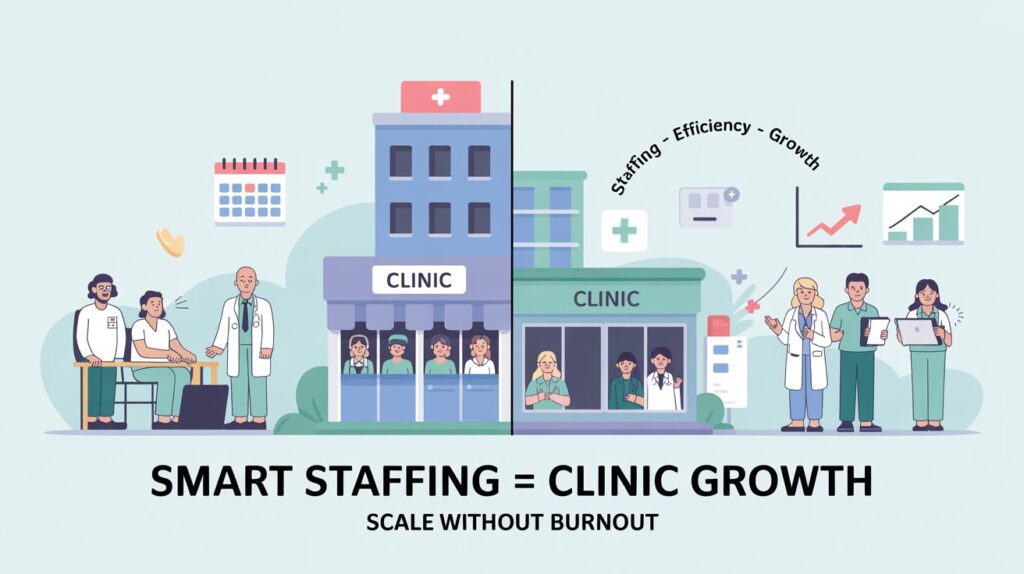
Running a clinic is a balancing act. You are managing patient care, administrative demands, regulatory requirements, and the day-to-day chaos that comes with any healthcare environment. But underneath all of it, one factor shapes everything else: who you hire and when.
Staffing Is A Growth Strategy, Not Just A Necessity
Most clinic owners think about staffing reactively. Someone quits, so you post a job. Patient volume spikes, so you scramble. But when you start thinking about staffing as a proactive strategy, everything shifts. Your team is not just filling roles. They are building the foundation your growth sits on.
When hiring for a doctor’s office, the instinct is often to prioritize credentials and availability. Those matter, of course. But the clinics that scale successfully tend to hire with a longer view, thinking about where the practice will be in two years, not just who can start Monday.
Know Which Roles Drive Revenue
Not every position carries the same weight in your growth equation. Some roles directly impact patient throughput and billing. Others support the infrastructure that makes everything run smoothly. Knowing the difference helps you prioritize your hiring budget.
Roles that tend to have the most direct impact on growth include:
- Medical assistants who keep your providers moving efficiently through their day
- Billing and coding specialists who protect your revenue cycle
- Front desk staff who shape the first and last impression every patient takes home
- Nurse practitioners or physician assistants who can extend your capacity without requiring you to hire another physician immediately
When one of these positions sits vacant too long, you feel it in your numbers.
Timing Your Hires Matters More Than You Think
There is a common mistake clinic owners make: waiting until they are overwhelmed to hire. By that point, your existing staff is burned out, patient satisfaction is slipping, and you are hiring out of desperation rather than strategy. That rarely ends well.
A smarter approach is to hire slightly ahead of demand. If you can see that your schedule is consistently booked out three or four weeks, that is your signal. Do not wait until it is six weeks. Build the capacity before the pressure becomes a problem.
Building A Culture That Retains People
Scaling is not just about bringing new people in. It is about keeping the people you have. Turnover in healthcare is expensive, and not just financially. Every time someone leaves, you lose institutional knowledge, patient relationships, and team momentum.
You can build retention into your culture without a massive budget. Flexibility where possible, clear communication from leadership, and genuine recognition go a long way. People stay where they feel seen and where the work feels meaningful. In a clinical setting, that meaning is already built in. Your job is not to manufacture it, just to protect it.
Use Data To Guide Your Next Hire
Your clinic is already generating the data you need to make smarter staffing decisions. Look at:
- Patient wait times and where delays are consistently happening
- No-show and cancellation rates and the staff time spent managing them
- Billing lag and claim denial rates that signal a gap in your revenue cycle team
- Provider-to-support ratio compared to industry benchmarks
When you let the numbers guide your staffing decisions, you take the guesswork out of growth.
The Bottom Line
Your clinic grows when your people can do their best work. That means having the right roles filled at the right time, with the right people in them. Strategic staffing is not a luxury for large health systems. It is the engine that moves every practice forward, no matter the size.