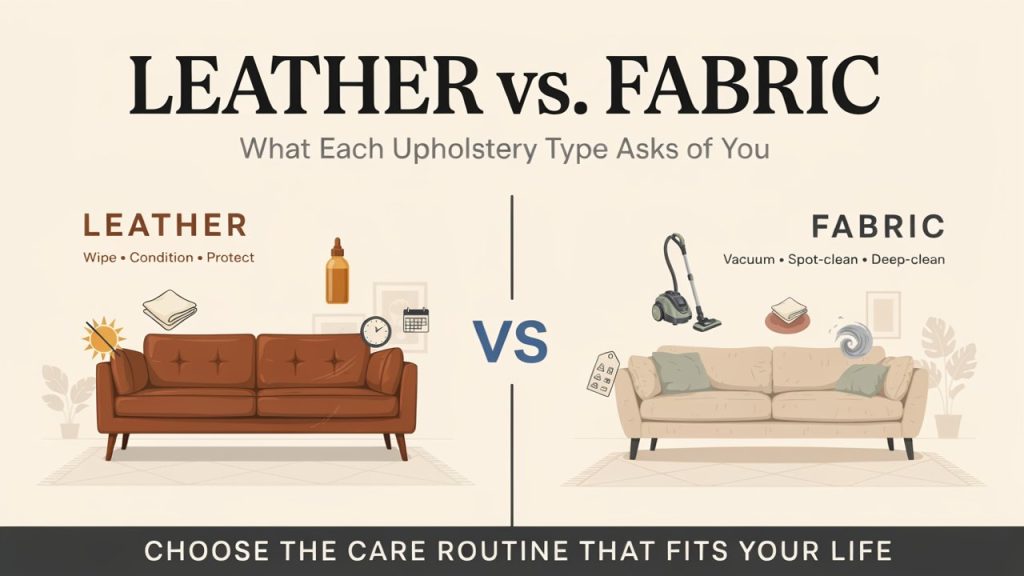
Every Sofa Comes With Homework
Furniture showrooms talk about color, comfort and price. Rarely about maintenance. Which is odd, because the material you pick decides how the next ten years with that sofa will go.
Leather and fabric aren’t just two different looks. They’re two different relationships. One sulks loudly when ignored, the other quietly hoards dirt.
Neither wins across the board, and both eventually need more than a wipe-down at home. Whether it’s a quick refresh or a full upholstery cleaning charlotte nc appointment, the right approach depends entirely on what
the sofa is made of. So let’s put the two in the ring.
Round One: The Spill
Picture a glass of red wine tipping over during a movie.
On Leather
Finished leather buys a few seconds. The liquid beads on the protective coating, and a quick wipe usually saves the day. Usually. Unfinished, or aniline, leather is a different animal – it drinks spills almost as fast as fabric and can darken for good.
On Fabric
Fabric starts absorbing immediately. Synthetic blends and performance fabrics hold out a little longer; cotton and linen give up fast. The rule is blot, don’t rub, and check the cleaning code before reaching for anything wet.
Score: leather, mostly. Unless it’s aniline. Then it’s a tie in misery.
Round Two: Pets
Dogs and cats change the math completely.
Claws are leather’s natural enemy. One excited jump can leave a scratch that no cream fully hides. Some owners call it patina. Others quietly cry.
Fabric handles claws better, especially tight weaves and microfiber, but it hangs onto hair, dander and smell. Loose, nubby weaves can snag, and a cat that discovers one may decide it’s a brand-new scratching post.
Score: depends on whether you’d rather vacuum hair or explain scratches.
Round Three: Sun and Heat
Both materials fade near a bright window. Leather has an extra problem – it dries out. Direct sun and heating vents pull moisture from the hide, and dry leather cracks. Once it cracks, there’s no going back.
Fabric fades more visibly but doesn’t crack. Natural fibers like cotton and silk can still weaken and turn brittle after years of direct light.
Round Four: Aging
Here’s where the personalities really show.
Good leather can look better with time – softer, a touch darker, full of character. People online often say a well-kept top-grain leather sofa can last fifteen years or more. Bonded leather is another story: it’s made from leather scraps glued to a backing, and it has a reputation for peeling
within a few years no matter how lovingly it’s treated.
Fabric ages more evenly but less gracefully. It pills, flattens and slowly dulls as dirt settles into the weave.
Warren Buffett’s line fits furniture surprisingly well: “Price is what you pay. Value is what you get.” A cheap sofa that peels in three years is rarely the bargain it looked like under showroom lights.
What Leather Wants From You
Leather is high-maintenance in a specific, predictable way:
- A wipe with a soft, barely damp cloth every week or two to remove dust and body oil
- Conditioning a couple of times a year so the hide stays supple
- Distance from radiators, fireplaces and the sunniest window in the house
- No all-purpose sprays, baby wipes or anything with alcohol – they strip the finish
- Quick attention to dye transfer from new jeans before it sets
Skip these and leather complains loudly. Cracks, stiffness, shiny worn patches on the armrests.
What Fabric Wants From You
Fabric is quieter. It doesn’t crack. It just slowly collects everything. Its routine looks like this:
- Vacuum weekly with an upholstery tool, seams and crevices included.
- Read the cleaning code tag – W, S, WS or X – before treating any spot.
- Blot spills right away with a white cloth, working from the outside in.
- Rotate cushions so wear spreads evenly.
- Book a deep clean once or twice a year, more often with pets, kids or allergies.
The trap with fabric is that it looks fine for a long time. Then one day it doesn’t, and three years of build-up show up all at once.
Why the Material Changes the Cleaning
Leather and fabric need very different professional treatment. Leather calls for pH-balanced cleaners, gentle hand work and conditioning afterward – soaking it with hot water would be a disaster. Fabric often does well with hot water extraction or a low-moisture method, depending on the fiber.
That’s why a technician should always identify the material before anything else. Treating aniline leather like a microfiber couch is a fast way to ruin both the sofa and somebody’s afternoon.
Le Corbusier famously called a house “a machine for living in.” Machines need servicing. The sofa, being the part of the machine everyone actually sits on, needs it more than most.
So Which One Is Yours?
Ask a few honest questions. Pets with claws? Small kids with juice boxes? A living room flooded with afternoon sun? Do you actually enjoy a maintenance routine, or will conditioning get forgotten until the leather cracks?
Answer those and the choice usually makes itself. Whatever you pick, it comes with homework. Every sofa does.