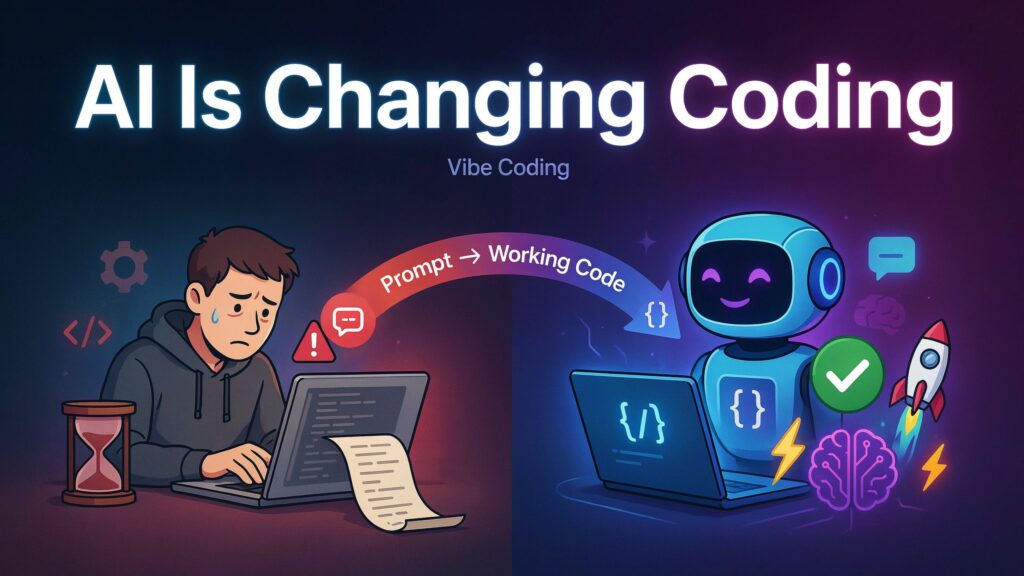
Software development has gone through several genuine inflection points over the past two decades — the shift to cloud infrastructure, the rise of low-code platforms, the integration of AI assistance into the IDE. What’s happening now with AI-native development tools represents another one, and the pace of change in how code actually gets written has accelerated quickly enough that development practices from just a couple of years ago already look noticeably dated.
The category that’s generated the most discussion isn’t simply autocomplete or code suggestion — it’s a more fundamental shift in how the relationship between developer intent and working code gets bridged. AI-native development environments now let a developer describe intent in natural language while the system generates, tests, and iterates on functional code with a level of capability that earlier AI coding assistants didn’t approach, and vibe coding tools 2026 has become the shorthand the industry uses to describe that entire category. The terminology is new enough that it’s still settling, but the underlying capability shift is what’s driving the conversation.
What’s Actually Different This Time
AI-assisted coding has existed for several years, but the earlier generation of tools operated primarily as sophisticated autocomplete — suggesting the next few lines based on context, useful but fundamentally still requiring the developer to architect the solution and write most of the actual logic. The current generation of tools operates at a different level of abstraction, capable of taking a natural-language description of desired functionality and producing substantial, working implementations that a developer then reviews, tests, and refines.
That shift changes the nature of the development work itself. Less time goes into the mechanical translation of a clear mental model into syntactically correct code, and more time goes into the conceptual work of defining what the system should actually do, evaluating whether generated code meets that intent, and catching the cases where the AI’s interpretation diverged from what was actually needed.
Where the Productivity Gains Are Concentrating
The productivity impact of this generation of tools isn’t uniform across all types of development work. Boilerplate-heavy tasks — CRUD operations, standard API integrations, common UI patterns, test scaffolding — have seen the most dramatic acceleration, since these tasks involve well-established patterns that AI models have been trained on extensively and can reproduce reliably.
More novel, architecturally complex work sees smaller but still meaningful gains, since the AI can accelerate specific components even when it can’t reliably architect the entire solution independently. The developers reporting the largest productivity improvements tend to be those who’ve learned to decompose complex problems into the kind of well-specified components that current tools handle well, rather than expecting end-to-end generation of genuinely novel system architecture.
The New Skill of Specification
A consistent theme among developers who’ve adapted successfully to this generation of tools is that the skill of writing precise, complete specifications has become more valuable, not less. Vague or incomplete prompts produce code that technically runs but misses edge cases, security considerations, or performance requirements that weren’t explicitly stated.
This has elevated the importance of a skill that was always valuable but easy to shortcut when writing code manually — thinking through requirements, edge cases, and constraints before generating a solution, because the quality of AI-generated output depends heavily on the quality and completeness of what it’s asked to produce. Developers who write thorough specifications upfront get dramatically better results than those who iterate through vague prompts and hope the tool converges on the right solution eventually.
Code Review and Trust Calibration
The shift toward AI-generated code at scale has created new demands around code review practice. Code that was generated rather than manually written carries different risk patterns — it might be syntactically correct and pass basic tests while containing subtle logical errors, security vulnerabilities, or architectural decisions that don’t fit the broader codebase’s conventions in ways that wouldn’t occur to a human writing the same function from scratch.
Teams that have integrated these tools successfully have generally developed more rigorous review practices specifically calibrated to these failure modes, rather than assuming AI-generated code carries the same risk profile as human-written code and can be reviewed with the same habits developed for manual code review.
Team Composition and Skill Development Implications
The changing nature of development work has implications for how teams are structured and how junior developers build expertise. If a significant portion of mechanical implementation work is increasingly automated, the traditional path of learning architecture and design judgment through years of writing implementation code becomes less straightforward, and teams are still working out how to structure mentorship and skill development in an environment where junior developers have less of the repetitive implementation experience that used to build foundational pattern recognition.
This is an open question across the industry rather than a solved problem, and the organizations navigating it most thoughtfully tend to be deliberately creating opportunities for junior developers to engage with architectural decisions and code review at an earlier career stage than was previously typical, compensating for reduced hands-on implementation volume with more intentional exposure to higher-level decision-making.
Where This Is Heading
The trajectory suggests continued acceleration rather than a plateau. The tools are getting better at handling larger, more architecturally complex tasks, and the gap between what AI-native development environments can handle independently and what still requires direct human implementation continues to narrow. The organizations and developers adapting fastest are the ones treating this as a genuine shift in how software gets built, rather than a productivity tool layered on top of unchanged practices.