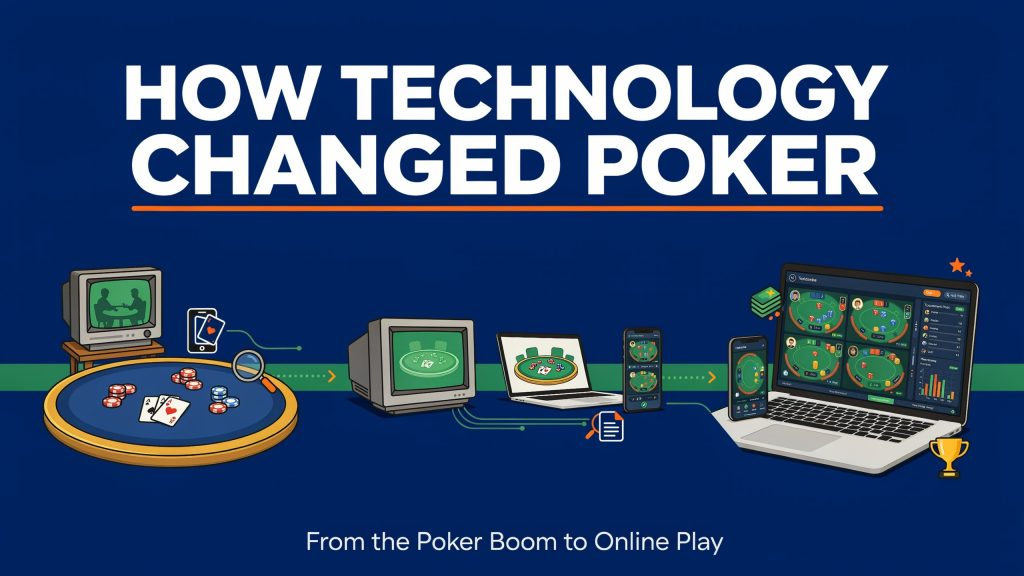
The poker boom changed the game forever in terms of popularity. Technology is what allowed that growth to keep going.
The poker boom took place in the early 2000s through things like televised tournaments and a wave of online poker rooms. We saw new players push poker into the mainstream. What followed was not simply a bigger version of the same game. Poker became faster and much more varied. We saw technology changing almost every part of the experience.
Players can join huge tournaments from a laptop or phone these days. The basic rules of poker are still familiar. The way people access and experience the game is very different from the one that powered the original boom.
Online Poker Built a Much Bigger Industry
One of the biggest changes has been scale.
Traditional poker depends on people gathering around physical tables. Online poker removed that limit and made it possible to connect huge numbers of players at the same time. Technology has facilitated the connecting of players on all continents.
That opened the door to massive multi table poker tournaments. Online events can involve hundreds or even thousands of entries. Players are automatically moved between tables as the field gets smaller, while the software handles blinds, chip counts and seating in the background.
This would be extremely difficult to manage physically on the same scale.
Technology also made different poker formats much easier to find. Texas Hold’em is still the biggest game. Online platforms can run Omaha and several tournament styles at the same time. This variety helped poker grow into a much broader industry. Players are no longer limited to whichever game happens to be running nearby.
The Poker Boom Made Online Play Feel Normal
Online poker existed before the boom. The early 2000s gave it a much larger audience.
Televised poker became increasingly popular. It meant viewers could see hole cards on screen and this made the game far easier to follow. Internet connections were improving at the time. Home computers were becoming more capable.
Those changes worked together.
People watched poker on television and then discovered that they could play online without visiting a card room.
The experience was basic compared with modern platforms. Graphics were simple. Lots of the tables looked flat and there were fewer features. There was a feeling of it being the start of a big trend.
Smartphones Changed When Poker Could Be Played
Mobile technology created another major shift. Ownership of smartphones rocketed from 2009 onward.
Playing the game normally meant sitting at a computer when the Poker Boom was in full swing in the early 2000s, before we had one of the most important bits of technology seen today. Smartphones came along and removed that restriction.
A quick game could suddenly be played on a laptop or with a spare half-hour at home. Tablets made longer sessions possible too. They gave players a larger screen without needing a full desktop setup.
Cash games and quick formats became much easier to fit around everyday life. Mobile interfaces also forced poker software to become cleaner. High-performance apps have been designed to allow people to play poker easily.
A desktop screen can hold several tables and plenty of information. A phone cannot. Developers had to make buttons larger and important information easier to read at a glance.
That design work helped make mobile poker feel like its own format rather than a badly squeezed version of the desktop game.
Multi-Tabling Changed the Pace Completely
Technology also allowed players to do something that would be impossible in a physical poker room. To play several tables at once.
Multi-tabling became a major part of online poker.
A player could have many tables open on one screen and move between hands as action arrived. This hugely increased the number of hands someone could play in an hour (or however long they wish to play for).
Online poker became its own skill set rather than simply being physical poker moved onto a screen.
Software Made Poker Much More Analytical
Poker has always involved math and numbers. It is really built into the way the game is played. It is fair to say technology made the analytical side far more visible.
Players can now review hand histories and use training tools to understand how certain decisions perform over time. We live in an age of stats and analysis. Players can evaluate things like whether deep stack play works for them or short stack is better.
That changed the way serious players learn.
Hands can be studied in detail so that the patterns become easier to spot.
Mistakes can be compared across hundreds or thousands of hands rather than one memorable evening.
The result is a more technical poker culture.
Online Poker Keeps Creating New Variations
One of the most interesting effects of technology is how quickly new poker formats can spread. A physical card room has limited space and every new variation needs enough interested players to fill a table.
Online platforms have far fewer limits.
A new tournament structure or fast-fold format can be offered to thousands of players at once.
Poker today is far more connected and varied than it was during the original boom. Huge multi-table tournaments can run online. Yet the central game is still recognizable.