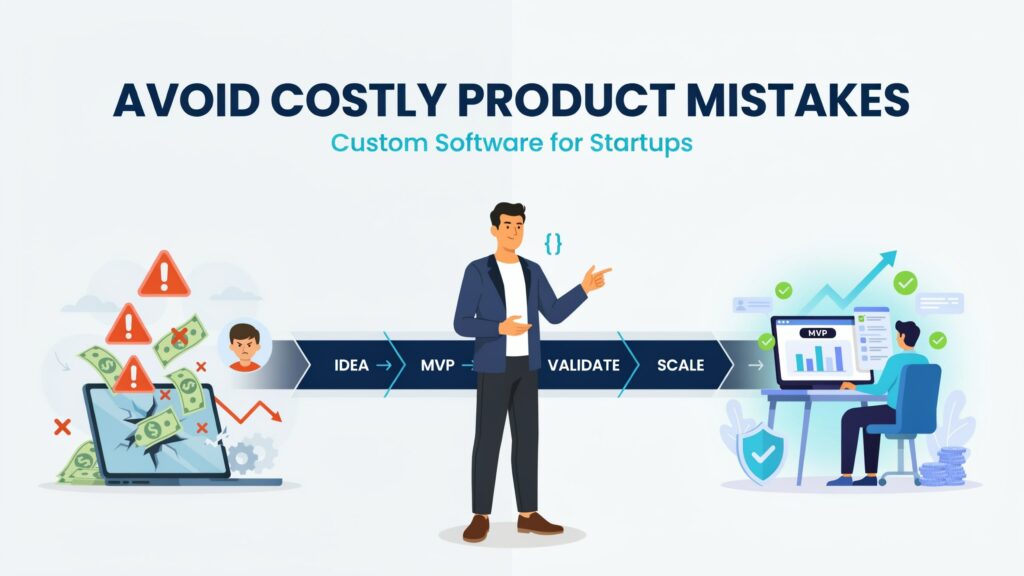
Early stage startups burn capital fastest when they build the wrong product, not the wrong business or team, but the wrong features shipped to the wrong users at the wrong time. Custom software development helps prevent this by letting founders validate ideas, control architecture, and iterate based on real data instead of guesswork.
The Real Cost of Product Mistakes for Early Stage Startups
Off the shelf software often forces startups to compromise on functionality, leading to workarounds instead of directly solving user problems. Custom software developers and custom software development reduce financial and operational risks by addressing the exact market context.
Product mistakes result in these costs:
- Engineering rework: rebuilding features scoped incorrectly
- Opportunity cost: competitors gain ground while fixing issues
- Brand damage: poor initial experiences drive users away
- Investor confidence erosion: missed goals and delays hurt funding prospects

From Idea to Minimum Viable Product. How Custom Software Reduces Risk
Startups can save costs by starting with a minimum viable product. Custom software lets you design that MVP around your exact hypotheses and user journeys instead of bending to the limits of off the shelf tools. The average cost of custom software development varies by project complexity, so scoping the MVP tightly controls budget and timeline. You can estimate your MVP budget before committing resources.
Actions to reduce risk at this stage:
- Story mapping: identify user journeys that test the core value proposition
- Technical spikes: build small proofs of concept for risky technical unknowns before full implementation
- Clickable prototypes: allow early user testing of ideas before production code
- Usability sessions: gather real user feedback early to catch UX flaws before they become costly
Startup Software Development and the Role of a Technical Partner
Early stage startups often lack senior engineering leadership. Architecture, security, and scalability decisions need experience that small founding teams usually don’t have. A specialist startup software development partner bridges this gap.
The software development company process in a startup context moves faster and tolerates more uncertainty than enterprise projects, but it still needs structure to avoid wasted effort. “The first architecture decision a startup makes often determines whether the product can evolve or must be rewritten. Getting that decision right requires a partner who has shipped products at this stage before.”
Key responsibilities of the technical partner:
- Choosing the tech stack based on product needs
- Establishing coding standards and reviews early
- Planning development, staging, and production environments
- Setting quality gates for every release
- Aligning development lifecycle with startup milestones
Aligning Tech Stack and Product Strategy from Day One
The teams had picked technologies they knew, not technologies their products needed. Rebuilding the backend cost months of runway and, as Wired has reported, premature scaling is one of the top reasons startups fail after initial traction.
Tech stack alignment matches frameworks, databases, cloud services, and infrastructure to product growth, regulations, and data strategy. Choosing scalable technologies early cuts future costs. Custom software integrates with existing tools via APIs and custom components without data loss.
Validation and Iteration. Using Custom Software to Avoid Rebuilds
The most common and costly mistake is rushing from idea to code without validating whether target users want the product. Custom software enables the instrumentation needed to observe user behavior from the first build.
SoftDoes follows this validation checklist with clients:
- Clickable prototypes before coding: test core user journeys with five to ten target users before production code
- Usability tests during development: run sessions at sprint ends to catch friction early
- Feature flags: deploy new features to a small user percentage; measure adoption and feedback before full rollout
- A/B tests on key flows: compare onboarding, pricing, or navigation variants with real data
- Closed beta programs: invite controlled early adopters; use feedback to prioritize next versions
- Experiment driven roadmaps: link product initiatives to hypotheses, metrics, and decision points
Building Quality and Compliance in from the Start
Many startups treat testing and compliance as post-launch tasks, but in regulated sectors like healthcare and payments, this leads to failed audits, security issues, and costly rebuilds.
Key quality strategy components for early startups:
- Unit and integration tests: developed alongside features
- Automated regression suites: custom tools catch bugs instantly
- Secure coding standards: OWASP guidelines from sprint one
- Code reviews: every pull request checked by another engineer
- Environment parity: staging mirrors production for consistent bug detection
- Compliance documentation: updated continuously, not last-minute
This approach integrates quality and compliance into the software development lifecycle, reducing costly mistakes and ensuring readiness for audits.
Communication, Transparency, and Post Launch Support
Strong technical skills cannot compensate for weak communication, unclear scope, or abandonment after launch. The key difference between a good engineering team and a good partner is disciplined communication.
Founders should insist on practical protocols:
- Weekly check-ins: thirty-minute calls covering progress, blockers, and decisions
- Shared backlog: both sides access the same board; no hidden trackers
- Single contact point: one person owns communication on each side
- Clear estimates: tasks estimated before sprints, with ranges
- Visible progress tracking: daily updated burndown charts or flow diagrams
- Structured change control: documented process for scope changes
- Open tradeoff discussions: timeline vs quality conversations happen in writing, not behind closed doors
As TechCrunch has covered, many startups that achieve cost efficiency in their first two years do so by owning their technical stack and iterating in house or with a dedicated partner, rather than assembling a patchwork of SaaS subscriptions.
Turning Product Goals into a Living Development Plan
A product strategy defines vision, goals, and initiatives, improving decision making and resource allocation. It helps prioritize initiatives based on impact and includes market vision and measurable product goals. Startups benefit from tailored strategies for unique market needs.
Founders should create a time-bound development plan linking initiatives to releases and engineering tasks.
Plan steps:
- Discovery and requirements: research and hypothesis setting
- Architecture and UX design: design docs and prototype validation
- Implementation sprints: feature delivery with tests
- Stabilization and testing: bug fixes and compliance
- Launch: coordinated release and support
- Post launch optimization: refine using data and feedback
A good custom software development company adjusts this plan continuously to avoid costly rework.
Startups avoid mistakes by choosing partners who enable continuous learning. Review your development approach and consult a team like SoftDoes for startups in fintech, healthtech, and B2B SaaS.