What is sentiment analysis?
Sentiment analysis is defined as the analysis of digital texts to find out whether the sentiment or emotions expressed in the text are positive, negative, or neutral.
Currently, companies are dealing with huge volumes of text data, including:
- Emails
- Customer support chat sessions
- Social media comments
- Reviews of products or services
- Survey results
Sentiment analysis tools read all of these texts or emails and analyze them automatically to find out the sentiment of the author about a specific topic, product, or brand.
What are the uses of sentiment analysis?
Sentiment analysis, also known as opinion mining, is one of the most important tools of business intelligence that helps companies enhance customer relationships, brand reputation, and more.
Here are some of the most important benefits of sentiment analysis:
1. Provide Objective Insights
Organizations can avoid the personal bias inherent in human analysts by adopting AI-based sentiment analysis tools. This way, businesses obtain objective insights into their customers’ views.
For example, take the sentence:
“I’m amazed by the speed of the processor, but disappointed that it heats up quickly.”
A marketer may only be aware of the positive remark on the speed of the processor. But, the sentiment analysis tool would be able to correctly identify the sentiment expressed by the customer. This would help businesses gain a comprehensive view of their customers’ perceptions. This would be more objective and not based on personal perceptions and biases.
2. Build Better Products and Services
A sentiment analysis tool would enable businesses to create better products and services based on actual customer perceptions.
AI technologies would be able to identify the actual objects and topics in the world, referred to as ‘entities,’ to which customers may express certain sentiments.
In the example sentence, the sentiment analysis tool would be able to identify the ‘entities’ and the ‘sentiments’ expressed by the customer. This would be:
- Processor – Entity
- Heats up Quickly – Sentiment
This would enable businesses to improve the heat management capability of the processor. This would help businesses create better products and services for their customers.
3. Analyze Data at Scale
Businesses today generate massive amounts of unstructured data from various sources, such as:
- Emails
- Chatbots
- Surveys
- Customer Relationship Management (CRM) Systems
- Product Reviews
Cloud-based sentiment analysis tools would enable businesses to process and analyze large amounts of data. This would help businesses identify the patterns and trends in the data. This would be a more efficient and faster approach to data analysis, rather than manually reading and analyzing large amounts of data.
4. Real-Time Insights
In the fast-changing digital environment, businesses need to be aware and take timely action on the insights they obtain.
Sentiment analysis software allows marketers and customer experience teams to track brand sentiment in real-time.
Sentiment analysis software can alert marketers and customer experience teams to sudden spikes in negative sentiment related to specific keywords. This allows brands to act quickly in response to:
- Customer complaints
- Product problems
- Public relations crises
This helps brands protect their reputation and maintain customer trust.
Business applications for sentiment analysis
Sentiment analysis is extremely useful in interpreting the qualitative data that businesses collect through different customer touchpoints.
Some of the most common applications of sentiment analysis software have been listed below:
Voice of the Customer (VoC) Programs
It is extremely important for businesses to understand how their customers feel about the brand in order to improve the customer experience.
Businesses often collect customer data through different channels. This data is considered the Voice of the Customer (VoC).
One way that sentiment analysis software is used in the VoC program is through the Net Promoter Score (NPS) metric. In the NPS metric, the following question is asked to the customer:
“How likely are you to recommend us to a friend?”
Customers reply on a scale from 1 to 10.
Customers who have replied with a score of 9 or 10 are considered promoters because they will most likely recommend the brand to a friend.
A high NPS score is considered a sign of customer loyalty and word-of-mouth marketing.
However, the NPS score does not reveal the reasons behind the customer’s response. In the VoC program, the customer may have replied with a high or low score. Sentiment analysis software helps in interpreting the reasons behind the customer’s response. Sentiment analysis software allows businesses to efficiently process thousands of customer responses.
It also helps businesses identify customers who have reported very negative experiences, and issues can be addressed accordingly.
Customer Service Experience
A good customer service experience may be the reason for customer loyalty to a certain brand.
Sentiment analysis may help customer service operations run much more efficiently.
Machine learning algorithms process customer interactions and categorize them based on:
- Sentiment
- Topic
- Urgency
For example, in an online community where customers report technical issues, sentiment analysis may identify customers who have expressed very negative sentiments.
These customers may be directed to the customer service team, and the issues may be addressed accordingly.
As a consequence:
- Response time improves
- Customer service teams work more efficiently
- Customer satisfaction increases
Brand Sentiment Analysis
How customers perceive a brand can strongly influence whether they decide to purchase its products.
Companies conduct sentiment analysis on conversations across multiple platforms to understand the public image of their brands.
They track discussions about:
- Brand names
- Products
- Competitors
This helps them understand:
- How the brand is perceived
- What customers think about products
- How the brand compares with competitors
- Which topics create positive or negative sentiment
- How PR campaigns influence reputation
For example, a negative viral video or controversial news story can significantly affect brand sentiment. Monitoring conversations allows companies to respond strategically and protect their reputation.
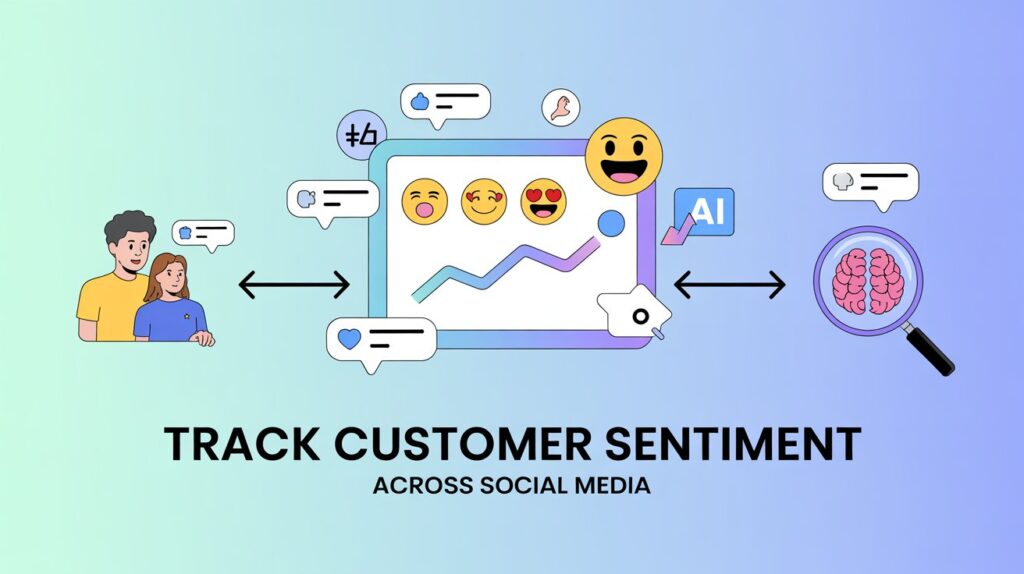
Social Media Sentiment Analysis
Social media platforms strongly influence public opinion.
Positive posts and recommendations can attract new customers, while negative posts can damage a company’s reputation quickly.
Research suggests that even a single negative social media review can influence many potential customers.
Sentiment analysis tools monitor platforms such as:
- YouTube
When combined with a social listening tool, businesses can track mentions, hashtags, and trending conversations across these platforms in real time.
This real-time monitoring allows brands to manage crises effectively and maintain strong relationships with their customers.
Market Research and Competitive Analysis
Sentiment analysis can also help businesses identify emerging trends and evaluate competitors.
Companies analyze feedback about competitors’ products to understand what customers like or dislike.
For example:
If competitors receive frequent complaints about poor battery life, another company with longer battery life can highlight that advantage in its marketing campaigns.
Sentiment analysis can also be applied to:
- Industry reports
- Business news
- Market discussions
For example, sentiment analysis in real estate discussions might reveal that a specific location is gaining positive attention. Investors and companies can use this information to make early strategic decisions.
Conclusion
Tracking consumer sentiment across social platforms has become a crucial capability for modern brands. With millions of online conversations happening every day, businesses must understand how customers feel about their products, services, and brand image.
Sentiment analysis allows companies to transform large volumes of unstructured data into meaningful insights. From improving customer service and product development to managing brand reputation and optimizing marketing campaigns, the technology supports data-driven decision-making.
As digital communication continues to grow, organizations that effectively monitor and analyze consumer sentiment will gain a significant competitive advantage. By listening closely to customer voices in real time, brands can build stronger relationships and deliver experiences that truly resonate with their audience.