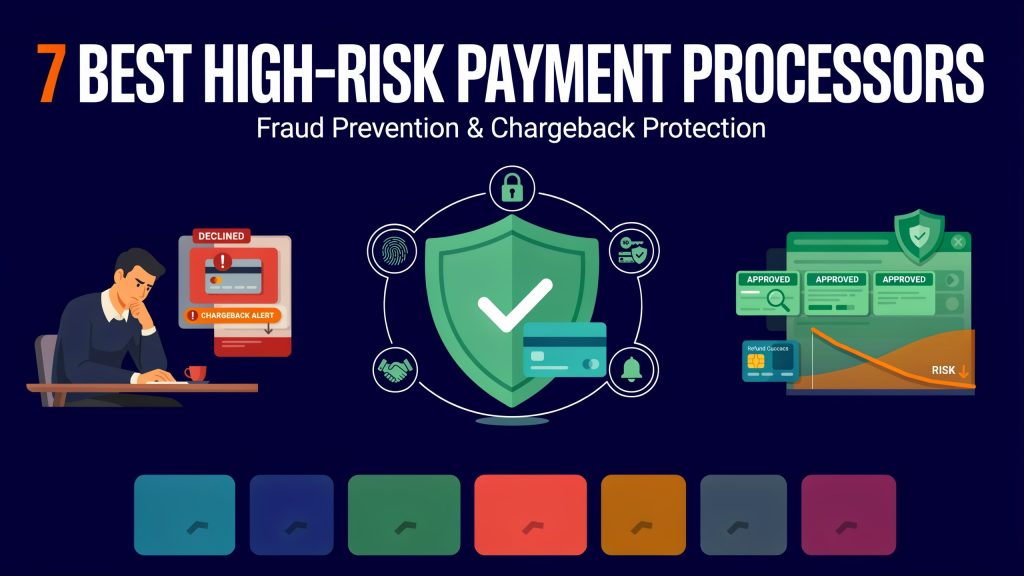
A chargeback starts when a cardholder asks their bank to reverse a card payment. The bank pulls the money back from the merchant while it looks at the case. Fraud is a payment made on a card by someone other than its owner, and it usually turns into a chargeback once the real cardholder sees the charge. A high-risk merchant is a business in a category that banks watch more closely, such as subscriptions or supplements. It deals with both problems through one set of tools, while its bank counts every dispute.
Those tools come into play before approval, on the day a dispute opens, and in the weeks after a chargeback posts.
How a Chargeback and Fraud Stack Works
Before Approval: Screening and 3D Secure
The first layer checks a payment before the card is charged. Address checks compare the billing address with the bank’s records, and a card code check confirms the digits printed on the card. Velocity rules flag many tries from one card or device. Risk scoring turns those signals into one score that approves the payment, sends it for review, or blocks it. On card-not-present sales, meaning online and phone orders, many processors add 3D Secure. In that step, the card’s bank confirms the shopper through a code or a banking app, which can lower the merchant’s liability for some fraud disputes.
When a Dispute Opens: Alerts
Alerts arrive between a cardholder’s complaint and a formal chargeback. Networks such as Ethoca and Verifi send the dispute to the merchant first, and a merchant who refunds in time closes the case before a chargeback is filed. Visa’s Rapid Dispute Resolution refunds on its own, using rules the merchant sets ahead of time. Alerts are usually billed one at a time, and each dispute settled this way stays out of the chargeback count the bank is watching.
After the Chargeback: Representment
Once a chargeback posts, the merchant can answer it through representment. That is the formal reply in which the merchant sends proof, such as delivery records or accepted terms, through its processor to the card network. Each network sets its own deadline. A processor’s part can be anything from a dashboard for uploading files to a team that writes the reply. A won case returns the money, but the chargeback still counts toward the merchant’s dispute ratio.
1. Durango Merchant Services
Durango Merchant Services, founded in 1997, screens with 3D Secure 2.0, address and card code checks, tokenization and real-time monitoring, and its machine-learning tools score each transaction as it happens.
When a dispute opens, Durango’s automated chargeback alerts reach the merchant in real time. Its chargeback analytics and reports then show where the disputes are coming from.
After a chargeback, Durango builds a custom chargeback plan with the merchant. It also offers free prevention and fraud reduction training. The training is aimed at the staff who take orders and approve refunds, a part of the problem that software does not reach.
Durango sells accounts that belong to Fifth Third Bank, so approval and the final terms rest with the bank.
2. Easy Pay Direct
Easy Pay Direct places each merchant on a dedicated merchant account with one of its bank partners and runs payments through its own gateway. Before approval, that gateway applies fraud scoring and rule-based filters, and it keeps saved cards in a tokenized vault.
When a dispute opens, the merchant gets early-warning alerts. Every account comes with these alerts and the chargeback tools, so a small account starts with the same set as a large one.
After a chargeback, Easy Pay Direct handles the reply for the merchant, along with decline recovery and the rest of the chargeback work.
A merchant finds out which of its more than 30 partner banks will carry the account only once underwriting has made the match.
3. PaymentCloud
PaymentCloud places high-risk businesses with a range of partner banks and adds fraud and dispute help from its own team. For screening, it offers fraud filters the merchant can set, 3D Secure, machine learning, and two-step login checks.
Real-time fraud detection sends alerts about odd activity while the account runs.
On the response side, PaymentCloud relies on people. Its team watches the account and helps the merchant fight chargebacks that look unfair.
PaymentCloud won’t consider a business whose chargeback ratio is 3% or higher. A merchant already above that level has to bring it down first.
4. PayKings
PayKings works through a network of acquiring banks and includes chargeback alerts on every pricing tier, from the entry plan up. Its screening covers 3D Secure, address and card code checks, velocity checks, and machine-learning risk scores.
After a chargeback, PayKings offers help with representment and with reason codes, which are the codes the card’s bank attaches to each dispute. It also tracks the merchant’s chargeback ratio.
That help stops short of taking the reply over, the way Easy Pay Direct does, so a PayKings merchant should expect to write part of each response.
5. Finix
Finix is strongest before approval, where it guards against card testing as well as ordinary fraud. Its rules include velocity checks and address and card code checks, plus BIN attack rules that catch card numbers from one bank’s range being tried in bulk. Its fraud API scores each transaction with machine learning and those rules, then approves or blocks it. Disputes are answered in the Finix Dashboard or through the API, within 7 to 21 days depending on the card network.
Finix doesn’t say whether it works with Ethoca, Verifi, or Rapid Dispute Resolution, so ask about the middle stage before applying.
6. SensaPay
SensaPay does its own underwriting and keeps its dispute tools on the same platform as its gateway. Fraud filters and 3D Secure screen payments first. Chargeback alerts arrive when a dispute is filed. After a chargeback, SensaPay gathers the evidence on its own and runs representment, and it says it goes after the chargebacks it sees as illegitimate. Its dispute analytics then report on the results.
SensaPay sets rates account by account after that review, so the cost is known only once a quote comes back.
7. Bankful
Bankful sells its dispute tools one alert at a time, and the prices are public: $38 per Ethoca alert, $20 per Verifi alert, and $17 per Rapid Dispute Resolution case, plus a CDRN option with 48 hours of notice. Screening runs through 3D Secure 2 and its Fraud Shield, and its Rapid Dispute Resolution option includes an auto-refund setting. Fraud and chargeback management is open to every Bankful merchant.
Those prices cover the software and the alerts. Card rates come from the processing bank’s merchant agreement, and Bankful acts as processor of record only in some setups.
Questions That Separate Built-In Tools From Add-Ons
The same tool name can mean different things from one provider to the next, so the useful questions are about who supplies each piece and how it is billed. Alerts can come from a named network or from the provider’s own monitoring. They can be priced per alert, as Bankful’s are, or included with the account, as they are at PayKings and Easy Pay Direct. The reply to a chargeback splits the same way. PaymentCloud’s team helps build the case, SensaPay collects evidence on its own, and Finix pairs its dispute tools with live chargeback expert support. It also helps to ask whether 3D Secure runs inside the provider’s gateway or needs a separate vendor, which adds a contract and an integration. Going through the three stages in order, and noting for each one whether the tool comes with the account, costs extra per use, or needs an outside vendor, gives a fairer comparison than a list of feature names.