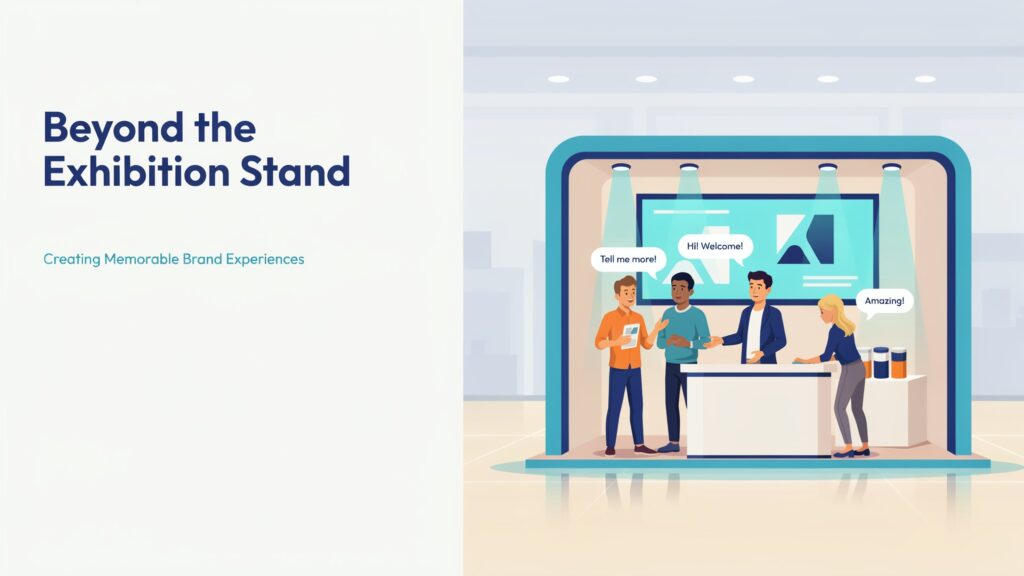
An exhibition stand is often treated as a practical necessity: somewhere to display products, hold meetings, store brochures, and put up a logo. But for visitors, it is rarely experienced that way. It is a physical introduction to your brand—one they can walk through, touch, question, photograph, and remember.
That distinction matters. At a busy trade show, attendees are processing hundreds of competing signals at once. They are deciding where to stop, what deserves their time, and which conversations feel worthwhile. A standard shell-scheme space may meet basic functional requirements, but it can struggle to communicate why a business is different. A thoughtfully designed stand, by contrast, gives people an immediate sense of what the brand values and how it operates.
The most effective exhibition environments do not simply look impressive from the aisle. They make the visitor experience easier, clearer, and more engaging. They create a setting where a company’s story can be understood without relying on a lengthy sales pitch.
A stand can shape perception before a conversation begins
People make rapid judgements in physical spaces. A cluttered stand can suggest a cluttered offer. A closed-off layout may feel intimidating, even if the team inside is welcoming. Conversely, a calm, well-organised environment can signal confidence and professionalism before anyone says hello.
This is not just about choosing attractive colours or adding large graphics. Spatial decisions influence behaviour. Wide entrances invite exploration. Clear sightlines help visitors identify what is being demonstrated. Seating areas positioned away from the busiest traffic flow make conversations feel more focused. Even lighting can guide attention towards a key product, prototype, or message.
A bespoke approach allows these decisions to start with the visitor rather than a pre-set structure. Instead of asking, “How do we fit our materials into this footprint?”, the more useful question is, “What should someone understand, feel, or do after spending five minutes here?”
That is why organisations increasingly view bespoke exhibition stand design as part of their wider brand experience, rather than a standalone event expense. The physical setting can reinforce the same principles communicated through a company website, product experience, customer service, and marketing campaigns.
Designing for the visitor journey
A good stand has a natural rhythm. Visitors should be able to approach it without uncertainty, quickly grasp its relevance, and choose how deeply they want to engage. Not everyone will be ready for a detailed product demonstration; some may only have time for a quick introduction. The space should accommodate both.
Start with the first ten seconds
From a few metres away, a visitor needs to understand the basics: who you are, what you offer, and why it may matter to them. This does not require filling every surface with copy. In fact, too much information often has the opposite effect.
A strong headline, a visible product, or a striking but relevant visual can do more than a wall of technical claims. The aim is to create enough clarity and curiosity to earn the next few seconds of attention.
Once someone enters the space, the experience can become more detailed. Demonstration zones, digital displays, samples, and knowledgeable staff should all support a logical progression rather than compete for attention.
Turning passive browsing into meaningful participation
Trade show visitors remember what they do more clearly than what they merely observe. That does not mean every stand needs a virtual reality headset, a competition, or an elaborate interactive installation. Technology should solve a real communication challenge, not become a distraction.
For a manufacturing business, that might mean displaying a working component alongside a simple explanation of its performance benefits. For a software company, it could involve short, tailored demos based on visitors’ roles or sectors. A professional services firm may benefit more from a comfortable consultation area and visual case studies than from a screen-heavy display.
The principle is simple: give people a reason to take part. When visitors can test, compare, configure, or discuss something relevant to their own needs, the stand becomes an active part of their decision-making process.
Making complex offerings easier to understand
Many businesses exhibit products or services that are difficult to explain quickly. Technical specifications, long procurement cycles, and intangible outcomes can all create barriers. A bespoke stand can help make complexity more approachable by structuring information in layers.
The first layer should be easy to absorb: a clear proposition, a recognisable challenge, or a compelling outcome. The second can provide evidence through demonstrations, diagrams, customer stories, or data. The third is for serious prospects who want detailed discussions with specialists.
This layered approach respects the fact that visitors arrive with different levels of knowledge. It also prevents staff from having to deliver the same lengthy explanation to everyone who walks past. The environment does some of the early communication work, allowing conversations to become more relevant and human.
Measuring experience, not just footfall
A crowded stand can be encouraging, but visitor volume alone is a weak measure of success. If the space draws attention without creating useful conversations, it may be generating activity rather than value.
Better evaluation looks at the quality of engagement. After an event, teams should review:
- Which areas attracted the most sustained attention
- Whether visitors understood the main message without prompting
- What questions came up repeatedly
- How many conversations led to follow-up meetings or qualified opportunities
These insights are valuable beyond the exhibition itself. They can reveal how clearly the wider brand proposition is landing with the market.
Avoiding design for design’s sake
Bespoke does not have to mean extravagant. The most memorable stands are often those where every element has a purpose. Materials, graphics, furniture, lighting, and technology should work together to support a coherent experience.
Sustainability is increasingly part of that equation too. Modular components, reusable structures, durable finishes, and designs that can adapt across multiple events can reduce waste while maintaining a distinctive presence. Visitors are paying closer attention to whether a brand’s stated values are reflected in its physical choices.
Ultimately, an exhibition stand is a temporary space with a lasting role. It can make a complex business feel understandable, turn a passing glance into a conversation, and give visitors something more tangible than a brochure to remember. When the experience is designed around their needs, the brand has a far better chance of staying with them after the event doors close.