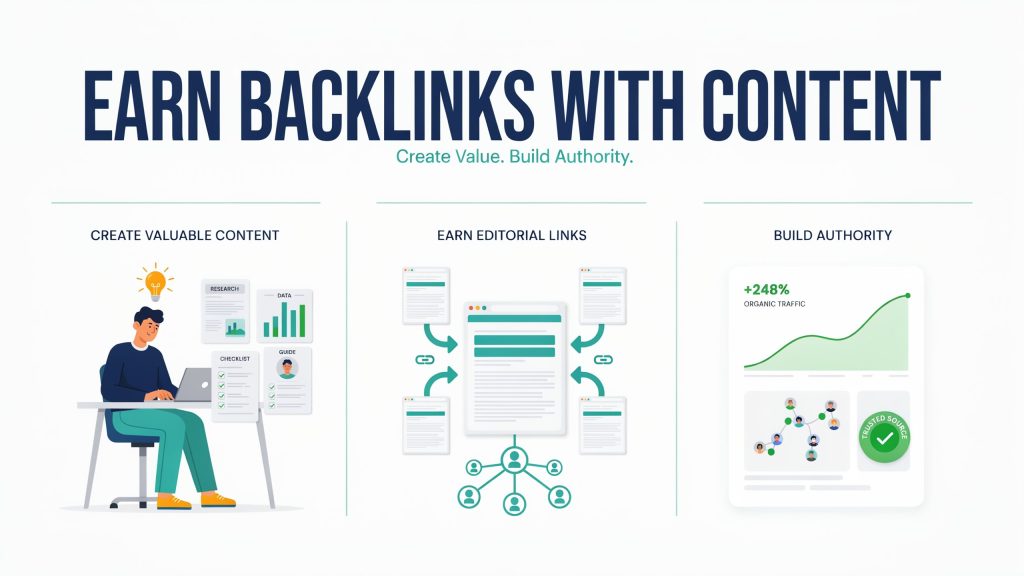
Backlinks can help search engines discover how websites relate to one another, but pursuing them as a numbers game often leads to weak results. A durable backlink strategy starts with a more useful question: what can a business publish that another site would genuinely want to reference? That shift puts audience needs, editorial quality, and long-term credibility ahead of quick link counts.
Why content is the foundation
A link is more meaningful when it appears in a context where it helps the reader. A well-researched guide, clear explanation, original analysis, or practical tool gives other publishers a reason to point their audience toward a resource. By contrast, a generic article created mainly to place a link may earn little attention and do little for the site’s reputation.
Useful content does not have to be elaborate. A small business might explain how to compare service providers, clarify a confusing industry term, or share a checklist based on recurring customer questions. The important thing is that the material answers a real question with enough detail to be useful on its own. The approach described in this overview of content-led link building reflects that principle: create something worth citing, then make it easy for relevant readers to find.
Choose subjects with a clear audience
Before commissioning an article, identify who should read it and what they need to know. “Write about finance” is too broad to guide a useful piece. A more focused brief could explore how a new business can separate operating cash from tax savings, or what consumers should consider before comparing fixed and variable costs. Narrow subjects help writers research the right questions and make the final article more valuable to a specific audience.
Look for topics where the business has experience, evidence, or a useful point of view. That may include:
- Practical guidance: Steps readers can follow to understand a process or avoid common mistakes.
- Original data: Findings from a carefully explained survey, customer analysis, or industry study.
- Expert explanation: A clear account of a complex issue, including relevant limits and trade-offs.
- Useful reference material: A glossary, comparison framework, or checklist that readers may return to.
Originality matters, but it does not mean every post must present a groundbreaking discovery. A familiar subject can still earn attention if it is better organized, more specific, or more transparent about its evidence than competing resources.
Make outreach relevant and respectful
Publishing a strong resource is only part of the work. The people most likely to link to it are those whose readers would benefit from it. Research relevant publications, professional associations, educators, and creators who cover the topic. Read their recent work before getting in touch, and explain briefly why the resource could help their audience.
A useful outreach note is specific. It might point out a new statistic that updates an older article or mention a detailed guide that addresses a question the publication’s readers frequently ask. Avoid sending the same vague pitch to a long list of unrelated sites. Editors have limited time, and a poorly matched request can make a sound resource look like a link-building scheme.
External articles can also introduce useful ideas to a new readership. When contributing to another publication, write for its readers first and make any link relevant to the point being discussed. A backlink should provide a sensible next step, such as a detailed resource or methodology, rather than interrupting the article with a sales message. Follow each publisher’s editorial rules, and do not assume that every placement will produce referral traffic or improve rankings.
Set a workflow that protects quality
Content-led link building requires research, writing, editing, and follow-up. Some businesses can manage those tasks internally; others bring in independent specialists for a particular project. Whichever route they choose, a clear brief helps everyone understand the intended audience, format, sources, deadline, and approval process.
When hiring a freelancer, define what counts as complete before work begins. Specify whether the assignment includes interviews, research, draft revisions, image sourcing, or publication support. Businesses comparing hiring options can read Osdire’s guide to extra credit when hiring freelancers as they think through project scope and budgeting. On a marketplace, clear deliverables and review criteria make it easier for both the buyer and freelancer to judge whether the work meets expectations.
Editorial review is especially important when an article makes financial, technical, or performance-related claims. Check that sources support the statements, examples are presented accurately, and limitations are not hidden. A careful review can prevent small errors from damaging trust after a piece has been published or shared.
Measure more than the number of links
Track links, but treat them as one signal among several. Note whether referring sites are relevant, whether readers arrive through those links, and whether they engage with the page. Search visibility may change over time, so compare results across a reasonable period instead of drawing conclusions from a short-term fluctuation. Also look at indicators such as qualified inquiries, newsletter sign-ups, or repeated references from industry sources when they fit the business goal.
Quality is not always captured by a single metric. A link from a well-matched publication may bring a small but interested audience, while a larger number of unrelated links may produce little practical value. Reviewing the context and usefulness of each placement helps teams understand what is working and where to focus future effort.
Build credibility one useful resource at a time
A sustainable backlink strategy is part of a broader effort to be a dependable source of information. Create material that reflects real expertise, make claims readers can check, and pursue opportunities where the audience fit is clear. Over time, useful resources and thoughtful editorial relationships can earn attention more naturally than campaigns built around link volume alone.