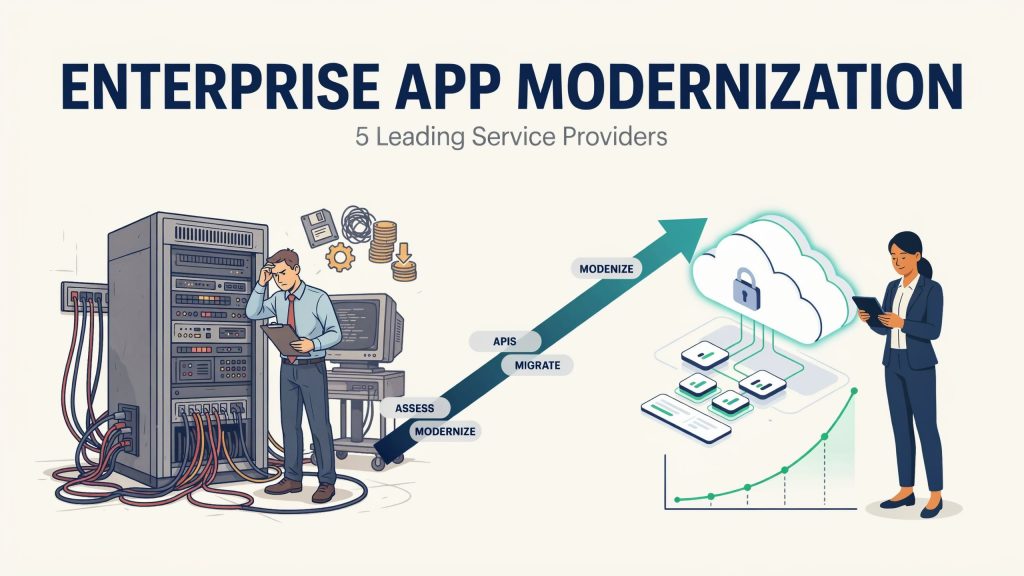
Ask a bank CIO what actually keeps them up at night. It’s rarely AI. More often it’s some COBOL system from 1988 that still closes the books at 2 a.m. and that nobody (seriously, nobody) wants to open up. Feeding a monolith like that swallows 60 to 80 cents of every enterprise IT dollar, give or take. New products get whatever’s left.
Why Old Monoliths Eat the IT Budget
Washington, oddly enough, is the most open about it. GAO auditors keep finding that federal agencies sink about 80% of a $100-billion-plus yearly IT budget into keeping the lights on, and some of those systems were written back in the Nixon years. Private firms won’t publish numbers like that. Their architects already know the numbers. Picture a normal Tuesday: a change request for a new loan product sits in a queue for six weeks because the module it touches also feeds the regulatory reporting batch.
Age isn’t the scary part, though. A botched cutover is. So when it comes to moving critical legacy systems into the cloud with as little operational risk as possible, many corporations fold into their global IT transformation strategies and split the work into phases instead of betting everything on one weekend. They’ve seen the alternative up close. TSB went big-bang in 2018, and somewhere around 1.9 million customers ended up staring at login errors. Cleanup ran north of £330 million. Then the regulators came, with £48.65 million in fines on top.
Who still reads COBOL, anyway? Mostly people near retirement. By Micro Focus’s 2022 count, something like 800 billion lines are still live out there, and colleges dropped the language from their syllabi ages ago. Contractors who still know CICS charge accordingly.
Refactor, Rehost, Split or Wrap: Picking a Modernization Method
Is there one right method? No. And a vendor pitching a single approach for an entire 4,000-app portfolio has earned some awkward questions. AWS’s “7 Rs” list exists for a reason. It runs from retire to refactor, and in a big estate every option ends up used somewhere.
Mainframe refactoring is the hard road. Parsers chomp through COBOL and JCL, draw up a who-calls-what map, then generate Java on the other end. Typical scope? Pricing rules, interest calculations, nightly batch chains nobody has documented since Y2K. AWS uses Blu Age for this, IBM has watsonx Code Assistant for Z. On a 2-million-line policy system, discovery alone can drop from about a year to roughly ten weeks. Sounds great, right? The catch is testing. Proving the new code rounds interest exactly the way the old one did takes months.
Rehosting is the quick fix. The code mostly stays as is and runs on x86 or cloud under something like Rocket Software’s Enterprise Server. Licensing bills often get cut in half. The technical debt comes along for the ride, of course. Fine as a first step, a bad place to stop.
Then there’s the cloud-native dream: microservices on Kubernetes (EKS, AKS, OpenShift), usually built with Martin Fowler’s strangler fig pattern, where new services slowly take over pieces of the old system. It works. It isn’t magic, though. Funny thing: Amazon’s own Prime Video engineers pulled one monitoring service back into a monolith in 2023, and its infra bill fell by over 90%. Cut a system along the wrong seams and what you get is a distributed monolith. Plus latency.
Or just leave the core alone. IBM z/OS Connect or MuleSoft, a few REST endpoints bolted onto CICS, done. The mobile app now reads balances off the mainframe directly. Underneath, nothing’s fixed. Still, it can buy a company a few years.
One method per program? Almost never. What keeps showing up looks roughly like this. Quarter one or two: APIs over the core. Within the year, the low-stakes batch jobs get rehosted. Years two to four go to pricing, claims, onboarding, the stuff that earns money. Slow? A bit. Each phase, however, frees up MIPS and license money that pays for the next one.
And the pipelines? Make-or-break. Zowe lets Jenkins or GitHub Actions ship mainframe code like anything else, while DORA metrics (deploy frequency, change failure rate) keep score. Weekly releases instead of quarterly ones on a 30-year-old claims engine? Honestly, that’s a win. Skip the pipelines, and every freshly modernized service slowly turns into the next legacy problem.
Leading Application Modernization Partners for Global Enterprises
Core systems rarely go to boutique shops. Batch blows up at 3 a.m. Singapore time. Who answers? Who knows what the PRA or the OCC will ask for next quarter? That’s the shortlist test, and these five names usually pass it.
IBM
IBM, in a way, sells both halves of the story: the IBM Z boxes, and the services to shift work off them. Its consultants lean on watsonx Code Assistant for Z to convert COBOL into Java and on ADDI to map dependencies. OpenShift (part of the $34 billion Red Hat buy, closed 2019) is where most containerized workloads land. Projects often begin with short IBM Garage pilots. Good match for firms that plan to keep z/OS running core transactions for another decade.
DXC Technology
DXC Technology? Born in 2017 out of CSC plus HPE’s Enterprise Services arm. Its client list leans heavily on banks, insurers, airlines and government agencies, the kind that can’t afford a bad night. First step is usually a portfolio sweep, and every app gets a tag. Rehost. Replatform. Refactor. AWS, Azure and Google Cloud partnerships cover the mainframe moves, while managed services keep the old stack humming as the new one gets built next door.
Accenture
Accenture’s trump card is scale: over 750,000 people and a Cloud First unit set up in 2020 with a $3 billion budget. myNav models the target cloud setup and its costs before anything moves, and GenWizard uses generative AI to document and reverse-engineer old code. Alliances with AWS and Google Cloud, plus Microsoft through Avanade, mean multi-cloud isn’t an exotic request there. Where it fits best: long programs in which retraining people counts as much as the code.
Deloitte
Deloitte usually shows up via the CFO’s office, not the data center. Business case first, always. Then: which regulator cares, and how much? An EU bank under the Digital Operational Resilience Act, or a US hospital chain with HIPAA auditors at the door, will recognize that order. Alliances with AWS, Microsoft, Google Cloud, Oracle and SAP cover the build. S/4HANA is a big piece too, with mainstream SAP ECC support done in 2027. Hence the rush.
Capgemini
Capgemini, Paris HQ. Back in 2020 it bought Altran, now called Capgemini Engineering, and picked up a lot of engineering muscle in the deal. Delivery? Big hubs in India and Europe, AWS, Azure and Google Cloud alliances, a growing stack of gen-AI tools for converting and testing code. Sovereignty-sensitive work in Europe often lands on its desk. Bleu, for one: a joint venture with Orange running Microsoft cloud services under French control.
Before Signing Anything
Reference architectures all look the same on slides. The differences show up once a vendor is asked for:
- a code-level assessment of one real application, not a maturity questionnaire;
- a way to prove batch outputs match, cent for cent;
- a parallel-run plan with clear rollback points;
- named engineers who’ve actually worked on mainframes;
- a price sheet that keeps one-off migration fees apart from what the thing costs to run each month.
Here’s the uncomfortable bit: the logo on the contract matters less than how disciplined the rollout is. Small, boring, tested steps beat one heroic all-nighter. Just ask TSB. And a vendor pushing for a single cutover date in the very first meeting should raise a few eyebrows.