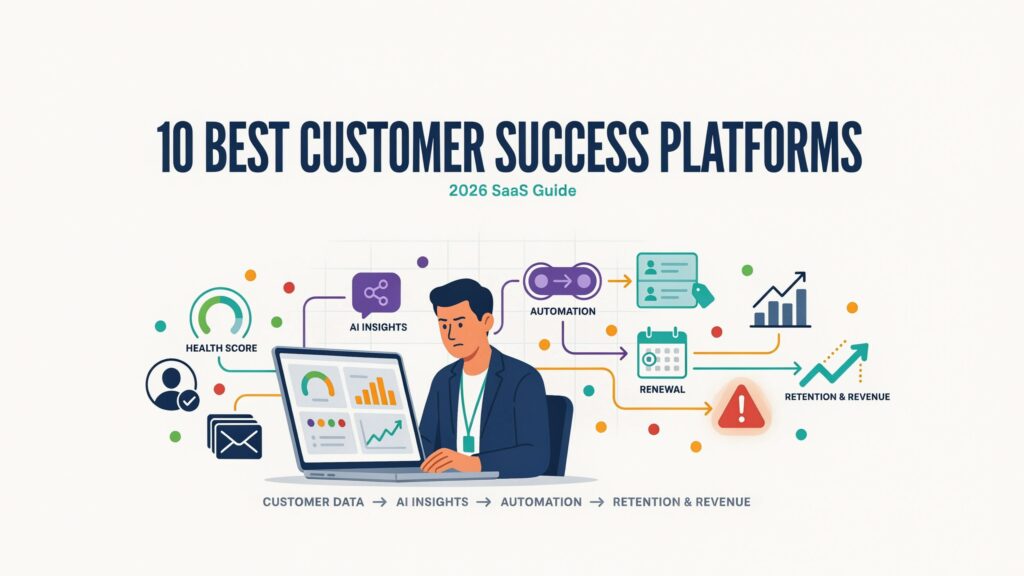
Customer Success platforms have matured significantly by 2026. The strongest tools now combine AI-assisted health scoring, lifecycle automation, and revenue visibility, instead of just surfacing dashboards for CSMs to stare at once a week. The practical value comes from systems that watch product usage, sentiment, and commercial signals in real time, then trigger playbooks, draft outreach, and escalate risk without waiting for a human to remember the account exists.
At the same time, the implementation and cost side of this market has become painfully clear. If you pick a platform that’s too heavy for your stage, you’ll spend quarters wiring data together, hiring a CS Ops admin, and still have CSMs working out of spreadsheets. Pick something too lightweight, and you’ll hit ceilings on health-score logic, automation depth, or Salesforce alignment just as your churn and expansion numbers start to matter. The goal of this guide is to map the real trade-offs—depth vs simplicity, cost vs capability, AI automation vs human oversight—to the realities of SaaS teams at different ARR and CS maturity levels.
Below, I’ll walk through what actually matters in a CS platform in 2026, then rank the leading options by “best for” scenarios, and finish with a stage-based decision framework, implementation tips, and human-style FAQs grounded in what teams are actually seeing in the field.
What matters most in a CS platform
Modern CS platforms sit on top of four core pillars: health scoring, segmentation, playbooks/automation, and renewals/expansion tracking, all fed by integrations across your CRM, product analytics, billing, and support stack. Every tool on this list offers some version of a customer 360 profile, configurable health scores, segments, lifecycle stages, and workflow automation; the differences are in depth, usability, and how much AI actually does for you versus being a bolt-on.
By 2026, “AI assistance” is no longer a marketing bullet—teams expect AI to explain risk signals, summarize complex account history, and suggest concrete next steps tied to health changes. Gainsight’s MCP and agent features, Vitally’s AI Copilot and Meeting Recorder, Planhat’s AIP layer, ChurnZero’s AI Agents, CustifyAI, and ClientSuccess’s SmartCS AI all work toward this: translating raw usage, tickets, sentiment, and notes into ranked risks, opportunities, and recommended actions. The tools that win are the ones where AI is embedded in workflows—health-score configuration, playbook triggers, meeting follow-up—not just sitting in a separate “AI tab.”
Time-to-value has also become a top buying criterion. Enterprise platforms like Gainsight and Planhat are built for complex data models and governance and can take months to fully stand up; mid-market tools like ChurnZero and Vitally aim for implementation in weeks to a couple of months; lighter platforms like Custify or ClientSuccess can realistically go live in a few weeks if your data is clean. Smaller teams are rightly wary of year-long implementations where health scores remain theoretical and CSMs never adopt the system.
Practically, your decision should start from four dimensions:
-
Team size & CS maturity: under ~5 CSMs and sub-$5M ARR vs scaling teams vs large, complex CS orgs.
-
Account volume & touch model: low hundreds vs thousands of accounts; high-touch vs tech-touch motions.
-
Existing stack: Salesforce-centric vs HubSpot vs a mixed environment with strong product analytics and data warehouse usage.appexchange.
-
Budget: most teams end up spending roughly 1–3% of ARR on CS tooling; below $1M ARR you often don’t need a platform at all.
With that context, let’s look at the platforms that actually make sense in 2026.
The best customer success platforms
Gainsight
Best for: Enterprise CS organizations that need depth, governance, and complex workflows across thousands of accounts and multiple products.
Gainsight is still the de facto enterprise standard: 360° customer views, sophisticated health scoring, Cockpit tasking, Journey Orchestrator for lifecycle automation, Renewal Center, and rich survey and NPS tooling all sit on a mature platform designed for large CS and RevOps teams. More recently, Gainsight’s MCP and agentic capabilities focus on turning health scores, open risks, sentiment, and renewals into inputs for AI and workflow engines, giving CS teams and LLM-based agents full customer context when deciding what to do next.
The trade-off is complexity and cost. Gainsight doesn’t publish pricing, but typical contracts start around $50,000 per year for smaller enterprise teams and climb with customer volume, seats, and modules. Implementations can easily run into multiple quarters and usually require a dedicated Gainsight admin or CS Ops function to keep health models, playbooks, and reports coherent. For mid-market or early-stage teams without that ops muscle, Gainsight is often overkill—great software that your team won’t fully use.
Implementation notes: Expect a multi-month project involving CRM, product, billing, and support integrations, plus health-score workshops and playbook design; plan for ongoing admin capacity rather than treating it as “set and forget.”
Pricing character: Enterprise, quote-based, often low-to-mid five figures annually at minimum, rising with modules and services.
ChurnZero
Best for: Mid-market all-rounder with strong real-time engagement and playbook capabilities, especially for product-led SaaS in the 5–100M ARR band.
ChurnZero targets B2B SaaS and subscription businesses with configurable ChurnScores (health models), journeys and plays, in-app messaging and walkthroughs, success plans, surveys, and a Renewal & Forecast Hub. Its AI Agents (Engagement AI, Snapshot AI, and others) help summarize account context, recommend next-best actions, and draft emails and content, keeping humans in charge of strategy while AI handles a lot of the repetitive work.
Strengths include robust health scoring, lifecycle automation, and digital engagement across email and in-app channels, making it a good fit for teams who want one platform to manage onboarding, adoption campaigns, and renewals. Limitations are mostly around enterprise-scale governance and the fact that pricing and packaging are quote-based with no public tiers, which can make budgeting harder.
Public benchmarks put entry-level ChurnZero contracts around $12,000 per year for smaller teams, with mid-market deployments in the low-to-mid five figures and large enterprise deals above six figures. Implementation is moderate: most teams can go live in a few months if data sources are reasonably clean, but you still need someone to own health-score design and journey logic.
Implementation notes: Plan 6–12 weeks to connect CRM, support, and product data, then roll out journeys segment by segment; avoid trying to automate everything in the first quarter.
Pricing character: Mid-market, quote-based; think low-five-figure annual starting points, rising with account volume and modules.
Vitally
Best for: Modern platform for growing SaaS teams that want speed, clean UX, and strong product data integration with serious AI assistance.
Vitally positions itself squarely for scaling B2B SaaS teams, with three pillars: Vitally AI (Copilot + Meeting Recorder), Blueprints (journey automation and playbooks), and Visibility (health scoring, segmentation, and reporting). Vitally AI unifies unstructured customer data—notes, conversations, meeting transcripts, docs, surveys—into instant summaries, risk detection, and AI-generated tasks and follow-up content, making it feel like a true Copilot rather than a generic chatbot.
Strengths include fast implementation, modern UI, strong integrations (Salesforce, HubSpot, product analytics, data warehouses, billing), and a no-nonsense automation builder that supports branching logic and multi-step flows. Teams typically praise Vitally for reducing admin overhead via AI Meeting Recorder and Copilot, and for making health-score changes and segmentation adjustments much less painful than in heavier platforms.
Pricing is still quote-based, but independent guides place Vitally’s starting tiers around a few hundred dollars per month, with Tech-Touch, Hybrid-Touch, and High-Touch tiers mapping to different CS motions. That puts it materially cheaper than enterprise platforms while still robust enough for mid-market teams with 5–25 CSMs. Limitations: Vitally is opinionated about data structure and is best suited to teams that already invest in product analytics and central data; very messy, legacy environments may need more upfront data work.
Implementation notes: With a clean CRM + product analytics stack, teams can realistically get to live health scores, segments, and core playbooks within 4–8 weeks; AI Meeting Recorder and Copilot tend to add value quickly once linked to calendars and conferencing.
Pricing character: Modern mid-market SaaS pricing—custom quotes, but competitive versus Gainsight and ChurnZero and accessible for Series A–C startups.
Planhat
Best for: Teams that want a flexible data model and high visibility across the customer lifecycle, with AI-native automation that spans CS, CRM, and services.
Planhat brands itself as an “agentic customer platform” covering CSP, CRM, and PSA in one integrated workspace, with an AI Platform (AIP) embedded across use cases. It centralizes product usage, CRM activity, support data, billing, and surveys, then uses AI to generate predictive health scores, churn-risk indicators, account summaries, and lifecycle insights. Its Automations and AI Workflows handle everything from ownership assignment and workload balancing to QBR preparation and multi-signal risk monitoring.platform.
Planhat’s key strengths are flexibility and data unification: you can deploy it as your CS platform, CRM, services hub, or all three, with AI stepping in to automate tasks and surface insights wherever you design workflows. It’s particularly compelling for scale-ups and enterprises that don’t want separate systems for CS and CRM, or that want to push more tasks to AI agents while maintaining a clear governance layer.
Limitations include its enterprise-leaning complexity and quote-based pricing with no public tiers; most teams should expect enterprise-style costs and the need for dedicated configuration effort. Implementation tends to be moderate-to-heavy depending on whether you’re also using Planhat as CRM; the upside is fewer tools overall if you commit.platform.
Implementation notes: Start with a narrow slice—health scoring and churn-risk workflows for a segment—before enabling AI across the full lifecycle; Planhat itself advises focusing on 2–3 AI use cases first to build trust in signals.
Pricing character: Enterprise, enquire-only, with pricing scoped across CSP, CRM, and PSA plus optional AI platform upgrades.platform.
Totango
Best for: Modular option with a genuinely useful free/lower-cost entry point for smaller teams building their first CS practice.
Totango stands out as one of the few CS platforms with a meaningful free tier: Community (free) includes core health scoring and basic engagement for up to roughly 100 accounts, giving small teams a way to formalize CS without budget. Paid plans—Starter at $249/month and Growth at $1,099/month—extend users, accounts, automation, reporting, and integrations, with Enterprise and Premier tiers quote-based for larger deployments.
The platform leans on modular “SuccessBLOCs,” prebuilt journey templates and playbooks that speed up deployment by letting teams turn on packaged lifecycle flows rather than designing everything from scratch. That, combined with the free plan, makes Totango particularly attractive for early-stage SaaS teams just starting to codify onboarding and renewal motions.
Trade-offs: the free Community Edition is fairly limited on automation and account capacity; Starter-to-Growth is a steep price jump; and Totango’s broader multi-product footprint (including Catalyst and AI products) can make packaging feel more complex than simpler mid-market tools. Teams that outgrow the free tier should budget carefully for the jump to Growth and for enterprise-scale contracts, which third-party data places with a median annual contract around $66,150 among larger buyers.
Implementation notes: You can get value from Totango’s free tier or Starter plan within a few weeks, especially if you adopt its SuccessBLOC templates instead of designing everything custom; it’s a good “starter CS OS” before you’re ready for deeper configuration.
Pricing character: Free-to-paid ladder, from $0 to ~$1,099/month for public tiers, with custom enterprise pricing above that.
Catalyst
Best for: Revenue-focused CS teams emphasizing expansion and commercial outcomes, especially when you want deep Salesforce alignment.
Catalyst (now sold under Totango’s “Customer Growth” product line) is a Salesforce-native customer success and growth platform built to unify CS and sales around shared data. Health scores, expansion signals, notes, and tasks operate directly on Salesforce objects, with bidirectional sync that avoids the version conflicts you get when a CS tool is merely integrated rather than built on Salesforce.
Strengths include native alignment with Salesforce, account-based pricing (historically with unlimited users), and a focus on revenue outcomes—expansion, upsell, and forecasting—rather than purely “customer happiness.” Teams with Salesforce Enterprise and cross-functional GTM squads (sales, CS, RevOps) often find Catalyst easier to justify than layering an external CS platform beside Salesforce.appexchange.
Limitations: Catalyst’s pricing is entirely quote-based, with no published rates; it is sold alongside Totango and Unison AI, so total platform cost can escalate quickly if you need capabilities across multiple products. Independent guides place starting contracts around $20,000/year for smaller teams, with enterprise-style economics beyond that. Implementation is moderate and usually requires close collaboration with Salesforce admins to align objects, permissions, and processes.
Implementation notes: Treat Catalyst as a Salesforce extension, not a separate tool; invest in shared revenue playbooks and health-score definitions that sales, CS, and RevOps agree on, or you won’t get the revenue-focused value it’s built to unlock.
Pricing character: Enterprise, Salesforce-native, quote-based; think in the same ballpark as other mid-to-enterprise CS platforms.
Custify
Best for: Smaller SaaS teams that want a capable platform without enterprise complexity or cost, especially sub-$10M ARR CS orgs with 1–3 CSMs.
Custify is a dedicated CS platform for B2B SaaS, aimed at small to mid-size teams managing a few hundred accounts. It offers configurable customer 360 views, customizable health scores, lifecycle tracking, dynamic segmentation, tasks and alerts, automation playbooks, dashboards, surveys, and a customer portal. Newer CustifyAI capabilities focus on using AI to configure playbooks, health scores, and workflows from uploaded documents and to automate low-touch motions, reducing the implementation burden that usually weighs down smaller teams.ecosystem.
The upside is straightforward, practical CS functionality without the overhead of enterprise platforms. Teams appreciate Custify for health scoring, lifecycle automation, and the ability to centralize CRM, billing, and support data without needing a data engineer. It’s frequently recommended for 1–3 CSM teams or CS orgs under $10M ARR.
Pricing is quote-based, but multiple directories put the starting point around $899/month for up to 3 seats, with higher tiers scaling seats and account volume. That’s notably more expensive than Totango’s starter tiers but still below many enterprise contracts; for very small teams, it can feel like an “awkward middle” if you could get by with Totango’s free plan or Vitally’s lower-cost tiers.
Implementation notes: With a clean Stripe + Intercom + CRM stack, teams can realistically deploy Custify in about a week and start using health scores and automation across a few hundred accounts, as independent reviews highlight.
Pricing character: Mid-range, quote-based, around ~$899/month entry for 3 seats, scaling with users and accounts.
ClientSuccess
Best for: Solid simpler alternative for mid-market teams seeking straightforward lifecycle management and fast time-to-value.
ClientSuccess is a lightweight CS platform focused on small to mid-market B2B SaaS companies that need customer health, playbooks, and renewal management without enterprise complexity. It centers around SuccessScores (health scores) and SuccessCycles (lifecycle playbooks) with 360° views, renewal forecasting, and SmartCS AI assistance and meeting intelligence.
Strengths include clean UX, clear lifecycle structures, and a strong emphasis on time-to-value—ClientSuccess itself highlights that teams are often live in weeks, not quarters. It’s a good fit when you know you need more than spreadsheets but don’t want to hire a CS Ops admin just to run your CS platform.
Limitations: pricing is tiered and quote-based with limited public detail, and starting annual costs can be relatively high for very small teams. Third-party procurement data suggests mid-market annual contracts often land roughly in the $25k–$90k range, with larger deployments above that. Features are intentionally simpler than Gainsight or Planhat—great if you value usability, limiting if you want highly customized health models and deep automation.
Implementation notes: If your data sources (CRM, support, billing) are in decent shape, expect a realistic go-live timeline measured in weeks with basic health scores and playbooks; this is one of the faster enterprise-grade options.
Pricing character: Mid-market, quote-based, with meaningful but not budget-tier annual costs; more affordable than Gainsight, more expensive than free/entry-level tools.
Specialized and emerging options
For slots 9–10, it’s worth calling out two specialized paths teams increasingly take in 2026: AI-first lean tools and Salesforce-native lighter options.
AI-first lean tools (e.g., Oliv AI)
Platforms like Oliv AI focus on agentic AI for customer success, sales, and RevOps, with modular agents for health scoring, churn detection, and CRM automation starting at around $19/user/month. These tools are best for early-stage or lean teams that want autonomous health scoring and playbook recommendations without a full-blown CS stack, often layering on top of existing CRM rather than replacing it. The trade-off: less traditional CS depth (lifecycle journeys, renewals modules) but radically lower cost and faster experimentation.
Salesforce-native lighter CS tools
Beyond Catalyst, there are lighter Salesforce-native CS extensions that give you health scores and simple playbooks directly within Salesforce, positioned as “Easy CS” options in some comparison matrices. These are ideal for very Salesforce-heavy orgs that want to avoid another platform entirely, and they typically offer simpler workflows than Catalyst or Gainsight with lower implementation overhead. Trade-offs: fewer specialized CS features, limited AI, and constrained segmentation compared to dedicated CS platforms.
Decision framework by SaaS stage
You can think about platform choice primarily by ARR and CS maturity rather than chasing features.
Early-stage / small CS team (<5 CSMs, often founder-led)
Below roughly $1M ARR and 50 customers, most teams don’t need a dedicated CS platform. A disciplined spreadsheet, clear onboarding checklist, and regular customer conversations are enough, and your budget is better spent on product and discovery. If you want structure, Totango’s free Community plan or a lightweight Salesforce-native extension can give you health scores and basic engagement without real spend.appexchange.
For teams in the $1–5M ARR range with 1–3 CSMs and a few hundred accounts, Custify or ClientSuccess start to make sense: both offer straightforward health scoring and automation without enterprise complexity. Oliv AI or similar AI-first tools can also be attractive if you’re comfortable running CS from CRM and just need agents to watch signals and trigger actions.
Growing mid-market (5–25 CSMs, hundreds to low thousands of accounts)
This is where dedicated CS platforms pay off. ChurnZero and Vitally are strong fits here: they balance functional depth with manageable implementation, and don’t require you to build a full CS Ops department just to keep them running. Planhat is compelling for data-mature teams that want integrated CSP + CRM + PSA and agentic AI across the lifecycle.
If your GTM stack is deeply Salesforce-centric and you want CS and revenue to operate from one source of truth, Catalyst becomes a leading choice. ClientSuccess also works well for fast-growing mid-market teams when time-to-value and simplicity outrank deep customization.
Enterprise / complex (larger teams, high-touch, heavy governance)
Once you’re managing thousands of accounts, multiple products, and complex org structures, Gainsight and Planhat are the two platforms that consistently show up in enterprise shortlists. Gainsight excels in mature CS orgs with the appetite for heavy health-score modeling and cross-functional governance; Planhat’s agentic platform is a fit if you want AI-native workflows spanning CS, CRM, and services.
Catalyst is a strong option for enterprises that treat Salesforce as the core system of record and want CS, sales, and revenue forecasting deeply intertwined. Totango’s enterprise tiers, combined with Catalyst, can also serve complex orgs, but you’ll need to negotiate carefully to manage total cost.
Quick recommendation matrix
Implementation and success tips
Get your data house in order before blaming the platform. Every tool here depends on clean CRM data, reliable product usage, and consistent billing and support integrations; bad data will produce noisy health scores and untrustworthy AI signals regardless of vendor. Prioritize a small number of trustworthy data sources and clear identifiers before wiring them into your CS stack.
Avoid the “set and forget” health score trap. Many teams over-engineer health scores with 20+ metrics, then leave them untouched for quarters. Start with 3–5 high-impact signals (usage, tickets, NPS, renewal risk) weighted differently by segment, and tie every health-change event to a concrete playbook action. AI-assisted scoring is powerful, but only if it leads to workflows, not just dashboards.
Measure platform ROI in terms your CFO cares about. Aim to track retention lift, expansion influence, and CSM productivity: e.g., churn rate moved from 7% to 3%, expansion revenue grew 20%, average at-risk accounts touched per CSM per week doubled. CS software typically consumes 1–3% of ARR; small improvements in churn usually pay for the platform multiple times over if you instrument impact well.
Know when to switch or consolidate. If at-risk accounts are consistently flagged but untouched and your CSMs still live in spreadsheets, you either have an adoption problem or the wrong tool. Similarly, if you’ve stacked CRM + CS platform + separate PSA + AI add-ons and nobody can explain which system owns what data, you may be better off consolidating into an integrated platform like Planhat or rationalizing around Salesforce-native options.
FAQs
What’s the best customer success platform for a SaaS company under $5M ARR?
If you’re under $1M ARR, you probably don’t need a CS platform—use spreadsheets, Totango’s free Community tier, or a lightweight Salesforce-native CS extension. Between $1–5M ARR with 1–3 CSMs, Custify or ClientSuccess are strong picks: both give you health scores, lifecycle automation, and renewals without enterprise overhead, while Totango Starter is a cheaper path if you’re okay with some limitations.appexchange.
Is Gainsight worth it or overkill for mid-market teams in 2026?
For mid-market teams with 5–25 CSMs and moderate complexity, Gainsight is often overkill unless you explicitly need deep governance, multi-product analytics, and have CS Ops capacity. Vitally, ChurnZero, or Planhat usually deliver better time-to-value and lower implementation risk at that scale, with enough depth for serious health scoring and automation.
How does Vitally compare to ChurnZero for growing SaaS companies?
Vitally leans modern and AI-heavy: Copilot, Meeting Recorder, and Blueprints make it attractive for teams that want clean UX, strong product data integration, and AI woven into everyday workflows. ChurnZero offers broader in-app engagement tooling and is slightly more established in mid-market SaaS, with strong ChurnScores and journey automation but less of a “purpose-built AI Copilot” feel. If product data and AI-assisted workflows are your priority, Vitally usually wins; if you care more about multi-channel engagement and renewal management, ChurnZero is compelling.
How long does implementation usually take for these platforms?
Enterprise platforms like Gainsight and full Planhat deployments can take multiple quarters, especially if you’re also reworking data models and governance. Vitally, ChurnZero, and ClientSuccess typically reach usable health scores and core playbooks within 6–12 weeks if your data is in reasonable shape, while Custify and Totango’s free/Starter tiers can be live in weeks for small teams.
Do we need a dedicated CS platform if we already use HubSpot or Salesforce?
Not necessarily. If you’re early-stage and can manage health and lifecycle in CRM with simple reports, you can postpone CS tooling and layer AI-first tools like Oliv AI for health scoring. Once you hit ~50–100 customers and 1–3 CSMs, dedicated CS platforms become valuable because they centralize lifecycle automation, health scoring, and renewals in ways CRMs aren’t designed to handle. For Salesforce-centric orgs, Catalyst or lighter Salesforce-native CS extensions can act as “CS inside Salesforce” rather than bolting on a separate platform.appexchange.
Which platforms have the strongest AI features for churn prediction and playbooks?
Vitally, Planhat, Gainsight, ChurnZero, Custify, and ClientSuccess all have meaningful AI layers by 2026; the more AI-native experiences are Vitally AI, Planhat AIP, and some AI-first tools like Oliv AI. Vitally AI focuses on account summaries, risk detection, and AI-generated actions; Planhat AIP offers AI Workflows, sentiment analysis, and agentic automation; Gainsight MCP feeds full customer context into LLM-based agents; ChurnZero’s AI Agents handle content and recommendations; CustifyAI helps configure the platform itself; ClientSuccess’s SmartCS AI boosts health scoring and meeting intelligence.
What’s a realistic budget for a CS platform at different stages?
Rule of thumb: expect to spend 1–3% of ARR on CS tools, with lower percentages at very early stages. Under $5M ARR, that might mean free Totango Community or mid-range subscriptions like Custify’s ~$899/month or Vitally’s lower tiers. Mid-market teams often see ChurnZero and Vitally contracts in the low-to-mid five figures annually, while enterprise deployments of Gainsight, Planhat, Catalyst, and larger Totango packages can run from $50,000/year into six figures.
How important is product usage data integration when choosing a tool?
Critical. Health scores that don’t include product usage are essentially opinion polls; you need usage, support, sentiment, and commercial signals combined to get reliable risk and expansion insight. Vitally, Planhat, ChurnZero, Custify, and Totango all emphasize product analytics integrations and usage-based health scoring; if your product data is weak, you’ll need to fix that in parallel with buying a CS platform.
Can small CS teams get real value from these platforms or are they built for larger orgs?
Small teams absolutely can get value—if they choose tools that match their stage and keep configuration focused. Totango’s free plan, Custify, ClientSuccess, and AI-first tools like Oliv AI are designed specifically for lean teams that want health scores, basic automation, and renewals without enterprise overhead. The mistake is buying Gainsight- or Planhat-level depth before you have the data quality, account volume, or CS Ops capacity to justify it.
What’s the biggest mistake companies make when buying a Customer Success platform?
The two biggest mistakes are buying the platform before defining the playbook, and treating health scores as reports instead of triggers. If you don’t have 3–5 clear intervention playbooks (e.g., “usage drop,” “no executive sponsor,” “renewal in 90 days”) before you buy, you’ll end up with dashboards that don’t drive action. And if health-score changes don’t automatically route to owned workflows—with AI assistance where helpful—you’ll just accumulate “red” accounts that no one touches.
The bottom line: in 2026, the best Customer Success platform for your SaaS business is the one your team can actually implement and use to drive proactive work, not just reporting. Match platform depth to your stage, insist on AI that feeds real workflows (not just a chatbot), and be honest about your data and ops capacity before signing an enterprise contract.