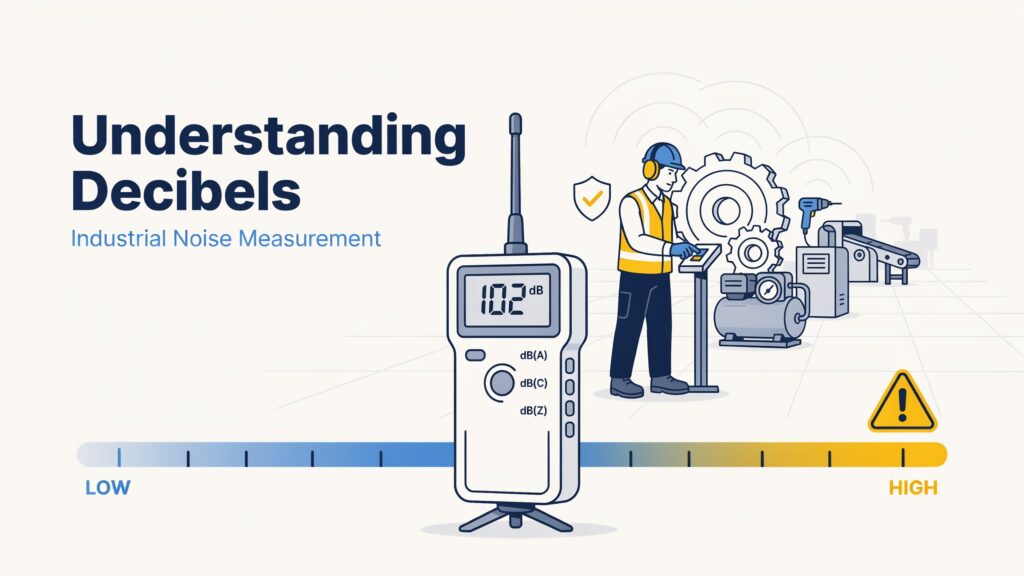
Industrial workplaces around the UK and the world depend on accurate noise measurement as part of businesses’ efforts to protect workers’ hearing and satisfy their legal duties.
Reliable instruments such as sound level meters help employers measure sound levels effectively. This puts organisations like these in a stronger position to assess and manage risk and support compliance with applicable legislation.
In Great Britain, the Control of Noise at Work Regulations 2005 establish requirements for protecting workers from risks associated with workplace noise. Northern Ireland has separate but similar legislation.
However, if employers and safety professionals are to make suitably informed decisions about noise control and hearing protection at their workplaces, they will need to understand how decibel measurements work and what they mean in practical terms.
What Are Decibels?
The decibel (dB) is a logarithmic unit used to express the ratio between a measured quantity and a reference value. In acoustics, it is commonly used to express sound pressure levels and other acoustic quantities.
The logarithmic detail is a crucial one, as it means that even small numerical changes can represent substantial changes in sound intensity. A 10 dB increase represents a tenfold increase in sound intensity, although the corresponding increase in sound pressure is smaller and the sound will not be perceived as 10 times louder.
With regard to industrial contexts, decibels are commonly used to describe the level of noise generated by machinery, tools, processes, and other sources.
The Importance of Decibel Measurements in Industry
A wide range of noise sources can exist in a typical industrial workplace, encompassing the likes of:
- Manufacturing equipment
- Compressors and pumps
- Power tools
- Electric motors
- Construction and engineering equipment
- Ventilation and extraction systems
- Forklifts and other vehicles
- Production lines and processing equipment
These various machines and devices will not, of course, all produce the same level of noise. This will depend on the particular equipment being used, as well as how long the given machines are operating for, and the surrounding environmental characteristics.
Businesses that are able to measure the noise at their sites effectively will be well-placed to understand the acoustic conditions in different parts of the workplace.
Furthermore, possessing such noise-measuring capability can help these organisations to pick out especially noisy machinery or areas where on-site staff might be exposed to potentially harmful noise levels.
A Simple Explanation Of dB(A), dB(C), and dB(Z)
Not all decibel measurements can be directly compared. Sound level meters can use different frequency weightings to reflect the fact that human hearing is not equally sensitive across frequencies:
- A-weighted decibels, written as dB(A), apply a frequency weighting that broadly reflects the sensitivity of human hearing. They are widely used for assessing average workplace noise.
- C-weighted decibels, or dB(C), provide a flatter response across a wider range of frequencies. They are commonly used when assessing peak, impact, or explosive noise, including loud sounds with substantial low-frequency content.
- Z-weighted decibels, or dB(Z), represent a nominally flat and unweighted frequency response. This is a weighting used mainly for specialised analysis.
The answer to the question of which weighting to use will depend on what is being measured and the purpose of the assessment. It is therefore crucial to use the correct settings when taking workplace noise measurements.
Why Does Accurate Decibel Measurement Matter So Much?
The cumulative nature of workplace noise exposure is crucial to acknowledge. It means that both the level and duration of exposure need to be considered. Short periods of high-level noise can contribute significantly to a worker’s overall noise exposure, while repeated exposure to different sources can also have a cumulative effect.
In light of this, it is important for the measurement process to identify high-risk tasks and areas. The results of measurement will also help guide engineering controls (such as quieter equipment, enclosures, and isolation), as well as any administrative measures that may be necessary, like job rotation or reduced exposure time.
Decibel measurements can also help inform the selection of appropriate hearing protection, alongside the assessed noise exposure and the attenuation characteristics of the available protectors.
By using suitable equipment, adhering to good measurement practices, and considering noise exposure as part of a broader risk-management approach, organisations can take practical steps towards the creation of safer work environments.