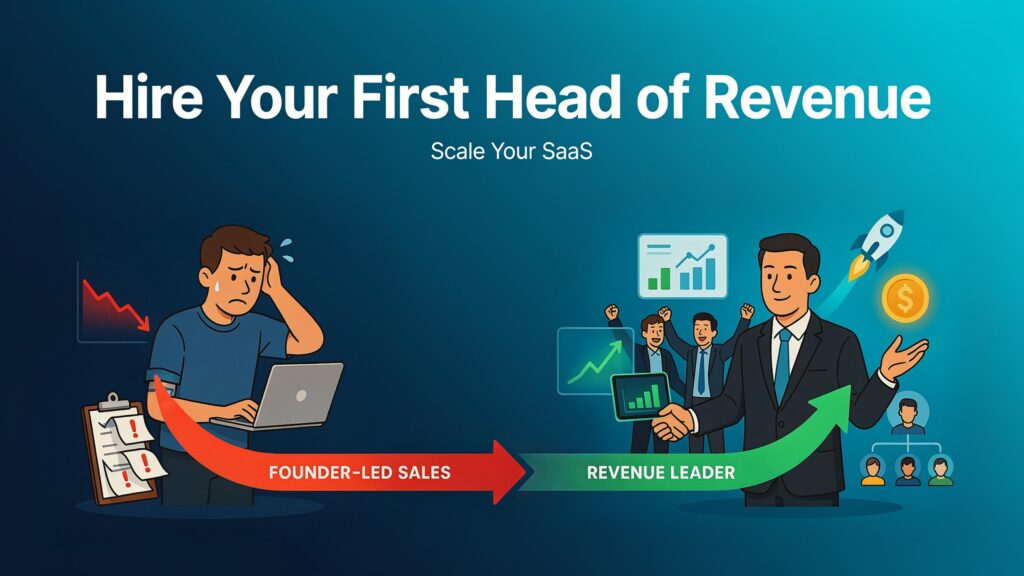
Hiring your first Head of Revenue (or VP Sales / CRO-lite) is one of the highest-leverage — and highest-risk — decisions you’ll make as a scaling SaaS founder. Get it right and you compound growth, stabilize forecasts, and free yourself to focus on product and strategy. Get it wrong and you burn 12–18 months, a painful chunk of cash, and a lot of team morale.
You already know you can’t just “hire a rockstar and let them own revenue.” At this stage, you’re still close to the motion, and the person you bring in will be sitting in the same boat as you — with all the imperfections of your product, pipeline, and brand. Most founders who mis-hire a first sales leader later admit they treated it like a title upgrade rather than a stage-fit decision.
This guide is written founder-to-founder, assuming you’ve done at least some selling yourself and are trying to decide whether it’s time to move from “founder plus AEs” to a real revenue leader. We’ll walk through when you’re actually ready, what profiles fit $1–5M vs $5–15M ARR, how to run a rigorous process, what to pay in 2026, and how to set this person up to succeed instead of quietly failing in month nine.
The goal is not to find a perfect unicorn profile. It’s to find someone who fits your stage, motion, and culture — and then to run a disciplined process that surfaces their strengths, limitations, and trade-offs before you sign the offer.
When You’re Actually Ready
Before you hire a Head of Revenue, you need evidence that there’s a motion to lead, not just a set of heroic founder deals. Most SaaS operators and investors converge on the same prerequisite: founders should have personally closed 10–20 customers and documented a repeatable sales motion before hiring senior sales leadership.
Signals you’re ready:
-
You have a consistent pipeline that would keep a leader and a small team genuinely busy — not just a handful of warm intros each month.
-
Deals follow a recognizable pattern: similar ICP, similar buying journey, similar objections, and you can describe the steps from first touch to close in a way someone else could follow.
-
You have at least one or two reps (or you as founder) hitting quota with a motion that isn’t totally dependent on your personal network or reputation.
-
You can financially support the role for 12+ months, including some additional hires they will need (SDR, second AE, maybe RevOps or CS headcount), without relying on immediate hero quotas to keep the company alive.
Red flags you’re hiring too early:
-
You’re still changing the ICP every month, rewriting the positioning, or shipping major product pivots that fundamentally change who you sell to and how.
-
Your deals are all snowflakes: no two look the same, and you can’t explain why some close and others stall in a way that feels like a teachable pattern.
-
Most of your revenue still comes from one-off founder relationships, not a repeatable inbound/outbound engine.
-
You’re counting on this hire to “figure out product-market fit” or “own all of revenue” while you retreat completely from sales. That’s not leadership; that’s abdication.
If you see more red flags than readiness signals, you’re likely better served by:
-
A fractional sales leader who helps you tighten ICP, refine messaging, and codify the motion over 3–6 months while you stay primary on closing.
-
A founding AE who can sell and help you shape the process, with the understanding that leadership comes later once you can see repeatability.
The Head of Revenue role should multiply a motion you already understand, not be the person you hope will discover that motion from scratch.
Right Profile by Stage
Your ARR and go-to-market maturity matter more than the title you put on the offer letter. The profile that works at $1–3M ARR is very different from what you need at $8–15M ARR.
Early Scaling: $1–5M ARR
At $1–5M ARR, you’re still close to the ground. You likely have a small team (or just you plus one or two AEs), a handful of big logos, and some messy but promising process. The right revenue leader here is usually a player-coach Head of Sales / VP Sales who can both carry a quota and architect the next layer of structure.
Key dimensions:
-
Hunter vs farmer: Bias toward hunter. You still need net-new ARR more than complex upsell machines, even if expansion matters later.
-
Mid-market/SMB vs enterprise: Match their experience to your ACV band. A leader who has built a mid-market engine with $10–30K ACV may struggle to make enterprise, multi-stakeholder deals work — and vice versa.
-
Sales-led vs product-led hybrid: If you have strong PLG and inbound, look for someone who’s built hybrid motions with self-serve plus sales assist; if you’re classic outbound sales-led, prioritize someone who’s run outbound teams.
-
Builder vs optimizer: Strong bias toward builder. They should have built at least one sales process from scratch at a previous startup, not just optimized an inherited engine.
Must-have experience at this stage:
-
Recent, hands-on quota-carrying experience closing deals similar in size and complexity to yours.
-
Proven track record of building basic sales infrastructure: CRM discipline, pipeline hygiene, stages and exit criteria, rudimentary forecasting.
-
Exposure to early-stage ambiguity — not just big-brand environments with full RevOps, brand awareness, and established collateral.
Nice-to-have:
-
Prior experience as the first or second sales leader in a startup that grew from similar ARR into the next stage.
-
Comfort with PLG data and working closely with product and growth teams.
Later Scaling: $5–15M+ ARR
By $5–15M ARR, you’re typically dealing with a more complex org: multiple AEs, perhaps SDRs, some CS structure, and pressure from your board to make the numbers more predictable. The right profile shifts toward someone who can scale and manage a team over 6–10 quota-carrying reps, not just be the best seller in the room.
Key dimensions here:
-
Hunter vs farmer balance: You need someone who can grow new ARR and create a culture of expansion and retention with CS and account management.
-
Enterprise vs mid-market: If your ASP and ACV are climbing, experience with longer cycles and multi-stakeholder deals matters more; if you’re still mostly mid-market, someone who scaled inside sales may be a better fit.
-
Sales-led vs product-led: At this ARR, hybrid PLG + sales-led is increasingly common; look for leaders who can interpret product data, activation metrics, and usage patterns and turn them into sales plays.
-
Builder vs optimizer: You now need a builder-optimizer — someone who can respect and refine the existing motion, not tear it up impulsively, but who also won’t just run last year’s playbook on autopilot.
Must-haves:
-
Managed a team of at least 5–10 AEs, with a track record of hitting org-level quota rather than just individual numbers.
-
Demonstrated ability to hire, ramp, and retain sales talent — not just inherit a team.
-
Experience partnering with marketing, CS, and RevOps to build a coherent revenue engine.
Cultural and founder-fit criteria (for both stages):
-
You’d personally buy your own product from them — they sell in a style that fits your brand and values. SaaStr’s research shows mis-hired first reps and leaders often fail this basic gut check.
-
They respect that you’ve been the de-facto revenue leader and are willing to partner, not “clean slate” your work.
-
They can handle transparency around runway and constraints; early-stage leaders with purely big-company expectations tend to struggle.
Scorecard and Job Spec
At this level, generic job descriptions (“We’re looking for a rockstar VP Sales to own revenue”) attract exactly the wrong people — title-chasers and storytellers who know how to talk about growth but not build it under constraints. You’re better served by a blunt, outcome-based scorecard and a job spec that makes the trade-offs obvious.
Outcome-Based Scorecard
Define what success looks like in:
-
First 6 months: Example outcomes: tighten ICP and messaging, improve pipeline hygiene, hire 1–2 additional AEs, stabilize weekly forecast calls, and hit a realistic, agreed-on ARR target.
-
12 months: Org-level quota attainment, a documented sales playbook, clear SDR/AE/CS handoffs, and improved conversion rates at key funnel stages.
-
18 months: A scalable org design for the next ARR bracket, a bench of promotable managers, and credible forecasts that your board believes.
Turn these into measurable objectives (for example, “Increase opportunity-to-close win rate from 18% to 25%” or “Hire and ramp three AEs to full productivity by month nine”) and make them central to your hiring conversation.
Core Competencies and Deal-Breakers
Core competencies:
-
Building and enforcing pipeline discipline without bureaucratic overkill.
-
Coaching frontline reps on discovery, qualification, and negotiation.
-
Translating messy sales reality into metrics and dashboards that finance and the board can trust.
Deal-breakers:
-
Purely strategic backgrounds with no recent hands-on selling or frontline management.
-
No startup experience or clear discomfort with operating without brand, mature marketing, and RevOps support.
-
A track record of blaming “lead quality” or “product” in every failure story.
Writing the Job Description
Your job spec should:
-
Explicitly state stage, ARR range, ACV band, and motion (inbound-heavy PLG, outbound-led mid-market, enterprise field, etc.).
-
Describe outcomes first, responsibilities second, and title last — e.g., “You’ll build and lead a small team to take us from $3M to $8M ARR in 24 months.”
-
Be honest about constraints: runway, support functions, geographic expectations, and whether the role is fully remote or tied to a hub.
This filters out tourists and title-collectors and attracts operators who understand the work, not just the optics.
Sourcing and Attracting Candidates
For your first Head of Revenue, “post on a job board and hope” is a bad strategy. Strong candidates at this level typically come from targeted outreach, trusted referrals, and specialist recruiters — not generic inbound.
Where the best candidates actually come from:
-
Your extended network and investor network: Ask specifically for people who have built sales from low single-digit ARR to your current or next target.
-
Previous colleagues and customers: People who’ve sold to your ICP or operated in adjacent markets often know who the real operators are.
-
SaaS-focused executive recruiters: The good ones help define your stage-fit profile, screen for builder vs scaler, and keep you honest on comp.
Job boards may still play a role, but they’re better for creating a baseline pipeline, not for landing your top 3 finalists.
Positioning the Opportunity
You’re not competing on title. You’re competing on impact and equity story:
-
Be clear about where you are on the journey (e.g., “From $3M to $10M ARR over the next three years”) and how this role moves the needle.
-
Spell out the mandate: build the engine, not inherit it; create playbooks; hire, coach, and manage; partner with product and marketing.
-
Share your funding status and runway honestly; senior candidates expect transparency on risk and upside.
Done well, your pitch should attract leaders who are motivated by building something meaningful, not just by maximizing guaranteed cash.
Compensation Realities in 2026
Comp expectations vary by geography, stage, and title, but benchmarks converge for US-based SaaS:
-
VP Sales (Series A/B scale-up): Typical OTE ranges from roughly 250K to 400K USD, combining base and variable, with base usually 50–60% of OTE.
-
VP Sales (Series B growth): Compensation guides show base in the 200K–275K range, OTE 400K–600K, and equity 0.5–1.5%.
-
Across 704 postings analyzed by The CRO Report, VP Sales base ranges from about 167K to 251K, with total OTE 80–120% above base once variable is included.
For a first Head of Revenue at $3–8M ARR, you’re usually in the lower end of those bands but still competing with similar roles:
-
Reasonable OTE: mid-200Ks to mid-300Ks USD in major US markets, with a 50/50 or 60/40 base/variable split and equity in the 0.5–1% range.
-
In Europe and the UK, benchmarks show lower cash but often similar equity for Head of Sales-level roles.
Adjust for your geography (secondary US markets, remote-first, Europe, India, etc.) and stage, but don’t expect to hire an experienced builder for mid-manager cash. Underpaying at this level is a fast way to end up with someone who talks the talk but isn’t in it for the grind.
Interview and Evaluation Process
This is where founders either de-risk the hire or get seduced by storytelling. You want a structured loop that tests for how they’ve built revenue engines, not just whether they can narrate growth in a polished way.
Structured Interview Loop
A typical high-signal loop:
-
Founder interview(s): Focus on stage-fit, shared philosophy on go-to-market, and cultural alignment.
-
Product/engineering: Test how they think about customer feedback, roadmap trade-offs, and selling against product constraints.
-
Existing sales/CS team: Let frontline folks probe on coaching style and operational rigor; you’ll learn quickly whether they can win trust.
-
Advisor or key customer: Optional, but very revealing — can they communicate value credibly to someone who isn’t impressed by their title?
Keep the loop tight (ideally 3–5 interviews plus a working session) and aligned to your scorecard.
High-Signal Questions and Exercises
Questions that reveal how they operate:
-
“Walk me through the last sales engine you built: ARR when you joined, ARR when you left, team structure, and the three key changes you made.” Ask for specifics (numbers, ratios, timelines).
-
“Tell me about one rep who went from missing quota to hitting it under your leadership. What exactly did you do?”
-
“Give me an example of a time you pushed back on the CEO or board about unrealistic targets or headcount plans. What happened?”
Case exercises:
-
Ask them to review your current pipeline and forecast (even anonymized) and present how they’d restructure stages, qualification, and forecast cadence.
-
Share a simplified ARR target for next year, your current team, and funnel metrics, and ask them to sketch an org plan and hiring sequence.
You’re looking for structured thinking, comfort with constraints, and the ability to connect numbers to actions.
Reference Checks That Reveal Truth
Most founders do “check-the-box” references. You want pattern-of-behavior references:
-
Talk to both their former manager and at least one AE who reported to them.
-
Ask specific questions: “How did they respond in the first bad quarter?”, “What changed in the team’s behavior after they joined?”, “Would you work with them again at a company of your size today?”
-
Look for alignment between their interview narrative and reference stories; big gaps are a red flag.
Common Red Flags
Red flags that show up repeatedly in failed first revenue hires:
-
Storytelling without numbers: They can describe “hypergrowth” and “scaling” but can’t recall quotas, conversion rates, or ARR at join/leave.
-
Blame culture: Every setback was about “lead quality,” “pricing,” or “product,” never about their own hiring, coaching, or process decisions.
-
Inability to operate lean: Their solutions always involve more headcount, more tools, and more marketing spend, with little creativity about doing more with less.
-
Purely big-company background: No evidence they’ve succeeded in environments without brand and infrastructure.
If you see more than one of these in a candidate, think very hard before you move forward.
Making the Offer and Setting Up for Success
Once you have the right person, the offer and onboarding are where you either cement a productive partnership or set up lingering misalignment.
Negotiation and Equity Philosophy
Be clear upfront on your philosophy:
-
Cash should be competitive but not outlier; you’re paying for stage-fit and builder skills, not for a Fortune 500 CRO. Benchmarks for 2026 VP Sales roles give you realistic OTE bands to reference.
-
Equity should reflect impact and risk. For a first Head of Revenue at your stage, 0.5–1% fully diluted (with standard four-year vesting and one-year cliff) is typical in venture-backed SaaS.
-
Variable compensation should be uncapped, tied to clear KPIs (org quota, net-new ARR, team attainment), and documented in a written plan.
Align early on how success is measured so you don’t have hard conversations later about “unfair” targets.
30/60/90-Day Plan
Agree on a written plan before they start:
-
First 30 days: Deep discovery — meet customers, shadow calls, audit pipeline, understand ICP, and co-create updated scorecard.
-
60 days: Implement pipeline hygiene, refine stages and qualification, set up weekly forecast cadence, and start building initial hiring plan.
-
90 days: Present updated GTM plan (headcount, quotas, funnel improvements) and show early results in pipeline velocity or conversion.
You’re not expecting them to “fix revenue” in 90 days, but you are expecting tangible movement on the leading indicators they own.
How You Should (and Shouldn’t) Stay Involved
You shouldn’t disappear from sales. You also shouldn’t micromanage every deal.
Healthy involvement:
-
Stay in the top 10–20% of strategic deals where your presence materially improves close odds.
-
Join key forecast reviews and quarterly business reviews to keep context and alignment.
-
Be available as a sounding board on hiring, territory design, and board communication.
Unhealthy involvement:
-
Overriding their decisions in front of the team or changing comp plans unilaterally.
-
Taking over deals because “it’s faster if I just jump in,” which undermines their authority.
Onboarding should transfer tribal knowledge without creating permanent dependency on you as the only person who can close.
Common Failure Modes
Patterns in failed first Heads of Revenue are depressingly consistent across SaaS:
-
Hiring a big-company leader who can’t operate lean: They’ve only succeeded with brand and large teams, and they expect to recreate that environment instead of working with your constraints.
-
Hiring a pure hunter when you need a system builder (or vice versa): At $1–3M ARR, you need a builder-hunter; at $10M+, you often need a manager-optimizer more than another super-closer.
-
Unclear ownership between founder and new hire: Targets, authority, and decision boundaries are fuzzy, so the org doesn’t know who’s really in charge.
-
Ignoring cultural or values misalignment: You let a high-ego or blame-heavy leader in because of their résumé, and they quietly erode trust and cross-functional collaboration.
Most of these are avoidable if you’re honest about your stage, define a clear scorecard, and check references rigorously.
Conclusion
Your first Head of Revenue should multiply the motion you’ve already proven, not invent a completely new one while you step away. The right time is when you have consistent pipeline, a repeatable sales process, and enough runway to let a senior operator build for at least a year.
Prioritize stage-fit, builder vs optimizer balance, and founder alignment over pedigree. Use a scorecard-driven process, talk to real references, and be realistic on compensation for 2026. Treat this hire as a partnership — a shared project to build a durable revenue engine — not as a hand-off where you throw them the keys and hope they magically fix everything.
FAQs
When is the right time to hire a Head of Revenue instead of just adding more AEs?
You hire a Head of Revenue when you’ve already proven a repeatable motion with founder-led sales and at least one or two AEs, and your main constraint has shifted from “more hands to close deals” to “building a scalable, predictable engine.” Most SaaS startups reach this point around the low seven figures of ARR, once two reps are consistently hitting quota and you can see the same types of deals closing in a repeatable way.
If you’re still learning who to sell to and how, adding a founding AE or fractional help is almost always higher leverage than hiring a full-time leader.
Should I look for someone from a bigger SaaS company or someone who’s scaled a similar-sized company?
For your first Head of Revenue, someone who has scaled from roughly where you are to your next stage is usually better than someone who has only operated at much larger scale. Big-company leaders can bring useful best practices, but they often struggle with lack of brand, thin pipeline, and limited support functions.
Look for candidates who’ve built or led teams at similar ACV and ARR, ideally taking a company from low single-digit ARR into the teens, rather than someone whose success came entirely in late-stage or public environments.
What’s a realistic compensation package for a first Head of Revenue at $3–8M ARR?
In 2026 benchmarks, VP Sales and Head of Revenue roles at Series A/B/B+ SaaS typically land in the 250K–400K USD OTE range in major US markets, with base often 50–60% of that and the rest variable tied to org quota and net-new ARR.
For $3–8M ARR, a typical band might be:
-
Base: roughly 170K–230K USD in the US (lower in secondary markets and some remote roles).
-
OTE: 250K–350K USD, with a 50/50 or 60/40 base/variable split.
-
Equity: 0.5–1% fully diluted, with standard vesting.
Adjust for geography and funding, but be prepared to pay at least mid-market for a proven builder.
How do I know if a candidate can actually build process versus just being a strong individual seller?
Look for:
-
Concrete stories about building stages, exit criteria, forecasting cadence, and sales playbooks, with before/after metrics.
-
Evidence they’ve hired, coached, and fired reps — not just carried a quota themselves.
-
References from former AEs and managers that describe improvements in pipeline discipline and team performance, not just “they were a killer closer.”
In interviews, push for specifics: “What changed in your pipeline after you implemented X? How did you decide on your stage definitions?” Vague answers are a warning sign.
What are the biggest red flags in interviews for this role?
Common red flags:
-
Vague growth stories with no hard numbers on ARR, team size, or conversion metrics.
-
A pattern of blaming marketing, product, or pricing in every story about missed targets.
-
No startup experience or clear discomfort with lean environments.
-
Inflexibility on comp and equity that suggests they’re anchored to late-stage norms, not your reality.
Take these seriously; they tend to show up again in real performance.
How involved should I stay in sales after I hire this person?
You should stay involved in:
-
Strategic deals where your presence materially increases the chance of closing.
-
Key forecast and planning rituals so you keep context and can represent GTM credibly to your board.
You shouldn’t:
-
Override their decisions in front of the team.
-
Take back day-to-day responsibility for coaching reps or running pipeline reviews.
Think of yourself as an active partner, not a shadow VP Sales.
Is it better to hire a VP Sales or a broader Head of Revenue / CRO-type at this stage?
At $1–10M ARR, a VP Sales / Head of Sales with a clear mandate over new ARR and early sales management is usually more appropriate than a full CRO who nominally owns marketing, CS, and partnerships.
You can structure the role as “Head of Revenue” if you want explicit cross-functional alignment, but make sure the person has real experience collaborating with marketing and CS rather than just carrying the CRO title in a larger org.
How long does a good search usually take, and should I use a recruiter?
Expect a serious search for your first Head of Revenue to take 3–6 months, especially if you’re being disciplined about stage-fit and references. Data on VP Sales searches suggests many fast-growth SaaS companies start the search about two years after founding and take several months to land the right person.
Using a specialist SaaS executive recruiter is often worth it for this hire; they help refine your profile, structure comp realistically, and surface candidates you’d never see through inbound.
What happens if the hire doesn’t work out after 6–9 months?
If, after a fair ramp and clear targets, you see:
-
Stalled pipeline, low activity, and no improvement in conversion metrics.
-
Little progress on hiring, process, or forecasting discipline.
-
Growing misalignment with your team and culture.
You need to treat it as a high-stakes mis-hire, not a “maybe they’ll turn it around.” Founders and advisors warn that keeping a mis-fitted first sales leader can cost you a full year and half your cash; moving decisively preserves runway and culture.
How do I evaluate cultural fit when the candidate comes from a very different company environment?
Probe for how they’ve adapted across different cultures:
-
Ask about times they joined a company with very different values or operating style and what they changed in their own behavior.
-
Listen for respect for prior founders and teams, not just “I came in and fixed everything.”
-
Have your existing team interact with them and debrief honestly about how they’d feel working under this person.
A different background isn’t a problem; an inability to flex and an instinct to impose big-company norms on a lean startup is.