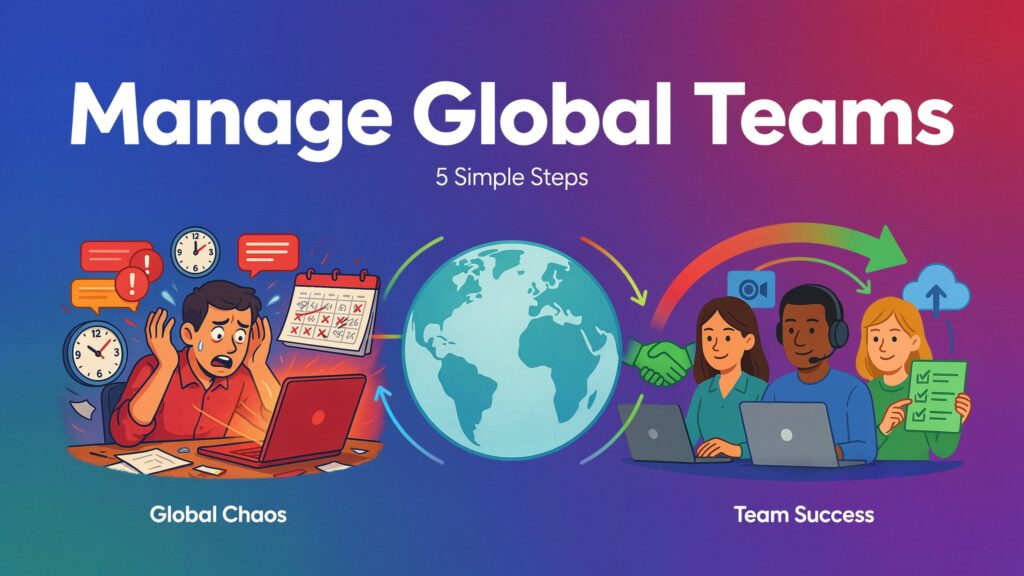
So, you manage a team. That’s challenging enough when everyone works in the same office. But your job is even harder. Why? Because it adds different time zones, languages, cultures, and employment laws into the mix. This is where things become much more complicated.
Of course, that doesn’t mean managing a global team has to feel… overwhelming. In fact, many businesses discover that once the right systems are in place, having employees around the world becomes a big strength. This is due to different perspectives, which lead to:
- Better ideas,
- Wider market knowledge,
- And the ability to support customers across multiple time zones.
The key here is to create ways of working that make collaboration feel straightforward. It shouldn’t matter where people are based.
Keep reading to learn more.
Step One: Master Asynchronous Work
One mistake – if not the biggest mistake – that many companies make in this situation is expecting everyone to be online at the same time.
When your team spans several countries, that’s rarely realistic. Some is always starting their day while someone else is finishing theirs. Trying to schedule every conversation as a live meeting usually leads to frustration and calendar overload. Neither of these you want.
Instead, focus on building a culture of asynchronous communication. Encourage people to leave detailed updates, document important decisions, and record meetings when appropriate. That way, team members contribute when they’re working, rather than feeling pressured to respond immediately.
Ironically, less real-time communication often leads to better communication. Why? Because people take a little more time to explain their thinking clearly.
Step Two: Standardize Your Tech Stack
There’s nothing more frustrating than discovering every department uses different tools to do essentially the same job.
It can be complicated. People will spend more time looking for information than actually using it because of three factors. One, communication only happens in one app. Two, files live somewhere else entirely. And three, project updates are tracked in several different places.
Keep your technology stack simple. Not only does this make life easier for your employees, but it’s simpler for you, too. Choose a consistent set of tools for messaging, project management, file sharing, and video meetings. Then ensure all workers understand how they’re meant to be used.
And remember! The fewer systems employees have to learn, the easier it is for new hires to settle in and existing teams to stay aligned.
Step Three: Focus on Output, Not Hours
If employees work across different countries, it becomes impossible to judge productivity. You certainly can’t go by who’s online the longest.
Some people will start work at 7am. Others will be more productive later on in the day. Different countries also have different public holidays, working patterns, and expectations around flexible schedules.
Rather than measuring time spent at a desk, focus on outcomes. Are some very important questions to do this, including:
- Are projects moving forward?
- Are deadlines being met?
- Is the quality of work where it needs to be?
The answers will show you valuable insights.
And give people the flexibility to organize their day. This often leads to higher engagement and better results because they’re trusted to manage their own workload.
Step Four: Bridge the Cultural Divide
A big strength of an international workforce is the variety of experiences. Different people bring with them different experience and expertise. At the same time, those differences sometimes lead to misunderstandings if they’re not acknowledged professionally.
Communication styles. Approaches to feedback. Attitudes towards hierarchy. Meeting etiquette. All of this varies from country to country. What feels direct and efficient in one culture may come across as abrupt in another.
If you can, create opportunities for people to learn about one another. And from one another, too. This goes a long way. That might mean celebrating a variety of cultural holidays, encouraging knowledge sharing in departments, or simply giving team members space to talk about how they prefer to work.
A little curiosity and empathy is enough. Both will make international collaboration feel much more natural.
Step Five: Streamline Global HR and Payroll
As a business grows internationally, the administrative side becomes increasingly… complex. Hiring employees in different countries often means dealing with new aspects. There will be different tax rules, employment laws, benefits, and payroll requirements.
Trying to manage all of that manually quickly becomes overwhelming. It’s a lot to do.
And that’s why many organizations rely on providers that specialize in global insurance, international HR, payroll, and employee benefits to help simplify these responsibilities. No one wants their employees to be treated unfairly, so you need to do this.
Have consistent systems in place, too. Doing so will reduce administrative headaches, support compliance, and help create a more seamless experience for employees wherever they’re based.
To conclude, managing a global team will always come with challenges. It also brings opportunities that simply aren’t possible with a workforce in one location. You just need to follow the steps outlined in this post.
By doing so, your business will create an environment where talented people are able to do their best work – no matter which corner of the world they call home.