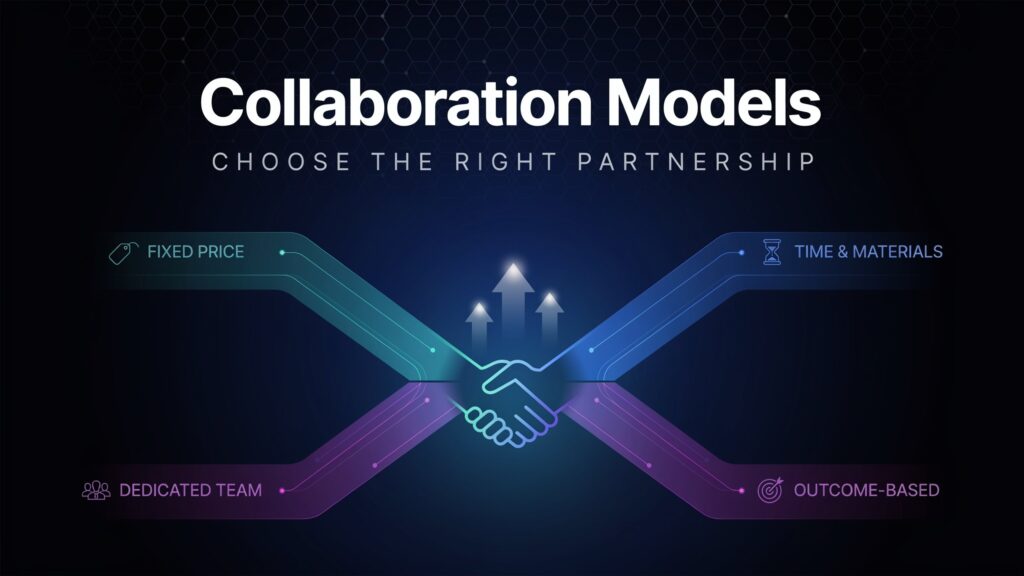
I’ve negotiated, managed, and advised on dozens of collaboration models over the years — from small fixed-price projects to large multi-year dedicated team engagements and complex outcome-based partnerships. The right model can accelerate delivery, improve quality, and align incentives perfectly. The wrong one can lead to scope disputes, cost overruns, misaligned expectations, and damaged relationships.
In 2026, with distributed teams, AI-assisted development, faster delivery expectations, and more sophisticated clients, choosing the right collaboration model is more important — and more nuanced — than ever.
This in-depth guide breaks down the main collaboration models used today, their pros and cons, when to use each one, and how to make the best decision for your project or organization.
Why Collaboration Models Matter
The way you structure your partnership with a development team directly affects:
- Speed of delivery
- Flexibility to change requirements
- Cost predictability and control
- Quality and ownership
- Risk distribution between client and vendor
- Long-term relationship strength
As projects become more complex (involving AI, cloud-native architectures, security, and compliance), the traditional “one-size-fits-all” approach no longer works. Smart organizations now mix and match models or evolve them over time.
The Main Collaboration Models in 2026
Here’s a clear comparison of the dominant models:
| Model | Best For | Pros | Cons | Risk Level | Flexibility | Cost Predictability |
|---|---|---|---|---|---|---|
| Fixed Price | Well-defined scope, clear requirements | Budget certainty, low risk for client | Inflexible to changes, can lead to disputes | Low for client | Low | High |
| Time & Material (T&M) | Evolving requirements, discovery phases | High flexibility, easy to scale | Less budget predictability, requires trust | Medium | High | Low |
| Dedicated Team | Long-term projects, ongoing development | Team stability, deep product knowledge, speed | Higher commitment, management overhead | Medium | High | Medium |
| Outcome-Based / Value-Based | Projects with clear business outcomes | Aligned incentives, focus on results | Harder to define metrics, requires maturity | Medium-High | Medium | Medium |
| Hybrid / Blended | Most real-world projects | Combines strengths of multiple models | More complex to manage | Medium | High | Medium |
| Retainer / Managed Services | Ongoing support, maintenance, small enhancements | Predictable support, quick response | Less suited for large new development | Low | Medium | High |
Detailed Breakdown of Each Model
1. Fixed Price
- Scope, timeline, and budget are agreed upfront.
- Works best when requirements are stable and well-documented.
- In 2026, many teams use “fixed price with change control” or phased fixed-price contracts.
- Best used when: Clear MVP scope, regulatory requirements, or when the client wants maximum cost certainty.
2. Time & Material (T&M)
- Billed based on actual hours + materials.
- Highest flexibility for changing requirements.
- Requires strong trust and good project management.
- Often combined with sprint-based delivery and regular demos.
- Best used when: Requirements are evolving, discovery is needed, or speed is critical.
3. Dedicated Team
- A full team (developers, QA, designers, etc.) works exclusively on your project.
- Usually billed monthly based on team composition.
- Builds deep domain knowledge and team cohesion over time.
- Very popular for long-term product development.
- Best used when: You need ongoing development capacity and want team stability.
4. Outcome-Based / Value-Based
- Payment is tied to achieving specific business outcomes (e.g., X% increase in conversions, reduced operational costs).
- Aligns vendor incentives with client success.
- Requires clear, measurable KPIs and mature processes on both sides.
- Growing in popularity for digital transformation projects.
- Best used when: Clear, quantifiable business goals exist and both parties are mature.
5. Hybrid Models (Most Common in 2026)
Many successful engagements now combine models:
- Discovery phase on T&M → Development on Fixed Price or Dedicated Team
- Core development on Dedicated Team + outcome bonuses
- Fixed price for well-defined modules + T&M for innovation/experimentation
Hybrid approaches often deliver the best balance of control, flexibility, and results.
How to Choose the Right Collaboration Model
Use this decision framework:
Step 1: Assess Project Characteristics
- How well-defined is the scope?
- How likely are requirements to change?
- What is the project duration?
- How important is speed vs. cost certainty?
- What level of control and involvement do you want?
Step 2: Consider Organizational Factors
- Your internal project management maturity
- Trust level with the vendor/partner
- Budget flexibility and risk tolerance
- Long-term vs. one-time need
Step 3: Match to Model
- Stable scope + need for certainty → Fixed Price (or phased)
- High uncertainty or discovery needed → Time & Material
- Long-term product development → Dedicated Team
- Clear business outcomes → Outcome-Based
- Most situations → Hybrid approach
Best Practices for Successful Collaborations
- Start with Discovery — Many projects begin with a short T&M discovery phase before committing to a larger model.
- Define Clear Governance — Regular checkpoints, escalation paths, and decision-making authority.
- Use Strong Contracts with Flexibility — Include change request processes, especially for Fixed Price.
- Focus on Outcomes, Not Just Hours — Even in T&M, tie work to business value.
- Build Trust and Transparency — Share roadmaps, risks, and progress openly.
- Plan for Evolution — Many relationships start with one model and evolve (e.g., T&M → Dedicated Team).
- Leverage AI and Tools — Use modern project management and collaboration tools for visibility.
Common Pitfalls to Avoid
- Choosing Fixed Price for highly uncertain projects
- Poor scope definition leading to constant change orders
- Lack of clear success metrics in outcome-based models
- Underestimating management overhead for Dedicated Teams
- Not planning for knowledge transfer and team continuity
Real-World Examples
Successful Hybrid: A fintech company started with T&M for discovery and MVP, then moved to a Dedicated Team for scaling. They later added outcome bonuses tied to user growth metrics.
Fixed Price Success: A healthcare provider used phased fixed-price contracts for a compliance-heavy system. Clear milestones and strong change control kept the project on budget.
Outcome-Based Win: A retail company partnered on an outcome-based model where the vendor was incentivized by conversion rate improvements. Both parties benefited significantly.
Final Thoughts
There is no single “best” collaboration model in 2026. The right choice depends on your project’s clarity, risk tolerance, duration, and goals.
The most successful organizations today:
- Understand the strengths and limitations of each model
- Are willing to use hybrid or evolving approaches
- Focus on alignment of incentives and clear communication
- Treat the relationship as a partnership rather than a transaction
Choosing the right collaboration model is one of the highest-leverage decisions you’ll make when working with external development teams. It sets the foundation for trust, speed, quality, and long-term success.
Take the time to assess your specific situation honestly. Involve both technical and business stakeholders in the decision. And don’t be afraid to start with one model and evolve it as the project and relationship mature.
The best partnerships are built on clarity, flexibility where needed, and shared commitment to delivering real value.
Choose wisely. Collaborate intentionally. Deliver together.
That’s how great software is built.