I’ve worked with over 60 early-stage startups across the US, Europe, India, Southeast Asia, and the Middle East. The ones that successfully raise Series A (and beyond) don’t just have good ideas — they have a clear, executable technology strategy that evolves intelligently at every stage.
Most founders either:
- Over-engineer too early (burning cash on infrastructure they don’t need)
- Under-engineer and hit technical debt walls that slow them down
- Make hiring and tech stack decisions based on hype instead of stage-appropriate needs
In 2026, raising funding is harder than it was a few years ago. Investors want to see not just traction, but a credible path to scale — and technology decisions are a major part of that credibility.
This in-depth guide gives you a practical, stage-by-stage technology roadmap from idea to Series A — with real frameworks, common mistakes to avoid, and what actually matters at each phase.
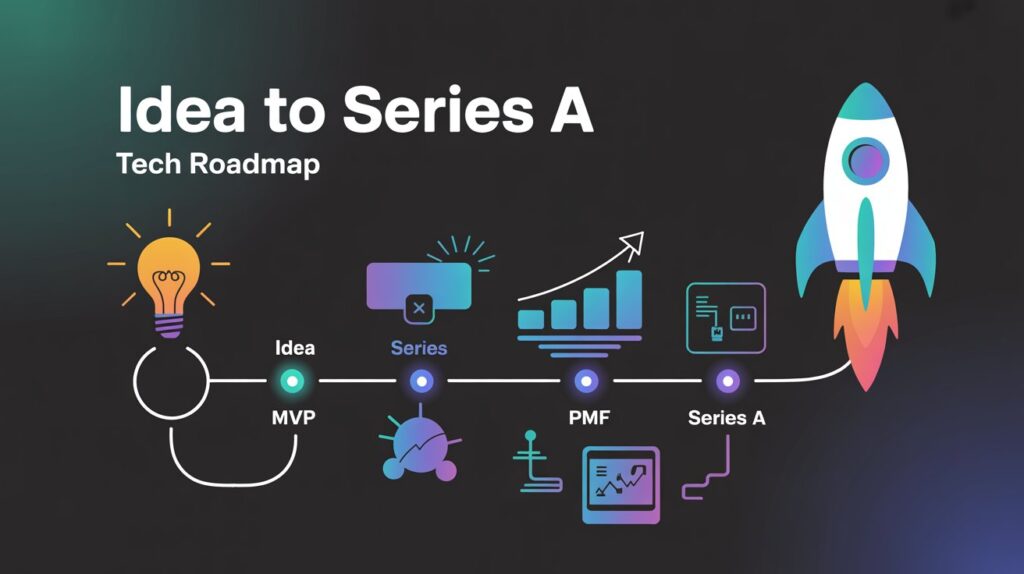
The Four Critical Stages of a Startup’s Tech Journey
Every startup goes through these stages (though timelines vary):
- Idea → Pre-Seed / MVP (0–6 months)
- MVP → Product-Market Fit (6–18 months)
- Product-Market Fit → Series A (12–30 months)
- Series A Readiness
Let’s break down what technology decisions actually matter at each stage.
Stage 1: Idea → Pre-Seed / MVP (Focus: Speed & Learning)
Goal: Validate the core problem and solution as fast and cheaply as possible.
Technology Priorities:
- Speed of building > technical elegance
- Ability to change direction quickly
- Low infrastructure and operational cost
- Easy to instrument and measure
Recommended Approach:
- Start with no-code/low-code tools where possible (Bubble, FlutterFlow, Softr, Retool, etc.)
- Use AI-assisted development heavily (Cursor, Claude, GitHub Copilot, v0, etc.)
- Choose simple, flexible stacks: Next.js + Supabase/Firebase + Vercel
- Avoid: Microservices, complex DevOps, custom infrastructure, heavy frontend frameworks
Key Principle: Your first version should be embarrassingly simple. If it’s not embarrassing, you probably built too much.
Common Mistake: Hiring senior engineers or building complex architecture too early.
Stage 2: MVP → Product-Market Fit (Focus: Learning & Iteration)
Goal: Find a repeatable, scalable way to acquire and retain users who love your product.
Technology Priorities:
- Rapid iteration capability
- Strong analytics and observability
- Ability to run experiments quickly
- Reliable core user flows
Recommended Approach:
- Move toward a more structured but still simple stack
- Invest in proper analytics (PostHog, Mixpanel, Amplitude, or custom)
- Build internal tools for your team (admin panels, support tools)
- Start documenting processes and code standards
- Consider your first key technical hire (if you haven’t already)
Key Principle: At this stage, speed of learning is your competitive advantage. Every technical decision should be evaluated against “How fast can we test and iterate?”
Common Mistake: Optimizing for scale before you have product-market fit. Premature optimization is still the root of much wasted startup capital.
Stage 3: Product-Market Fit → Series A (Focus: Scalability & Reliability)
Goal: Prove you can grow efficiently and reliably while preparing for the next level of scale.
Technology Priorities:
- Reliability and performance at current scale
- Clear path to 10x scale
- Security, compliance, and data protection
- Developer productivity and onboarding
- Cost efficiency at growing usage
Recommended Approach:
- Move to more robust infrastructure (proper cloud architecture, CI/CD, monitoring)
- Start thinking about data strategy and infrastructure
- Build or improve internal tooling and developer experience
- Begin technical documentation and knowledge management
- Plan for compliance needs (SOC 2, GDPR, HIPAA, etc. if relevant)
Key Principle: You should be able to explain to investors exactly how your current architecture can scale 10x — and what the next bottlenecks will be.
Common Mistake: Still running everything on a single server or very basic infrastructure when you have real usage and are raising money.
Stage 4: Series A Readiness – What Investors Actually Care About
When raising Series A, investors will look at your technology through these lenses:
1. Can this scale?
They want to see that you understand your current bottlenecks and have a realistic plan to address them.
2. Is the team credible?
They want to see that you have the right technical leadership (or access to it) for the next stage.
3. Are you building defensibility?
This could be through technology (proprietary models, data advantages, infrastructure) or through speed and execution.
4. Are you responsible with capital?
Investors love seeing that you’ve been thoughtful about technology spend and haven’t over-engineered.
What Good Looks Like at Series A:
- Clear architecture diagram and scaling plan
- Documented processes and technical standards
- Reasonable technical debt (not zero, but manageable)
- Team that can explain trade-offs they’ve made
- Infrastructure costs that make sense relative to revenue/usage
Strategic Technology Decisions That Actually Matter
Tech Stack Choices
- Early stage: Optimize for speed and flexibility
- Later stage: Optimize for scale, reliability, and team productivity
- Never choose a stack because it’s trendy — choose it because it solves your current problems efficiently
Hiring Strategy
- Pre-PMF: Small team + heavy use of AI + staff augmentation for specific needs
- Post-PMF: Start building a core in-house team while still using augmentation strategically
- Series A: You should have a clear technical leader (CTO or Head of Engineering) and a plan for the next 12–18 months of hiring
Infrastructure & DevOps
- Don’t over-invest before you need to
- Use managed services aggressively early on
- Start building internal platform capabilities only when developer productivity becomes a bottleneck
Security & Compliance
- Start thinking about it earlier than you think you need to
- SOC 2 Type I by Series A is increasingly expected for B2B SaaS
- Data privacy and security are now table stakes, not differentiators
Final Thoughts
Raising Series A is not just about having users or revenue. It’s about proving that you have a repeatable, scalable, and capital-efficient engine — and technology is a core part of that engine.
The best founders I work with don’t treat technology as a cost center or a black box. They treat it as a strategic capability that evolves with their business.
They make deliberate trade-offs. They invest in learning. They build just enough infrastructure to support their current stage — and no more.
If you’re building a startup right now, here’s my challenge to you:
Look at every major technology decision you’re about to make and ask:
“Does this help us learn faster or scale more efficiently at our current stage — or am I building for a future we haven’t validated yet?”
The honest answers to that question will save you months of time and hundreds of thousands of dollars.
The startups that win Series A in 2026 won’t necessarily be the ones with the most beautiful code or the most sophisticated infrastructure.
They’ll be the ones who built exactly what they needed, when they needed it — and could clearly explain why.
That’s the real technology strategy.