I recently audited the websites of 27 mid-sized companies in India. Only three of them would still perform well in 2026. The rest? They looked decent in 2023, but today they feel slow, outdated, and — worst of all — they’re quietly losing customers every single day.
One manufacturing company came to me after their website generated only 11 leads in an entire quarter. After a complete overhaul focusing on modern web development standards, they started getting 40–50 qualified leads per month. Same business. Same products. Just a website that actually works in today’s world.
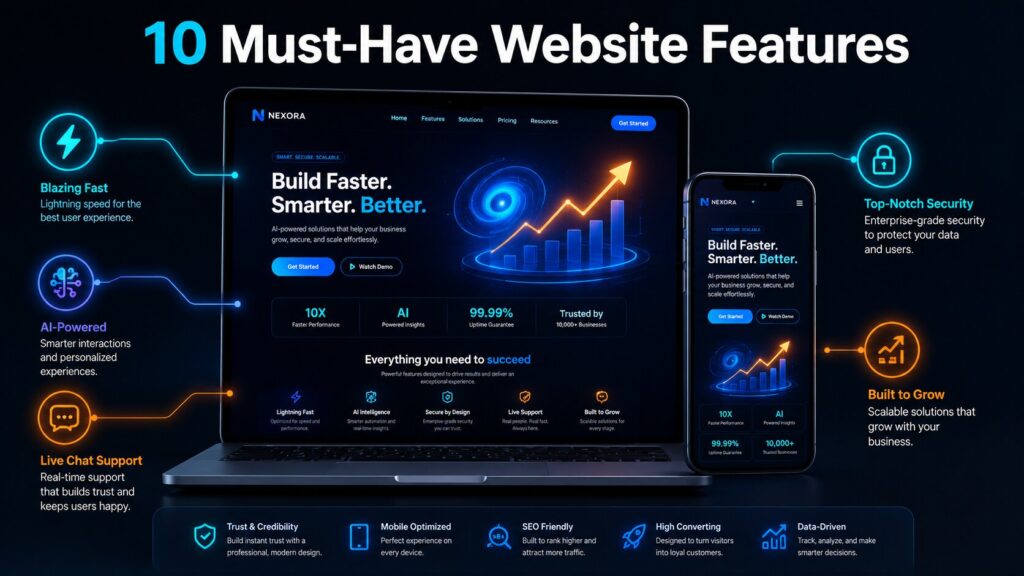
If your website was built before 2024, there’s a very high chance it’s hurting your business right now. This article gives you the exact 10 features every serious business website must have in 2026 to stay competitive and drive real revenue.
1. Lightning-Fast Loading Speed (Under 2 Seconds)
In 2026, speed is no longer a “nice to have” — it’s table stakes.
Google’s Core Web Vitals have become even stricter. If your site takes more than 2.5 seconds to load, you’re losing visitors before they even see your offer.
What top websites do:
- Use modern image formats (WebP & AVIF)
- Implement lazy loading + proper caching
- Leverage CDN (Content Delivery Network)
- Minimize JavaScript execution
- Use server-side rendering or static site generation where possible
Real impact: One e-commerce client saw a 34% increase in conversion rate simply by reducing load time from 4.8 seconds to 1.4 seconds.
2. Mobile-First & Fully Responsive Design
More than 68% of web traffic in India now comes from mobile devices. Yet many businesses still design for desktop first and then “make it responsive.”
In 2026, you must design mobile-first. That means:
- Touch-friendly buttons and navigation
- Readable fonts without zooming
- Fast mobile navigation menus
- Optimized checkout flows for small screens
3. AI-Powered Personalization
This is the biggest differentiator in 2026.
Modern websites don’t show the same content to every visitor. They adapt based on:
- Location
- Past browsing behavior
- Industry or company size
- Time of day
Examples:
- Show different case studies to manufacturing vs healthcare visitors
- Recommend relevant products or services automatically
- Display localized pricing or offers
Even basic personalization can boost engagement by 25–40%.
4. Seamless Multi-Language Support
If you want to expand beyond your state or country, this is non-negotiable.
Not just Google Translate — proper i18n (internationalization) with:
- Culturally appropriate messaging
- Right-to-left support if needed
- Region-specific content
- Automatic language detection
Indian businesses targeting Middle East, Africa, or Europe are gaining massive advantages here.
5. Advanced Security & Trust Signals
In 2026, users are extremely cautious.
Must-have security features:
- SSL certificate (obviously)
- GDPR + DPDP Act compliance
- Visible trust badges
- Clear privacy policy that’s easy to understand
- Two-factor authentication for client portals
- Regular security audits and badges
One security breach or loss of trust can destroy years of brand building.
6. Powerful Conversion-Focused Design
Your website exists to convert visitors into leads or customers.
Essential elements:
- Clear, benefit-driven headlines above the fold
- Strong calls-to-action (CTAs) that stand out
- Strategic lead capture forms (not too early, not too late)
- Social proof — real testimonials with photos and video
- Exit-intent popups (used tastefully)
- One-click contact options (WhatsApp chat, click-to-call)
7. Integrated Chat & Instant Communication
Live chat is dead. Instant, intelligent communication is alive.
Best setups in 2026 include:
- AI chatbots that can answer 70–80% of common questions
- Seamless handoff to human agents
- WhatsApp Business integration (huge in India)
- Video chat option for high-value inquiries
8. SEO That Actually Works in 2026
SEO has evolved dramatically.
Modern requirements:
- E-E-A-T signals (Experience, Expertise, Authoritativeness, Trustworthiness)
- Helpful, in-depth content
- Proper schema markup
- Voice search optimization
- Zero-click answer optimization
- Fast, crawlable architecture
Your website must be built to rank for both transactional and informational queries.
9. Analytics & Data Intelligence Dashboard
You can’t improve what you don’t measure.
Every serious website in 2026 has:
- Real-time analytics
- Heatmaps and session recordings (tools like Hotjar, Microsoft Clarity)
- Conversion funnel tracking
- User behavior insights
- ROI measurement on marketing campaigns
This data should be easily accessible to both marketing and leadership teams.
10. Easy Content Management & Future Scalability
Your website shouldn’t require a developer every time you want to update content.
Look for:
- Intuitive CMS (not necessarily WordPress — there are better options now)
- Headless CMS architecture for flexibility
- Easy integration with new tools and platforms
- Modular design so new pages and features can be added without rebuilding everything
Bonus Emerging Features (2026+)
- Dark mode by default
- Immersive 3D product visualization
- Voice navigation
- Progressive Web App (PWA) capabilities
- Carbon footprint display (for conscious brands)
How Much Should This Cost?
A properly built modern business website in 2026 typically costs between $5000 to $20000 depending on complexity. Cheap websites built on old templates will cost you far more in lost opportunities.
The ROI Reality
A great website doesn’t just look good — it becomes one of your strongest sales and marketing assets. Many of our clients recover their entire investment within 4–7 months through increased leads and conversions.
Final Thoughts
Your website is often the first (and sometimes only) impression people have of your business. In 2026, a mediocre website doesn’t just look outdated — it actively works against you.
Take 30 minutes this week and evaluate your current website against these 10 features. Be brutally honest.
If you’re missing more than 4 of them, it’s time for a serious upgrade.
The businesses winning right now aren’t necessarily the ones with the best products. Often, they’re the ones with websites that make it incredibly easy for customers to understand, trust, and buy from them.
Modern web development isn’t about flashy animations. It’s about creating digital experiences that convert visitors into loyal customers — efficiently, beautifully, and reliably.
Your move.