Last year, I watched a promising startup lose eight months and almost $400,000 because they jumped straight into coding without a proper development process. Their code was beautiful, but the final product was completely misaligned with what customers actually needed.
On the other hand, a logistics company I worked with followed a disciplined yet flexible Software Development Lifecycle. They delivered their platform in just 5 months, on budget, and their first version already solved 80% of their customers’ biggest problems.
The difference wasn’t talent. It was how they approached the Software Development Lifecycle (SDLC).
In 2026, the SDLC is no longer the rigid, waterfall-style process many of us learned years ago. It has evolved into something smarter, faster, and more human-centered. This guide will walk you through exactly how modern teams are building high-quality software in today’s world.
What SDLC Really Means in 2026
The Software Development Lifecycle is the structured process of planning, creating, testing, deploying, and maintaining software. But today’s version is far more adaptive than the old models.
Modern SDLC combines:
- Speed of Agile
- Reliability of DevOps
- Intelligence of AI-assisted development
- Focus on user outcomes instead of just features
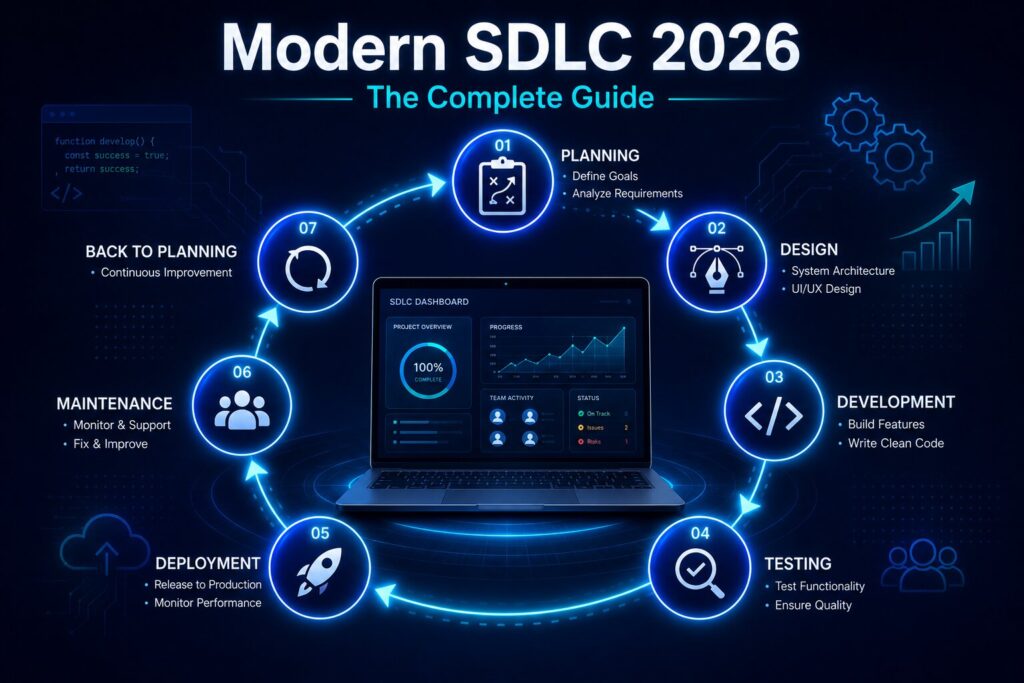
It’s no longer a straight line — it’s a continuous loop.
Why a Strong SDLC Matters More Than Ever
Poor processes cause:
- 52% of projects to exceed budget (Standish Group)
- 44% to miss deadlines
- Massive technical debt that slows future development
A well-designed SDLC reduces risk, improves quality, speeds up delivery, and — most importantly — increases your chances of building something people actually love and pay for.
The 7 Stages of Modern SDLC in 2026
Here’s how leading teams structure their development process today:
1. Planning & Discovery (The Foundation)
This stage has grown in importance. Smart teams now spend 15–25% of total project time here.
Key activities:
- Stakeholder interviews and requirements gathering
- Market and competitor research
- Defining success metrics (North Star + secondary KPIs)
- Technical feasibility assessment
- Risk analysis and mitigation planning
2026 Tip: Use AI tools to analyze competitor apps and generate initial user stories automatically, but always validate them with real humans.
2. Requirements & Analysis
Move beyond “what the client asked for” to “what the user actually needs.”
Create:
- Detailed user personas
- User stories and acceptance criteria
- Prioritized backlog using MoSCoW or RICE scoring
- Data models and system architecture outline
3. Design (UI/UX + Technical)
Split into two parallel tracks:
User Experience Design:
- Wireframes and prototypes
- User flow mapping
- Usability testing with real users
Technical Design:
- System architecture
- Database design
- API specifications
- Technology stack finalization
- Security and compliance architecture
4. Development (Where the Magic Happens)
Modern development is highly collaborative and iterative.
Best practices in 2026:
- 2-week sprints with clear goals
- Trunk-based development or GitFlow (depending on team size)
- AI pair programming tools (significantly faster coding)
- Automated code reviews and quality gates
- Daily code integration
5. Testing & Quality Assurance
This is no longer just “finding bugs.”
Modern testing includes:
- Automated unit, integration, and regression tests
- Performance and load testing
- Security penetration testing
- Accessibility testing
- Real-user beta testing
Aim for 80%+ automated test coverage on critical paths.
6. Deployment & Release
Continuous Integration / Continuous Deployment (CI/CD) is now standard.
In 2026, top teams use:
- Feature flags to release gradually
- Blue-green or canary deployments (zero downtime)
- Automated rollback capabilities
- Observability tools that monitor performance in real time
7. Maintenance & Continuous Improvement
This stage never really ends.
Focus on:
- Monitoring user behavior and system health
- Collecting feedback through multiple channels
- Regular security patches and updates
- Technical debt reduction sprints
- Planning the next major version
Popular SDLC Methodologies in 2026
| Methodology | Best For | Pros | Cons | 2026 Suitability |
|---|---|---|---|---|
| Agile + Scrum | Most web/mobile products | Fast feedback, flexibility | Can lack documentation | Very High |
| Kanban | Support, maintenance, operations | Continuous flow, less ceremony | Less predictability | High |
| DevOps / DevSecOps | Cloud-native, enterprise | Speed + security + reliability | Requires mature culture | Extremely High |
| Hybrid (Shape Up) | Startups & product teams | Fixed time, flexible scope | Needs strong discipline | Rising Fast |
| Waterfall | Highly regulated projects | Clear documentation, predictability | Slow and inflexible | Limited |
Tools That Power Modern SDLC in 2026
- Planning: Jira, Linear, ClickUp, Productboard
- Design: Figma, FigJam, Maze (for testing)
- Development: GitHub Copilot, Cursor, modern IDEs
- CI/CD: GitHub Actions, GitLab CI, ArgoCD
- Monitoring: Datadog, New Relic, Sentry
- Collaboration: Slack + Notion + Loom
Common SDLC Mistakes Even Experienced Teams Make
- Skipping or rushing Discovery — Leads to building the wrong thing
- Treating requirements as fixed — Markets change fast
- Insufficient automated testing — Creates fragile software
- Poor handoff between teams — Causes delays and frustration
- Ignoring technical debt until it becomes critical
- Measuring success only by “on time and on budget” instead of business outcomes
Real-World Success Patterns
Spotify famously uses a “Squads, Tribes, Guilds” model combined with Agile — giving teams autonomy while maintaining alignment.
Linear (the project management tool) ships new features extremely fast because their entire SDLC is built around simplicity and developer experience.
Stripe maintains one of the highest-quality codebases in the industry through obsessive focus on testing, documentation, and incremental releases.
How to Adapt SDLC for Different Company Sizes
- Early Startups: Keep it extremely lightweight. Focus on learning speed over perfection.
- Growing Companies: Add more structure and automation as team size increases.
- Enterprise: Emphasize compliance, documentation, security, and governance without killing speed.
Tools and processes are important, but great software is still built by people. The best teams I’ve seen combine strong processes with:
- Psychological safety (people can admit mistakes)
- Clear ownership
- Regular celebration of wins
- Honest retrospectives
Final Thoughts
The Software Development Lifecycle in 2026 is not about following rigid rules. It’s about creating a repeatable system that reduces risk while maximizing learning and delivery speed.
Whether you’re building your first product or scaling a complex platform, investing time in designing the right SDLC will save you months of wasted effort and hundreds of thousands in unnecessary costs.
Take one action today: Review your current development process. Identify the weakest stage. Strengthen it before your next sprint or project begins.
The teams that master modern SDLC aren’t necessarily the ones with the biggest budgets or brightest engineers. They’re the ones who turn good ideas into great software — consistently, predictably, and with delighted users.
That’s the real competitive advantage in 2026 and beyond.