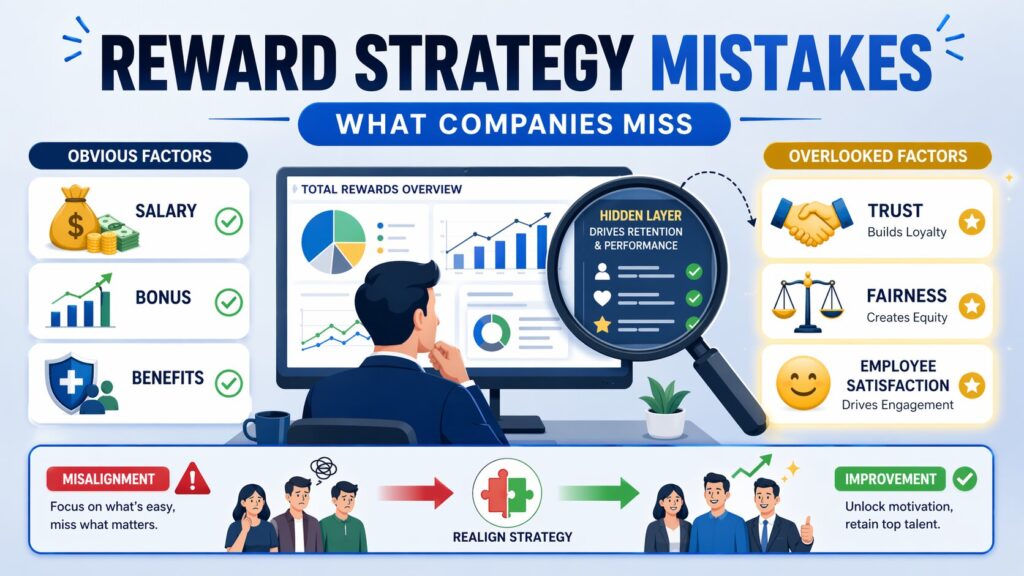
Reward strategy reviews often start with good intentions: benchmark salaries, tweak bonus mechanics, refresh benefits, move on. Yet the organisations that treat reward as a living system—one that shapes behaviour, trust, and performance—tend to get more value (and fewer unintended consequences) from the same budget.
So what gets missed? Usually, it’s not the big-ticket items. It’s the “in-between” factors: the assumptions baked into pay structures, the stories employees tell themselves about fairness, and the operational reality of administering rewards consistently at scale.
Below are the most common blind spots I see when organisations revisit reward strategy, plus practical ways to address them.
The hidden risks of treating reward as a pricing exercise
Benchmarking isn’t strategy
Market data is essential, but it’s a compass—not a destination. Companies often over-index on matching a median figure without asking the strategic question: What do we need reward to achieve here? Attraction in scarce roles? Retention of high performers? Mobility across functions? A stronger performance culture?
A benchmark-driven approach can also produce strange outcomes:
- New hires leapfrog incumbents because offers track “today’s market,” while internal salary movement lags.
- Specialist teams are paid like their market peers, but managers aren’t equipped to explain the difference to adjacent functions.
- Pay ranges widen over time without a clear philosophy about progression.
The fix is simple but requires discipline: define a small set of reward principles (e.g., “pay for sustained impact,” “internal equity matters as much as external competitiveness,” “transparency beats mystery”), then evaluate every change against those principles.
You can’t spreadsheet your way out of trust issues
Reward strategy is inseparable from employee trust. If people believe decisions are inconsistent—or worse, arbitrary—no amount of clever design will land well. The tricky part is that trust issues don’t show up in compensation models. They show up in exit interviews, engagement surveys, and manager “workarounds.”
When reviewing reward, ask: Where do employees feel the system is unfair, and why? That “why” often points to a fix that has little to do with pay levels. It might be unclear job scopes, inconsistent performance ratings, or a benefits policy that reads well but is impossible to access in practice.
The overlooked middle: job architecture, governance, and capability
Job architecture is the foundation—yet it’s often shaky
Many organisations attempt to modernise reward while standing on a patchwork of job titles, legacy grades, and inconsistent levelling. That makes everything harder: benchmarking, pay progression, internal mobility, and pay equity analysis.
A useful review question is: Could two managers place the same role at the same level, using the same criteria? If the answer is “not reliably,” then pay decisions will vary by manager confidence rather than role value.
You don’t need a perfect job architecture to move forward, but you do need:
- Clear role families and levels for the most common and most contested roles
- Consistent decision criteria (scope, complexity, impact, skills depth)
- A governance path for exceptions
Reward governance is where good designs go to die
Even strong reward frameworks unravel if governance is vague. Who can approve off-cycle increases? How are counteroffers handled? What happens when a business unit wants a bespoke allowance? If the answer is “it depends who shouts loudest,” then the real reward strategy is informal—and employees can sense it.
This is also where specialist expertise pays off. In many reviews, HR teams realise they need deeper capability in reward analytics, policy design, and stakeholder management to make changes stick. It’s common to consult specialists in reward and benefits recruitment when building that capability, especially when the organisation is scaling or shifting its operating model and needs experienced reward leadership to steer governance and implementation.
Managers are the delivery mechanism—and they’re underprepared
Reward strategy “happens” in manager conversations: performance reviews, promotion discussions, offer negotiations, and the day-to-day moments when people ask, “Am I valued here?”
Yet managers are often handed a set of pay ranges and told to “communicate confidently.” That’s not fair on them, and it’s risky for the organisation. A review should assess manager capability as seriously as it assesses salary structures.
Consider:
- Do managers understand how pay progression works in practice?
- Can they explain the difference between performance, potential, and role scope?
- Do they know what they can and can’t promise?
If not, your reward strategy may be technically sound but operationally fragile.
Benefits and recognition: where “value” is frequently misread
Utilisation beats generosity
Organisations love adding benefits. Employees love benefits they can actually use. The gap between the two is where money quietly leaks.
A smart review looks beyond what’s offered and asks:
- Which benefits are used by which employee segments (and which aren’t)?
- What’s the friction—eligibility rules, admin complexity, lack of awareness, stigma?
- Are benefits aligned with workforce realities (hybrid work, caring responsibilities, neurodiversity, regional cost differences)?
Often, small adjustments drive disproportionate value: simplifying access, improving communications, or redesigning a benefit around life stages rather than one-size-fits-all.
Recognition is part of reward, even if it’s not in payroll
If recognition programmes feel performative, they can do more harm than good. But when recognition is timely, specific, and connected to real behaviours, it reinforces culture in a way pay alone can’t.
Keep it grounded: focus on peer-to-peer recognition for everyday impact, and reserve larger awards for measurable outcomes. If everything is “above and beyond,” nothing is.
Equity, transparency, and the long tail of unintended consequences
Pay equity analysis isn’t a once-a-year audit
Many organisations run pay equity checks as an annual compliance exercise. A more mature approach builds equity into routine processes: hiring, promotions, performance ratings, and off-cycle adjustments.
A practical step is to examine where inequity tends to enter the system:
- Starting salary negotiation patterns
- Discretionary bonuses without clear criteria
- Promotion timing and nomination processes
Here’s the one place a short checklist helps. When reviewing reward decisions, test for:
- Consistency: Would this decision be the same in another team?
- Evidence: What data supports it (performance, scope, outcomes)?
- Precedent: Does it create a rule you’ll need to apply again?
- Explainability: Can a manager justify it clearly and respectfully?
Transparency isn’t all-or-nothing
Transparency tends to get framed as a binary choice: publish pay bands or keep everything confidential. In reality, most organisations can increase transparency without exposing individual salaries.
Start with clarity:
- How are pay ranges set?
- What drives movement within a range?
- What does “promotion-ready” mean here?
When employees understand the rules of the game, they don’t have to invent them—and you reduce the rumour economy that often surrounds pay.
Turning a reward review into a strategic advantage
A reward strategy review is a chance to do more than “keep up with market.” It’s a moment to rebuild credibility, sharpen decision-making, and align investment with the behaviours you actually want.
If you’re planning a refresh, pressure-test the fundamentals first: job architecture, governance, and manager capability. Then look at pay and benefits through the lens of utilisation, equity, and trust—not just cost.
Because in the end, the most effective reward strategies aren’t the most complicated. They’re the ones employees can understand, managers can deliver, and leadership can defend with a straight face.