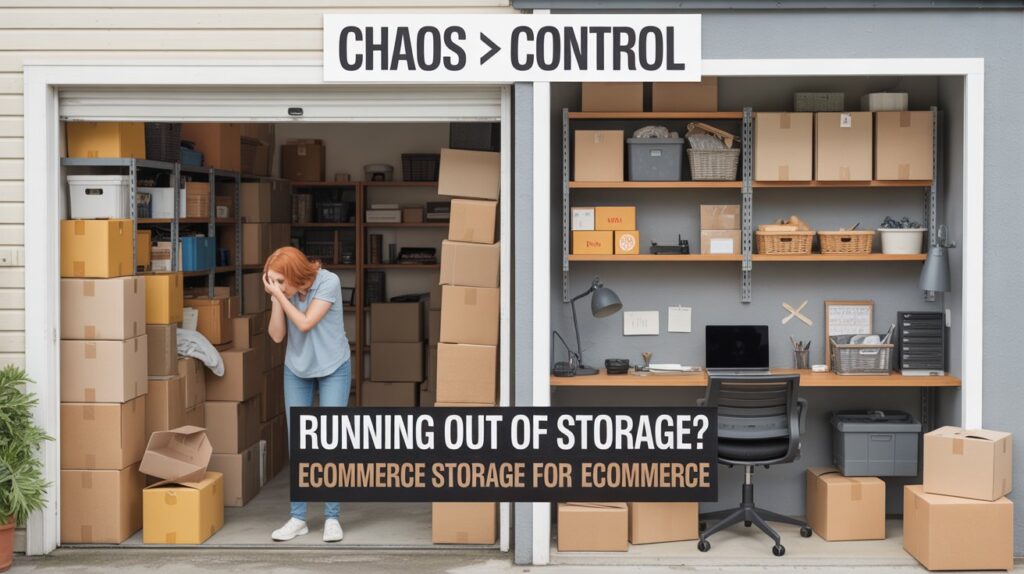
No more storage space for inventory?
Every ecommerce business owner has been there.
Orders are selling, new products are constantly getting added to the lineup, and now your garage or spare bedroom looks like complete chaos.
It’s at this moment you realize…
Storage Space is expensive. Unless you develop a plan for commercial business storage you will struggle to grow.
Luckily, there are strategies you can employ to conquer the storage game. These storage solutions have helped ecommerce businesses scale for years. Let’s dig in.
You’ll Learn:
- Why Storage for Ecommerce Businesses Is Unique
- How Much Does Poor Storage Really Cost
- 6 Storage Solutions that Work for Real Ecommerce Businesses
- How To Pick The Perfect Storage Solution
Storage For Ecommerce Businesses Is Unique
Warehousing your ecommerce inventory is different from storing stuff for brick and mortar retail shops.
Take a moment and visualize how you’re currently storing ecommerce inventory.
Your customers aren’t browsing through your stock picking out what they want. Unlike retail shops your ecommerce warehouse needs to package unrelated SKUs together at lightning fast speed.
Ecommerce warehouses need to be optimized to fit thousands of SKUs for multiple products all while staying organized enough to ship anything in your store at a moment’s notice.
With that being said…
Some online sellers may start storing inventory at home. But once you start surpassing orders you’re packed to capacity. You’ll need space specifically for your business. Places that offer storage units in Arizona give small businesses the space they need without having to commit to a costly long term warehouse storage lease.
Especially for seasonal businesses, flexibility is key.
How Much Does Poor Storage Really Cost
Messy storage isn’t convenient. It can also cost your business money.
43% of small businesses track inventory manually or not at all.
Could your storage be costing you sales?
Think about what bad storage leads to…
- Products getting damaged due to poor storage
- Lost sales from being out of stock
- Valuable time trying to find products
- Losing sales on shipping costs due to inefficient order fulfillment
- Customers complaining about late orders
Now think about how good storage could help your business.
Businesses that utilize efficient storage increase their order fulfillment rates and customer satisfaction.
If you improve how you store your inventory you could save weeks of time back that you’ve lost searching through piles of inventory.
6 Storage Solutions That Actually Work
Now comes the fun part. Here are 6 storage solutions that every growing ecommerce business should consider.
Vertical Storage
Go Vertical!
Until now you may have only been using floor space. Maximize your vertical space by adding shelving. You’ll be able to double how much inventory you can store overnight.
Don’t forget about accessibility!
Place your slower moving products on the taller shelves. Rotate your fast movers to eye level for faster picking.
Self Storage
You don’t need a giant warehouse.
Renting a self storage unit is a great way for ecommerce businesses to have a space solely dedicated to storing inventory. Self storage is one of the fastest growing industries at 6.5% per year. Business owners are discovering how beneficial self storage can be.
Why’s self storage so great?
- Rent month to month
- Many self storage facilities offer climate controlled units.
- Secure facilities with cameras and gated access
- No long term contracts
This is perfect if you only need extra storage during busy seasons. Load up on inventory before the holidays without committing to a big warehouse.
Just-In-Time Inventory
There’s a storage solution that eliminates storage problems altogether.
Just-In-Time or JIT inventory requires you to only order new products when you need them. Instead of keeping months of inventory on hand. Ecommerce businesses using JIT place smaller quantities of inventory and restock more often.
Sounds simple enough but what are the downfalls?
You’ll most likely pay more money in shipping but you’ll save on storage. It’s a nice trade off that many ecommerce businesses are starting to take advantage of.
This may require you to have a great relationship with your suppliers. You don’t want to be left without inventory in case your supplier messes up.
Third Party Logistics
Outsource storage and fulfillment.
Third party logistics or 3PL’s are companies that will do the heavy lifting for you. They’ll provide the storage, pick the products, package the orders and ship them out. Using a 3PL can completely eliminate the need to think about storage altogether.
When to consider 3PL?
- Your order volume has outgrown your ability to store and fulfill at home.
- You think multiple shipping locations would benefit your customer.
- You just don’t have time to manage inventory.
Keep in mind that using a 3PL will likely cost you more per order. However, think about how much your worth if you can outsource time consuming tasks like order fulfillment.
Inventory Management Software
Don’t underestimate the power of technology.
With real-time inventory tracking you’ll know exactly how much of each product you have in stock at all times. Set automated re-order points for your software to notify you when it’s time to restock. Use analytics to identify which products should be taking up prime real estate.
Here are some scary statistics…
Only 22% of small businesses utilize inventory management software. If your one of them you have a huge leg up on your competition.
Product Line Optimization
Only store your best sellers.
Look over your sales data and determine what products are really crushing it. Then go through what’s actually been collecting dust. Sure you can always store more but why not do some spring cleaning.
Here are some questions to ask yourself:
- What products haven’t sold in the last 90 days?
- How much profit are you making on each SKU?
- Are any of your products taking up too much storage with little sales?
Trimming your product lineup doesn’t mean you’re failing. Smart business owners know that optimizing your product line can increase your storage capacity and profit margins.
Picking The Perfect Storage Solution
There’s no one size fits all solution when it comes to storage. Take into account your current situation and pick the solution that works best for you.
Here are some things to think about:
- How much product are you moving monthly? Are you steadily growing?
- Is your product large? Do you require climate controlled storage?
- How big is your budget? How will this affect your cash flow?
- Do you sell seasonal products?
Start small and scale as you grow. It would cost a lot to jump into a storage unit. It’s much harder to get out of a 3 year warehouse lease.
Use a combination of 2-3 storage solutions. Maybe use vertical storage at home, and outsource overflow to self storage. Or use JIT inventory for half your product line while outsourcing the rest.
Always think flexibly.
Ecommerce is constantly evolving. Don’t lock yourself into a storage solution that you might outgrow in a month’s time.
Wrap Up
Searching for more storage space doesn’t have to slow down your ecommerce business. Use these storage solutions to help your business continue to scale without skyrocketing overhead costs.
Let’s review…
- Use vertical storage to maximize space.
- Utilize storage units for flexible overflow storage.
- Apply just-in-time principles where you can.
- Outsource work with a 3PL.
- Use inventory software to maximize organization.
- Store only your best sellers.
The businesses that come out on top long term will be the ones that use storage to their advantage.
Don’t worry about trying to do it all at once. Focus on one storage solution and perfect it. Slowly your storage situation will start to get out of control.
That’s how you win the storage game.