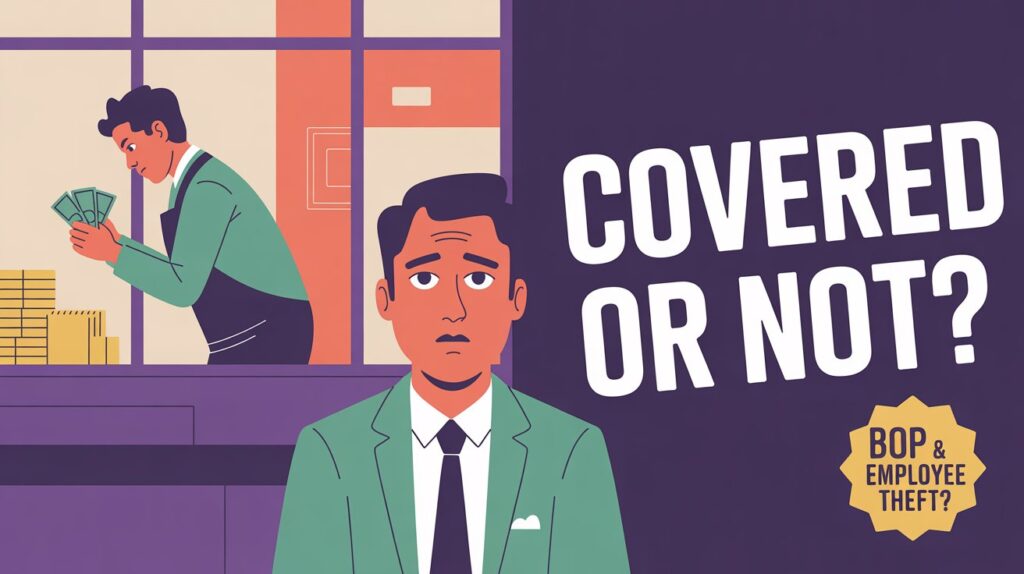
A standard Business Owners Policy (BOP) usually does not cover employee theft unless you add extra “employee dishonesty” or crime coverage to it. Some insurers bundle a small employee theft limit into a BOP, but it is never automatic for every policy and often far too low to protect you.
This is where many owners get caught. Your policy may say it covers “theft,” so you assume that includes employees—but in most policies “theft” only means burglars, robbers, or outside criminals, not the people on your payroll. At the same time, studies and insurer data show internal theft happens far more often than outside burglary and can be much more expensive. This guide walks you step by step through what your BOP really does, what it misses, and how to plug the gap so your business is not exposed.
What Is a Business Owners Policy (BOP)?
A Business Owners Policy is a bundled small‑business insurance package that combines property coverage and liability coverage in one policy, often with business interruption (business income) protection built in. It is designed for small and mid‑sized businesses that want basic, affordable protection in a single contract.
The key thing for you: a BOP focuses on outside risks (fire, storms, slip‑and‑fall, break‑ins), not on crimes your own employees commit against you.
What a Standard BOP Typically Covers
While wording varies, most BOPs include three core pieces of protection:
-
General liability – Covers bodily injury and property damage you cause to others (for example, a customer slips in your shop or you damage a client’s property on a job).
-
Commercial property – Covers your building (if you own it) and your business contents—equipment, stock, furniture—against risks like fire, certain weather events, vandalism, and many kinds of outside theft.
-
Business interruption (business income) – Replaces lost income and helps with extra expenses if a covered event (like a fire) shuts you down temporarily.
Specific covered causes of loss commonly include fire, wind or hail (depending on region), vandalism, burglary, robbery, and theft of physical items by outsiders.
What a Standard BOP Typically Excludes
Here are some things that are usually not covered by a plain BOP (without extra endorsements):
-
Employee dishonesty / employee theft – Commercial property insurance generally excludes theft by anyone on your payroll; it is written to cover outside thieves only.
-
Intentional acts by you or your partners – No policy will pay when the owner, partners, or the business itself steals or commits fraud.
-
Certain cyber crimes and funds‑transfer fraud – These are typically handled under separate cyber or crime policies, not standard property or liability forms.
-
Professional liability (errors and omissions) – Mistakes in your professional work (for example, accounting or consulting errors) need separate professional liability coverage.
This is why you cannot assume, “My BOP covers theft, so I’m fully protected.” It covers some theft, not all theft.
What Counts as Employee Theft?
For insurance purposes, “employee theft” or “employee dishonesty” is any intentional act by an employee to steal money, property, or other assets from your business for personal gain. It also often includes fraud where the employee manipulates records, systems, or payments.
Common examples include:
-
Cash register skimming – A cashier pockets part of the day’s cash instead of recording every sale.
-
Embezzlement – A trusted employee or manager quietly moves money out of company accounts, often over many months or years.
-
Payroll fraud – An employee inflates hours, creates “ghost employees,” or manipulates pay rates to steal extra wages.
-
Inventory theft – Staff steal products, parts, supplies, or materials for personal use or resale.
-
Forged checks – An employee signs or alters company checks or bank drafts without permission.
-
Unauthorized electronic transfers – An insider uses online banking access or accounting systems to move funds to a personal account.
Quick real‑life style example:
Your bookkeeper pays company bills, reconciles accounts, and has full access to online banking. Over six months, they quietly transfer small amounts—say 300–500 at a time—to their own account, coding them as vendor payments. By the time you notice a cash shortfall, they have stolen tens of thousands. This is the kind of slow, hidden loss employee dishonesty coverage is designed to address.
Does a Standard BOP Cover Employee Theft?
The Default Rule
In most cases, a plain BOP does not cover employee theft.
Commercial property coverage (which is part of a BOP) is built to cover burglary, robbery, and theft by outsiders—people who break in, rob your store, or steal equipment—not your own staff. Policies and agent articles are very clear that employee theft is specifically excluded from standard commercial property forms.
Some insurers add a small “employee dishonesty” limit (for example 10,000–50,000) into the BOP by endorsement, but this is not universal and depends on the company and the exact forms used. If you do not see this coverage and limit listed on your declarations page, you should assume you do not have employee theft protection.
Why It’s Excluded
Insurers exclude employee theft from basic property coverage for a few key reasons:
-
Moral hazard – If a policy automatically paid for any loss caused by insiders, it would be easier for dishonest owners or staff to abuse the system, and harder for an insurer to tell a real claim from staged theft.
-
Underwriting limits – Internal fraud can grow for months or years before discovery, and average employee theft losses in many sectors run into six figures or more. Because of that, insurers handle it under more specialized crime or fidelity forms with their own caps, conditions, and pricing.
So instead of rolling this risk into every BOP, most insurers keep it separate as a crime or employee dishonesty add‑on.
Important Policy Language to Look For
When you read your policy, check the property and crime sections carefully. Wording varies, but some red‑flag or key phrases include:
-
“Employee dishonesty” or “employee theft” under exclusions in the property section.
-
“Crime coverage not included” or no crime or fidelity section listed at all.
-
Notes that protection against employee theft is available only via a separate crime policy, fidelity bond, or endorsement.
Your declarations page (the summary near the front) should list any crime or employee dishonesty coverage, including the limit (for example, “Employee Dishonesty – 25,000”). If there is nothing there, coverage is almost certainly missing.
When DOES a BOP Cover Employee Theft?
Employee Dishonesty Endorsement
To protect against theft by employees, you normally need to add coverage to your BOP. Insurers call this by several names:
-
Employee dishonesty coverage
-
Employee theft coverage
-
Crime coverage or commercial crime coverage
-
Fidelity coverage or fidelity bond
Some companies, like Progressive Commercial, offer employee dishonesty specifically as an endorsement you can add onto a BOP, while others include small crime limits inside a BOP but allow you to increase them. Either way, the idea is the same: you bolt crime coverage onto your BOP so insider theft becomes a covered cause of loss.
What This Endorsement Covers
A typical employee dishonesty or employee theft endorsement can cover a wide range of dishonest acts, up to the limit you chose:
-
Theft of money – Cash taken from the register, safe, bank deposits, or petty cash.
-
Theft of property – Stolen inventory, tools, parts, supplies, or other physical assets.
-
Forgery and alteration – Employees forging signatures or altering checks, drafts, or financial documents.
-
Computer fraud and funds‑transfer fraud (sometimes) – Unauthorized electronic transfers, manipulation of digital records, or fraud carried out through your systems, when included in the crime form.
Every policy is a little different, so you must check which specific crime “insuring agreements” you have (for example, Employee Theft, Forgery, Computer Fraud, Funds Transfer Fraud).
Many small businesses start with a BOP; for official guidance on types of business insurance including BOP bundles, refer to the U.S. Small Business Administration‘s guide.
Coverage Limits & Sublimits
Employee theft coverage is usually written with its own limit and sometimes sublimits:
-
Common limits for BOP add‑ons – Many BOP‑based employee dishonesty endorsements sit in the 10,000–50,000 range, depending on your insurer and any “broadening” endorsements.
-
Higher crime limits – Standalone crime or broader employee dishonesty policies often offer limits from 100,000 up to 1 million or more, especially for larger or higher‑risk firms.
-
Deductibles – You will usually have to absorb a deductible (for example 1,000–2,500) before insurance pays, just like property coverage.
-
Per occurrence vs aggregate – Some policies cap each individual loss event, others set an annual maximum; many use a per‑occurrence limit with a separate overall cap across multiple forms of crime coverage.
Because employee theft can go on for years, one of the biggest traps is simply buying too small a limit. Several claim studies show real‑world crime claims often end up being far larger than owners first estimate.
Real‑World Scenarios: Covered vs Not Covered
Use these examples to picture how your own coverage would respond.
-
Scenario 1: Cash stolen by your cashier
-
A cashier pockets cash from the register over several months.
-
Coverage: This is not covered by standard property coverage, but would usually be covered if your BOP has an employee dishonesty or crime endorsement in place and the loss is proven.
-
-
Scenario 2: External burglary of your shop
-
Thieves break in overnight, smash a window, steal equipment and inventory, and damage the premises.
-
Coverage: This is typically covered under your BOP’s commercial property section as burglary or theft by outsiders, subject to deductibles and limits.
-
-
Scenario 3: Partner steals funds
-
Your business partner drains the company account and disappears.
-
Coverage: Most employee dishonesty and crime policies specifically exclude theft by owners, partners, or principals, so this is often not covered.
-
-
Scenario 4: Independent contractor steals
-
A freelance IT contractor with network access moves funds to their own account.
-
Coverage: Employee dishonesty coverage generally applies only to “employees” as defined in the policy, and many forms exclude contractors, vendors, and customers unless you add special “client coverage.” In most basic setups this would not be covered.
-
How Much Does Employee Theft Coverage Cost?
Average Cost in 2026
Actual prices depend on your business, but current insurer and broker data give a useful range.
-
Broad commercial crime or business crime insurance for small businesses often falls roughly between 650 and 2,500 per year, with minimum premiums as low as about 100 for very basic protection.
-
For a very small, low‑risk business, adding a modest employee dishonesty limit onto a BOP can often land in the roughly 150–500 per year range for basic coverage, while higher limits or broader crime forms push costs upward.
Remember: these are ballpark numbers. To know your exact cost, you will need actual quotes based on your revenue, staff count, and controls.
Factors Affecting Cost
Insurers look at several drivers when pricing employee theft or crime coverage:
-
Industry type – Cash‑heavy and inventory‑heavy sectors (retail, restaurants, hospitality, construction, and some healthcare) are viewed as higher risk.
-
Number of employees – More people with access to money or stock means more exposure.
-
Revenue and coverage limits – Higher sales and higher chosen limits both push premiums up.
-
Internal controls – Segregation of duties, dual approvals, regular audits, background checks, and security systems can all lower risk and sometimes qualify you for discounts.
-
Claims history – Prior theft or fraud claims will often raise your rates.
For budgeting, think of employee theft coverage as a small fixed cost that protects you from a loss that could literally shut your doors.
Industries Most at Risk of Employee Theft
Any business with employees faces this risk, but some sectors show higher incident counts or bigger losses in current studies:
-
Retail stores – Retail and restaurant sectors report some of the highest employee theft rates, with internal theft accounting for a large share of inventory loss. Staff handle cash and merchandise all day, often with high turnover and limited supervision.
-
Restaurants and bars – Tips, cash payments, alcohol, and food create many chances for skimming, under‑ringing, and taking stock home. Busy shifts and shift‑based work make close control hard.
-
Construction companies – Tools, equipment, and materials are valuable and often stored on sites with weaker security; construction also shows relatively high fraud and loss amounts in industry fraud data.
-
Medical offices and clinics – Healthcare organizations handle patient payments, insurance reimbursements, and sensitive data; employee dishonesty coverage is often recommended for health and finance sectors.
-
Small accounting and financial firms – Banking and financial services regularly rank among the top sectors for employee fraud cases and large losses. Even a small firm can lose huge sums if one insider abuses trust.
-
E‑commerce businesses – Even without a storefront, staff can steal through refunds, coupon abuse, unauthorized discounts, or misuse of payment and inventory systems, often blending into digital noise.
If your business handles a lot of cash, valuable inventory, or financial data, you should assume your exposure to employee theft is higher than average.
Common Misconceptions About Employee Theft Coverage
Here are some myths that cause painful surprises after a loss:
-
“My BOP automatically covers everything.”
Standard BOPs and commercial property policies do not cover employee theft unless crime or employee dishonesty coverage is added. -
“I trust my team, so I don’t need it.”
Surveys and fraud studies show that around 75% of employees admit to stealing at least once, and about 5% of business revenue is lost to employee fraud and abuse each year on average. Most large thefts are committed by trusted long‑term employees in positions of responsibility. -
“Workers’ comp covers employee theft.”
Workers’ compensation only covers injuries and illnesses suffered by employees on the job, not crimes committed by employees against your business. -
“Cyber insurance covers payroll or funds‑transfer fraud.”
Cyber policies usually focus on data breaches and attacks from outside hackers, while payroll fraud and many funds‑transfer issues are treated as employee dishonesty or crime issues instead. You need to check how your crime and cyber policies split these risks.
What Is NOT Covered Even With Employee Theft Coverage?
Even when you buy employee dishonesty or crime coverage, there are important gaps you should know about:
-
Theft by business owners or partners – Most policies specifically exclude dishonest acts by the insured business itself, its owners, partners, or principals.
-
Theft by people you already know are dishonest – If you know an employee has previously stolen and keep them anyway, later losses tied to that person may be excluded.
-
Losses without proof – Pure “inventory shrinkage” or unexplained shortages that you cannot tie to a specific act usually are not covered. Insurers want clear, documented evidence.
-
Indirect or consequential losses – Things like reputational damage, time spent investigating, and lost future sales are generally excluded as “indirect” losses.
-
Data, trade secrets, and some cyber‑related losses – Theft of confidential information, trade secrets, or pure data can fall under cyber or other policies, not employee dishonesty forms, unless specifically included.
This is why strong internal controls and documentation matter even when you have insurance—you need to be able to show what was stolen, how, and by whom.
How to Add Employee Theft Coverage to Your BOP
Here is a simple way to tighten your protection without getting lost in technical language:
-
Review your current policy declarations page
Look for any line that mentions Employee Dishonesty, Crime, Fidelity, or Commercial Crime, and note the limit and deductible. If you do not see it, assume you do not have it. -
Ask your insurer or broker about a crime or employee dishonesty endorsement
Tell them you want coverage for theft, fraud, forgery, and funds‑transfer fraud caused by employees, not just outside theft. Ask whether they offer it as a BOP add‑on or only as a separate crime policy. -
Choose proper limits
Use your cash flow, inventory value, and access levels to decide on a realistic limit. Many BOP endorsements start at 10,000–50,000, but higher limits like 100,000 or more may be wise if one trusted person controls large sums. -
Evaluate and strengthen internal controls
Insurers often price coverage and decide limits based in part on your controls—segregation of duties, approvals for payments, reconciliations, audits, background checks, and technology safeguards. Stronger controls can reduce both your risk and sometimes your premium. -
Compare quotes from a few providers
For the same limit, crime coverage prices can vary widely. Getting quotes from multiple insurers or through a broker helps you balance cost, coverage breadth, and service.
Going through these steps once a year when you renew your BOP keeps your crime protection aligned with how your business is actually operating right now.
How to File a Claim for Employee Theft
If you suspect or discover employee theft, quick, organized action is critical both for your finances and for your claim:
-
Document evidence immediately
Save bank statements, POS reports, invoices, emails, access logs, and any video or physical evidence that shows how the theft occurred and the amounts involved. -
File a police report
Most crime and employee dishonesty policies require you to report theft to law enforcement, and insurers expect to see that report. -
Notify your insurer promptly
Many policies bar coverage if a loss is not reported within a set time after discovery—60 or 90 days is common for employee dishonesty forms. Delayed reporting can absolutely void a claim. -
Provide detailed financial records
Your insurer will want a clear calculation of how much was stolen and over what period, often supported by an independent accountant or auditor. -
Cooperate with the investigation
Be ready for interviews, further document requests, and possibly examinations under oath; cooperation is usually a policy condition.
Treat a suspected theft as both a crime and a financial emergency—lock down access, consult legal and accounting help, and pull in your insurer early.
Should Small Businesses Add Employee Theft Coverage?
Even very small teams are not immune to fraud. How you think about this coverage changes a bit with your setup.
1–3 Employees
With only a few people, it is easy to think “nothing can slip past me,” but data shows otherwise: a significant share of small businesses report staff theft, and small firms often suffer the highest median losses when fraud hits. Because one dishonest person may control everything from deposits to bookkeeping, a single scheme can be devastating. For most small teams, a basic employee dishonesty limit is a smart, affordable layer of protection.
Cash‑Heavy Business
If your business handles a lot of cash—retail shop, restaurant, bar, salon, small grocery, convenience store—the risk from both customers and staff is especially high. In these sectors, internal theft often accounts for a large share of shrink or inventory loss, and many experts consider employee theft coverage “must‑have,” not optional.
Fully Remote Team
Remote work reduces some physical theft risk but raises digital ones. Employees can still commit:
-
Payroll fraud
-
Fake refunds or bogus vendor invoices
-
Unauthorized online transfers
-
Misuse of company cards or accounts
If your staff touches your accounting system, payment platforms, or customer data from home, employee dishonesty and crime coverage is still very important.
BOP vs Standalone Crime Insurance
Here is a simple side‑by‑side view to help you decide what makes sense for your business:
BOP Endorsement vs Crime Policy
| Feature | BOP + Employee Dishonesty Endorsement | Standalone Commercial Crime Policy |
|---|---|---|
| Cost | Lower add‑on cost; often roughly 150–500 extra per year for small limits in low‑risk businesses. | Higher; broad crime programs for small businesses often 650–2,500+ per year depending on limits and risk. |
| Limits | Usually lower (often 10,000–50,000; sometimes up to 100,000). | Higher and scalable (100,000 to 1,000,000+ common). |
| Customization | More limited menu of crime coverages; may only include basic employee theft and small forgery coverage. | Flexible; can mix and match employee theft, forgery, computer fraud, funds‑transfer fraud, client coverage, and more. |
| Best for | Smaller, lower‑risk businesses that want simple, affordable protection layered onto a BOP. | Medium to larger or higher‑risk businesses, or anyone needing higher limits and broader crime protection. |
For many small businesses, starting with a BOP endorsement and moving to a standalone crime policy as you grow is a practical path.
Final Verdict: Does a BOP Cover Employee Theft?
Put simply:
-
Standard BOP only (no add‑on) → ❌ Employee theft is almost never covered. Commercial property covers burglars and robbers, not dishonest staff.
-
BOP + Employee Dishonesty / Crime Endorsement → ✅ Employee theft is covered, but only up to the specific crime limits and subject to exclusions.
If your business holds cash, inventory, or sensitive financial data—and almost every business does—it is wise to treat employee theft coverage as a core protection, not a luxury. Larger or higher‑risk companies should seriously consider a full standalone crime policy with higher limits and tailored coverages. BOPs are popular for small businesses per the NAIC: Business Interruption Insurance/Businessowner’s Policies (BOP). However, internal risks like employee theft require additional protections.
Frequently Asked Questions
Is employee theft covered under commercial property insurance?
In almost all cases, no—commercial property insurance covers theft by outsiders (burglary, robbery, shoplifting) but specifically excludes employee theft. To cover insider theft, you need employee dishonesty or crime coverage.
What is employee dishonesty insurance?
Employee dishonesty insurance (also called employee theft, fidelity, or crime coverage) reimburses your business when employees steal money, property, or commit fraud, forgery, or similar dishonest acts, up to policy limits. It can be added to a BOP or purchased as part of a standalone crime policy.
Does BOP cover payroll fraud?
A plain BOP does not cover payroll fraud by employees. Payroll fraud (such as falsified hours or ghost employees) is usually only covered if you have employee dishonesty or crime coverage that specifically includes payroll‑related dishonesty.
Is embezzlement covered by insurance?
Embezzlement by employees can be covered under employee dishonesty or crime insurance, as long as you have that coverage in place and the loss fits the policy terms. It is not covered under standard property or general liability forms.
How much employee theft insurance do I need?
Think about how much a trusted insider could realistically steal before you would catch it—consider access to bank accounts, inventory, and payments—and set limits accordingly. Because typical fraud schemes last many months and median losses can reach into six figures in some industries, many experts suggest limits of at least 50,000–100,000 for small firms and higher for larger or high‑risk operations.
Does BOP cover theft by independent contractors?
Usually not. Employee dishonesty coverage generally applies only to “employees” under the policy definition and excludes contractors, vendors, and customers unless you add special client or third‑party crime coverage. If contractors have access to your systems or funds, ask your broker about extending crime coverage to that exposure.