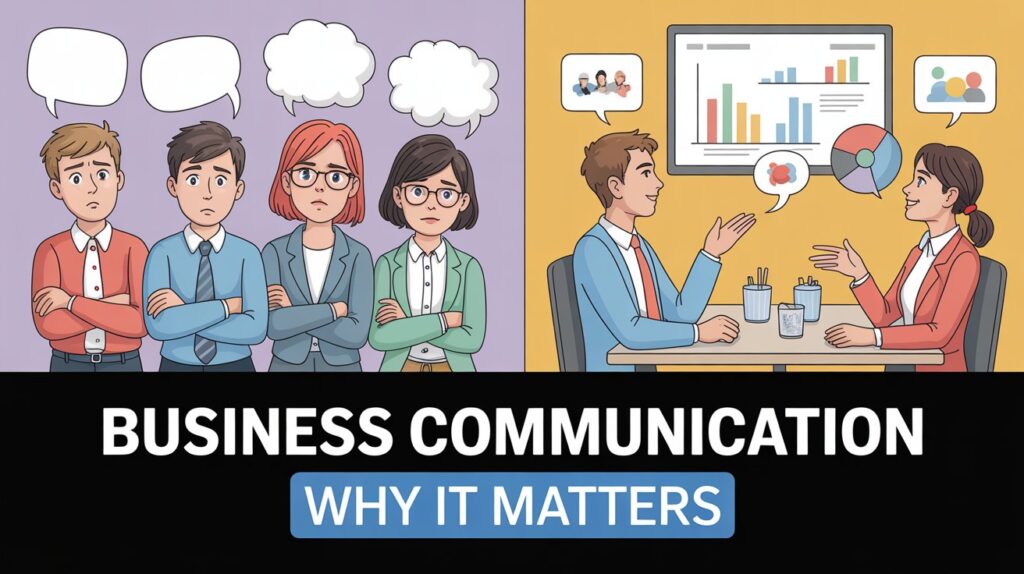
Imagine this: A manager sends a quick email saying “We need to redesign the product strategy.” The design team interprets this as a complete overhaul. Three weeks and thousands of dollars later, the team discovers that the manager only wanted minor adjustments to the pricing model. The redesign effort gets scrapped. Both teams are frustrated. Deadlines slip. Trust erodes.
This isn’t a rare occurrence. It happens in organizations every day, and it costs real money.
Business communication is simply the exchange of information between people in a workplace—whether that’s through conversations, emails, meetings, or presentations. But here’s the thing: it’s not just about sharing information. It’s about making sure the message sent is the same message received, and that both parties understand what happens next.
Why does this matter now more than ever? Because your business moves at lightning speed. Remote teams are scattered across time zones. Decisions need to happen faster. Customers expect instant responses. One miscommunication can snowball into missed deadlines, lost revenue, damaged relationships, or even a company’s reputation in ruins.
In this article, you’ll learn why communication isn’t just a nice-to-have skill—it’s the lifeblood of business success. We’ll explore how communication shapes everything from employee motivation to customer loyalty, and I’ll give you practical, actionable steps to improve how you and your team communicate.
What Is Business Communication?
Before we dive into why communication matters, let’s be clear about what we’re talking about.
Business communication is any exchange of information that helps your organization run. That includes your morning standup meeting, an email update to a client, feedback given to an employee, or a presentation to investors. But it’s more nuanced than that.
Internal vs External Communication
Internal communication happens inside your company—between employees, between departments, from leadership to staff. It’s how you keep everyone aligned, motivated, and informed.
External communication goes beyond your walls. It’s how you talk to customers, partners, investors, and the public. This shapes your reputation and builds relationships that matter.
Formal vs Informal Communication
Some communication is structured and documented. A formal meeting with an agenda, official reports, policies, and procedures. This matters because it creates a paper trail and ensures consistency.
But don’t underestimate informal communication. A chat by the coffee machine. A quick Slack message. A hallway conversation between two colleagues. Often, these informal channels are where real work gets done, where problems get solved, and where people actually feel connected.
The best organizations blend both. They have clear formal processes, but they also encourage open, casual dialogue.
One-Way vs Two-Way Communication
One-way communication is broadcasting. You send a message, and people receive it. A company announcement. A quarterly earnings report. A training video. It’s efficient, but it doesn’t allow for questions or feedback.
Two-way communication is conversation. You speak, they listen, they respond, you listen back. This is where understanding happens. This is where misunderstandings get cleared up before they become problems.
Most businesses rely too heavily on one-way communication. That’s a mistake.
Why Communication Is Not Just “Talking”
Here’s something many managers miss: talking doesn’t equal communication. You can talk for hours and still not communicate effectively. Real communication is when the other person understands exactly what you mean, and you understand what they’re trying to tell you. It’s clarity. It’s listening. It’s checking for understanding. It’s tone, body language, and timing. It’s knowing your audience and tailoring your message. It’s following up to make sure things happened the way you intended.
Why Communication Is Important in Business (The Big Picture)
Let’s look at the numbers, because they tell a powerful story.
Poor communication costs U.S. businesses approximately $1.2 trillion annually. That breaks down to about $12,506 per employee per year in lost productivity alone. For a company with 500 employees, that’s a potential loss of $6.25 million every year—just from people not understanding each other clearly.
Employees lose about 25.5 hours per week trying to sort out miscommunications and clarifications. That’s more than three full workdays. Imagine getting that time back.
But the costs go deeper than just time. Let’s talk about what happens when communication breaks down:
Communication as the Foundation of Operations
Every single process in your business depends on communication.
When operations and finance don’t communicate about budget changes, you overspend. When sales and marketing don’t align on messaging, fewer deals close. When a manager doesn’t clearly explain expectations to an employee, that employee works on the wrong priorities. When a customer service team doesn’t have context about a customer’s history, you deliver inconsistent, frustrating experiences.
Communication is the invisible thread connecting every person and every process. Pull that thread tight—make it clear and strong—and your entire operation runs smoother.
How Every Department Depends on It
Think of your business as a human body. Each department is an organ. They all need to work together, and they communicate through your nervous system—just like people communicate through language.
Without clear communication between departments, you get siloed teams. Marketing creates campaigns that sales doesn’t believe in. Product development builds features customers didn’t ask for. Customer service doesn’t know about upcoming changes. Everyone’s frustrated, and your company works against itself instead of as a unified force.
The best-performing companies have broken down these silos. They’ve created communication channels that allow information to flow freely between departments. Decisions happen faster. Duplicated work gets eliminated. People feel part of something bigger.
The Hidden Cost of Poor Communication
Here’s what most leaders don’t see on the surface: the hidden costs of poor communication.
There’s the cost of rework. When instructions aren’t clear, work gets done wrong, and then it has to be redone. That’s time and money.
There’s the cost of missed opportunities. Maybe your sales team never told product about a huge market opportunity they’re hearing from customers. Or your customer service team never shared the top complaints with the leadership team. Information that could drive growth stays locked in silos.
There’s the cost of conflict. Misunderstandings breed resentment. People feel unheard. Relationships suffer. The workplace becomes tense. Productivity drops.
There’s the cost of turnover. When employees don’t feel heard or understood, they leave. And replacing someone costs time, money, and institutional knowledge.
Why Good Communication Creates Competitive Advantage
Here’s the flip side: organizations that master communication have a massive competitive advantage.
When communication is clear, decisions happen faster. Instead of spending weeks clarifying what needs to be done, teams move immediately. That speed matters.
When communication is honest and transparent, trust builds. Employees believe their leaders. Customers believe your brand. Partners want to work with you. Trust opens doors that money can’t.
When communication is two-way and people feel heard, they’re more engaged. Engaged employees do better work. They stay longer. They take ownership. They care about the outcome.
Companies that invest in better communication see measurable results: 72% higher productivity, 56% higher work satisfaction, and twice as much revenue growth compared to companies with poor communication.
Communication and Leadership: How Leaders Set the Tone
Here’s a simple truth: culture flows from the top.
If your leader communicates clearly, openly, and with respect, your team learns to do the same. If your leader is vague, dismissive, or dishonest, your team mirrors that. Leadership communication isn’t just important—it’s foundational.
How Leaders Influence Communication Culture
Managers account for 70% of the variance between a good workplace and a mediocre one. Seventy percent. That’s nearly all of it.
When a leader practices good communication, the ripple effect is enormous. A manager who listens carefully to an employee gives that employee permission to listen carefully to their peers. A leader who admits mistakes and shares what they learned creates a culture where people take risks and own their failures. A leader who explains the “why” behind decisions helps teams understand the bigger picture and make better decisions themselves.
The opposite is also true. A leader who dominates meetings without inviting input creates a culture of silence. A manager who shoots down ideas without explanation discourages creativity. A leader who hoards information creates suspicion and distrust.
You can’t talk about creating a communicative culture without starting with leadership. Leaders don’t just create culture—they ARE the culture.
Transparency and Trust
One of the most powerful tools a leader has is transparency.
Right now, only 23% of employees strongly trust the leadership of their organization. That’s a crisis. But here’s the good news: when leaders communicate clearly, lead confidently through change, and inspire confidence in the future, that number jumps to 95%.
Transparency doesn’t mean sharing every internal struggle or every problem before you have answers. It means being honest about what you know and don’t know. It means explaining decisions and the reasoning behind them, not just announcing outcomes. It means sharing both good news and bad news. It means acknowledging when something didn’t go as planned and what you’re learning from it.
50% of employees say that a lack of transparency holds their company back. Think about that. Half your workforce feels like they’re operating in the dark, and it’s directly affecting performance.
Clear Vision and Direction
Here’s a frustrating statistic: 71% of employees believe their leaders do not spend enough time communicating goals and plans.
Employees can’t execute a vision they don’t understand. They can’t align their work with company priorities if nobody explains what those priorities are. They make assumptions. They work on what they think matters instead of what actually matters. Energy gets scattered.
A clear leader says: Here’s where we’re going. Here’s why we’re going there. Here’s how you fit into this picture. Here’s what I need from you. Here’s how we’ll measure success. Here’s how I’ll support you along the way.
That clarity might feel simple, but it transforms how people show up to work.
Listening vs Just Speaking
Most managers talk too much and listen too little.
Effective leadership communication isn’t a monologue. It’s a dialogue. It means asking questions. It means sitting with discomfort while someone shares a perspective different from your own. It means checking your ego and actually considering that someone on your team might have a better idea than you do. Because they might.
When an employee feels genuinely heard by their leader, something shifts. They become more engaged. They’re more willing to give difficult feedback. They take more ownership of their work. They’re more likely to stay.
Examples of Good vs Bad Leadership Communication
Bad: A CEO sends a cryptic email asking for urgent data without context. The team scrambles, guesses what’s needed, works late nights, and delivers something that’s not what the CEO wanted. Time and morale are wasted.
Good: A CEO calls a quick meeting and says, “I had a conversation with a board member about turnover at our Huntsville location. I’m not sure if this is a real problem or not. Can someone help me understand what’s actually happening there?” The team gathers information, provides context, and has a meaningful conversation about what’s real and what’s perception.
Bad: A manager gives feedback to an employee via email about something they did wrong, and the employee never hears from the manager again—not to check in, not to acknowledge improvement, not to show that they care about the employee’s development.
Good: A manager has a regular one-on-one conversation with the employee. They discuss what went well, where there’s room to grow, and what support the manager can provide. They check in regularly to see how things are progressing.
Role of Communication in Employee Engagement and Motivation
Here’s the reality: if your employees don’t feel heard, they won’t feel engaged.
Engagement isn’t just about whether someone shows up to work. It’s about whether they care about the outcomes, whether they feel connected to their team and company, and whether they’re willing to give their best effort.
How Communication Affects Morale
Imagine working somewhere where nobody tells you how you’re doing. You never hear if your manager thinks you’re doing great or if there’s something you need to work on. You don’t know if your work matters or if anyone even noticed it.
That silence is demoralizing.
Now imagine the opposite. Your manager gives you specific feedback on what you’re doing well. They acknowledge your contributions in front of the team. They explain why your work matters in the bigger picture. They ask for your input on decisions that affect you.
You feel seen. You feel valued. You show up differently.
Clear Expectations and Job Clarity
One of the biggest sources of employee frustration is unclear expectations.
An employee comes into a new role and thinks they understand what success looks like. Three months later, they discover their manager had a completely different idea. The employee feels like a failure. The manager is frustrated that expectations weren’t met. Both parties blame the other.
Good communication prevents this. It means taking time to clearly define roles, responsibilities, success metrics, and timelines. It means checking in regularly to make sure the employee understands what’s expected and feels equipped to deliver.
97% of employees believe that communication impacts their daily tasks. Let that sink in. Communication isn’t a side benefit—it directly affects whether people can do their jobs well.
Feedback, Recognition, and Appreciation
Here’s something that will blow your mind: employees who receive recognition from their manager at least once a week are 2.9 times as likely to say they receive valuable feedback from people they work with.
Recognition isn’t frivolous. It’s not a nice perk. It’s a core element of how feedback lands. When people feel appreciated for what they do well, they’re open to hearing about where they can improve. When all they hear is criticism, they shut down.
The best managers balance it. They give specific praise. They acknowledge contributions. They make people feel valued. And in that context, when they deliver constructive feedback, people hear it as something meant to help them grow, not something meant to put them down.
Two-Way Communication and Employee Voice
Employees have ideas. Frontline staff know things about your business that your executives don’t. They see problems before they become crises. They know what customers care about. They see inefficiencies in processes.
But often, these insights never make it up the chain because the communication is one-way.
Two-way communication means creating channels where employees can share ideas, concerns, and feedback without fear of retribution. It means actually listening to what they say. It means acting on good ideas. It means explaining when you can’t act on something and why.
When people feel like their voice matters, they feel like they matter. And that changes everything.
Impact on Retention and Loyalty
Employees who feel heard are more likely to stay.
The cost of replacing an employee is significant—somewhere between 50% and 200% of their annual salary when you factor in recruitment, training, lost productivity, and knowledge transfer. Retention is profitable.
But it’s not just about the economics. When someone feels genuinely valued and understood by their organization, they stay. They become advocates. They recruit great people. They stick around through tough times. That loyalty is worth its weight in gold.
Communication and Team Collaboration
One of the most common complaints in organizations is that teams don’t work well together. Departments have different goals. There’s competition instead of collaboration. People don’t share information.
Most of the time, it comes down to communication.
How Teams Function Through Communication
Think about a high-performing sports team. The players communicate constantly. They call out plays. They ask for the ball. They tell each other where they’re moving. They give feedback. They encourage each other. Without all that communication, even the most skilled players can’t perform as a cohesive unit.
It’s the same in business. Teams that communicate well solve problems faster. They catch mistakes before they become disasters. They share knowledge so everyone learns. They support each other.
Well-connected teams report a 20-25% increase in productivity. That’s not magic. That’s just what happens when people are on the same page and supporting each other.
Cross-Department Communication Challenges
Here’s where it gets tricky. Getting people within a team to communicate is one thing. Getting different departments to communicate is another.
Marketing has different metrics and priorities than sales. Operations thinks differently than customer service. Finance sees the world through a different lens than product. These differences are healthy—they bring different perspectives. But they can also create friction.
When departments don’t communicate well, you get:
-
Duplicated efforts (two teams solving the same problem)
-
Contradictory messages (customer hears one thing from sales, another from marketing)
-
Missed opportunities (one team doesn’t know what another team is working on)
-
Conflict (teams blame each other for failures instead of collaborating on solutions)
The best organizations break down these silos deliberately. They create cross-functional teams. They facilitate regular communication between departments. They celebrate collaborations that benefit the whole company, not just one department.
Remote and Hybrid Team Communication
Remote work has changed the rules of collaboration.
In an office, you can walk over to someone’s desk, see their face, read their body language, have a quick conversation, and move on. Remote work removes all of that. Everything becomes more intentional. Nothing happens by accident.
82% of knowledge workers say that remote work has increased their need for effective communication strategies.
The challenges are real:
-
You miss non-verbal cues that provide context
-
Time zones mean people can’t always be online at the same time
-
Technical problems disrupt conversations
-
It’s easy to feel disconnected or left out
-
Informal conversations that spark creativity don’t happen naturally
But remote work also creates opportunities for better communication. It forces you to be explicit. You can’t assume understanding. You have to document things. You can be more inclusive because written communication is available to everyone asynchronously.
The key is being intentional. Use video when discussing complex or sensitive topics. Use asynchronous written communication for information that needs to be documented. Create regular touchpoints to maintain connection. Be aware of time zones and don’t expect instant responses.
Preventing Misunderstandings and Conflicts
Most workplace conflicts don’t start with real disagreement. They start with miscommunication.
One person thinks they understood what another person said. They act based on that understanding. The other person is surprised or frustrated. Both parties think the other is being unreasonable. Conflict escalates.
Often, five minutes of clarification at the beginning would have prevented all of it.
Preventing misunderstandings means:
-
Taking time to make sure you understand what someone is asking before you answer
-
Asking clarifying questions instead of making assumptions
-
Confirming important decisions in writing
-
Checking in on progress and adjusting course if needed
-
Approaching disagreements with curiosity instead of defensiveness
Tools That Support Collaboration (Without Overdoing It)
Technology can help, but it can also create problems if you’re not careful.
The right tools make communication easier. Video conferencing lets remote teams meet face-to-face. Collaboration platforms let teams share documents and work together in real-time. Project management tools keep everyone aligned on priorities and deadlines.
But here’s the thing: most teams use too many tools. You end up with email, Slack, Teams, Asana, Monday.com, plus your industry-specific software, plus whatever else. People don’t know where to look for information. They get distracted by notifications. Communication becomes fragmented.
The solution isn’t more tools. It’s choosing a few tools that work for your team and using them well. It’s having clear guidelines about which tool to use for which purpose. It’s protecting people from notification overload so they can actually focus.
Importance of Communication in Decision-Making
Fast decision-making is an advantage. But fast doesn’t matter if you decide wrong.
The quality of your decisions depends on the quality of information you have and how well you understand that information.
Information Flow and Clarity
Decisions are made based on information. If that information gets stuck in one person’s head, never reaches the decision maker, or gets misunderstood, you make bad decisions.
Consider this: A customer success team knows that three major clients are thinking about leaving, and they’ve mentioned they’d stay if you added a specific feature. But the customer success team doesn’t have a direct relationship with the product leadership. The information never travels. Product decides to focus on a different feature. Months later, those clients leave, and the company is shocked. They didn’t know it was a risk.
Clear information flow means:
-
Information gets to the people who need it
-
Everyone understands the information the same way
-
Multiple perspectives are considered
-
The reasoning is documented so others understand how you arrived at the decision
Faster vs Smarter Decisions
There’s a tension here. Sometimes speed matters more than perfect information. Sometimes you need to gather all the information and take more time.
Good decision-making processes communicate about which kind of decision you’re facing. For a quick operational decision, you might just loop in a couple of people. For a strategic decision that affects the whole company, you need broader input.
But even quick decisions benefit from clear communication. A manager quickly decides how to handle a problem. They communicate the decision and the reasoning to the team. The team understands and can execute. If the manager only communicates the decision without the reasoning, the team might not buy in or might question it.
Avoiding Confusion and Delays
Unclear decisions create delays.
A project gets delayed because the team isn’t sure what they’re supposed to deliver. Multiple rounds of clarification happen. Time gets wasted. People get frustrated.
Clear decision-making communication means:
-
Here’s the decision
-
Here’s why we made it
-
Here’s what needs to happen next
-
Here’s who’s responsible
-
Here’s when we need it done
-
Here’s how we’ll measure success
When people have that clarity, they can move immediately.
Role of Data, Meetings, and Discussions
Good decision-making usually involves multiple inputs: data, meetings where you discuss and debate, expert input, and customer feedback.
But these only work if they’re communicated well. A meeting where people passively listen isn’t a meeting—it’s a lecture. A meeting where people have genuine dialogue, where different perspectives are shared and considered, where ideas get refined through discussion—that’s when good decisions happen.
Data is powerful, but it’s often misunderstood. A number without context is misleading. You need communication to explain what the data means, what it doesn’t mean, and what assumptions you’re making.
How Poor Communication Leads to Wrong Decisions
Sometimes companies make spectacularly bad decisions because nobody communicated what was actually needed.
Maybe leadership makes a strategic decision without talking to the teams executing it, and they don’t realize the decision is based on a false assumption. Maybe different departments optimize for different metrics without talking to each other, and it creates a conflict that undermines the overall goal. Maybe a decision looks good on paper but nobody mentioned a critical constraint that makes it impossible to execute.
Poor communication doesn’t just slow decisions down. It leads to wrong decisions. And wrong decisions cost far more than delayed decisions.
Communication and Customer Relationships
Your relationship with customers is built on communication.
How you communicate with customers shapes what they think about your brand. It determines whether they trust you, whether they feel understood, whether they want to do business with you again.
How Communication Shapes Customer Experience
Think about your own experience as a customer. When a company has communicated clearly about what to expect, when they update you on progress, when they explain what happened if something goes wrong, you feel confident. You feel like they care. You want to give them your money.
When a company is vague, when you have to guess at status, when they don’t respond to your questions, you feel frustrated. You question whether they’re trustworthy. You look for alternatives.
90% of customers consider quick responses and communication quality as important criteria in their experience. It’s not just a nice-to-have—it’s a major factor in how customers evaluate you.
Listening to Customer Needs
This is where too many companies fail. They talk AT their customers instead of listening TO their customers.
Customers tell you what they need if you ask and listen. They tell you about problems with your product. They tell you about desires you haven’t addressed. They give you insights about your competitors. They tell you what would make them more likely to buy more or recommend you to others.
But if you’re not set up to listen—if you don’t have channels for customers to share feedback, if you don’t systematically gather and analyze that feedback, if you don’t act on what you learn—then you miss all of it.
The best companies have built-in systems to listen to customers. They conduct surveys. They have regular conversations with key customers. They monitor social media and online reviews. They analyze customer support interactions to find patterns. They use all of that input to inform product development and business decisions.
Handling Complaints and Feedback
How you handle a complaint is a moment of truth. A customer has a problem. How you respond determines whether you keep them as a customer or lose them.
52% of customers leave a brand because they had to contact them multiple times about the same problem. That’s not about the original problem. That’s about communication. It’s about feeling like nobody’s listening.
Good complaint handling means:
-
Acknowledging the problem quickly
-
Showing empathy and understanding
-
Explaining what you’re going to do
-
Following through
-
Following up to make sure it’s resolved
-
Learning from the complaint so it doesn’t happen again
Trust, Loyalty, and Long-Term Relationships
When customers feel heard and understood, they stay. Companies offering omnichannel communication enjoy an 89% retention rate, almost double the rate of companies offering just one channel.
That’s the power of good communication. It builds loyalty. It creates relationships that survive one-off problems. It turns customers into advocates who recommend you to others.
Internal Communication’s Impact on Customer Service
Here’s something many companies miss: the communication inside your organization directly affects how you communicate with customers.
If your customer service team doesn’t know about upcoming changes, they can’t prepare customers for them. If they don’t have context about a customer’s history, they deliver disconnected experiences. If they don’t feel heard by internal leadership, they’re less patient and empathetic with customers.
The communication your team experiences internally shapes the communication they deliver externally. It’s all connected.
Communication in Sales and Marketing
Sales and marketing are supposed to work together. Often, they don’t. And communication is the culprit.
Messaging Consistency
Customers are hearing about you from multiple directions: ads, website, sales conversations, case studies, reviews, word-of-mouth. That message needs to be consistent. If marketing is saying one thing and sales is saying another, customers get confused.
Consistent messaging doesn’t mean robotic sameness. Different teams will emphasize different things. But the core value proposition, the company story, the key benefits—those need to be aligned.
Understanding Customer Psychology
Both sales and marketing are trying to influence customer decisions. They’re more effective when they understand how customers actually think and make decisions.
That understanding comes from communication. Salespeople need to share what they’re hearing from customers. Marketing needs to share research about customer psychology. Both need to listen to customer service teams who talk to customers every day.
Internal Alignment Between Sales and Marketing
Here’s the problem: only 17% of sales and marketing teams report complete alignment. That’s terrible.
When these teams aren’t aligned:
-
Marketing creates leads that sales doesn’t believe in
-
Sales ignores the materials marketing created
-
They blame each other for failures
-
Revenue suffers (companies lose up to 10% in revenue due to misalignment)
-
Both teams are frustrated
What’s interesting is that the top barrier is communication. 43% of marketers and sales reps cite poor communication as the main obstacle to alignment.
Getting aligned requires:
-
Regular meetings where they discuss goals and strategy together
-
Sales sharing what they’re hearing from customers
-
Marketing involving sales in content development
-
Both teams aligned on what defines a “good” lead
-
Clear handoff processes when marketing passes leads to sales
-
Shared metrics so they’re measured on the same success
How Miscommunication Kills Conversions
When sales and marketing aren’t aligned, opportunities get lost.
Maybe marketing creates content that sounds good but doesn’t address the actual objections customers have. Sales can’t use it. Deals slow down. Maybe marketing delivers leads that don’t fit the sales team’s target profile, so sales dismisses them. Good opportunities get ignored.
Or maybe marketing and sales are using different definitions of when a lead is “sales-ready.” Marketing thinks the lead is ready to talk to a salesperson. Sales thinks they need more information. The lead gets lost in the handoff.
Clear Value Propositions
Your value proposition is the answer to a customer’s question: Why should I do business with you instead of your competitor?
It needs to be clear and consistent. It needs to come through in how sales talks about the product and how marketing describes it. It needs to be true—not hype, but real value that you can deliver.
When sales and marketing communicate well, the value proposition is crystal clear. Every customer-facing interaction reinforces it. Conversions happen.
Communication and Workplace Conflict Management
Conflict is inevitable when humans work together. The question is how you handle it.
Why Conflicts Happen in Businesses
People have different goals, different perspectives, different priorities, different communication styles. They compete for resources. They have egos. They’re stressed. Sometimes they just have bad days and snap at each other.
Conflict isn’t inherently bad. It can lead to better decisions when different perspectives are heard. The problem is when conflict isn’t handled well.
Miscommunication as the Root Cause
Most workplace conflicts don’t start with real disagreement. They start with miscommunication.
One person says something. The other person misunderstands. They react based on the misunderstanding. Now both people are frustrated. The conflict escalates. By the time they actually talk about what was said, emotions are high and it’s harder to resolve.
If they had just clarified the misunderstanding at the beginning—”Wait, I think I misunderstood. When you said X, did you mean A or B?”—no conflict would have happened.
How Clear Communication Prevents Conflicts
Prevention is better than resolution.
Clear communication prevents conflicts by:
-
Making sure expectations are explicit so people don’t make wrong assumptions
-
Encouraging questions and clarification instead of assumptions
-
Creating space for feedback and concerns before they become problems
-
Being direct about issues instead of letting resentment build
-
Explaining the reasoning behind decisions so people understand, even if they don’t agree
Handling Difficult Conversations Professionally
Sometimes you have to have hard conversations. Someone did something wrong. There’s a disagreement that needs to be resolved. You have feedback someone doesn’t want to hear.
These conversations are difficult, but they’re essential. And how you handle them determines whether the conflict gets resolved or gets worse.
Good difficult conversations:
-
Start with genuine curiosity. Ask why. Listen to understand, not to wait for your turn to talk.
-
Focus on the behavior, not the person. It’s not “You’re lazy.” It’s “This deadline was missed, and I need to understand what happened.”
-
Be specific. Give examples. Don’t generalize.
-
Acknowledge the other person’s perspective even if you disagree
-
Focus on moving forward, not assigning blame
-
End with clarity about what happens next
Building a Respectful Communication Culture
The best organizations have cultures where people can disagree respectfully. Where you can voice a contrary opinion without fear of punishment. Where conflicts get resolved through dialogue instead of escalation.
That culture is built, not inherited. It comes from leaders modeling respectful communication. It comes from clearly valuing different perspectives. It comes from treating people with dignity even when you disagree with them. It comes from systems and processes that encourage dialogue.
Types of Business Communication You Must Master
Communication happens in different formats, and you need to be good at all of them.
1. Verbal Communication
This includes meetings, calls, presentations, and conversations.
The best verbal communicators are clear and concise. They get to the point. They don’t ramble. They make eye contact (in person) and engage the listener. They invite questions and create space for dialogue. They listen more than they talk.
Bad verbal communicators dominate conversations. They don’t listen. They’re vague. They ramble. They leave people confused about what was actually decided.
In our remote world, verbal communication has changed. You’re often on video calls instead of in person. You lose some nonverbal cues. You have to be even more intentional about creating engagement and checking for understanding.
2. Written Communication
Email, messages, reports, proposals, documentation.
Written communication is powerful because it creates a record. People can refer back to it. It works across time zones—someone can read your email on their own schedule.
But written communication also requires discipline. An email can be misinterpreted more easily than a conversation because people can’t ask follow-up questions in real-time. Written communication needs to be clear and complete.
Good written communication:
-
Gets to the point quickly
-
Is organized so readers can find what they need
-
Includes necessary context so people understand why they’re reading this
-
Uses plain language instead of jargon
-
Is concise—respects people’s time
-
Clearly states what you need from the reader
3. Non-Verbal Communication
This is body language, tone of voice, facial expressions, appearance, even silence.
Research suggests that 93% of effective communication is nonverbal. That might be overstated, but the point is real: how you say something matters as much as what you say.
A manager could say “I appreciate your work” in a tone that communicates the opposite. A leader’s slumped posture communicates lack of confidence. Rolling your eyes during someone’s idea communicates that you think they’re stupid.
Non-verbal communication is constant. You’re always sending messages through your body, your tone, your facial expressions. The best communicators are aware of this and make sure their non-verbal communication supports their words, not undermines them.
4. Digital Communication
We’re living in the age of digital communication: Slack, Teams, WhatsApp, email, video conferencing, social media.
Digital communication has benefits. It’s immediate. It’s scalable—you can communicate with hundreds of people at once. It creates a record.
But it also has challenges. Without tone of voice and facial expressions, messages get misinterpreted. People expect instant responses. Communication becomes fragmented across different platforms. People experience burnout from constant connectivity.
The best organizations have guidelines for digital communication:
-
Some things are better discussed in person or on a video call than via text
-
Some messages are urgent; others can wait
-
You don’t need to respond to every message immediately
-
Messages should be clear enough to be understood without follow-up
Barriers to Effective Communication in Business
Understanding obstacles to communication helps you overcome them.
Language and Cultural Barriers
In a global workplace, language and cultural differences create challenges. 65% of executives admit that language barriers exist between managers and other employees.
When people don’t share a native language, miscommunication is more likely. Cultural differences in how people communicate also matter. In some cultures, directness is valued. In others, it’s seen as rude. In some cultures, you’re expected to argue and debate. In others, you’re expected to accept what leadership says.
These differences aren’t problems to be eliminated—they’re features of a diverse workplace. But they need to be managed. It means being aware of different communication styles. It means being patient and asking clarifying questions. It means creating inclusive environments where people feel safe speaking up even if their communication style is different.
Poor Listening
Most people are terrible listeners. They hear words but don’t really listen. They’re waiting for their turn to talk. They’re thinking about what they’re going to say next. They’re distracted.
Real listening means:
-
Putting down your phone
-
Making eye contact
-
Showing that you’re engaged
-
Asking clarifying questions
-
Paraphrasing to confirm you understood
-
Not interrupting
When someone feels genuinely listened to, it changes the conversation. They feel respected. They’re more likely to share honestly. They’re more likely to listen back.
Assumptions and Biases
We all make assumptions. We fill in gaps with what we think is true based on our past experiences and beliefs.
But assumptions are often wrong. You assume a colleague is being difficult when they’re actually stressed about something outside work. You assume a customer doesn’t care about price when they’re actually very price-sensitive. You assume your team understands the strategy when they’re actually confused.
Biases are similar. We have beliefs that filter how we interpret what we see. Someone who believes women aren’t good at technical work might interpret a woman’s technical contribution as her boyfriend helping her. Someone who has a bias against older workers might interpret an older worker’s caution as being out of touch, instead of wisdom from experience.
Good communicators know their biases. They ask questions instead of assuming. They check their interpretations.
Technology Overload
We have more communication tools than ever. And it’s making communication worse, not better.
People are overwhelmed. Notifications are constant. Messages come through email, Slack, Teams, text, social media. You can’t focus. You’re always context-switching. You’re always “on.”
And paradoxically, with all this technology, people feel less connected. Remote work makes it easier to fall through the cracks. You can be in Slack channels with hundreds of people and still feel isolated.
The solution isn’t more technology. It’s being intentional about which tools you use and having boundaries around how and when you use them.
Hierarchy and Fear of Speaking Up
In organizations with rigid hierarchy, communication flows downward but not upward.
People are afraid to speak up because they fear retaliation or being labeled a problem. They don’t share concerns. They don’t voice ideas. Information gets bottled up.
The best organizations have deliberately flattened hierarchy around communication. Leaders actively invite input from junior employees. There are channels for anonymous feedback. People are protected from retaliation for speaking up respectfully.
When people aren’t afraid to speak up, organizations learn things they would have otherwise missed. Problems get caught early. Innovation happens.
How Poor Communication Hurts a Business
Let’s look at the concrete damage poor communication causes.
Financial Losses
We mentioned the $1.2 trillion annual cost to U.S. businesses. That’s real money. It’s rework that didn’t need to happen. It’s deals that fell through because of miscommunication. It’s customers who left because they felt unheard. It’s employees who left because they felt undervalued.
For a large company, poor communication costs tens of millions of dollars per year. For a small business, it can be thousands or even hundreds of thousands of dollars.
Missed Opportunities
Information that could drive growth gets stuck in silos.
Your customer service team is hearing from customers that they want a feature you don’t have. But customer service isn’t in regular communication with product leadership. The opportunity gets missed. A competitor notices the gap and launches a product. They take market share. You’re left wondering what happened.
Missed opportunities are expensive. You don’t always see the cost because you don’t know what you missed.
Low Productivity
When people don’t understand what they’re supposed to do, they can’t work efficiently. When they have to constantly ask for clarification or do work twice because instructions weren’t clear, productivity suffers.
We mentioned that people lose 25.5 hours per week sorting out miscommunications. For a 40-hour workweek, that’s more than half their time.
High Employee Turnover
When employees don’t feel heard or valued, they leave.
The cost of replacing an employee is staggering. There’s the cost of recruiting. The cost of training. The cost of lost productivity while the new person gets up to speed. The cost of lost institutional knowledge. The cost of other employees covering while you’re short-staffed.
And it’s not just financial. High turnover demoralizes remaining employees. Clients lose continuity. Your competitive advantage degrades.
Damaged Brand Reputation
In the age of social media, news travels fast.
A customer has a bad experience because communication broke down. They post about it online. It goes viral. Your reputation takes a hit.
Or your leadership says something publicly that contradicts what they told employees privately. Employees lose trust. Your ability to attract top talent is damaged.
Poor communication doesn’t just hurt internally. It damages your brand reputation externally.
Benefits of Effective Communication in Business
Now for the good news. When communication is effective, amazing things happen.
Higher Productivity
Clear communication means people understand what they need to do. They don’t waste time asking for clarification. They don’t do rework. They don’t have competing priorities pulling them in different directions.
Companies with effective communication see a 72% increase in productivity among business leaders. And that makes sense—they’re spending time on actual work instead of clarification and rework.
Stronger Teams
When team members feel heard and understood, they bond. They trust each other. They collaborate effectively.
There’s a safety in knowing that your teammate has your back, that they’ll give you feedback respectfully, that they’ll ask before assuming the worst about you. That safety creates the foundation for great teamwork.
Better Customer Satisfaction
Customers want to feel heard and understood. When your team communicates well internally, that positive communication flows through to customers.
A customer service representative who feels valued by their organization is more patient and empathetic with customers. A sales team that understands the customer’s actual needs makes better recommendations. A product team that listens to customer feedback builds better products.
Faster Problem-Solving
When communication is good, you identify problems quickly. You gather information from multiple perspectives. You solve problems collaboratively.
In organizations with poor communication, problems stay hidden until they become crises. By then, they’re expensive to fix.
In organizations with good communication, you catch problems early when they’re easier and cheaper to solve.
Long-Term Business Growth
All of these benefits—higher productivity, stronger teams, better customer satisfaction, faster problem-solving—compound over time.
A company that communicates well grows faster than a company that doesn’t. Customers stay longer. Employees stay longer. Efficiency increases. Innovation happens.
The company that takes communication seriously builds competitive advantages that are hard for competitors to replicate.
Communication in the Digital and Global Business Era
The nature of work has fundamentally changed, and so has communication.
Remote Work Challenges
Remote work requires different communication approaches. You can’t rely on the informal conversations that happen in an office. You have to be more intentional.
The challenges are real:
-
Time zones make it hard to have real-time conversations with everyone
-
Written communication is more important, but it can be misinterpreted
-
Video calls create fatigue
-
It’s easy to feel disconnected
-
Building trust is harder without in-person interaction
But remote work also creates opportunities. It forces clarity. Documentation becomes essential. It can be more inclusive because asynchronous communication means everyone can participate on their own schedule.
Global Teams and Time Zones
When your team is spread across the globe, you need a different approach.
You can’t expect everyone to be online at the same time. You have to build asynchronous communication into how you work. You have to document decisions and reasoning so people can read and understand them on their own time.
You also have to be more intentional about synchronous time. When you do have everyone together, make those moments count. Use them for collaboration and connection, not for information sharing that could be done asynchronously.
Cultural Sensitivity
Global teams mean working across cultural differences.
What’s appropriate to say in one culture might be offensive in another. Different cultures have different communication styles—some more direct, some more indirect. Different cultures have different expectations about hierarchy, feedback, decision-making.
The key is learning about these differences and being respectful. It doesn’t mean everyone communicates the same way. It means being aware of differences and adapting your communication style when necessary.
Importance of Clarity in Digital Messages
Without tone of voice and facial expressions, written messages are more easily misinterpreted.
A message that sounds joking in person might sound sarcastic in writing. A direct statement in person might sound mean in writing.
Good digital communication is extra clear:
-
Use simple language
-
Be explicit about your intention or tone
-
Use emojis if they help clarify your tone
-
When discussing something important or sensitive, use video or voice instead of text
-
Don’t assume people understand implications—spell them out
Adapting Communication Styles
Different situations require different communication styles.
A quick operational decision might need a brief email. A strategic decision that affects the whole company needs more discussion and input. A difficult conversation needs to happen synchronously, ideally in person or on video.
The best communicators are flexible. They adapt to what the situation requires.
How to Improve Communication in Business (Actionable Tips)
Here’s what you can actually do to improve communication.
Encourage Open Communication
Create an environment where people feel safe speaking up.
This means:
-
Leaders and managers asking for input instead of just broadcasting decisions
-
Creating channels for anonymous feedback if people are afraid to speak openly
-
Protecting people from retaliation for raising concerns respectfully
-
Celebrating when people voice different perspectives
-
Asking “What am I missing?” instead of assuming you have the full picture
When people feel safe speaking up, you learn things that will help your business. You catch problems early. You get better ideas. You prevent resentment from building.
Practice Active Listening
This is the most important skill and one of the most neglected.
Active listening means:
-
Putting away distractions
-
Making eye contact
-
Focusing on understanding what the other person is saying
-
Asking clarifying questions
-
Paraphrasing to confirm you understand
-
Not interrupting
-
Suspending judgment until you fully understand
Most of us listen while thinking about what we’re going to say next. Real listening requires discipline. But it transforms conversations.
When someone feels genuinely listened to, they:
-
Share more honestly
-
Feel respected
-
Are more likely to listen back
-
Feel like the relationship is stronger
Improve Written Communication Skills
So much business happens through writing—emails, messages, documents, reports.
Good written communication:
-
Gets to the point quickly
-
Is organized so people can find what they need
-
Includes enough context to understand why they’re reading this
-
Uses clear, simple language
-
Is free of jargon or defines jargon when used
-
Is respectful in tone
-
Clearly states what you need from the reader and when you need it
Invest in improving your written communication. It’s a skill that compounds over your entire career.
Use the Right Tools (Not Too Many)
Technology can help communication, but it can also create problems.
Choose a few tools that work for your team and use them well:
-
Email for formal communication that needs a record
-
A messaging app (Slack, Teams, etc.) for quick conversations
-
A project management tool for tracking work
-
Video conferencing for meetings
-
A document sharing platform for collaboration
Have guidelines about when to use which tool. Protect people from notification overload.
Don’t add tools just because they sound cool. Every new tool means people have to learn it, switch between it, and monitor another notification stream.
Create Regular Feedback Loops
Communication shouldn’t be a once-a-year performance review. It should be ongoing.
Create regular touchpoints:
-
Weekly one-on-ones between managers and their employees
-
Monthly team meetings to discuss progress and challenges
-
Quarterly check-ins with customers
-
Regular pulse surveys to gauge how people are feeling
These regular touchpoints help you catch issues early. They help people feel heard. They keep everyone aligned.
Provide Training and Development
Communication is a skill, and like any skill, it improves with practice and training.
Offer training in:
-
Active listening
-
Giving feedback
-
Receiving feedback
-
Difficult conversations
-
Presentation skills
-
Writing skills
-
Emotional intelligence
-
Conflict resolution
When you invest in people’s communication skills, you get a huge return. Better communicators are more effective leaders. They build better relationships. They solve problems faster.
Real-World Examples of Good vs Bad Business Communication
Let’s look at actual examples to see how this works in practice.
Example 1: Lack of Clarity Leads to Wasted Work
What Happened: A CEO asked an analytics team for a comparison of program performance. The team spent three weeks gathering data and analyzing it in one way. When they presented the results, the CEO said, “That’s not what I needed.” The team went back to the drawing board. Two more weeks of work that didn’t need to happen. Missed deadlines. Frustrated team.
What Went Wrong: The CEO didn’t take 10 minutes to clarify what comparison they actually wanted. The team didn’t ask clarifying questions. They made assumptions. Both sides blamed the other.
What Could Have Been Done: A quick conversation: “When you say comparison of program performance, what specifically do you want to understand? Are you comparing this year to last year? Comparing different programs to each other? Something else?”
Key Takeaway: A little clarification upfront saves weeks of work.
Example 2: Miscommunication Damages Brand
What Happened: A major CEO made a social media post intended to be humorous and show a hands-off leadership style. It said, “Things I’m sick of hearing” with a list of common complaints, ending with “I don’t care.” The CEO meant it as a joke showing he trusted his team. But the internet interpreted it as arrogant and out-of-touch. It went viral for the wrong reasons. The company’s reputation took a hit.
What Went Wrong: The CEO wasn’t clear about their intent. The message was ambiguous. Context was missing.
What Could Have Been Done: If the CEO had communicated more clearly—maybe writing out the full message with more context, or testing it with trusted advisors first—they could have avoided the disaster.
Key Takeaway: In written communication, what seems clear to you might be misunderstood by others. Get feedback before sending important messages.
Example 3: Leadership Transparency Builds Trust
What Happened: During uncertain times, a CEO did a quarterly all-hands meeting where she:
-
Shared what the company was facing honestly, including challenges
-
Explained the decisions they were making and why
-
Acknowledged what she didn’t know yet
-
Gave people a chance to ask questions and share concerns
-
Committed to regular updates as the situation evolved
Afterward, surveys showed that trust in leadership actually increased despite the challenging situation.
What Went Right: The CEO was transparent. She didn’t hide information or pretend to have all the answers. She treated employees as adults who could handle the truth. She invited their input.
Key Takeaway: Transparency builds trust even in difficult times.
Example 4: Failing to Listen to the Customer
What Happened: A company’s own executives noticed their employees weren’t using the company’s internal payment app. An executive said, “If our own employees won’t use it, how can we expect customers to use it?” Instead of investigating, the company just pushed harder to get employees to use it. Nobody asked why employees weren’t using it. If they had, they would have learned that the app had serious usability problems. The company launched the app to customers anyway. Customers hated it. The company had to go back and redesign it, wasting months.
What Went Wrong: Leadership didn’t listen to the people actually using the product.
What Could Have Been Done: Ask employees: “What’s the problem with the app? What would make you want to use it?” Listen to the answers. Fix the problems before launching to customers.
Key Takeaway: Your team knows things about your business that leadership doesn’t. Listen to them.
Communication Skills Every Business Professional Should Develop
If you want to succeed in business, these are the skills to invest in:
Listening Skills
Listening is underrated. Most of us focus on being heard instead of on hearing others.
Practice deep listening. Try to truly understand what the other person is saying. Ask follow-up questions. Don’t interrupt. Notice when your mind starts planning what you’re going to say next, and bring your attention back to listening.
Listening is a superpower in business. It builds relationships. It prevents misunderstandings. It helps you learn things you need to know.
Emotional Intelligence
Emotional intelligence is the ability to recognize and manage your own emotions, and to recognize and respond to the emotions of others.
High emotional intelligence means:
-
You understand why you feel what you feel
-
You don’t let emotions control your decisions
-
You can read the emotional state of others
-
You can respond to people’s emotional needs, not just their logical requests
-
You manage conflict with empathy and respect
Emotionally intelligent leaders create better relationships. They inspire people. They handle difficult situations with grace.
Clarity and Simplicity
The best communicators make complex ideas simple.
They don’t hide behind jargon. They break down complicated concepts into pieces people can understand. They use examples and analogies. They get to the point.
Practice explaining your ideas simply. If someone doesn’t understand, that’s not their failure—that’s your failure to communicate clearly.
Persuasion and Influence
Sometimes you need to convince people to see things your way or do things your way.
Persuasion isn’t manipulation. It’s presenting your idea clearly, explaining why it matters, addressing objections, and helping people see the value.
The best persuasion is backed by data and logic. It respects the other person’s perspective. It’s honest.
Conflict Resolution
Conflict is inevitable. The ability to address it directly and resolve it is valuable.
This means:
-
Staying calm when emotions are high
-
Listening to understand the other person’s perspective
-
Expressing your own perspective clearly without attacking
-
Finding common ground
-
Focusing on solutions, not blame
People who can handle conflict well are trusted. They make good leaders.
Future of Communication in Business
The future is arriving faster than you might think.
AI and Automation in Communication
Artificial intelligence is already reshaping business communication.
AI is being used for:
-
Chatbots that handle routine customer questions
-
Automated email responses and scheduling
-
Real-time transcription and meeting summaries
-
Sentiment analysis (understanding the emotional tone of messages)
-
Language translation
-
Predictive analytics (anticipating customer needs)
In 2026, AI will become even more integrated. It will handle routine communication tasks, freeing people to focus on high-value interactions.
But here’s the key: the future isn’t AI replacing human communication. It’s AI handling the routine stuff so humans can focus on the meaningful stuff.
Human Touch vs Technology
The most successful organizations will be the ones that get this balance right.
AI is great for handling volume and routine tasks. But it can’t replace empathy. It can’t replace genuine understanding. It can’t replace the connection that happens when one human truly listens to another.
The future of business communication is hybrid. AI handles the routine. Humans handle the strategic, the complex, the emotional. The best communicators will be those who can blend both.
Personalization at Scale
One of AI’s superpowers is the ability to personalize at scale.
Instead of sending the same message to everyone, you can send messages tailored to each person’s preferences, behavior, and history. This is already happening in marketing and customer service, and it will expand.
Personalization increases engagement. People pay more attention to messages that speak directly to them.
Importance of Empathy
As technology becomes more prevalent, empathy becomes more valuable.
People are hungry for genuine human connection. They want to be understood. They want to feel like someone cares about them, not just about extracting value from them.
Empathy is a skill. It’s the ability to understand and share the feelings of another person. In a world of increasing automation, empathy is a differentiator.
Frequently Asked Questions
Why is communication important in business success?
Communication is the glue that holds an organization together. It aligns people toward common goals. It prevents misunderstandings that lead to costly errors. It builds trust between leaders and employees, and between your company and customers. Organizations that communicate well are more productive, more profitable, and have lower turnover.
How does communication affect productivity?
Poor communication costs organizations about 25.5 hours per week per employee in miscommunication and clarification. When communication is clear, people understand what they need to do and can do it efficiently. They don’t waste time in meetings trying to understand what was actually decided. They don’t do rework because instructions were unclear. Clear communication directly translates to higher productivity.
What happens when communication fails in business?
When communication fails, costs accumulate quickly. Projects get delayed because instructions weren’t clear. Decisions get made with incomplete information. Customers leave because they don’t feel heard. Employees leave because they don’t feel valued. Conflicts escalate that could have been prevented with one honest conversation. Teams work against each other instead of together. For a large company, communication failures can cost millions of dollars per year.
What are the most important communication skills?
The most important skills are: (1) active listening—genuinely understanding what others are saying; (2) clarity—expressing yourself so others understand; (3) emotional intelligence—understanding emotions in yourself and others; (4) feedback skills—giving and receiving feedback well; (5) questioning—asking good questions to clarify and understand; (6) writing—communicating clearly in writing; (7) conflict resolution—handling disagreements constructively.
How can businesses improve communication?
Start by encouraging open communication where people feel safe speaking up. Train people in active listening and other communication skills. Use the right tools without overcomplicating. Create regular feedback loops—one-on-ones, team meetings, customer conversations. Make sure leaders model good communication. Invest in training and development. Focus on clarity and simplicity. Ask questions instead of making assumptions. Listen more than you talk.
Final Thoughts
Here’s what we’ve learned:
Communication isn’t nice-to-have. It’s essential. It’s not a soft skill that’s secondary to technical skills. It’s a power skill that determines whether your technical skills actually create value.
The organizations winning right now are the ones where:
-
Leaders communicate with clarity, transparency, and respect
-
Employees feel heard and valued
-
Teams collaborate instead of compete
-
Customers feel understood and appreciated
-
Information flows freely
-
Problems get caught early and resolved quickly
You can’t buy better communication. You can’t automate your way to it. You can’t delegate it. You have to build it deliberately.
It starts with you. If you’re a leader, start by listening more and talking less. Start being transparent about decisions and reasoning. Start asking for input and actually acting on it. Model the communication culture you want.
If you’re an individual contributor, start by listening actively in conversations. Start asking clarifying questions instead of making assumptions. Start giving feedback respectfully. Start being clear in your written communication. You’d be shocked at how much you can influence your team’s communication culture.
The investment you make in better communication will pay dividends. You’ll be more effective. Your team will be more productive. Your customers will be more loyal. Your organization will grow faster.
Communication is the foundation. Everything else builds on it.