Let’s be honest for a second.
Most marketing campaigns don’t fail because of bad creatives. They don’t fail because the ad copy was terrible or the landing page design was ugly. They fail because businesses simply don’t know what’s actually working.
You might be running Google Ads, posting on LinkedIn, sending email campaigns, publishing SEO blogs, maybe even experimenting with influencer marketing. The clicks look decent. Engagement feels good. But when someone asks, “So… what’s the real ROI?” things get a little uncomfortable.
And that’s where the real problem begins.
The Illusion of Clear Results
At first glance, marketing metrics look impressive. You see impressions, clicks, conversions, cost per acquisition, and return on ad spend. Everything feels measurable.
But here’s the thing — most of these numbers only tell part of the story.
Imagine a customer sees your Instagram ad on Monday. On Wednesday, they read your blog post. On Friday, they search your brand on Google and finally convert through a branded search ad. Now tell me… which channel gets the credit?
If you’re using basic tracking models, chances are you’re giving 100% credit to the last click. That branded search ad suddenly looks like your hero.
But is it really?
This is exactly why marketers have started relying on multi-touch attribution to understand how different channels contribute across the entire customer journey instead of just rewarding the final interaction.
Because the truth is simple: customers don’t buy in one step anymore. They research. They compare. They revisit. And your marketing touches them multiple times before they convert.
If you ignore those touchpoints, your ROI calculation will always be incomplete.
Over-Reliance on Last-Click Attribution
Last-click attribution became popular because it’s easy. It’s clean. It’s simple to explain in reports.
But simple doesn’t mean accurate.
When you rely only on the last touchpoint, you end up:
-
Over-investing in bottom-funnel channels
-
Underestimating awareness campaigns
-
Cutting budgets for content marketing too early
-
Ignoring social media’s influence
You might pause a display campaign because it “didn’t convert,” without realizing it was quietly warming up your audience behind the scenes.
So you’re not just misreporting ROI. You’re actively making poor budget decisions based on incomplete data.
And over time, that compounds.
The Customer Journey Is No Longer Linear
There was a time when marketing funnels were predictable.
Awareness → Consideration → Purchase.
Now? It’s messy.
A customer might:
-
Watch your YouTube video
-
Click your retargeting ad
-
Visit your pricing page
-
Leave
-
Read a third-party review
-
Come back through organic search
-
Download a guide
-
Then convert two weeks later
If your measurement system only values the final click, you’re ignoring 80% of the journey.
Modern consumers don’t behave in straight lines. They zigzag across platforms, devices, and content types. And unless your ROI measurement reflects that complexity, your numbers will always be misleading.
Vanity Metrics Create False Confidence
Here’s something that happens a lot.
A marketing team celebrates:
-
100,000 impressions
-
5,000 clicks
-
1,200 likes
-
300 shares
But revenue barely moved.
Vanity metrics feel good. They’re visible. They’re easy to present in slides.
But they don’t automatically translate to ROI.
Real ROI connects marketing spend to actual business outcomes:
-
Revenue growth
-
Customer acquisition cost
-
Lifetime value
-
Profit margins
If your reporting dashboard doesn’t connect these dots, you’re measuring activity — not impact.
And activity can be dangerously misleading.
Data Silos Are Killing Clarity
Another major reason campaigns fail to measure real ROI? Disconnected data.
Your Google Ads data sits in one platform.
Your CRM lives somewhere else.
Your email performance is in another dashboard.
Your analytics tool tells a slightly different story.
No one system shows the complete picture.
So marketing teams end up manually exporting spreadsheets, merging reports, and trying to make sense of inconsistent numbers.
When data lives in silos, attribution becomes fragmented. And fragmented attribution leads to flawed ROI calculations.
If your systems don’t talk to each other, your numbers won’t either.
Short-Term Thinking Distorts ROI
Let’s say you run a content marketing campaign.
You publish high-quality SEO blogs for three months. Traffic slowly increases. Engagement improves. But direct conversions are still modest.
Leadership starts asking questions.
“Why are we spending on this?”
So you cut the budget.
Six months later, your organic pipeline weakens. Leads slow down. Now you’re forced to spend more on paid ads to compensate.
This happens because many businesses evaluate ROI too quickly.
Some channels — like SEO, brand campaigns, or educational content — compound over time. Their ROI doesn’t show up instantly. It builds.
If you judge every campaign using short-term metrics, you’ll constantly abandon strategies before they mature.
And that creates instability in your marketing performance.
Poor Goal Alignment Between Marketing and Sales
Sometimes the issue isn’t tracking. It’s alignment.
Marketing might optimize for:
-
Leads
-
Form fills
-
Demo bookings
But sales might care about:
-
Qualified pipeline
-
Revenue
-
Deal size
-
Retention
If those goals aren’t aligned, ROI reporting becomes disconnected from business reality.
You might generate 1,000 leads at a low cost. But if only 20 convert into actual customers, was it really effective?
Real ROI measurement requires shared definitions:
-
What qualifies as a good lead?
-
What revenue threshold defines success?
-
How long is the sales cycle?
Without alignment, ROI becomes a marketing vanity report instead of a business metric.
Lack of Clear Attribution Strategy
Many businesses install tracking tools but never define a clear attribution strategy.
They don’t decide:
-
Which model fits their sales cycle
-
How to weight early vs late interactions
-
How to handle cross-device behavior
-
How to treat branded search
So they default to whatever their analytics platform suggests.
That’s risky.
Attribution should reflect how your customers actually behave — not just what’s easiest to measure.
If your product has a long buying cycle, first-touch and assisted interactions matter more. If your product is impulse-driven, last-touch may be more relevant.
There’s no universal model. But there must be an intentional one.
What Actually Helps Measure Real ROI
Now look — this isn’t about making marketing measurement perfect. That’s unrealistic.
But you can dramatically improve clarity by:
-
Mapping your full customer journey
-
Aligning marketing and sales definitions
-
Integrating CRM and ad platforms
-
Evaluating performance over realistic timeframes
-
Using attribution models that reflect multi-channel influence
And most importantly — shifting your mindset.
Stop asking, “Which ad generated the sale?”
Start asking, “Which combination of touchpoints influenced this customer?”
That small change in thinking changes everything.
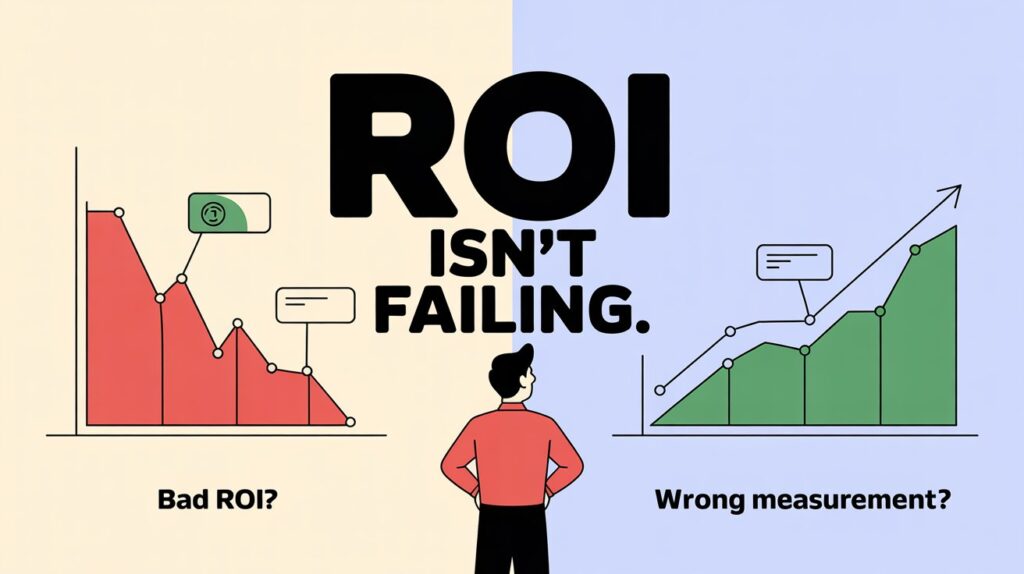
The Real Reason Campaigns “Fail”
Here’s the uncomfortable truth.
Many campaigns don’t actually fail.
They’re just measured incorrectly.
When you oversimplify attribution, ignore early touchpoints, chase vanity metrics, and evaluate results too quickly, you create the illusion of failure.
Then budgets get cut. Strategies shift. Teams lose confidence.
But the real problem wasn’t the campaign.
It was the measurement system.
And once you improve how you measure ROI, something interesting happens — your marketing decisions become calmer, smarter, and more strategic.
Because you’re no longer reacting to incomplete data.
You’re responding to the full story.