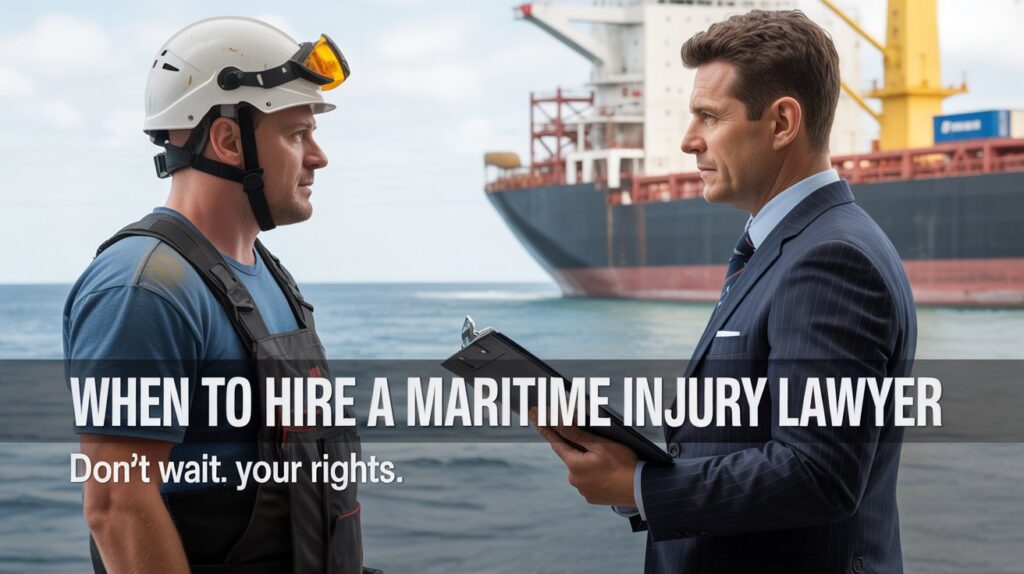
If you’ve been injured while working at sea or offshore, you’re probably dealing with pain, medical bills, and uncertainty about your future. You might be wondering whether you need a lawyer or if you can handle this on your own. Here’s the truth: timing matters enormously in maritime injury cases, and waiting too long can seriously hurt your chances of getting fair compensation.
Maritime cases are completely different from normal injury claims. While a car accident case follows straightforward state laws, your offshore injury falls under special federal laws like the Jones Act, the Longshore Harbor Workers’ Compensation Act, or general maritime law. These laws have strict deadlines, unique evidence requirements, and complex rules that most personal injury lawyers simply don’t understand.
Every day you wait, evidence disappears. Witnesses forget details. Vessel logs get “lost.” The accident scene changes. Your employer starts building their defense. Maritime companies and their insurance companies move fast to protect themselves, and if you’re not doing the same, you’re putting yourself at a massive disadvantage.
You might think you can trust your employer to take care of you. After all, you’ve worked hard for them. But the reality is that maritime employers have teams of lawyers and insurance adjusters whose job is to minimize what they pay you. Going up against them alone is like bringing a rowboat to a naval battle.
This guide will walk you through exactly when you need to hire a maritime injury lawyer, the warning signs that demand immediate legal help, and how the right attorney can protect your future. You’ll learn what makes maritime law different, what mistakes to avoid, and how to choose a lawyer who truly understands the unique world of offshore work.
What Is a Maritime Injury Lawyer?
A maritime injury lawyer is a specialized attorney who focuses on injuries that happen on navigable waters, offshore platforms, and in maritime occupations. Unlike regular personal injury lawyers, these attorneys have deep knowledge of admiralty law, the Jones Act, and the Longshore Harbor Workers’ Compensation Act (LHWCA).
Maritime law is a completely separate legal system from standard personal injury law. It has its own courts, its own rules, and its own deadlines. For example, under the Jones Act, you have only three years to file a lawsuit. Under the LHWCA, you have just one year from when your employer stops paying benefits. Miss these deadlines, and you lose your right to compensation forever.
These lawyers handle cases for seamen, offshore oil rig workers, dockworkers, commercial fishermen, cruise ship employees, and anyone else injured in maritime work. They understand the dangerous conditions you face daily, from slippery decks and heavy equipment to explosions and toxic chemical exposure.
If you’re unsure whether you need a maritime-specific lawyer, consider this: a general personal injury attorney who handles car accidents and slip-and-fall cases likely doesn’t know the difference between maintenance and cure benefits and Jones Act negligence claims. That knowledge gap could cost you hundreds of thousands of dollars in compensation.
Clear Signs You Should Hire a Maritime Injury Lawyer Immediately
You Were Injured While Working at Sea or Offshore
If you were injured on a vessel, offshore platform, or while performing maritime duties, you need a lawyer who understands seaman status and offshore worker classifications. The Jones Act protects seamen who spend at least 30% of their time working on a vessel in navigation.
But here’s the tricky part: not everyone who works near water qualifies as a seaman. Your lawyer needs to analyze your job duties, time spent on vessels, and connection to maritime work to determine which laws protect you. This analysis is critical and must be done correctly from the start.
Vessel-related injuries include falls on slippery decks, equipment failures, crane accidents, man-overboard incidents, and exposure to hazardous materials. Each type of injury requires different evidence and legal strategies. A maritime injury lawyer knows how to investigate these accidents properly and build your case while you focus on healing.
Your Employer Denies Responsibility
When your employer starts blaming you for the accident or claims they weren’t negligent, you need legal help immediately. Maritime employers often try to shift blame to avoid paying compensation. They might argue you were careless, violated safety procedures, or that the accident was just “part of the job”.
Under the Jones Act, employers are liable for even slight negligence. If your employer provided unsafe equipment, failed to train you properly, or assigned you too much work, they may be responsible. But proving this requires evidence that maritime lawyers know how to preserve and present.
Your employer might also claim you don’t qualify as a seaman or that your injury isn’t work-related. These are legal arguments that require immediate counteraction. Without a lawyer, you’re vulnerable to their tactics.
You Are Being Pressured to Return to Work
If your employer or their doctor is pushing you to go back to work before you’re ready, this is a major red flag. Returning to work too soon can aggravate your injury and permanently damage your health. It can also hurt your legal case.
Maritime law gives you the right to maintenance and cure benefits, which means your employer must pay your basic living expenses and medical costs until you reach maximum medical improvement. Some employers try to cut off these benefits early by having their doctors declare you fit for duty.
A maritime injury lawyer can protect you from premature return-to-work orders and ensure you get proper medical treatment from a doctor who works for you, not your employer. Your health is too important to let your employer’s insurance company make these decisions.
Your Injury Is Serious or Long-Term
Serious injuries like broken bones, head trauma, spinal cord damage, burns, or chemical exposure require immediate legal representation. These injuries often lead to permanent disability, chronic pain, and lost earning capacity.
The compensation you need goes far beyond current medical bills. You must account for future surgeries, ongoing therapy, lost wages for the rest of your working life, and pain and suffering. Calculating these damages requires economic experts, medical specialists, and experienced maritime lawyers who know how to present this evidence effectively.
If your injury might prevent you from returning to maritime work, you could lose a career that pays significantly more than land-based jobs. Your lawyer must calculate this loss accurately and fight for compensation that truly reflects what you’ve lost.
You Are Offered a Quick Settlement
When an insurance company offers you money within days or weeks of your accident, be extremely cautious. This is almost always a lowball settlement tactic designed to make your case disappear before you understand the full extent of your injuries.
Quick settlement offers rarely cover future medical expenses, lost earning capacity, or long-term pain and suffering. The insurance company knows that once you accept their offer and sign a release, you cannot come back for more money, even if you need additional surgeries or can’t return to work.
Maritime injury lawyers have seen these tactics repeatedly. They can spot a lowball offer immediately and negotiate for the full compensation you deserve. Without legal representation, you might accept $50,000 when your case is actually worth $500,000 or more.
Situations That Almost Always Require a Maritime Injury Lawyer
Certain maritime accidents are so complex and serious that you should hire a lawyer immediately, no questions asked.
Offshore oil rig accidents involve multiple layers of federal law, including the Outer Continental Shelf Lands Act (OCSLA), the Jones Act, and state workers’ compensation. Determining which law applies depends on whether the rig is fixed or floating, where you were injured, and your job duties. These cases often involve multiple responsible parties, including your employer, equipment manufacturers, and third-party contractors.
Vessel explosions and fires cause catastrophic injuries and often involve multiple victims. These cases require immediate investigation to preserve evidence about what caused the explosion, whether safety protocols were followed, and if equipment was properly maintained. Maritime lawyers have the resources to conduct these investigations while you recover.
Man-overboard incidents raise questions about vessel safety equipment, crew training, weather conditions, and rescue procedures. Proving negligence requires witness statements, vessel logs, and expert analysis that a maritime attorney knows how to obtain.
Crane and cargo accidents involve heavy machinery, complex operations, and often third-party contractors. These cases require technical expertise to determine if equipment was defective, improperly maintained, or operated unsafely. Maritime lawyers work with experts who understand these systems.
Toxic exposure cases from chemicals, drilling fluids, or other hazardous materials can cause latent injuries that appear months or years later. These cases are extremely complex and require scientific evidence linking your exposure to your illness. Maritime attorneys have experience with these challenging claims.
What Happens If You Don’t Hire a Maritime Injury Lawyer
Choosing to handle your maritime injury claim alone can have devastating consequences for your financial future.
Missed compensation is the most common problem. You might not know you’re entitled to maintenance and cure payments, lost wages, pain and suffering, loss of earning capacity, and other damages. Maritime law offers more comprehensive compensation than traditional workers’ compensation, but only if you ask for it correctly.
Legal loopholes can destroy your case. Maritime law has specific requirements for reporting injuries, filing claims, and proving negligence. Missing a deadline by even one day can bar you from recovery forever. For example, if you don’t report your injury within seven days under some maritime policies, you may lose your right to benefits.
Evidence loss happens quickly at sea. Vessel logs get altered or disappear. Witnesses scatter to different ports. Safety equipment gets repaired or replaced. The accident scene changes. Without a lawyer to send preservation letters and conduct immediate investigation, critical evidence vanishes.
Employer legal advantage is overwhelming. Maritime companies have experienced legal teams, insurance adjusters, and safety departments whose job is to minimize payouts. They know maritime law inside and out. Facing them alone is like going into a storm without navigation equipment. They will use your lack of legal knowledge against you at every turn.
The Right Timeframe to Contact a Maritime Injury Lawyer
The simple answer: as soon as possible. But let’s break down the critical moments when legal help becomes essential.
Immediately after injury, once you’ve received emergency medical care, call a maritime lawyer. They can send preservation letters to prevent evidence destruction, identify all potential claims, and ensure you don’t say anything to your employer that hurts your case. Early involvement gives your lawyer the best chance to build a strong case while evidence is fresh.
After medical stabilization, when your immediate health crisis is under control, meet with a lawyer to discuss your long-term strategy. Your attorney needs to understand your injuries, treatment plan, and prognosis to calculate the true value of your claim.
Before giving statements to your employer or their insurance company, consult a lawyer. Anything you say can be used against you. Insurance adjusters are trained to ask questions that make it seem like the accident was your fault. Your lawyer can prepare you for these interviews or handle them entirely.
Before insurance negotiations begin, hire an attorney. Once the insurance company makes an offer, they’re invested in that number. Bringing in a lawyer later is harder than having one negotiate from the start. Your attorney can establish the true value of your claim before the insurance company locks in a lowball figure.
Remember, the Jones Act has a three-year statute of limitations, but waiting nearly that long is a huge mistake. The longer you wait, the weaker your case becomes.
How a Maritime Injury Lawyer Protects You
Legal Strategy Development
Your lawyer’s first job is determining which laws apply to your case. Should you file under the Jones Act, LHWCA, general maritime law, or state workers’ compensation? This decision affects everything from your compensation to your legal rights.
If you qualify as a seaman, the Jones Act allows you to sue your employer for negligence and collect damages for pain and suffering, lost wages, and future earning capacity. If you don’t qualify as a seaman, you might be covered under LHWCA, which provides workers’ compensation benefits but limits your recovery.
Your attorney will develop a comprehensive legal strategy based on your specific situation, the evidence available, and the responsible parties. This strategy guides every decision from evidence collection to settlement negotiations.
Evidence Protection
Maritime cases live or die based on evidence that can disappear quickly. Your lawyer acts immediately to preserve critical documentation like vessel logs, maintenance records, safety inspection reports, and witness statements.
They’ll send formal letters requiring your employer to preserve all evidence related to your accident. This includes photographs of the scene, video footage, equipment involved in the incident, and crew statements. If equipment failure caused your injury, your lawyer will ensure that equipment is preserved for expert examination.
Your attorney will also gather your medical records, employment records, and documentation of your lost wages. They’ll interview witnesses while memories are fresh and consult with maritime experts who can testify about industry standards and safety violations.
Claim Valuation
Calculating the true value of your maritime injury claim is complex. It’s not just about today’s medical bills. Your lawyer will work with economic experts to determine your lost earning capacity over your entire career. Maritime jobs often pay significantly more than land-based work, so this calculation is critical.
Your attorney will also quantify non-economic damages like pain and suffering, mental anguish, and loss of enjoyment of life. They’ll account for future medical expenses, rehabilitation costs, and any necessary modifications to your home or vehicle.
This comprehensive valuation ensures you don’t accept a settlement that leaves you struggling financially years down the road.
Negotiation and Litigation
Insurance companies respect lawyers who regularly handle maritime cases. When you have experienced representation, insurance adjusters know they can’t use lowball tactics effectively. Your attorney understands the true value of your case and won’t settle for less.
If negotiations fail, your lawyer will file a lawsuit and represent you in court. Maritime litigation requires specific knowledge of admiralty procedure and federal court rules. Your attorney will handle all court filings, discovery, depositions, and trial preparation. They’ll present expert testimony, cross-examine defense witnesses, and argue your case to the judge or jury.
Red Flags That Indicate You Need Legal Help
Watch for these warning signs that your employer or their insurance company is not acting in your best interest:
Employer controls your medical care. If you’re being forced to see a company doctor who minimizes your injuries or pushes you to return to work, you need a lawyer. You have the right to choose your own physician under maritime law.
Benefits are delayed or denied. If your employer stalls on paying maintenance and cure benefits or denies your claim without clear reasons, legal intervention is necessary. These delays are often tactics to pressure you into accepting a low settlement.
Documents you don’t understand. Never sign releases, settlements, or legal documents without having a maritime lawyer review them first. You might be signing away rights you don’t even know you have.
Threats or retaliation. If your employer threatens to fire you, blackball you from the industry, or take other punitive actions for filing a claim, contact an attorney immediately. These threats are illegal, and your lawyer can protect you.
How to Choose the Right Maritime Injury Lawyer
Maritime Law Experience
Look for an attorney whose practice focuses primarily on maritime law, not someone who handles an occasional maritime case along with car accidents and divorces. Maritime law is too specialized for general practice.
Ask potential lawyers what percentage of their cases are maritime-related. The right attorney will have handled dozens or hundreds of Jones Act and LHWCA cases. They’ll be familiar with the specific federal courts that handle maritime claims and the judges who preside over them.
Offshore Case Track Record
Ask about their past results in cases similar to yours. While no lawyer can guarantee outcomes, they should be able to describe cases they’ve won for offshore workers, seamen, and maritime employees. Look for experience with your specific type of injury and work environment.
An attorney with a strong track record will have relationships with maritime experts, investigators, and medical specialists who can strengthen your case. They’ll know the tactics used by major maritime employers and how to counter them effectively.
Fee Structure Transparency
Most reputable maritime injury lawyers work on a contingency fee basis. This means you pay nothing upfront, and the attorney only gets paid if they win your case. Their fee is typically a percentage of your settlement or verdict.
Make sure you understand the fee structure before hiring anyone. The agreement should clearly spell out what percentage the lawyer takes and whether that percentage changes if your case goes to trial. Be wary of lawyers who ask for money upfront or have confusing fee arrangements.
Most maritime lawyers charge around 40% contingency fees, which is higher than standard personal injury cases (typically 33.3%). This reflects the complexity of maritime law, the need for specialized experts, and the risk attorneys take in advancing substantial case costs. While this might seem high, remember that a skilled maritime attorney can often recover significantly more than you would get on your own, even after their fee.
Watch out for “escalating fees” that increase as the case progresses. Look for transparent, flat-fee structures that don’t change. The cheapest lawyer isn’t always the best choice—in maritime law, expertise directly impacts your compensation.
Communication and Trust
Your relationship with your maritime lawyer will likely last months or even years. You need someone who communicates clearly, responds promptly, and makes you feel comfortable.
During your initial consultation, pay attention to how the lawyer explains complex legal concepts. Do they use plain language or drown you in legal jargon? Are they patient with your questions? Do they seem genuinely interested in your case, or are you just another file on their desk?
Ask about their communication policy. How often will they update you? Who will be your primary contact—the attorney or a paralegal? What’s the best way to reach them with urgent questions? A lawyer who establishes clear communication expectations from the start will reduce your stress throughout the process.
Trust your instincts. You should feel confident that this person will fight for you, keep your best interests front and center, and provide honest guidance even when the news isn’t what you hoped to hear.
Questions to Ask Before Hiring a Maritime Injury Lawyer
Before signing any agreement, ask these critical questions:
“Have you handled Jones Act cases similar to mine?” Don’t settle for vague assurances. Ask for specific examples of cases like yours and their outcomes. An experienced maritime lawyer should be able to discuss similar cases confidently.
“Who will manage my case personally?” In large firms, your case might be passed to a junior associate. Make sure you know exactly who will handle your case and meet that person before hiring the firm.
“How long will my case take?” While no lawyer can give you an exact timeline, experienced maritime attorneys can provide realistic expectations based on similar cases. Be wary of promises that sound too quick or guarantees about specific outcomes.
“What compensation can I realistically expect?” A good lawyer will give you an honest assessment, including best-case and worst-case scenarios. They should explain what factors will influence your compensation and what challenges they foresee.
“What are the total costs if we lose?” Understand whether you’re responsible for case costs even if you don’t win. Most reputable maritime lawyers advance all costs and only recover them if you win, but confirm this in writing.
“Can I speak with past clients?” While privacy laws limit what they can share, some attorneys can connect you with former clients who agreed to be references. This gives you insight into what it’s like working with them.
Real-Life Scenarios
Dockworker Injury Case
John, a 45-year-old dockworker in Louisiana, suffered a severe back injury when a cargo container shifted unexpectedly during loading. His employer denied responsibility, claiming John hadn’t followed proper procedures. They offered him $75,000 to settle quickly.
John hired a maritime injury lawyer who discovered the crane operator had received inadequate training and the cargo wasn’t properly secured. The lawyer also found three other workers who witnessed similar near-misses. After thorough investigation and negotiation, John’s case settled for $850,000—more than ten times the initial offer—covering his surgeries, lost wages, and future medical care.
Offshore Rig Injury Example
Mike, a 28-year-old roughneck on a Gulf of Mexico oil rig, suffered third-degree burns in a flash fire caused by a faulty pressure valve. The rig owner, a foreign corporation, tried to claim U.S. law didn’t apply. They offered Mike $200,000 and pressured him to sign a release.
Mike’s maritime attorney immediately filed a lawsuit under the Outer Continental Shelf Lands Act and the Jones Act. The lawyer hired engineering experts who proved the valve hadn’t been inspected in over a year, violating safety regulations. The case went to trial, and the jury awarded Mike $2.5 million for his injuries, pain and suffering, and lost future earnings.
Seaman Slip-and-Fall Case
Carlos, a 52-year-old seaman on a commercial fishing vessel, slipped on an unmarked wet deck and shattered his heel bone. The vessel owner claimed Carlos was clumsy and offered $30,000. Without a lawyer, Carlos would have accepted, desperate for money while unable to work.
His maritime attorney investigated and found the vessel’s deck coating was worn away, creating an unreasonably slippery surface. The lawyer also discovered the vessel hadn’t passed its last safety inspection. The case settled for $275,000, allowing Carlos to get proper medical treatment and retrain for shore-based work when he couldn’t return to sea.
FAQs
Is consultation free?
Yes, virtually all maritime injury lawyers offer free initial consultations. This meeting lets you discuss your case, understand your rights, and evaluate whether the attorney is right for you without any financial risk.
How much does it cost to hire one?
Maritime lawyers typically work on contingency, meaning you pay nothing upfront. They receive around 40% of your settlement or verdict, plus reimbursement for case costs they advanced. If you don’t win, you owe nothing.
Can I switch lawyers later?
Yes, but it can complicate your case. Your new lawyer must pay your old lawyer for work already done (from your eventual settlement). This can create conflict and reduce your final compensation. It’s better to choose carefully from the start.
What if my employer is foreign?
Maritime law often still applies if you were injured in U.S. waters or on the Outer Continental Shelf. However, foreign employers add complexity. An experienced maritime attorney can determine which laws apply and how to enforce them against foreign companies.
Will hiring a lawyer make my employer fire me?
Federal law prohibits retaliation for filing a maritime injury claim. If your employer tries to fire you, demote you, or blackball you from the industry, your lawyer can file additional claims for retaliation, which can substantially increase your compensation.
How long do I have to file a claim?
The Jones Act gives you three years from the date of injury. LHWCA claims must be filed within one year of when benefits stop. But waiting hurts your case—contact a lawyer immediately.
The Cost of Waiting Can Be Your Future
Here’s the hard truth: every day you wait to hire a maritime injury lawyer, you’re gambling with your financial future. The maritime industry moves fast to protect itself, and you need someone moving just as fast to protect you.
Your injuries have already changed your life. Don’t let inaction make things worse. The compensation you receive—or don’t receive—will impact you and your family for decades. It will determine whether you can afford quality medical care, whether your children go to college, whether you retire with dignity, or whether you spend years struggling to make ends meet.
The right maritime injury lawyer levels the playing field. They stand between you and powerful companies that view your injury as a financial problem to minimize. They preserve evidence that disappears quickly at sea. They calculate the true cost of your injuries, not just today’s bills, but your entire lost future. They negotiate from strength because they know what your case is really worth.
You’ve worked hard in one of the world’s most dangerous industries. You’ve risked your body to earn a living on the water. Now that you’re injured, you deserve someone who understands that world fighting for you.
The consultation is free. The advice is invaluable. The cost of waiting could be everything.
Don’t let your employer’s insurance company decide your future. Take control today. Your future self will thank you for making the call.
Protect your rights. Preserve your future. Contact a maritime injury lawyer today.