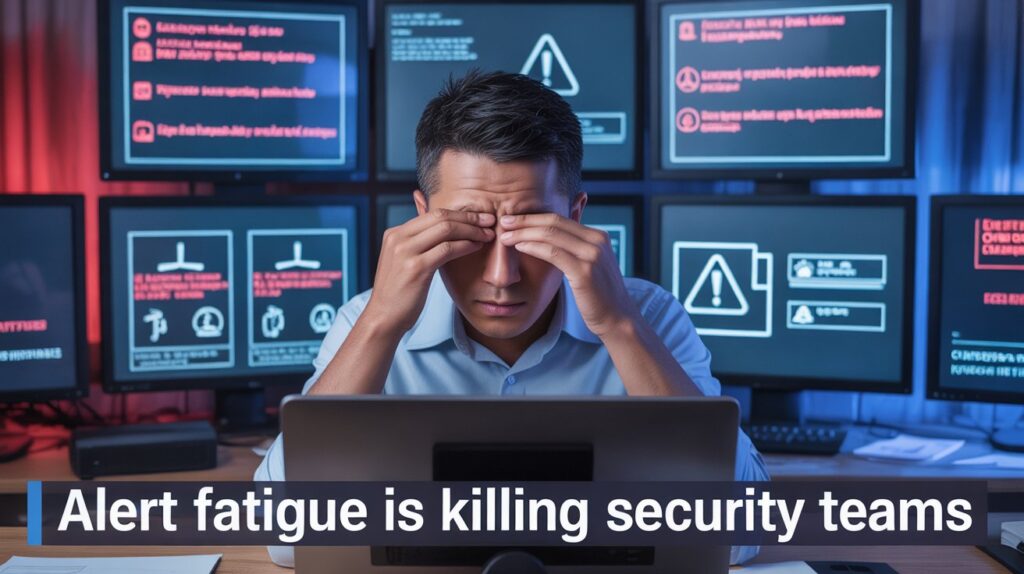
As humans, we are excellent in emergencies. Our entire system revamps itself with adrenaline, making us capable of doing more, thinking faster, and accomplishing even what may be defined as superhuman feats, in the short term.
The fact is, our bodies are designed for physical threats, not the modern corporate world. Ongoing stress, especially for security teams, can lead anyone (even the most trained) into the downward spiral that is burnout. Burned-out security teams respond more slowly, miss threats, and can be just as much of a risk to your business as the threats themselves.
The best way to keep your security teams sharp and ready to respond to real, significant threats is to reduce alert fatigue, and for that, you have this guide:
The Problem with Too Many Alerts
No amount of healthy living or wellness activities can avoid that spiral, either, especially with security alerts only increasing in frequency as cybercriminals have added AI agents into the mix capable of non-stop attempts. For most businesses, this could mean dealing with an average of 55 alerts every day. For the biggest enterprises, security teams may end up with thousands, or even tens of thousands of alerts.
The other issue is that most of those alerts are non-actionable. They may be low-priority and unlikely to cause any breach. They may even have a false positive. Your security team may not even need to do anything at all because your security system caught it, and yet, they’re still alerted.
You need to work to reduce those alerts from the outset. Otherwise, you run the risk of burnout, causing employees to treat every single alert as non-actionable or low-priority, putting you at risk of a real threat.
How to Reduce Alerts and Their Fatigue
The single best way to reduce alert fatigue? You use these tips to reduce the alerts themselves:
Invest in MDR
MDR, or managed detection and response services, works to address and sort those low-priority and non-actionable alerts, so that your actual security response team only needs to deal with the real threats. Investing in MDR can reduce the average of 55 alerts per day down to just one per week, and, as a result, reduce alert fatigue by up to 90%.
Test AI-Ready Response Systems
The most important factor for any new program or solution is trust. Ensure that the program performs optimally and can be trusted by rigorously testing alert tools and automation workflows in real-time monitoring environments. Improving alert, detection, and even response workflows with advanced automation can help you fine-tune alert thresholds to reduce false positives, and help automatically address low-priority alerts behind the scenes. If your system receives thousands of alerts a day, this step should be combined with MDR, allowing for multiple levels of triage to reduce alert fatigue from two separate approaches.
Monitor Key Metrics to Refine Alert Management Strategies
Every workflow and strategy can be improved and refined. To ensure that the improvements to workflows and guidelines are effective, however, monitor essential key performance metrics like alert volume, mean time to repair (MTTR), and false-positive rates that reach your internal IT and security teams and compare them before and after a new workflow, system, or solution is implemented. This will help you refine and improve the alert system, allowing your security teams the space to deal with real threats without the risk of burnout.