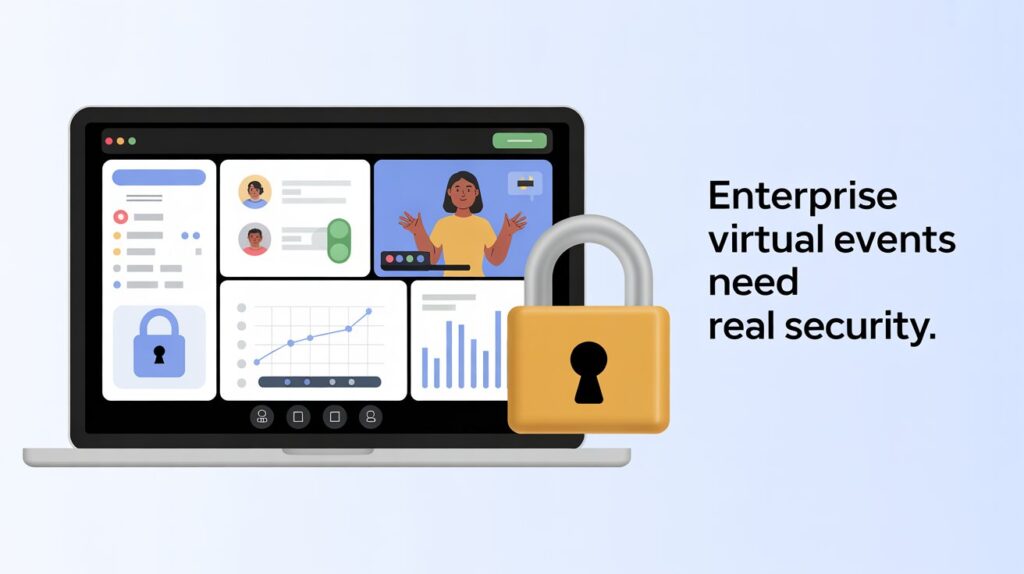
In the hyper-connected, post-pandemic business era, the digital event has evolved from a temporary workaround to a critical component of enterprise strategy. For an audience focused on media, technology, and information security, the crucial question is not if companies should host virtual events, but how they can do so securely, strategically, and at scale. The answer lies in moving beyond consumer-grade applications and embracing dedicated, enterprise-level software for virtual events.
The reliance on digital channels for high-value interactions, from investor relations and product launches to mission-critical training, places an enormous burden of trust on the platforms used. A security breach during a company-wide strategy session, or a data leak from a global customer event, carries catastrophic financial and reputational consequences. Therefore, for organisations that view their digital assets and audience engagement as strategic pillars, the choice of event technology is fundamentally a risk management decision. This article explores the strategic, data-driven, and security-focused imperative driving the adoption of purpose-built virtual event software.
Scaling Strategy: From Communication to Conversion
The primary challenge in modern business is not a lack of information, but a lack of focused engagement. Traditional methods of marketing and training often fail to capture reliable data on individual participation, making it difficult to measure true return on investment (ROI). Dedicated software for virtual events resolves this by integrating communication with comprehensive analytics.
These platforms enable organisations to host large-scale events, such as global sales kick-offs or industry summits, while simultaneously tracking individual attendee behaviour in granular detail. This moves the digital event beyond mere broadcasting and into the realm of a sophisticated lead qualification and content measurement engine.
For example, a marketing team can host a product webinar and immediately identify the attendees who spent the most time interacting with a specific feature demonstration, downloaded the pricing sheet, or engaged with the Q&A session. This rich, first-party data is priceless, allowing sales teams to follow up with a highly personalised and prioritised approach.
To build an engagement strategy that consistently converts interaction into an actionable pipeline, businesses need platforms built for scale, security, and integration. These sophisticated features are what differentiate purpose-built virtual event technology from basic video conferencing applications. Organisations looking to leverage the full capacity of online gatherings, from webinars to fully interactive digital conferences, need solutions that are robust and scalable. To understand the sophisticated features required to host large-scale, interactive brand experiences, one should review the offerings of specialised software for virtual events platforms.
The Security Imperative: Trust and Compliance in the Digital Event Space
In an environment where cybersecurity threats are constantly escalating, the security profile of the chosen virtual event platform is paramount. For information-sensitive organisations, the minimum acceptable standard is enterprise-level security, not consumer-grade best-effort protection.
A dedicated solution must offer robust features that address data integrity, privacy compliance, and content protection. This includes advanced security protocols such as:
- End-to-End Encryption: Protecting sensitive corporate or unreleased product information shared during internal or external events from interception.
- Authentication and Access Control: Utilising multi-factor authentication and strict, unique credential access to ensure only invited, verified users can attend a confidential session. This is critical for controlling who views proprietary content.
- Global Regulatory Compliance: Ensuring the platform adheres to international data privacy laws, including the General Data Protection Regulation (GDPR) and regional equivalents. This is essential for managing events with a global audience without incurring massive legal risk.
Relying on solutions built for enterprise use minimises the risk of data leakage and ensures that the platform itself does not introduce systemic vulnerabilities into the corporate IT ecosystem. The platform should support internal security audits and seamlessly integrate with existing corporate governance and compliance frameworks.
Data Integrity and Revenue Attribution
The transition to virtual events offers a profound, strategic advantage for CFOs and CMOs: the ability to generate high-quality, attributable revenue data. When using a platform designed for business, engagement is measurable and directly linked to the sales funnel.
These systems track depth of engagement, unlike simple attendance metrics. They record which polls an attendee answered, which resource PDFs were downloaded, and how much time was spent on each agenda item. This level of detail allows an organisation to accurately score leads based on their genuine interest and intent.
This data integrity allows marketing departments to prove their ROI precisely. They can demonstrate that attendees who engaged for more than 40 minutes on a platform conversion tool were three times more likely to become qualified sales leads. This analytical capability transforms the digital event into a predictable, measurable source of pipeline and revenue, moving it firmly out of the ‘marketing expense’ category and into the ‘strategic investment’ column. Research shows that 73% of B2B marketers and sales leaders believe webinars are the best way to generate high-quality leads, underscoring the platform’s utility as a lead generation tool.
Future-Proofing Strategy: Hybrid and On-Demand Value
The final strategic consideration for organisations is the platform’s ability to sustain value long after the live event concludes. The future of engagement is decidedly hybrid, combining the intimacy of physical gatherings with the scalability of digital ones.
A robust event platform must serve two critical purposes: the live experience and the on-demand library. High-quality content captured during the live event becomes a durable asset, hosting recordings, transcripts, and downloadable materials in a dedicated content hub. This hub serves as a powerful, 24/7 lead generation engine.
Moreover, dedicated virtual event solutions facilitate the necessary technological bridge for hybrid models. They allow a business to stream a physical keynote presentation to a global virtual audience while simultaneously managing the data streams from both groups within the same secure environment. This flexibility is vital for ensuring business continuity and maximising content utility across all channels. This perspective is backed by projections showing that the global virtual events market size was estimated at USD 98.07 billion in 2024 and is expected to nearly triple by the end of the decade, showcasing its staying power as a critical business infrastructure.
In conclusion, for any organisation in the information age, the decision regarding digital event infrastructure is pivotal. It is an investment in security, a commitment to data-driven growth, and the strategic foundation for managing global audiences effectively. Choosing best-in-class software for virtual events is simply non-negotiable for securing success in the digital frontier.