So you’re asking yourself, “How long does it actually take to become a dermatologist?” And honestly, that’s a great question—but the answer is more complex than just a number.
When people think about becoming a dermatologist, they’re usually imagining treating acne, doing Botox injections, and working reasonable hours. The reality? Yes, that’s part of it. But there’s so much more to the journey, and it takes way longer than most people think.
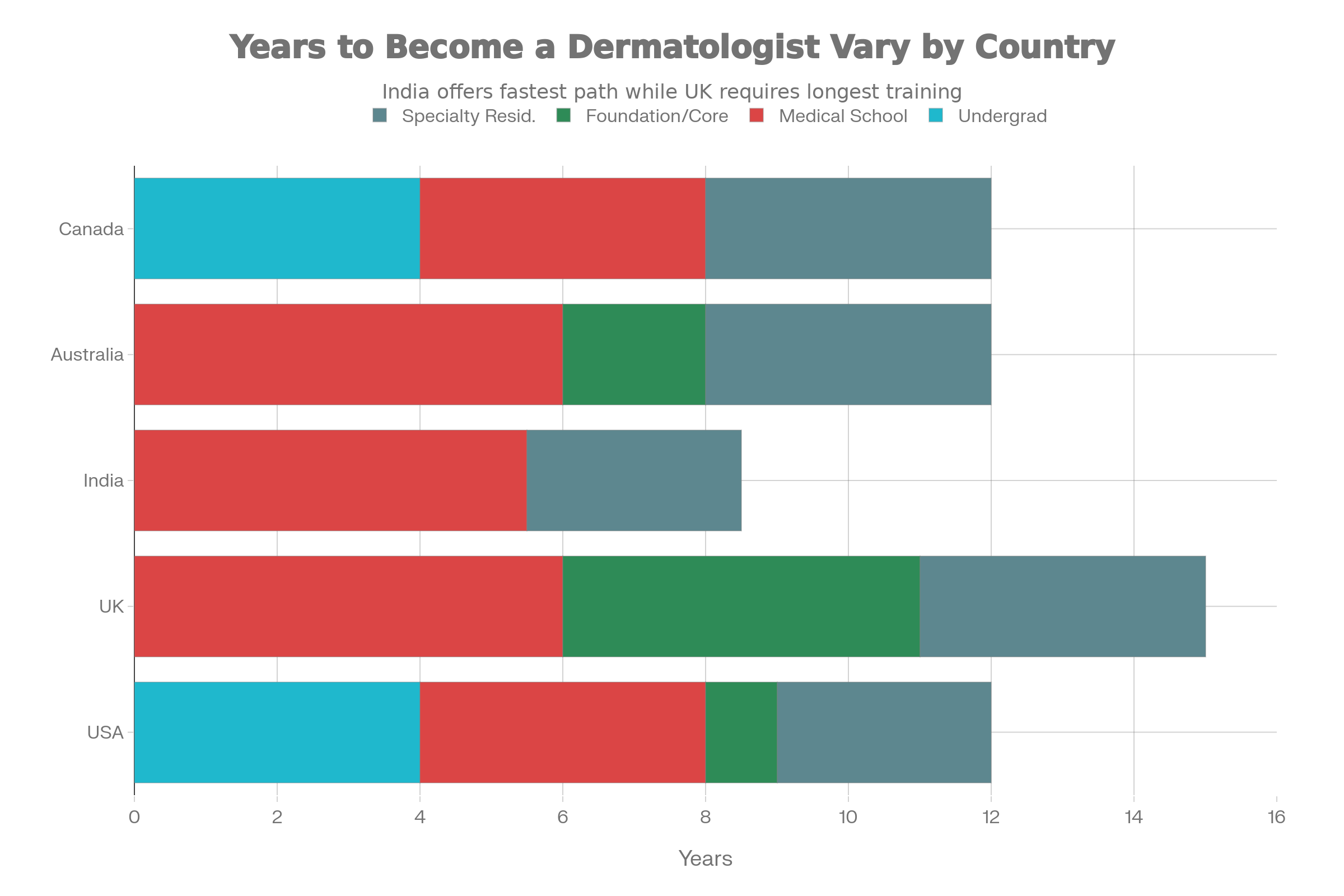
Here’s the straightforward answer: It takes a minimum of 12 years after high school in the United States, and often 13-15 years in countries like the UK. But before you get discouraged, understand why this matters and what you’re actually signing up for.
Why is this question asked so frequently? Because dermatology is one of the most competitive and desirable medical specialties. It offers high earning potential, excellent work-life balance, and the chance to help people feel confident in their skin. Everyone notices these perks, which is exactly why getting there isn’t easy.
What Does a Dermatologist Actually Do?
Before you commit to a decade-plus of training, you need to know what you’re actually training for.
Medical Dermatology vs Cosmetic Dermatology
Think of dermatology as having two main branches, though most dermatologists work in both areas.
Medical Dermatology is the disease-focused side. You’re diagnosing and treating skin conditions that affect people’s health. This includes acne, eczema, psoriasis, skin cancer (melanoma, basal cell carcinoma, squamous cell carcinoma), bacterial and fungal infections, autoimmune skin diseases, and even hair loss disorders. When someone has a rash that won’t go away or a suspicious mole, they’re coming to see a medical dermatologist. You’ll perform skin biopsies, prescribe medications, perform Mohs micrographic surgery (a specialized technique for removing skin cancer with precision), and provide ongoing management for chronic conditions.
Cosmetic Dermatology is the appearance-focused side. You’re enhancing how people look using procedures like Botox injections, dermal fillers, laser hair removal, chemical peels, microneedling, and various laser treatments for wrinkles and pigmentation. These procedures are elective—patients choose them to look younger or feel more confident. While it sounds simpler, cosmetic dermatology requires serious training in aesthetic judgment, injection techniques, and safety.
Here’s the key thing: Both are equally important, and all dermatologists learn both during their training. You don’t choose one or the other right away. During your residency, you’ll rotate through both medical and cosmetic services, discovering which areas genuinely excite you.
Daily Responsibilities
Your day as a dermatologist (once fully trained) typically looks like this:
Clinical work takes up most of your time. You’re seeing patients back-to-back in clinic. On a typical day, you might see 25-40 patients, which could include a teenager with severe acne, a 60-year-old with suspicious moles, a patient with psoriasis needing biotherapy, and someone wanting Botox for forehead lines. Each requires different expertise.
Procedures are a major part of your work. You might perform skin biopsies (taking tissue samples for diagnosis), excisions (removing moles or lesions), Mohs surgery for skin cancer, laser procedures, chemical peels, or injection-based cosmetic treatments. Some days are procedurally heavy; others are mostly consultations.
Documentation and administrative work fills gaps between patients. You’re writing notes, reviewing lab results, calling patients with pathology findings, and handling insurance approvals.
Research and teaching (if you work in academic settings) take additional time but offer intellectual stimulation and the chance to advance the field.
Emergency situations are rare. Unlike emergency medicine or surgery, skin conditions rarely require you to be called at 2 AM. This is actually one of dermatology’s biggest selling points.
Work-Life Balance: Myth vs Reality
The myth: “Dermatologists just work 9-to-5 with no stress.”
The reality: Dermatologists actually do have excellent work-life balance compared to most medical specialties, but the path there requires sacrifice.
Once you’re a practicing dermatologist, you’ll typically work 35-45 hours per week, often spread across four or five days. Many dermatologists work fewer than 40 hours weekly, especially in private practice where you control your schedule. You have minimal weekend work, few emergencies, and predictable hours.
But here’s what people don’t mention: Dermatology residents work 50-60 hours per week. You’re doing clinical work, attending lectures, preparing for exams, conducting research, and building the expertise you’ll need. It’s demanding, though it’s shorter and typically less intense than surgical residencies.
Total Time at a Glance: Quick Timeline Summary
Let me give you a bird’s-eye view before we break everything down step by step.
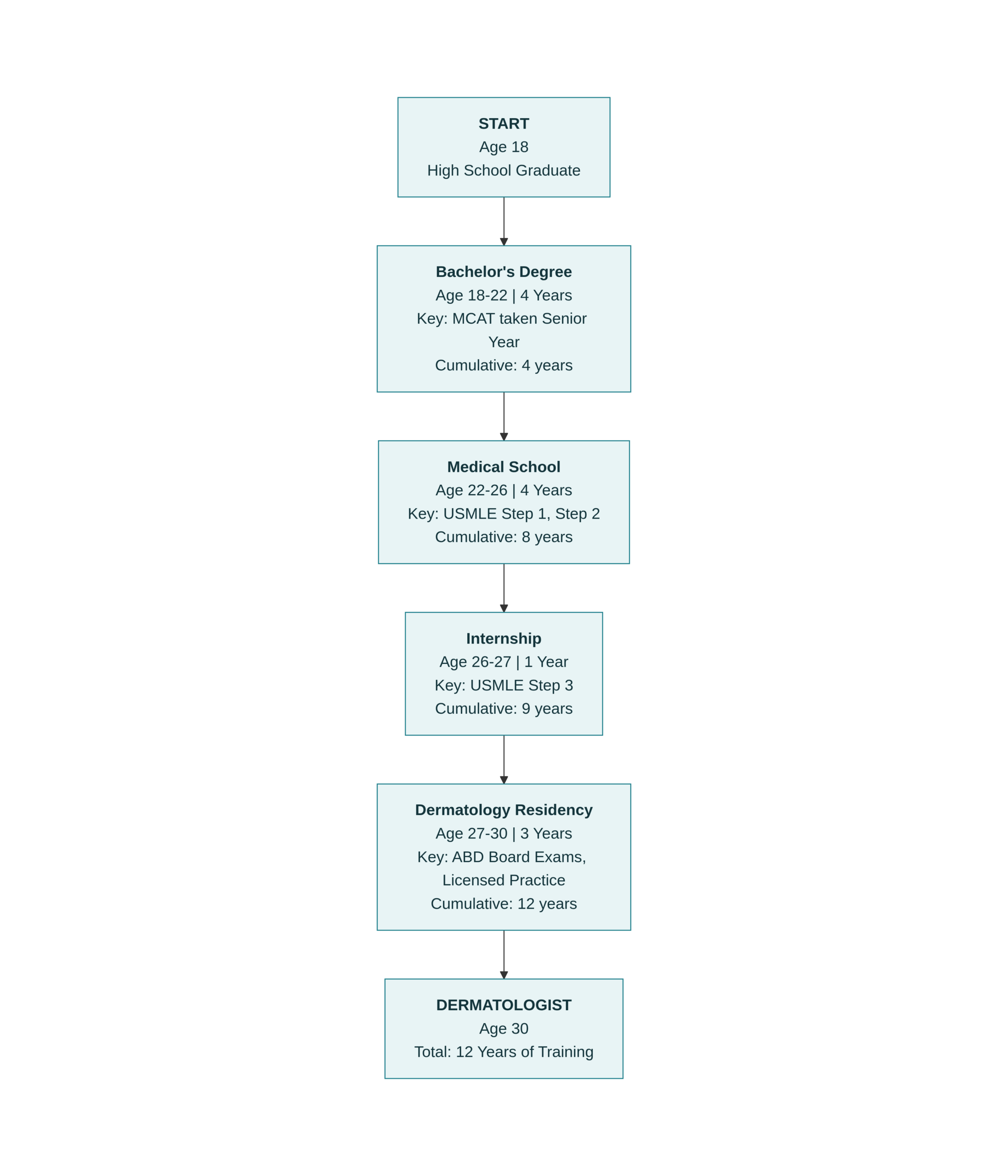
The Standard 12-Year Timeline (USA)
| Phase | Duration | Total Years |
|---|---|---|
| Bachelor’s Degree | 4 years | 4 |
| Medical School | 4 years | 8 |
| Internship (PGY-1) | 1 year | 9 |
| Dermatology Residency | 3 years | 12 |
| Optional Fellowship | 1-2 years | 13-14 |
Timeline by Country
| Country | Minimum Years | Notes |
|---|---|---|
| USA | 12 years | Bachelor’s → Med School → Internship → 3-Year Residency |
| UK | 13-15 years | Medical school → Foundation (2 yrs) → Core Training (2-3 yrs) → Specialty Training (4 yrs) |
| India | 8.5-9 years | Class 12 → MBBS (5.5 yrs) → MD Dermatology (3 yrs) |
| Australia | 12 years | Medical school → 2 yrs experience → 4-year advanced training |
| Canada | 12 years | Similar to USA |
The honest truth: Fastest achievable path is still 12 years, and that assumes you don’t take gap years, get delayed in matching to residency, or pursue research opportunities.
Step-by-Step Education Timeline to Become a Dermatologist
Let’s walk through this journey year by year.
1. High School Preparation (Optional but Smart)
You don’t need to do anything special in high school to become a dermatologist eventually, but certain choices make the journey easier.
Take science courses seriously. Biology, chemistry, and physics aren’t just prerequisites—they’re building blocks for medical school. If you’re struggling with these subjects now, it’s worth investing time to understand them deeply. Medical school assumes you know this material cold.
Consider extracurricular activities that hint at your interest in medicine. This could be volunteering at a hospital, shadowing a physician (including a dermatologist if you can), working as a summer camp counselor (shows leadership), or doing community service. Medical schools want to see genuine interest, not just grades.
Focus on building strong study habits. Medical school and residency require discipline and consistency. If you can develop these now, you’ll have a major advantage.
Here’s what you don’t need: Pre-med major isn’t required. English students have become dermatologists. Music majors have become dermatologists. What matters is completing the science prerequisites and demonstrating you can excel in them.
2. Bachelor’s Degree (Undergraduate – 3–4 Years)
After high school, you’ll spend 3-4 years getting your bachelor’s degree. Here’s what you need to know.
Required science courses include one year of biology (with lab), one year of general chemistry (with lab), one year of organic chemistry (with lab), one year of physics (with lab), biochemistry, and often anatomy/physiology. These prerequisites are mandatory for medical school applications.
Your major doesn’t matter. You could major in biology, chemistry, English, psychology, business—anything. What matters is that you complete the science prerequisites and do well in them. Many successful dermatologists majored in completely unrelated subjects.
GPA matters, but not for dermatology specifically yet. Aim for at least a 3.5 overall GPA, though a 3.7+ is significantly more competitive for medical school. If you struggle in your science courses early on, you can retake them. Medical schools see all attempts, but they focus on your grade trend. Getting an A on your second attempt looks better than a B initially.
Use these four years strategically. Get some clinical experience—volunteer at a hospital, work as an EMT, become a phlebotomist or medical assistant. This isn’t required yet, but it shows you understand what you’re getting into and demonstrates genuine commitment. When medical school admissions committees review your application, they want to know you’ve actually spent time in healthcare settings.
During your junior or senior year, you’ll take the MCAT (Medical College Admission Test). This standardized exam is basically the gateway to medical school. Expect to spend 2-3 months preparing for it seriously. Many students study for 300-350 hours. The exam tests science knowledge, critical thinking, and reasoning. Average MCAT scores range from 490-510, but for competitive specialties like dermatology, scoring above 510 significantly helps your chances.
3. Medical School (4 Years)
Medical school is where you go from being a biology student to actually learning medicine. The first two years are usually classroom-based (pre-clinical), and the last two years involve clinical rotations where you work directly with patients.
Pre-clinical years (Years 1-2): You’re learning the fundamentals—anatomy, physiology, pharmacology, pathology, biochemistry, microbiology. Classes are intense, the material is dense, and everyone around you is incredibly smart. You’ll also begin studying for USMLE Step 1 (United States Medical Licensing Examination), which you’ll take after second year. This exam assesses basic science knowledge and is crucial for matching into competitive specialties like dermatology. Average scores for dermatology-matched students are around 249—well above average.
Clinical years (Years 3-4): Now you’re in hospitals and clinics working with supervising physicians. You’ll rotate through different specialties including pediatrics, surgery, internal medicine, obstetrics, and psychiatry. During Year 3 or 4, you’ll hopefully get a dermatology rotation. This is your chance to see if you actually like it. Many students think they want dermatology until they experience it; others discover they love it more than they expected. This rotation is critical for your future application because dermatology is so competitive.
During medical school, you’ll also prepare for USMLE Step 2 (taken in fourth year). Step 2 has two components: clinical knowledge (CK) and clinical skills (CS). Average scores for dermatology-matched students are around 256—excellent scores. These board exam results heavily influence which dermatology programs will interview you.
Research is important for dermatology. If you’re serious about dermatology, you should try to get involved in research projects, ideally with published results or presentations at conferences. Dermatology residency programs look for candidates with research experience. Matched dermatology residents averaged 5.8 research experiences and 19 publications/presentations. Yes, that’s a lot. But it shows the commitment level required for competitive programs.
By the end of medical school, you’ll have earned your MD or DO (Doctor of Osteopathic Medicine) degree, but you’re not ready to practice independently yet. You need residency training.
4. Internship / Foundation Training (1 Year)
After medical school, you must complete a “preliminary year” or “internship”—your PGY-1 (post-graduate year 1). This year is required before you can legally start dermatology residency.
During this year, you’re typically rotating through internal medicine, emergency medicine, family medicine, pediatrics, or a transitional program with rotations across multiple specialties. The goal is to give you a broad understanding of general medical practice before specializing.
Why this year matters more than people think: You’re not just biding time waiting for dermatology to start. This year teaches you critical skills—how to manage sick patients, handle acute situations, work in a hospital system, and develop professional judgment. Many dermatologists report that their internship year was actually valuable for developing the clinical foundation they needed.
You’ll also typically pass USMLE Step 3 during or immediately after this year. Step 3 tests your clinical decision-making and judgment. It’s less high-stakes than Step 1 or 2, and most people pass, but it’s still an important milestone.
The internship is also when you’re applying for dermatology residency positions. Yes, you’re working full-time and studying for Step 3 while simultaneously preparing applications, going to interviews, and waiting for match results. It’s intense, but it’s a one-year sprint to the next phase.
5. Dermatology Residency (3–4 Years)
This is the home stretch. Your dermatology residency is typically 3 years, though some programs structure it as 3.5 or 4 years.
PGY-2 (First Year of Dermatology): You’re learning the fundamentals—how to diagnose common skin conditions, perform basic procedures like biopsies and excisions, and understand dermatologic medications. You’ll spend time in clinic, surgery, and potentially inpatient consultations. You’re taking on more responsibility but still under supervision.
PGY-3 (Second Year): You’re building specialized skills. You might have rotations in specific areas: medical dermatology (treating conditions), surgical dermatology (procedures), cosmetic dermatology (injectables and aesthetic treatments), or dermatopathology (examining tissue under a microscope). You’re becoming competent in procedures and managing complex cases.
PGY-4 (Third Year): You’re functioning almost as an attending physician. You’re teaching junior residents, managing cases independently, and deciding on treatment plans. By the end, you’re ready to practice independently.
During residency, you’ll take the CORE Exams administered by the American Board of Dermatology. These are four modules testing dermatologic knowledge. You become eligible to take them in your second year of dermatology training. Most residents pass these exams with proper studying, though they’re definitely challenging. After passing all four CORE modules and completing residency, you’re eligible to take the APPLIED exam, which tests how you actually apply dermatologic knowledge to patient cases.
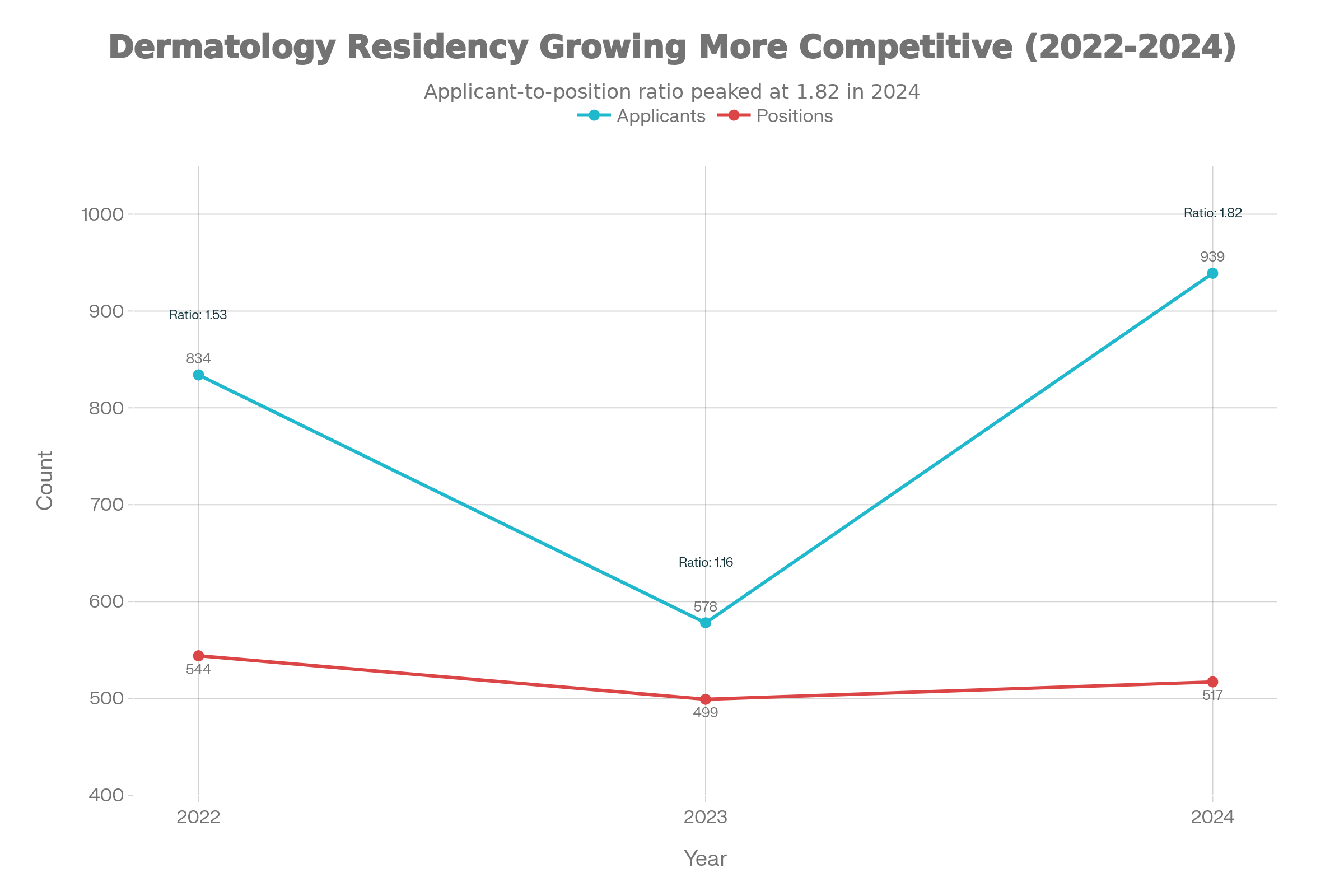
How competitive is dermatology residency? In 2024, there were 939 applicants for 517 available spots—nearly 1.8 applicants per position. For US medical graduates (MDs), the match rate is about 78%. For international medical graduates (IMGs) and osteopathic students, it’s lower—around 70% or less. So even after medical school, there’s a real chance you might not match on your first try.
To maximize your chances of matching, you need:
-
High board scores (Step 1, Step 2)
-
Research experience and publications
-
Clinical excellence during your dermatology rotation
-
Strong letters of recommendation from dermatologists
-
A well-written personal statement
-
Interview skills
Optional but Common Add-Ons That Increase Time
If the 12-year standard timeline isn’t specialized enough, or you want to develop expertise in a specific area, there are fellowships.
1. Fellowship Training (1–2 Years)
After completing your dermatology residency, you can pursue additional fellowship training. These are optional but increasingly common. Popular fellowships include:
Cosmetic Dermatology (1 year): This is probably the most popular fellowship. You’re training intensively in cosmetic procedures—lasers, injectables, chemical peels, microneedling, radiofrequency treatments. If you want to run a cosmetic practice or offer high-level aesthetic services, this fellowship is valuable. It’s also often lucrative.
Pediatric Dermatology (1-2 years): You’re specializing in skin diseases that affect children from infants to teenagers. This includes genetic skin conditions, rare disorders, and age-specific diseases. If you love working with kids and want to specialize in their unique skin needs, this is your path.
Dermatopathology (1-2 years): You’re essentially becoming a skin pathologist. You spend your days looking at skin biopsies under a microscope and making diagnoses based on histology (tissue appearance). It’s intellectually rigorous, involves less direct patient contact than clinical dermatology, and is crucial for diagnosing complex skin diseases. Many clinical dermatologists also have dermatopathology training.
Mohs Micrographic Surgery (1 year): This is specialized surgical training in Mohs technique—a precise method for removing skin cancer by examining tissue margins under a microscope during surgery. It’s intellectually demanding, technically challenging, and has high earning potential.
Dermatologic Oncology (1 year): You’re specializing in skin cancer diagnosis and treatment, including melanoma and non-melanoma skin cancers. This is increasingly important as skin cancer rates rise.
Research Fellowship: Some programs offer research-focused fellowships for academic-minded dermatologists wanting to conduct research and potentially lead research programs.
2. Research Years & Gap Years
Many dermatology candidates take gap years or research years before residency or during training, which extends the timeline.
Before residency: Some people take 1-2 years after medical school to do research, build their CV, or reapply to dermatology if they didn’t match the first time. This extra time can be valuable because it gives you publications and research experience that makes your next application more competitive.
During residency: Some dermatology programs build in research time. You might have a research year during PGY-3 or PGY-4 where you’re not seeing as many patients but are conducting research. This extends your residency timeline but produces valuable research.
Why dermatologists take them: If you’re interested in academic medicine or research, time dedicated to research is crucial. It’s hard to build a strong research program while seeing a full clinic of patients every day. Research years let you focus on scholarly activities, which opens doors to academic positions.
Total Years Required by Country
The timeline varies significantly depending on where you train. Let me break down the major countries separately.
United States
Total: 12 years minimum (up to 14 with fellowship)
-
Bachelor’s degree: 4 years
-
Medical school: 4 years
-
Internship: 1 year
-
Dermatology residency: 3 years
The US pathway is the most straightforward and fastest. Medical school is specifically designed for this timeline. Dermatology residency programs are well-established with standardized curricula. If you’re starting from high school with no interruptions, you could theoretically be practicing dermatology by age 30.
United Kingdom
Total: 13-15 years (sometimes more)
-
Medical school: 5-6 years
-
Foundation Programme (FY1 & FY2): 2 years of general medical training
-
Core Training (CT1-3): 2-3 years in Internal Medicine, Pediatrics, or Acute Medicine (you must pass MRCP or MRCPCH during this time)
-
Higher Specialty Training (ST3-6): 4 years in dermatology
The UK pathway is longer because the medical education system works differently. After medical school, doctors must complete foundation training (like an extended internship), then core training in a broad medical specialty before finally entering dermatology specialty training. You must also pass membership exams (MRCP – Membership of the Royal College of Physicians) before or during core training. By the end, you’ll sit the Specialty Certificate Examination (SCE) in Dermatology and receive a Certificate of Completion of Training (CCT), which allows you to practice as a consultant dermatologist in the UK.
India
Total: 8.5-9 years (potentially faster than Western countries)
-
Class 12 (High School): Prerequisite (Biology is required)
-
NEET-UG (entrance exam for MBBS):
-
MBBS: 5.5 years (including 1-year internship)
-
NEET-PG or INI-CET (entrance exam)
-
MD Dermatology: 3 years
India’s timeline is actually shorter than many Western countries, but that’s partly because MBBS is a longer integrated degree that includes internship. After MBBS, you must clear NEET-PG (National Eligibility cum Entrance Test for Postgraduate) or INI-CET (Entrance Examination for Postgraduate Courses) to get into MD programs. The MD in Dermatology is 3 years of specialized training, and you’ll likely sit for board certification through your medical council.
Australia & Canada
Total: 12 years
Australia:
-
Medical school: 6 years
-
Postgraduate experience: 2 years
-
Advanced training in Dermatology: 4 years
Australia requires longer medical school (6 years) but you get the 4-year dermatology training after some postgraduate experience. You’ll work toward Fellowship of the Australasian College of Dermatologists (FACD).
Canada:
-
Similar to USA timeline
-
Bachelor’s degree: 4 years
-
Medical school: 4 years
-
Residency (including internship): 4 years total
Canada’s system closely mirrors the USA. Canadian medical schools and residency programs follow similar structures.
Why Timelines Differ Globally
The differences come down to medical education philosophy. In the US, medical school is shorter (4 years) but very intensive, then you specialize. In the UK, medical school is longer (5-6 years) and includes more general training, followed by a structured pathway through various specialties before reaching your chosen field. In India, the model is different with longer MBBS but shorter postgraduate specialization.
Can You Become a Dermatologist Faster?
Okay, so 12 years is long. Can you speed it up? The answer is mostly no, but let me explain.
Accelerated Medical Programs
Some medical schools offer accelerated 3-year programs instead of standard 4-year programs. These exist but are extremely rare and highly competitive. You’d need near-perfect credentials, and even then, you’d be compressing the same amount of material into less time—it’s just a faster pace, not a shortcut. The time savings are minimal (1 year), and you’d still do a 4-year residency, so your overall timeline would be 11 years instead of 12. Marginal gain, huge stress.
Combined Degree Paths
There are some combined programs (like a 5-year internal medicine/dermatology program) that integrate some training, theoretically saving a year or two. But these programs are extremely rare in dermatology. The vast majority of dermatologists do the standard 1 + 3 pathway (1 year internship, 3 years dermatology).
Is “Faster” Actually a Good Idea?
Here’s the real talk: Most dermatologists are grateful for their training length, not frustrated by it. The years aren’t wasted time—they’re building your knowledge, skills, and professional network. Someone rushing through might pass exams faster but wouldn’t develop the clinical judgment, procedural skills, and deep understanding that makes a great dermatologist.
Also, dermatology residency is only 3 years long. That’s already one of the shortest residencies. Surgery is 5-7 years. Orthopedics is 5 years. Even family medicine is sometimes 3 years but often 4-5. You’re not looking at an unusually long training process in dermatology itself; the overall timeline is long because you have to become a physician first (which takes 8 years just for medical school and internship).
Age Factor: Is It Too Late to Become a Dermatologist?
You might be thinking, “I’m 30, is it too late?” or “I’m 40 and want a career change—is dermatology possible?” Let’s be honest about this.
Average Age at Completion
Most dermatologists begin practicing around age 30-32. They went straight through college, med school, internship, and residency without interruption. That’s the modal path.
Career Switchers in Their 30s or 40s
Is it possible? Yes, absolutely. People in their 30s and 40s do get into medical school and successfully complete residency. You’re not “too old.” Medical schools specifically look for and admit non-traditional students—people with interesting life experiences and different career paths.
But here’s what you need to understand: The timeline is still 9-11 years from now, not shorter. If you’re 35 right now and start medical school prerequisites immediately, you’re realistically looking at:
-
1-2 years: Completing any missing prerequisites and taking the MCAT
-
4 years: Medical school
-
4 years: Internship + dermatology residency
-
Total: 9-11 years, putting you at 44-46 when you finish
And that assumes you:
-
Get accepted to medical school on your first try
-
Immediately match into dermatology residency
-
Don’t take any gap years
That’s not impossible, but it’s a significant commitment, especially if you have family, a mortgage, or financial obligations.
Realistic Expectations vs Motivation
Before you pursue this path, ask yourself honestly:
-
Why dermatology? Not “I like skin” but real reasons. Have you shadowed dermatologists? Have you worked in healthcare? Do you know what the daily work actually involves?
-
Are you prepared for the debt? You’ll likely graduate with $200,000-$350,000 in student loans. As a resident earning $60,000-$70,000 per year, that’s a major financial burden.
-
Can you handle medical school competitiveness? Getting into medical school is genuinely hard. Your age might even help (showing maturity and determination), but you’ll still compete against 25-year-olds with perfect GPAs.
-
Do you have strong motivation? People who career-switch successfully into medicine do so because they have deep, genuine motivation—not just because dermatology looks nice. That motivation gets you through the hard years.
If you answer these honestly and still want to proceed, talk to a pre-medical advisor at a local college, find a dermatologist to shadow, and consider whether a physician assistant (PA) career in dermatology might be a better fit. A PA dermatology career is 2-3 years of PA school (much shorter and less debt), and you can still work in dermatology and make good money. It’s a real option worth considering.
Exams You Must Clear Along the Way
Becoming a dermatologist requires passing several major exams. Here’s what they are and why they matter.
Medical School Exams
MCAT (Medical College Admission Test): Taken before medical school, this 7.5-hour standardized exam tests science knowledge, critical thinking, and reasoning. It’s required by virtually all US medical schools. You’ll study for 300-350 hours typically. Scores range from 472-528, with average being around 500. For competitive specialties, you want 510+. This exam is high-stakes because it heavily influences which medical schools will interview you.
Licensing Exams
USMLE Step 1: Taken after second year of medical school, this exam tests basic science knowledge and is computerized. Average score for dermatology-matched students is around 249, well above the national average. If you score lower, you can still match, but it makes dermatology harder.
USMLE Step 2 CK (Clinical Knowledge): Taken in fourth year of medical school, this tests your clinical knowledge. Average for dermatology-matched students is around 256—an excellent score.
USMLE Step 2 CS (Clinical Skills): A practical exam where you see simulated patients and demonstrate your clinical skills. It’s not scored pass/fail but rather pass/fail (recently changed).
USMLE Step 3: Taken during or after your internship year, this exam tests clinical decision-making. It’s less high-stakes than Step 1 or 2, and most people pass, but it’s required for licensure.
Specialty-Specific Exams
American Board of Dermatology (ABD) CORE Exams: During your dermatology residency (starting year 2), you’ll take four CORE exams testing dermatologic knowledge. These are challenging but essential. Passing all four allows you to sit for the APPLIED exam.
ABD APPLIED Exam: After completing residency and passing all CORE exams, you take this exam, which tests how you apply dermatologic knowledge to patient cases. Most residents pass this.
Continuing Certification Program (CCP): After board certification, you must participate in continuing education and periodic exams to maintain certification.
International Exams
UK: During training, you’ll take MRCP (Membership of the Royal College of Physicians) exams during core training and SCE (Specialty Certificate Examination) in Dermatology during higher specialty training.
India: NEET-PG for entering MD programs, and board exams through the medical council.
Australia: Training and assessment through the Australasian College of Dermatologists.
Why All These Exams?
These exams filter out people who don’t have the knowledge to practice safely. Medical practice is high-stakes—people’s health and sometimes their lives depend on your decisions. These exams ensure you know your stuff. Yes, there’s also an element of credentials stacking (employers want board-certified doctors), but the underlying purpose is legitimate.
Cost vs Time: Is Dermatology Worth the Investment?
Let’s talk money, because time and money are intertwined in this career path.
Education Costs Overview
USA:
-
Bachelor’s degree: $20,000-$80,000+ (varies wildly by school)
-
Medical school: $200,000-$400,000+ (can exceed $400k at expensive private schools)
-
Total education cost: $400,000-$800,000
UK:
-
For UK nationals: Much lower due to subsidized medical education, around £120,000-£200,000 total
-
For international students: Can exceed £200,000+
India:
-
Generally lower; government medical college could be under $10,000, private colleges $50,000-$150,000+
-
MD programs relatively affordable
Canada:
-
Similar to USA, around $200,000-$400,000 CAD for medical school
Time Investment vs Income Potential
Let’s look at when dermatologists actually start earning well.
During training:
-
Medical school: You’re not earning; you’re paying
-
Internship year: You earn around $60,000-$70,000
-
Residency years (PGY-2 to PGY-4): You earn $70,000-$80,000 per year (US residents earn more than residents in many countries)
Once you’re practicing:
| Country | Annual Salary | Notes |
|---|---|---|
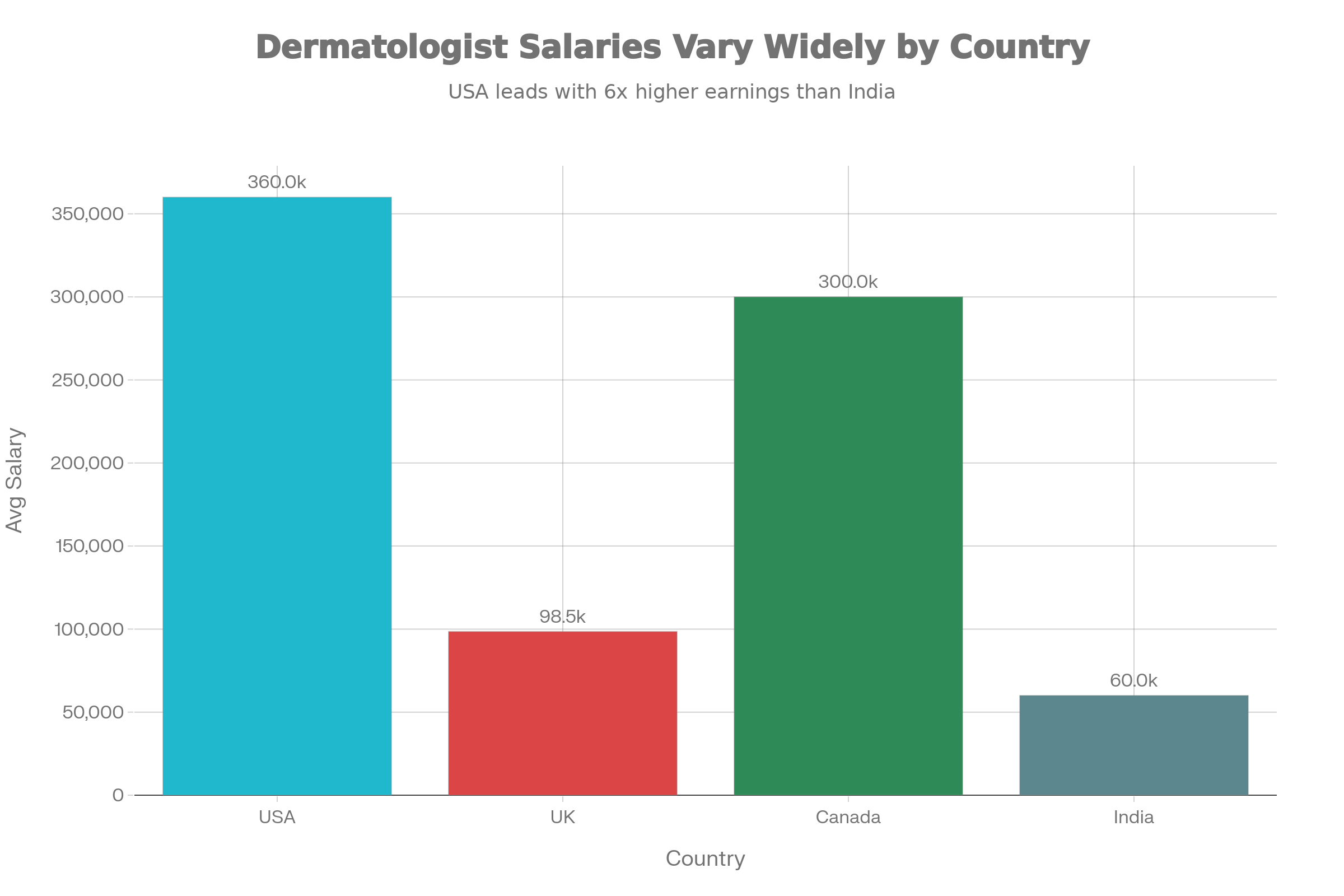
| USA | $360,000 (average) | Private practice: $400,000-$500,000+; Academic: $200,000-$300,000 |
| UK | £91,000-£106,000 (NHS); More in private | Entry: £87,000; Consultant range: £92,000-£150,000+ |
| India | Varies widely | Less than Western countries but better with private practice |
| Canada | CAD $250,000-$350,000 | Varies by province and practice setting |
The Math: Is It Worth It?
Let’s do a simple calculation for the US:
Total investment:
-
Education debt: $300,000 (average)
-
Years spent training: 12 years
-
8 years of living as a student/resident on lower salary: ~$600,000 in lifetime earnings lost compared to other careers
Total cost: ~$900,000 in combined debt and opportunity cost
Return:
-
First year practicing: $360,000
-
Working from age 30 to 65: 35 years
-
Potential lifetime earnings: $12.6 million+
-
Minus debt payback: ~$360,000-400,000 to refinance and repay loans
-
Net lifetime earnings advantage: Millions of dollars
The financial math works. You’re investing roughly $900,000 (in time and money) to earn millions over your lifetime. That’s a solid return.
But here’s the non-financial part: Dermatology ranks highly in physician satisfaction surveys. Dermatologists report good work-life balance, intellectual engagement, the ability to help people with conditions that significantly affect quality of life, and reasonable stress levels. If you hate the work or find it unfulfilling, no salary makes it worth it.
Common Misconceptions About Becoming a Dermatologist
Let me bust some myths you’ve probably heard.
Myth 1: “It’s Just Skin and Cosmetics”
Reality: Dermatology is complex medicine. Yes, you treat acne and do Botox, but you also diagnose melanoma (potentially life-saving), manage autoimmune diseases like lupus and scleroderma, perform Mohs surgery for skin cancer, manage severe psoriasis and eczema, and diagnose rare genetic skin conditions. Dermatologists also need to understand internal medicine, rheumatology, oncology, and other fields because skin often reflects systemic disease.
A patient comes in with a rash—is it a simple allergic reaction, or could it be a sign of systemic lupus erythematosus? Is that mole just a benign nevus, or is it melanoma? These are serious diagnostic questions that dermatologists answer regularly.
Myth 2: “Dermatologists Don’t Work Long Hours”
Reality (Nuanced): Once you’re practicing, dermatologists typically work 40 hours per week—excellent work-life balance. That part is true.
But: During residency, you’re working 50-60 hours per week. During medical school, you’re studying 40+ hours weekly. During your internship year, you might work long hospital shifts. The path to that cushy 40-hour work week requires years of longer hours.
Also, “40 hours per week” doesn’t mean your work-life balance is automatic. If you’re running a cosmetic dermatology practice, you might work “only” 40 hours but be constantly managing business operations, marketing, staff, and patient relationships. It’s less about hours and more about stress and flexibility.
Myth 3: “It’s Easier Than Other Medical Specialties”
Reality: Dermatology is highly competitive specifically because it’s desirable (good pay, good hours, interesting work), which makes it harder to get into, not easier. Dermatology residency gets nearly 2 applicants per spot. Orthopedic surgery gets similar competition. Meanwhile, many other specialties with lower competition are harder to actually practice—emergency medicine is stressful, surgery requires long days, internal medicine involves managing complex sick patients all day.
Dermatology might be “easier” once you’re practicing (fewer emergencies, reasonable hours), but getting there is genuinely competitive and requires high board scores, research experience, and clinical excellence.
Myth 4: “Cosmetic Dermatologists Don’t Need Medical Degrees”
Reality: This is actually false but widespread. All dermatologists—including those who focus on cosmetic dermatology—must complete medical school, residency, and specialty training. Some nurse practitioners or physician assistants work in cosmetic settings, but they work under physician supervision. You cannot legally practice dermatology (medical or cosmetic) without an MD or DO and proper licensure. The medical training is essential because aesthetic judgment comes from understanding anatomy, physiology, and patient assessment—things you learn in medical training.
Realistic Career Timeline Example (Year-by-Year Breakdown)
Let me paint a realistic picture with a specific example. Meet Alex, who starts at age 18 and follows the standard path.
| Age | Year | Phase | What’s Happening |
|---|---|---|---|
| 18-22 | 1-4 | Bachelor’s Degree | Studying biology, chemistry, physics, working as a hospital volunteer. MCAT prep in senior year. |
| 22-26 | 5-8 | Medical School | Years 1-2 are intense classroom work and board prep. USMLE Step 1 after Year 2. Years 3-4 are clinical rotations. Dermatology rotation happens somewhere in Year 3-4. USMLE Step 2 in Year 4. |
| 26-27 | 9 | Internship (PGY-1) | Rotating through internal medicine, ER, or transitional program. Completing USMLE Step 3. Applying to dermatology residency programs in the fall, interviewing winter/spring, matching in March. |
| 27-30 | 10-12 | Dermatology Residency | PGY-2: Learning fundamentals, starting CORE exams. PGY-3: Specialized rotations, advancing procedural skills. PGY-4: Advanced cases, teaching junior residents, preparing for APPLIED exam. |
| 30+ | 13+ | Practicing Dermatologist | Beginning practice, possibly pursuing fellowship for additional specialization (adds 1-2 years). Building reputation, patient base, and income. |
Best-Case vs Average Scenario
Best case: Alex goes straight through, gets excellent board scores, matches immediately into a top dermatology program, and starts practicing at age 30 earning $360,000+.
Average case: Alex takes a gap year for research between medical school and internship, doesn’t match to dermatology on first try (applies again), and starts practicing at age 32. Or Alex pursues a fellowship, starting practice at age 31 but with specialized expertise that increases earnings.
Challenging case: Alex’s MCAT score isn’t competitive, so Alex takes a post-bacc program, reapplies to medical school a year later. Or during residency, Alex struggles to match into preferred programs. These delays push the start of practice to age 32-33.
The variation is real, but most people are practicing dermatology between ages 30-33.
Is Dermatology the Right Career for You?
After reading all this, you might be thinking, “Do I actually want to do this?” That’s the right question to ask.
Personality Traits That Succeed
People who thrive as dermatologists typically:
-
Like continuity of care: You see the same patients over years (chronic diseases like psoriasis, acne management). You’re not just treating one acute problem and moving on. You build relationships and see long-term outcomes.
-
Enjoy procedures: If you like doing things with your hands—biopsies, injections, laser work, surgery—dermatology is perfect. If you only want to talk to patients and prescribe medications, other specialties might be better.
-
Are aesthetically minded: You need to understand how things look, develop an eye for cosmetics, and appreciate the visual nature of the field. This doesn’t mean you want to become a cosmetic dermatologist, but the visual component matters.
-
Are intellectually curious: Dermatology has a lot of complexity. New treatments emerge constantly. You need to want to keep learning and updating your knowledge.
-
Want autonomy: Dermatologists often control their schedules, their patient load, and their focus areas. If you want someone telling you what to do, other specialties have more hierarchy.
-
Value work-life balance: If this matters to you (and it should!), dermatology is a great fit. If you want to feel constantly busy and important, you might feel understimulated sometimes.
Who Should NOT Choose Dermatology
-
People who want to save lives in emergencies: Dermatology is rarely emergency-focused. If you’re energized by the intensity of emergency medicine or critical care, dermatology might feel slow.
-
People interested in internal systemic complexity: While dermatology involves systemic disease, it’s not the specialty for people who love deep internal medicine complexity. That’s a different skill set.
-
People uncomfortable with cosmetic procedures: The line between medical and cosmetic dermatology is blurry. You’ll be offering Botox, fillers, and lasers, even if your main interest is medical dermatology. If you find this philosophically troubling, it might be a mismatch.
-
People who can’t handle competition: If getting rejected stresses you out enormously, dermatology’s competitiveness (nearly 2:1 applicant-to-spot ratio) might break you. Other specialties have better odds.
-
People seeking quick entry into medicine: If you want to help people medically as fast as possible, PA school (2-3 years) is genuinely faster and might be a better path.
Honest Self-Assessment Checklist
Before committing, ask yourself:
-
Have I shadowed or worked with at least one dermatologist for significant time?
-
Do I understand what daily dermatology work actually involves?
-
Am I pursuing this for the right reasons (interest in the field, not just money or hours)?
-
Can I handle 4 years of medical school even if parts are boring or stressful?
-
Can I score competitively on board exams (realistic assessment, not just hope)?
-
Am I willing to build research experience and publications?
-
Can I handle potential rejection from dermatology programs if I don’t match?
-
Is the debt burden ($200,000-$350,000+) manageable for me?
-
Do I want to live in a city where dermatology training programs exist?
-
Would I be happy working in dermatology even if dermatology wasn’t prestigious?
If you answered yes to most of these, you might be onto something real.
Final Verdict: How Long It Really Takes (And Why It’s Worth It)
The direct answer: 12 years minimum in the USA, 13-15 years in the UK, 8.5-9 years in India, and 12 years in Canada and Australia.
If you’re starting from high school at age 18, you’ll likely be practicing dermatology around age 30-32.
What most people underestimate:
The hidden difficulty isn’t the raw time—it’s the competition and the emotional investment. You’ll spend 12 years working toward a career that’s highly selective. You might not match into dermatology on your first try. You might score lower on boards than you hoped. You might apply to dermatology and get rejected. Many people underestimate how much their identity becomes wrapped up in achieving this goal.
The other thing people underestimate is how much you’ll change during those 12 years. You might start medical school wanting to be a dermatologist and discover you love surgery instead. Or vice versa. You might realize during residency that you want to stay in academics rather than private practice. The specifics of your path will likely shift, and that’s okay.
Long-term rewards beyond money:
Yes, dermatologists earn well ($360,000+ in the US). Yes, they have good work-life balance. But the deeper rewards are:
-
Helping people feel confident: Dermatology directly impacts how people feel about themselves. When you clear someone’s severe acne or remove a concerning mole, the relief and gratitude is visible. That matters.
-
Combining medicine with aesthetics: You’re not just treating disease; you’re thinking about how treatment affects appearance. You’re helping people look like themselves again.
-
Building deep patient relationships: Because many conditions are chronic, you see patients repeatedly over years. You become their dermatologist of record, someone they trust with their skin concerns.
-
Intellectual challenge: Dermatology is more complex than most people realize. Rare conditions, systemic manifestations, procedural challenges—the learning never stops.
-
Reasonable life balance: By 30, most people want to have a life beyond work. Dermatology lets you actually have it.
-
FAQs
How long does it take after MBBS to become a dermatologist in India?
After MBBS (which takes 5.5 years including internship), it takes an additional 3 years to complete MD in Dermatology. So the total timeline is 8.5-9 years from Class 12. However, you must first clear NEET-PG or INI-CET to gain admission to an MD program. Many students take time to prepare for this exam, which can extend the timeline.
Can dermatologists start practice earlier?
Technically, after internship (around year 9 for US-trained physicians), you could potentially practice as a general physician in dermatology-related areas, but you wouldn’t be a board-certified specialist. Patients wouldn’t see you as a “dermatologist,” and you wouldn’t have the expertise to handle complex cases. The 3-year residency isn’t optional if you want to actually be a dermatologist. Some countries allow physicians to practice after internship without full specialist training, but this limits your capabilities and earning potential significantly.
Is dermatology harder than surgery?
This is a “depends what you mean” question. In terms of getting into the specialty: Dermatology is highly competitive (1.8 applicants per spot), and so is surgery. But dermatology boards don’t require as high scores as some surgical specialties. In terms of training difficulty: Surgery is longer (5-7 years) and more physically demanding. Dermatology is shorter (3 years) and less emergent, so many would say it’s “easier” in training. In terms of intellectual content: Both are intellectually demanding in different ways. Surgery requires manual dexterity and quick decision-making; dermatology requires diagnostic precision and procedural finesse. Not “harder,” just different.
Do cosmetic dermatologists need medical degrees?
For dermatologists: Yes, absolutely. All dermatologists, including those who focus on cosmetic procedures, must have MD/DO degrees, complete medical school and residency. There are non-physician options: RNs, PAs, and estheticians can perform cosmetic procedures, but only under physician supervision in most jurisdictions. A physician’s medical training is essential for understanding anatomy, physiology, complications, and safety—not just technique.
What’s the difference between dermatology in USA vs UK?
USA: Shorter overall pathway (12 years), faster board certification, more emphasis on procedures and cosmetic dermatology, higher income ($360,000+/year). UK: Longer pathway (13-15 years), structured progression through specialties, more focus on medical dermatology initially, lower income (£91,000-£120,000/year) in NHS but with better job security. USA path is faster and more lucrative; UK path is more structured and secure.
Can I specialize after becoming a general dermatologist?
Yes. Most dermatologists practice general dermatology initially, then many pursue fellowships in specific areas (cosmetic, pediatric, dermatopathology, Mohs surgery) after residency. You don’t have to choose a subspecialty right away. In fact, it’s better to do general dermatology during residency to see what interests you, then subspecialize if you want.
How competitive is dermatology really?
Very competitive. In 2025, there were 939 applicants for 517 positions. That’s 1.8 applicants per spot. For comparison, family medicine has more spots available and higher match rates. Dermatology is popular because of good lifestyle, good pay, and intellectual interest. This high competition means you need strong board scores (Step 1 and Step 2), research experience, excellent letters of recommendation, and possibly publications. If dermatology is truly your passion, don’t let this discourage you, but go in with eyes open.
What happens if I don’t match into dermatology?
You apply again next year. Many dermatology applicants don’t match on first try and reapply. In the year between applications, you can: do research to strengthen your CV, gain more clinical experience, take board exams if you haven’t, improve any weak areas. The second time around, your chances are better because you have more experience and publications. This adds 1-2 years to your timeline, but it’s manageable.
Can I work part-time as a dermatologist?
Yes. Dermatology is one of the medical specialties most amenable to part-time work. Many dermatologists work 3-4 days per week or take time off for family. This is especially common in cosmetic dermatology and private practice. If you value flexibility, dermatology accommodates it well.
Is medical school debt worth it for dermatology?
For most people, yes. You’ll graduate with ~$200,000-$350,000 in debt, but you’ll earn $360,000+ annually as a dermatologist. One year’s salary roughly covers your debt. If you stay in the field for 35+ years (typical career length), your lifetime earnings advantage is millions. However, if you’re not sure about the specialty, the debt is a big commitment. Research thoroughly before proceeding.
How do I get shadowing experience with dermatologists?
Contact dermatology offices directly and ask if they offer shadowing opportunities. Many dermatologists are willing to let interested pre-med or medical students shadow them. You don’t need to be a current student—just express genuine interest. Start with dermatologists in your city, then expand if needed. Shadowing for even a few days will help you see if dermatology is actually what you want.
What research should I pursue as a medical student interested in dermatology?
Any research is better than no research, but dermatology-specific research is ideal. This could be clinical research (studying patient outcomes), translational research (laboratory-based, studying mechanisms of skin disease), outcomes research, or case reports. Publish or present your findings if possible. Aim for 3-5 research projects and at least a few publications or presentations by the time you apply for dermatology residency.
Can I do dermatology PA instead of MD?
Yes, and it’s a legitimate path that takes much less time. PA school is typically 2-3 years after bachelor’s degree. You’d be working as a PA in dermatology under physician supervision. You’d make less money than MD dermatologists ($100,000-$150,000 vs $360,000+), but you’d enter the field much faster with less debt. If you want to help people with skin concerns and don’t need the independence or income of full physician practice, PA dermatology is worth considering.
Conclusion
So, how long does it take to become a dermatologist? Twelve years minimum, and probably 13-15 depending on your country and choices along the way.
That’s the honest answer. It’s not quick. But it’s also not impossible, and for the right person, it’s absolutely worth it.
The path requires dedication, strong academics, meaningful clinical experience, competitive board scores, and genuine passion for dermatology. You’ll face competition, potential rejection, financial burden, and years of training. But at the end, you’ll join a profession that offers:
-
Excellent work-life balance once you’re practicing
-
High income potential
-
The satisfaction of helping people feel confident in their skin
-
Intellectual challenge and constant learning
-
Relative job security and flexibility
-
Respect and status
If dermatology calls to you, start now. Shadow dermatologists. Study hard. Build your CV. Network with physicians and mentors. Apply to medical school. And when you’re in medical school, focus on getting strong board scores and relevant experience.
Twelve years from now, at age 30-32, you could be practicing dermatology, building a life you love, and finally being able to answer someone’s question about their skin concern with real expertise.
That’s worth the journey.
Your Next Steps:
-
Shadow a dermatologist if you haven’t already
-
Look into pre-med requirements at local colleges
-
Research medical schools and their dermatology match rates
-
Connect with current dermatologists and medical students for mentorship
-
Start building academic strength if you’re still in high school or college
-
Consider whether this path aligns with your long-term goals and values
The timeline is long, but your future self will thank you for starting today.