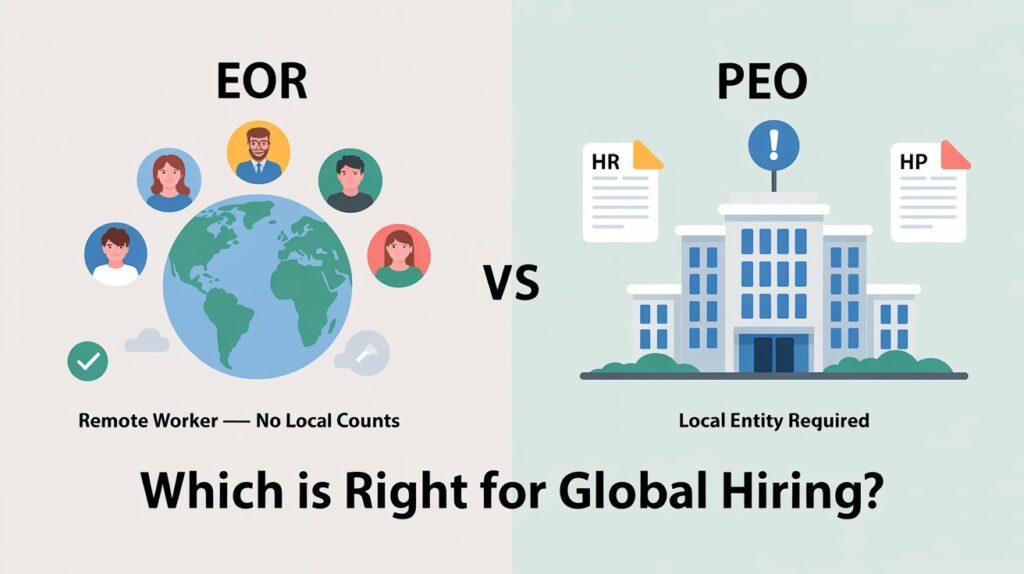
When you’re building a global team, hiring feels like it should be simple. You find the right person, offer them a job, and they start working. But in reality, international hiring involves layers of legal documents, tax obligations, benefits administration, and compliance rules that differ dramatically from country to country. Get this wrong, and you could face hefty fines, legal disputes, or lose valuable employees because of misclassifications.
That’s where two powerful models come in: Employer of Record (EOR) and Professional Employer Organization (PEO). Both help you hire internationally, but they work in fundamentally different ways. Many companies confuse the two—and that confusion can lead to costly mistakes.
The Rise of Global and Remote Teams
Over the last few years, remote work has transformed how companies build teams. You’re no longer limited to hiring within your country’s borders. A startup in New York can hire a developer in India, a designer in Portugal, and a marketer in Singapore—all without opening offices in those places. This flexibility is powerful, but it comes with complexity. Each country has its own employment laws, tax systems, benefits requirements, and compliance rules. What’s legal in one country might get you fined in another.
Why Many Companies Confuse EOR and PEO
Both EOR and PEO handle payroll, benefits, and HR functions. Both take pressure off your shoulders. But they operate under completely different legal structures, and using the wrong one for your situation can expose you to serious risks. Some companies think these terms are interchangeable—they’re not.
The Legal, Financial, and Compliance Risks of Choosing the Wrong Model
If you choose a PEO when you need an EOR (or vice versa), you might end up:
-
Unable to hire in countries where you don’t have a legal presence
-
Facing unexpected tax liability or penalties for misclassification
-
Sharing legal responsibility for compliance failures when you thought you had full protection
-
Paying far more than necessary for your headcount level
-
Trapped in a long-term contract that doesn’t fit your business growth
This article will help you understand exactly when to use each model, what each one really does, and how to avoid the pitfalls that catch most companies off guard.
What Is a Global Employer of Record (EOR)?
An Employer of Record is a company that steps in to be your employee’s legal employer on paper. You hire the person, you manage their day-to-day work, but the EOR handles everything legal: contracts, payroll, taxes, benefits, and making sure you follow the country’s labor laws. Think of it as renting the legal structure you’d need to hire locally, without actually building it yourself.
What an EOR Does in International Hiring
Here’s how it works in practice: you identify a candidate you want to hire in a country where you don’t have an office. Instead of spending months setting up a local company, you partner with an EOR that already has a legal presence in that country. The EOR becomes your employee’s official employer on the paperwork—they issue the employment contract, register the employee with local authorities, process payroll, and handle all tax filings.
You do everything else: you conduct the interview, make the hiring decision, assign the work, manage performance, and direct their day-to-day activities. From your new employee’s perspective, they’re working for you. But legally and administratively, the EOR is their employer.
Who the Legal Employer Is
This is the key distinction. On paper, the EOR is the legal employer. This means the EOR is responsible for:
-
Signing the employment contract
-
Registering the employee with government authorities
-
Processing monthly payroll and calculating taxes
-
Making contributions to social security, pension funds, and other mandatory benefits
-
Filing tax returns and regulatory documents
-
Ensuring you follow local labor laws
-
Managing employee termination and severance according to local rules
Because the EOR assumes these responsibilities, they also assume the legal and financial risk if something goes wrong.
How the EOR Model Works
Hiring without setting up a local entity
The beauty of the EOR model is speed. Normally, setting up a legal company in a new country takes 2–6 months, costs tens of thousands of dollars, and requires legal and accounting expertise. With an EOR, you skip all of that. The EOR already has legal entities registered in dozens of countries, bank accounts open, tax IDs issued, and compliance systems in place. You don’t need any of that infrastructure yourself.
Role of the EOR vs your company
Think of the relationship as a division of labor:
| Responsibility | Your Company | EOR |
|---|---|---|
| Finding and hiring the candidate | ✓ You do this | EOR supports |
| Day-to-day work direction | ✓ You manage | EOR doesn’t involved |
| Performance management | ✓ You handle | EOR doesn’t involved |
| Legal employment contract | EOR creates | ✓ Legal employer |
| Payroll processing | EOR calculates | ✓ EOR handles |
| Tax filings and compliance | EOR ensures | ✓ EOR responsible |
| Benefits administration | EOR manages | ✓ EOR handles |
| Handling terminations | You decide | ✓ EOR executes |
Countries where EOR is commonly used
Leading EOR providers operate in 150–185+ countries across North America, Europe, Asia-Pacific, Latin America, Middle East, and Africa. This includes places like India, Germany, Singapore, Canada, Australia, Brazil, Japan, and many others. Most major markets are covered, though the depth of service varies. Some countries have more local expertise and faster onboarding than others.
When Companies Typically Use an EOR
Hiring first employees in a new country
The most common scenario: you’ve just landed a great customer or a brilliant candidate in a country where you don’t have a physical presence. You can’t wait 6 months to set up an entity, and you don’t want to risk hiring as a contractor (which could trigger reclassification issues). An EOR lets you hire a real employee within days or weeks.
Testing international markets
Maybe you’re not sure if a particular market makes sense for your business. Hiring one or two people through an EOR lets you test demand, validate a business idea, or explore a region without the financial commitment of opening an actual office. If it works out, you can later convert to your own entity. If it doesn’t, you simply stop hiring.
Remote-first and distributed teams
Many modern companies don’t plan to ever open offices in other countries. They just want access to global talent. With an EOR, you can build a team spread across 10, 20, or 50 different countries. Everyone is properly employed and compliant, but you’re not managing 50 different subsidiaries.
What Is a Professional Employer Organization (PEO)?
A Professional Employer Organization is a company that takes over your HR and payroll duties. But here’s the key difference from an EOR: you still need to have a legal company in the country where you’re hiring. The PEO doesn’t become your employee’s sole employer—instead, you and the PEO co-employ them. It’s a partnership where you keep running your business and making the decisions, but the PEO handles the administrative burden of being an employer.
What a PEO Is and How It Operates
A PEO is really an outsourcing firm. Instead of hiring your own HR manager, payroll specialist, and benefits administrator, you hire the PEO to do all that work. Over 200,000 small and mid-sized businesses in the U.S. use PEOs.
The PEO takes on tasks like:
-
Processing payroll and calculating taxes
-
Managing benefits and insurance
-
Handling workers’ compensation
-
Ensuring compliance with employment laws
-
Creating employee handbooks
-
Managing terminations and disputes
You keep control of hiring decisions, firing decisions, work assignments, and company culture. The PEO just handles the paperwork and compliance side.
The Co-Employment Model Explained
In a co-employment relationship, both you and the PEO are considered the employer. This is different from an EOR, where the EOR is the sole legal employer. With a PEO:
-
You are the “worksite employer”—you manage the employees, direct their work, and make business decisions
-
The PEO is the “employer of record for HR purposes”—they handle administration and assume certain compliance responsibilities
But here’s the catch: you’re still liable for many things. The PEO doesn’t take full responsibility the way an EOR does. You still have to oversee compliance, make sure hiring decisions are legal, and monitor whether you’re following labor laws.
How the PEO Model Works
Shared employer responsibilities
Unlike an EOR where one company has clear responsibility, a PEO shares the load. You’re responsible for:
-
Hiring and firing decisions
-
Workplace safety
-
Discrimination and harassment prevention
-
Accurate job classification
-
Monitoring that the PEO is actually doing its job
The PEO is responsible for:
-
Processing payroll accurately
-
Withholding taxes correctly
-
Maintaining benefit plans
-
Staying updated on labor law changes
-
Filing required documents
But both of you are on the hook if something goes wrong. This means you can’t just hand over all responsibility and forget about it.
Payroll, benefits, and HR administration
Once an employee is on the PEO’s payroll, the PEO handles all the mechanical work: calculating gross pay, deducting taxes, processing benefits enrollments, generating paystubs, filing quarterly and annual returns. For larger companies, this is huge. It eliminates the need for an internal payroll department.
But the PEO is working within your existing legal entity. The employee’s contract is still with your company (not the PEO). The PEO is just the administrative middleman.
When Companies Use a PEO
Businesses with an existing legal entity
The fundamental requirement for a PEO is that you already have a legal company where you’re hiring. If you don’t, a PEO won’t work. They can only co-employ people at a company that already exists on paper.
Domestic or limited international expansion
PEOs work best when you’re expanding within your home country or in places where you already have established operations. For truly global expansion with employees scattered across many countries, a PEO becomes complicated because you’d need a separate PEO (or legal entity + PEO) in each country.
Medium to large organizations
PEOs are often used by established businesses with 20+ employees that want to reduce HR overhead. Small startups sometimes use them too, but the value proposition is stronger when you have enough headcount that the PEO’s fees become a small percentage of payroll, or when you’re burning money on expensive in-house HR staff.
EOR vs PEO: The Core Difference Explained
Let’s break this down in a simple way so you see exactly what’s different.
Legal Employer Responsibility
Who is the official employer on paper
In an EOR arrangement, there’s no confusion: the EOR is the legal employer. When a government agency looks at your employee’s tax records, the EOR’s company name is listed. When the employee gets a paystub, it comes from the EOR.
With a PEO, it’s murkier. You’re both employers. Your company is listed as the employer on some documents, the PEO on others. This co-employment can create confusion about who’s responsible for what.
Why this matters for compliance and liability
Because the EOR is the sole legal employer, they bear the legal risk. If payroll taxes aren’t filed on time, that’s on the EOR. If the employee’s classification is wrong (employee vs. contractor), that’s on the EOR. If you violate a local labor law, the EOR is held accountable.
With a PEO, responsibility is shared. You’re still liable if you fire someone illegally, even though the PEO handles payroll. You’re still responsible for ensuring there’s no discrimination in hiring, even though the PEO manages benefits. This is a bigger burden than many companies realize.
Entity Requirement
EOR: No local entity required
This is the game-changer. You can hire an employee in India without ever registering a company there. The EOR’s Indian subsidiary is the legal employer. You don’t need your own entity at all.
PEO: Local entity required
You must have already established a legal company in the country where you want to use a PEO. The PEO co-employs through your existing company.
This is why PEOs don’t work well for international expansion. If you’re hiring in 10 different countries and you don’t have entities in all of them, you can’t use a single PEO across all those countries.
Compliance and Risk Ownership
Labor laws
An EOR is responsible for ensuring you comply with the country’s labor laws. They monitor wage laws, working hours, leave entitlements, termination procedures, and more. They automatically adjust your contracts when laws change.
With a PEO, you share this responsibility. The PEO will inform you of law changes and guide you, but you still need to ensure your business practices are compliant. If you ignore the PEO’s advice and break the law, that’s your problem.
Termination rules
In many countries, you can’t just fire someone. There are notice periods, severance requirements, final settlements, and documentation rules. An EOR handles all of this according to the local law. They calculate what you owe, manage the final paycheck, and ensure everything’s documented correctly.
A PEO will process the termination and final pay, but if you terminate someone illegally, the legal risk is partly yours because you made the termination decision.
Misclassification risks
If you hire someone as a contractor but they should legally be an employee, that’s a misclassification. The person might be entitled to benefits, overtime, and job protections they didn’t get. This can result in lawsuits, back-pay claims, and penalties.
An EOR takes the risk because they’re classifying the person as an employee and managing them as such. With a PEO, you’re both responsible for the classification decision.
Global Employer of Record vs PEO: Side-by-Side Comparison
Here’s everything compared at a glance:
| Factor | EOR | PEO |
|---|---|---|
| Legal employer status | EOR is sole legal employer | You and PEO co-employ |
| Country coverage | 150–185+ countries | Limited to countries with your legal entity |
| Local entity required | No | Yes, mandatory |
| Payroll and tax responsibility | Full responsibility on EOR | Shared responsibility |
| Benefits administration | EOR handles | PEO handles, you oversee |
| Compliance liability | Full liability on EOR | Shared liability |
| Speed of hiring | Days to weeks | Weeks to months (entity first) |
| Cost per employee | $199–$1,000/month or 8–20% salary | $40–$160/month or 2–12% payroll |
| Setup fees | Minimal (if any) | $500–$5,000 |
| Best for | International expansion, new markets | Domestic scaling, existing entities |
| Best for startups | Hiring first international employee | Not ideal (no entity yet) |
| Scalability | Costs increase per employee | Better for large domestic teams |
| Long-term commitment | Flexible | Often requires commitment |
Cost Comparison: EOR vs PEO
Money matters, so let’s get specific about what you’ll actually pay.
How EOR Pricing Works
Per-employee-per-month model
Many EORs charge a flat fee for each employee, regardless of their salary. This might be $400–$600 per month. The advantage: you know exactly what you’ll pay. The disadvantage: a lower-paid employee costs the same as a higher-paid employee, so the percentage burden is heavier for junior roles.
Country-based cost variations
EOR fees vary dramatically by country.
| Region | Monthly Cost Range | Why |
|---|---|---|
| Eastern Europe | $350–$600 | EU compliance standards |
| Western Europe | $600–$1,000+ | Complex labor laws |
| India & Southeast Asia | $199–$599 | Lower regulatory complexity |
| Latin America | $300–$600 | Developing compliance frameworks |
| North America | $500–$800 | High complexity |
For example, hiring someone in Germany is more expensive than hiring in Poland because Germany has stricter labor laws. Hiring in India is cheaper than in Canada.
How PEO Pricing Works
Percentage of payroll
Most PEOs charge 2–12% of your total payroll. If you have five employees earning $50,000 each (total $250,000 annual payroll), a 5% PEO fee would be $12,500 per year. This scales with salaries, so higher-paid employees cost more to maintain.
Flat fee vs bundled pricing
Some PEOs charge a flat monthly fee per employee ($40–$160) plus additional charges for optional services. Others bundle everything into a percentage of payroll.
Which Model Is More Cost-Effective?
This depends on your situation:
Small teams (1–5 employees)
EOR is usually cheaper. If you’re hiring one person in India at $400/month EOR fee, that’s $4,800 annually. A PEO charging 5% of payroll on a $60,000 salary would cost $3,000—actually cheaper per person. But you’d need an entity, which costs money and time to set up.
Large teams (50+ employees)
PEO becomes more competitive if you have a large domestic team. A PEO charging 3% of $2 million in payroll costs $60,000. With an EOR, 50 employees at $500/month each would cost $300,000 annually. Clearly, EOR doesn’t scale as well for large headcounts.
Short-term vs long-term hiring
Testing a market with one hire for 6 months? EOR is more practical and cheaper. Hiring a permanent team of 30 in your home country? PEO makes more financial sense.
Compliance and Legal Considerations
This is where most companies get tripped up. Both models claim they handle compliance, but the reality is more nuanced.
Employment Law Compliance
Country-specific labor laws
Every country has different rules. India requires Provident Fund (12% of salary), Employee State Insurance, Professional Tax, and Gratuity calculations. Germany mandates specific notice periods and severance formulas. Canada has provincial variations on minimum wage and vacation days.
An EOR stays on top of all these rules. They have local legal teams, they monitor law changes, and they automatically update your contracts when regulations shift. You don’t have to think about it—it’s part of what you’re paying for.
A PEO will alert you to changes and guide you, but the ultimate responsibility is yours to ensure compliance. Many businesses find this confusing and accidentally break rules they didn’t know existed.
Contract requirements
An EOR creates an employment contract that’s legally compliant in that country. It covers probation periods, notice periods, IP ownership, confidentiality, benefits, and termination. You can customize it, but the EOR ensures it meets local requirements.
With a PEO, you’re working with your own legal contract, which may not be tailored to the country’s requirements if you’re hiring there.
Tax and Social Contributions
Employer vs employee obligations
In most countries, employers withhold employee taxes and make contributions to social security on the employee’s behalf. In India, this might be 12% Provident Fund + 0.75% ESI from the employer, plus income tax withholding. Different in every country.
An EOR calculates all of this, deducts it from salary, and files it with authorities. No guesswork.
A PEO does this for you too, but if you’re in multiple countries with different entities and different PEOs, you’re managing it across multiple systems.
Filing and reporting responsibilities
An EOR files all required documents: monthly/quarterly tax returns, social security contributions, annual filings, and regulatory reports. They know what’s due, when, and how to file it.
With a PEO, the PEO files for the entity you’ve set up, but again, shared responsibility means you should be verifying it’s being done correctly.
Data Protection and Privacy
GDPR and local regulations
In Europe, the GDPR restricts how you store and process employee data. In India, the Personal Data Protection Bill has similar requirements.
An EOR ensures compliance with these regulations. They know where data must be stored, who can access it, and how long to keep it. For India, Deel and other EORs specifically host payroll data in-country to comply with data localization rules.
Who is responsible for data compliance
With an EOR, the EOR is responsible for keeping data secure and compliant. With a PEO, you’re responsible for data governance within your entity, even though the PEO handles payroll data.
EOR vs PEO for International Hiring
This is where the two models diverge most sharply.
Why EOR Is Better for Global Expansion
No entity setup
If you want to hire in 5 countries, with an EOR you can do it tomorrow. With a PEO, you’d need to set up legal entities in 5 countries first, which would take months and cost tens of thousands of dollars.
Faster onboarding
An EOR can onboard an employee in days. An entity setup takes 2–6 months. If you’ve just won a contract and need to hire immediately, an EOR is your only option.
Lower upfront risk
You’re testing a market with one or two hires. With an EOR, you invest minimal capital—just the employee’s salary and the EOR fee. If the market doesn’t pan out, you’ve lost less. If you’d set up a legal entity, you’d have sunk costs that won’t come back.
Why PEO May Not Work Internationally
Entity requirement limitations
You can’t use a PEO in a country without an entity. Period. This makes international expansion unnecessarily complicated. You’d need a PEO in each country, which multiplies your vendor relationships and administrative burden.
Country restrictions
Most PEOs operate primarily in North America or a single country. Very few work globally like EORs do. Even “international” PEOs often operate as local PEOs in each country, not as a unified global platform.
Which Model Is Right for Your Business?
Let’s make this simple. Answer these questions:
Choose an EOR If:
-
You want to hire internationally fast (within weeks, not months)
-
You don’t want to open a local legal entity
-
You’re testing new markets without committing long-term
-
You need employees scattered across multiple countries
-
You don’t have an existing legal entity in the country where you want to hire
-
Your headcount is still small (fewer than 50 people per country)
Choose a PEO If:
-
You already have a legal entity established in the country
-
You want to outsource HR and payroll for domestic expansion
-
You operate primarily in one country or a few states
-
You have a large team and want to reduce administrative overhead
-
You don’t need international coverage
-
You want a long-term partner to manage your HR function as you scale locally
Real-World Hiring Scenarios
Let’s look at three common situations and what actually makes sense.
Scenario 1: Startup Hiring First International Employee
You’re a 5-person startup based in the U.S. You’ve just found an amazing engineer in Portugal, and you want her on your team next month.
Why EOR makes sense:
-
You don’t have a Portuguese subsidiary
-
You can’t wait 6 months for entity setup
-
You want one vendor, not 10 different legal firms
-
Your risk is just one employee—you can afford to test the market
What happens:
You partner with an EOR, they register the employee in Portugal within 2 weeks, she starts next month, the EOR handles all Portuguese taxes and benefits. You pay $500/month for the EOR service plus her salary.
Scenario 2: Company Expanding to Multiple Countries
You’re a $10 million SaaS company. You want to hire remote teams in India, Singapore, and Brazil—maybe 2–3 people in each country.
Why EOR scales better:
-
You don’t need to set up entities in three countries
-
You can manage all hiring through one EOR (if they cover all regions)
-
You keep flexibility—if a region underperforms, you can scale back easily
-
Speed matters; you want to hire within weeks
What happens:
You sign one contract with an EOR that operates in all three countries. Within weeks, you’ve hired in all three locations. The EOR manages compliance, payroll, and benefits in each country. You manage the people. One vendor, multiple countries.
Scenario 3: Established Business With Local Entity
You’ve been operating in Canada for 5 years with a full legal subsidiary. You have 30 Canadian employees and want to reduce your HR burden. You’re not expanding internationally—you just want to streamline operations.
When PEO is a better fit:
-
You already have a legal entity
-
You have a large enough team to justify the PEO cost
-
You don’t need international coverage
-
You want to hand off daily HR tasks
What happens:
You sign a PEO agreement. The PEO takes over payroll processing, benefits administration, and compliance monitoring. Your internal HR manager now focuses on hiring, culture, and strategy instead of processing paychecks. The PEO charges 5% of your payroll.
Common Misconceptions About EOR and PEO
Let’s bust some myths that get companies into trouble.
“PEO works globally without an entity”
The truth: PEOs are not global solutions. Each PEO typically works in specific countries, and you usually need a local legal entity for the PEO to operate. If you want to use a PEO in 10 countries, you’d need to either find a PEO that operates in all 10 (rare) or use 10 different PEOs (complicated). For true global hiring, an EOR is the only practical option.
“EOR employees aren’t real employees”
The truth: EOR employees are completely real. They have the same legal rights, protections, and benefits as any other employee in the country. They get paychecks, tax documents, and access to statutory benefits just like everyone else. The only difference is that the EOR is the legal employer on paper, not your company. From the employee’s perspective, they have a legitimate job with a legitimate contract.
“EOR is only for startups”
The truth: EOR is used by startups and by huge enterprises. A startup might use an EOR to hire its first engineer in Germany. A Fortune 500 company might use an EOR to test a new market in Vietnam. The size of your company doesn’t determine whether an EOR makes sense—your hiring needs do.
“Using an EOR means losing control”
The truth: You maintain complete operational control. You manage the employee’s day-to-day work, assign projects, handle performance reviews, and make work decisions. The EOR only handles the legal and administrative side (contracts, payroll, taxes, benefits). You’re not losing control—you’re outsourcing the boring compliance stuff so you can focus on actual work.
“Switching from EOR to a local entity is complicated”
The truth: Many companies transition from EOR to a local entity as they grow. It’s not simple, but it’s doable. You plan it out 12–18 months in advance, the EOR helps coordinate, and your employees transition smoothly to your new local payroll. You keep your team intact and just change the legal structure.
Risks and Limitations of Each Model
EOR Limitations
Long-term scaling costs
As you hire more people in the same country, the EOR model becomes expensive. If you’re paying $500/month for each employee and you end up with 20 people in India, that’s $120,000 per year just for the EOR service (plus salaries). If you’d set up your own entity, you might pay one HR manager $30,000 and save significantly.
This is why many companies use EOR for years at the small scale, then switch to a local entity once they hit 10+ employees in a country.
Less direct employer control
The employee’s contract is with the EOR, not with you. This can feel distant, especially if the employee is thinking about their legal rights and where their paycheck comes from. You maintain management control, but the legal relationship is different. Some companies address this through thoughtful onboarding and regular communication to emphasize that the employee is part of your team.
Permanent establishment risk
If you hire too many people, do too much business, or stay in a country too long through an EOR, tax authorities might deem you to have a “permanent establishment” there. This could mean you owe local corporate taxes and need a legal entity after all. This risk increases the more employees you have, the longer you operate, and the more control you exercise. After 12–18 months, this risk becomes real.
PEO Limitations
Compliance exposure
With shared responsibility, you’re exposed. If the PEO makes a compliance mistake, you’re both potentially liable. Many companies mistakenly assume the PEO has taken all the risk and then get surprised when they face a penalty for something the PEO didn’t properly handle.
Not suitable for entity-free expansion
You can’t use a PEO unless you already have a legal entity. This makes it unsuitable for companies trying to expand internationally without setting up subsidiaries. If global hiring is your goal, a PEO doesn’t solve the problem.
Limited geographical coverage
Most PEOs are domestic or regional, not truly global. You can’t simply scale a PEO relationship across many countries the way you can with an EOR.
Frequently Asked Questions
Is EOR legal in all countries?
No. EORs operate in 150–185+ countries, but not everywhere. Some countries restrict foreign employment, and some have regulations that make the EOR model difficult. Check with your EOR provider about coverage in specific countries.
Can a PEO act as an EOR?
Not really. A PEO is designed for co-employment in a country where you have a legal entity. An EOR is designed for being the sole employer in a country where you don’t. They’re fundamentally different models. Some companies market themselves as both, but they’re operating differently in each role.
Is EOR more expensive than PEO?
For small international hires, yes, EOR is usually more expensive per employee. But when you factor in the cost of setting up a local entity (which PEO requires), EOR often wins on total cost of ownership. For large domestic teams, PEO is cheaper.
Can startups use PEOs?
Technically yes, but it requires already having a legal entity. Most startups don’t, which makes PEO impractical. For startups that do have an entity and want to reduce HR burden, a PEO can work.
Can companies switch from EOR to PEO later?
Yes, and many do. Once you establish a legal entity in a country, you can convert your EOR employees to your own payroll (either self-managed or through a PEO). The transition typically happens 12–18 months after initial hiring through an EOR, when you’ve validated the market and decided to commit long-term.
Final Verdict: EOR vs PEO—Which One Should You Choose?
Quick Summary of Differences
| EOR | PEO | |
|---|---|---|
| Best for | International expansion, fast hiring, no local entity | Domestic scaling, existing entity, reducing HR burden |
| Speed | Days to weeks | Weeks to months (entity setup first) |
| Legal employer | EOR is sole employer | You and PEO co-employ |
| Entity required | No | Yes |
| Cost for 1 person | $199–$1,000/month | $40–$160/month or 2–12% payroll |
| Cost for 50 people | Very expensive | Much cheaper |
| Global coverage | Yes (150–185+ countries) | Limited/regional |
| Compliance responsibility | Full on EOR | Shared |
| Best for startups | Yes | Only if you have an entity |
Decision Framework Based on Business Stage
Early-stage (pre-product-market fit)
-
If hiring internationally: EOR
-
If hiring domestically: Probably internal hiring, not PEO yet
Growth stage (scaling, some revenue)
-
If hiring internationally: EOR (test markets with EOR, establish entities later)
-
If hiring domestically: PEO can make sense to reduce HR burden
Mature stage (profitable, large team)
-
If international operations are significant: Switch from EOR to local entities + internal HR/local PEO
-
If primarily domestic: PEO or internal HR depending on complexity
Recommendation Based on International Hiring Goals
If you want to hire your first international employee this year:
Use an EOR. It’s the fastest, lowest-risk way to get compliant hires in place.
If you want to hire in multiple countries across multiple continents:
Use an EOR that operates in all your target countries. It’s the only model that scales this way without massive administrative overhead.
If you want to establish a permanent presence in one country:
Start with an EOR to test the market, then plan a transition to a legal entity + local HR (or local PEO) after 12–18 months.
If you already have local legal entities and want to reduce HR complexity:
Use a PEO in those countries where you have entities.
If you want global coverage for your distributed team:
Use an EOR. PEOs can’t do this well.
Conclusion
The right choice between EOR and PEO depends entirely on your situation. They’re not interchangeable, and picking the wrong one can cost you time, money, and legal risk.
EOR wins on speed, flexibility, and global reach. If you’re building a distributed team across multiple countries or making your first international hire, EOR is your answer. The trade-off is slightly higher per-employee costs and the eventual need to transition to a local entity if you stay in a country long-term.
PEO wins on domestic scaling and cost efficiency for large local teams. If you already have a legal presence and want to hand off HR work, a PEO is practical. The trade-off is shared compliance responsibility and limited international applicability.
The best approach for many growing companies is a hybrid: use an EOR to test new markets and make initial international hires, then transition to local entities (and possibly local PEOs) as you commit to those markets long-term.
Whatever you choose, understand the model completely. Know who’s responsible for what, know your cost structure, and revisit the decision annually as your business grows. Your choice today might be perfect now, but it won’t be perfect forever. And that’s okay—moving between models is normal and expected as you scale.