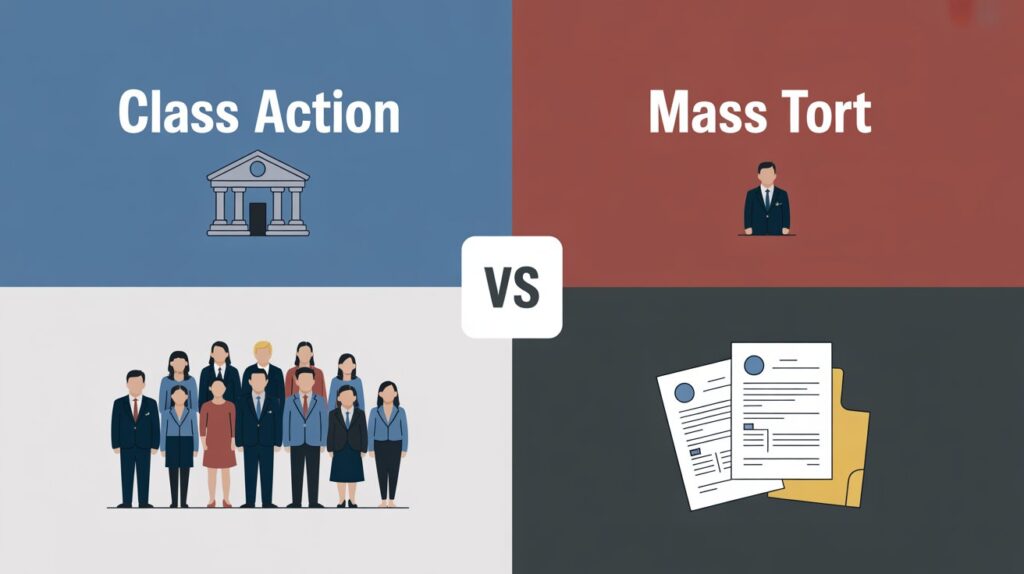
You’re harmed by a defective product, a dangerous drug, or a corporate mistake that affected thousands of people just like you. Now you’re left wondering: should you join a class action lawsuit or pursue a mass tort claim? The names sound similar, and honestly, the legal system doesn’t make it easy to tell them apart. But here’s the thing—choosing the wrong path could dramatically affect how much compensation you receive and how much control you have over your case.
Let me paint a picture. Imagine Johnson & Johnson’s talcum powder, which harmed over 63,000 people. Some victims joined class actions, while others pursued mass tort litigation through multidistrict litigation (MDL). Those in the MDL had their damages assessed individually, meaning someone with severe mesothelioma could receive millions, while those in a class action might split a pool of money equally with thousands of others. That’s not a small difference—we’re talking about the difference between getting significant compensation and getting a check for less than $100.
This guide will help you understand exactly what separates these two legal strategies, what each lawyer brings to the table, and most importantly, which path actually makes sense for your situation. By the end, you’ll have the clarity you need to make an informed decision that protects your rights and maximizes your potential recovery.
What Is a Class Action Lawsuit?
Think of a class action like a group lawsuit where one person (or a few people) steps up to represent everyone in the group. The court treats all the plaintiffs as a single unit, which means everyone gets the same outcome—either you all win together, or you all lose together.
Here’s how it works: One or a few named plaintiffs represent hundreds, thousands, or even millions of people with similar claims against the same defendant. To move forward as a class action, the court must certify the class by verifying that certain legal requirements are met. The case moves through the courts as one single lawsuit, and when it settles or goes to trial, the settlement or judgment applies to everyone in the class equally (or according to a predetermined formula).
Class action lawsuits are typically used when many people suffer the same type of harm in the same way. Consumer fraud cases are perfect examples—if a company overcharged 2 million customers by $5 each, a class action makes sense because everyone experienced identical damage. Same thing with data breaches, employment wage violations, or false advertising campaigns.
Once the court certifies the class, you’re automatically included unless you actively opt out. This is important—if you ignore the class action notice, you’re locked in, and you’ve waived your right to sue individually later.
What Is a Mass Tort Lawsuit?
A mass tort is different. Instead of one united lawsuit, you have multiple individual claims filed by separate plaintiffs, all against the same defendant, all for similar reasons, but each treated as its own case.
The key difference: in a mass tort, you keep your individual claim. Your damages are assessed based on your specific situation—your injuries, your medical costs, your lost wages, your pain and suffering. Someone with a severe injury receives more than someone with a mild injury. Someone who used a defective product for 20 years might get more than someone who used it for 1 month.
Mass torts often get consolidated into something called Multidistrict Litigation (MDL). When this happens, many similar cases from different federal courts get transferred to one court for pretrial proceedings. This saves time and resources, but here’s the crucial part: each case remains individual. At the end, when it’s time to settle or go to trial, each person’s damages are calculated separately based on their unique circumstances.
Why do mass torts exist? Because sometimes the injuries and damages are so different from person to person that treating everyone the same would be unfair. A defective drug might cause one person mild side effects while causing another person permanent organ damage. A toxic exposure site might affect some workers more severely than others based on their length of exposure. In these situations, the law recognizes that individual justice requires individual assessment.
Class Action vs Mass Tort: Core Structural Differences
Let’s break down the fundamental differences that matter most to your case.
How Claims Are Filed
In a class action, one lawsuit is filed on behalf of everyone. The court certifies the class, and boom—millions of people are now part of that single case. Think of it as one filing that represents everyone.
In a mass tort, multiple lawsuits are filed, but they’re managed together. If your case ends up in an MDL, it’s coordinated with thousands of other cases through a unified pretrial process, but technically you still have your own individual lawsuit. It’s like having separate court cases that are sitting next to each other in the same courtroom with the same judge overseeing discovery.
How Compensation Works
This is where things get really different, and it’s the part that affects your wallet the most.
In a class action, compensation is divided equally or according to a formula. If a company defrauded 10 million people out of $10 each, and the settlement is $50 million after attorney fees, then each person gets $5 (before the payout drops due to unclaimed funds and other costs). Everyone in the class gets treated the same, whether you suffered a tiny loss or a huge one.
In a mass tort, each person’s compensation reflects their individual damages. Did your injuries require surgery? That factors in. Did you miss work for six months? That’s calculated. Is your medical condition permanent? That increases your settlement value. This is why mass tort settlements vary so much from person to person. In the Johnson & Johnson talc litigation, some families received $20 million verdicts for mesothelioma, while others settled for smaller amounts depending on their specific health impacts.
Control Over Your Case
Class action members have very limited control. You’re represented by a class representative and a legal team. You don’t attend strategy meetings. You don’t make decisions about whether to settle or go to trial. The lawyers and the lead plaintiff make those decisions for you.
Mass tort plaintiffs have significantly more control. You can make your own decisions about settlement offers. You can hire your own attorney (and many mass torts involve multiple attorneys working together on different parts of the case). You have a say in how your case is handled. This is a real advantage if you want to be involved in your own legal process.
Legal Strategy Differences That Matter
Understanding how lawyers approach these cases reveals why they’re so structurally different.
Case Strategy: Efficiency vs. Personalization
Class action lawyers focus on proving that the defendant’s conduct harmed a large group of people in the same way. They look for statistical evidence and patterns that apply across the entire class. They might prove that a company systematically overcharged customers, then calculate the average overcharge across all customers. The strategy is built on efficiency and moving large numbers of claims through the system.
Mass tort lawyers do something different. They focus on building individual evidence for each plaintiff. For a defective drug case, a mass tort attorney might gather extensive medical records, expert witness testimony about causation, documentation of specific symptoms and treatments, and economic loss calculations specific to each plaintiff. It’s more personalized because damages depend on what actually happened to that specific person.
Evidence and Proof
In class actions, statistical proof often works. A lawyer might show that a company’s billing system systematically added fees to all customers’ bills, without needing to examine every single customer’s case individually. Courts accept pattern and practice evidence because everyone was supposedly harmed in the same way.
In mass torts, individual proof matters more. You typically need to show that you personally were exposed to the harmful product, that you personally suffered injury as a result, and that you personally have damages. This is why medical experts play such a huge role in mass torts. For pharmaceutical cases, you need expert testimony about how the drug caused your specific medical condition. For toxic exposure cases, you need documentation of your exposure levels and how they affected your health.
Settlement Dynamics
Class action settlements are one-time, global deals. The defendant agrees to pay $X million, the case ends for everyone, and the money gets distributed according to the settlement terms.
Mass tort settlements are often tiered or individualized. In an MDL, you might see “bellwether trials”—these are test cases where a few representative cases go to trial, and the results help guide settlement negotiations for the remaining cases. Someone might get $500,000 based on a bellwether trial result, while another person negotiates $2 million based on more severe injuries. Settlements can be negotiated individually or in groups based on injury severity.
Class Action Lawyer vs Mass Tort Lawyer
Now let’s talk about the lawyers themselves, because the type of attorney you hire matters enormously.
Skill Set Comparison
A class action lawyer is a specialist in class procedure and certification. They know Federal Rule of Civil Procedure 23 inside and out—the specific legal requirements for certifying a class, proving numerosity, commonality, typicality, and adequacy of representation. They understand how to manage millions of claims at once and navigate the complex procedural requirements that come with class litigation.
These lawyers also understand how to build statistical cases and present pattern evidence effectively. They’re comfortable working with data analysts and economists who can demonstrate harm across large populations. They typically work as part of a consortium—multiple law firms from different parts of the country coordinate their efforts on one class action.
A mass tort lawyer brings different skills entirely. They’re experts in managing the medical and scientific aspects of complex cases. They know how to work with medical experts, toxicologists, epidemiologists, and economists to build individual cases. They understand product liability law, pharmaceutical regulation, environmental law, or whatever area the mass tort involves.
Mass tort attorneys are also experienced at handling the administrative side of managing thousands of individual cases—organizing discovery, coordinating multiple plaintiffs, managing expert witnesses across many claims, and negotiating individual settlements. They’re used to trial work because mass torts often result in individual trials if bellwether trials don’t produce acceptable settlement offers.
Team Size and Resources
Class action firms often assemble what’s called a “consortium”—multiple law firms across different states working together on one unified class action. You might have lead counsel managing the case, coordinating counsel helping with specific issues, and settlement counsel handling distribution. This approach pools resources from many firms.
Mass tort litigation involves similar coordination, but it’s typically more decentralized. Different attorneys might represent different groups of plaintiffs within the same MDL. Some plaintiffs hire their own individual attorneys. The structure is more fragmented because each plaintiff retains their own case.
In terms of expertise, class actions often require economists and statisticians who can model how harm was distributed across millions of people. Mass torts require medical professionals, engineers, toxicologists, and other scientific experts who can evaluate individual cases and establish causation.
Types of Cases Best Suited for Each
Not every case works equally well in both formats. Some cases are class actions waiting to happen. Others need the mass tort approach.
Best for Class Actions
Consumer Fraud: When a company deceives millions of customers in the same way, a class action is ideal. Think of a false advertising campaign or misleading labeling that affected 5 million consumers equally.
Data Privacy Breaches: When hackers or a company exposes millions of people’s personal information in one breach, everyone suffered the same type of harm—their information got exposed. Individual damages are hard to quantify, making a class action sensible.
Employment Wage Claims: When a company systematically underpays employees, withholds breaks, or miscalculates overtime for a large workforce, a class action consolidates claims about the same company-wide practice.
Securities Violations: When investors are deceived about a company’s financial condition or misled about a stock, class actions handle those claims well because all investors were harmed by the same misrepresentation.
Best for Mass Torts
Defective Drugs: Different people experience different side effects from the same medication. One person gets severe internal bleeding (which might be life-threatening), another gets minor nausea. Their injuries are completely different, so mass torts work better than class actions.
Medical Devices: A defective hip implant might cause different levels of damage depending on a person’s age, bone density, activity level, and other factors. A mass tort allows these individual differences to be reflected in compensation.
Toxic Exposure: Environmental contamination affects different workers differently based on how long they were exposed, their job duties, and their health conditions. A mass tort approach captures these individual variations.
Large Personal Injury Claims: When a plane crashes, a product injures multiple people, or environmental exposure harms many people, the injuries are often dramatically different. Mass torts allow for individualized assessment of complex, varied injuries.
Pros and Cons: Side-by-Side Comparison
Here’s an honest breakdown of what you’re trading off with each approach:
| Factor | Class Action | Mass Tort |
|---|---|---|
| Speed | Faster—one case moves through system | Slower—thousands of individual cases to manage |
| Payout Size | Usually smaller per person due to distribution across large group | Potentially larger if your injuries are significant |
| Personal Control | Minimal—attorneys and lead plaintiff make decisions | High—you make decisions about your case |
| Legal Cost Risk | Minimal—contingency fee with no out-of-pocket costs | Higher—your attorney’s costs might impact your recovery |
| Case Complexity | High—managing millions of claims | Very High—each case is individually complex |
| Proof Required | Statistical/pattern evidence acceptable | Individual proof of exposure and causation required |
| Settlement Timing | Everyone settles together at once | Staggered settlements based on bellwether trials |
The speed advantage of class actions is real. A large class action might take 5-7 years to reach settlement. A mass tort can take 10-15 years or more because each case must be individually developed and tried (or negotiated separately).
But here’s the trade-off: if your injuries are severe and you’re in a mass tort, you could receive substantially more money than you’d get as part of a class action. In the Johnson & Johnson talc litigation, mass tort plaintiffs received verdicts ranging from $20 million to over $900 million for mesothelioma, while class action members receive much smaller shares of any settlement pool.
How Courts Treat Class Actions vs Mass Torts
The judicial process differs significantly between these two legal paths, and understanding this helps explain why the outcomes differ.
Class Certification Requirements
Before a class action can proceed, it must be certified by a judge. This isn’t a small hurdle. The court must verify that:
-
The class is so numerous that individual lawsuits would be impractical
-
Common questions of law or fact exist that affect all class members
-
The claims of the representative plaintiff are typical of the class claims
-
The representative plaintiff and their attorney will adequately protect everyone’s interests
The court must also determine that a class action is superior to other available methods for handling the dispute. This last requirement is important—it forces courts to consider whether a mass tort might actually be a better way to handle the case. If the court believes individual differences are too significant, it might deny class certification and force people to pursue individual claims instead.
Bellwether Trials in Mass Torts
Mass torts use something called bellwether trials as a way to manage thousands of cases efficiently. These are test trials where the court picks a handful of representative cases—maybe 3 to 6 cases that reflect the range of injuries in the MDL—and takes them to trial first.
Here’s why this matters: the verdicts from bellwether trials set a benchmark for settlement negotiations. If bellwether plaintiffs win big, defendants know they’re going to lose a lot of money and will likely settle the remaining cases at higher values. If bellwether plaintiffs lose or receive low awards, it signals that settling cheaper might be the better strategy for remaining claimants.
This bellwether process is unique to mass torts and MDLs. Class actions don’t use it because there’s no need—the entire class settles as one unit, so there’s no testing phase.
Judge Oversight Differences
In class actions, judges oversee the certification process rigorously, then continue supervising the settlement process to ensure it’s “fair, reasonable, and adequate” for all class members. The judge acts as a guardian ensuring that the deal protects absent class members who aren’t in the courtroom.
In mass torts, judges supervise the MDL pretrial process, but individual cases maintain their own status. The judge overseeing the MDL manages discovery and helps resolve common legal issues, but individual judges in individual cases ultimately control how those cases proceed. This distributed judicial oversight means more variation in outcomes but also more opportunity for individual advocacy.
Which One Is Right for You?
The decision comes down to some key questions about your situation, your injuries, and what matters most to you.
Ask Yourself These Questions
1. Was everyone harmed in the same way? If yes, a class action might work. If your injury is unique compared to others, mass tort litigation is better suited to your case.
2. Are your damages similar to other plaintiffs’, or very personal? If you lost $10 on a purchase, like millions of others, class action makes sense. If you require ongoing medical treatment costing hundreds of thousands of dollars, or you’ve become permanently disabled, your damages are too different for a class action to work well.
3. Do you want speed and minimal involvement, or do you want control over your case? Class actions move faster and require almost nothing from you besides filing a claim form. Mass torts require your participation—you need to gather medical records, stay in communication with your lawyer, and make decisions about settlement offers. Choose based on how involved you want to be.
4. How much potential compensation are you talking about? If your potential recovery is small ($100-$500), a class action is probably your only viable option because an individual lawsuit’s costs wouldn’t make economic sense. If your potential recovery is substantial ($50,000+), you can afford an individual attorney and might do better outside a class action.
5. Are you the lead plaintiff type? The lead plaintiff in a class action plays a bigger role and receives a larger payout, but also takes on additional responsibilities and public visibility. If you want anonymity, class actions offer that option (though you’re still bound by the class representative’s decisions).
When You Need Class Action Lawsuit Experts
You should seek out a specialized class action lawyer when:
-
You’re part of a large group that suffered identical harm
-
The defendant is a major corporation with deep pockets
-
The legal issues are complex but apply equally to everyone
-
Your individual damages are small but adding millions together creates leverage
-
You want minimal involvement and faster resolution
Class action attorneys typically work through consortium arrangements, meaning you’ll benefit from multiple firms’ resources and experience. Look for lawyers with proven track records certifying classes under Federal Rule of Civil Procedure 23.
When You Need Mass Tort Litigation Experts
You should pursue mass tort litigation when:
-
Your injuries are different from others affected by the same product or conduct
-
Your damages are substantial enough to justify individualized representation
-
You want more control over legal strategy and settlement decisions
-
The case involves complex medical, scientific, or technical issues
-
You’re willing to wait longer for potentially larger compensation
Mass tort lawyers should have specific experience with your type of injury or product—a pharmaceutical mass tort lawyer is very different from someone handling environmental exposure cases. Ask about their experience with bellwether trials and settlement negotiations in MDLs.
Common Mistakes People Make
Here’s what people frequently get wrong about these two legal paths.
1. Joining the Wrong Lawsuit Type: The biggest mistake is not understanding your options. Many people join a class action without realizing they could opt out and pursue a mass tort claim that might pay significantly more. By the time they realize their mistake, the opt-out deadline has passed.
2. Ignoring Opt-Out Rights: You receive a class action notice and ignore it. You think you’re automatically part of the class and will get compensated. But actually—oh wait, you’re already locked in, and the opt-out deadline passed. Now you’re stuck in the class action whether you want to be or not.
3. Choosing Inexperienced Legal Teams: Just because a lawyer handles some litigation doesn’t mean they specialize in class actions or mass torts. These are highly specialized fields. An inexperienced attorney might miss critical deadlines, fail to negotiate good settlement terms, or mishandle the complex procedural requirements. Don’t hire general personal injury lawyers for class actions or mass torts—hire attorneys with proven experience in these specific areas.
4. Falling for Unrealistic Payout Promises: Be skeptical of lawyers promising you’ll get rich from a settlement. The reality is more complicated. Average class action payouts per person range from $20 to $500, though some larger cases pay more. Mass tort payouts can be much higher for serious injuries, but they take years to resolve. Real lawyers will give you honest assessments based on similar cases, not pie-in-the-sky promises.
5. Not Understanding Settlement Timelines: Class actions and mass torts take years to resolve. Some class actions settle in 3-5 years. Some mass torts drag on for 10-15 years or more. If you need money immediately, neither path is ideal. But if you can wait and your injuries are serious, the potential recovery might make the wait worthwhile.
Frequently Asked Questions (FAQ)
Can a case switch from class action to mass tort?
Once a class is certified by the court, it stays a class action unless something changes dramatically. However, if the court denies class certification, individual plaintiffs can pursue cases separately, which might eventually be consolidated into an MDL (mass tort). Rarely, a court might decertify a class, returning cases to individual status, but this is uncommon.
Can I opt out of a class action and file separately?
Yes—but you have to act quickly. When you receive a class action notice, it includes an opt-out deadline (usually 60-90 days after notice). You must submit a written opt-out request by that deadline. Miss it, and you’ve waived your right to sue separately. If you think your injuries are serious enough to justify individual litigation, opt out immediately and consult a mass tort attorney about your options.
Which pays more on average?
Mass torts pay significantly more for serious injuries because compensation is individualized. But class action payouts are more certain—you know roughly how much you’ll get. Mass torts are unpredictable—you might get millions if you go to trial and win, or you might settle for less. Class action payouts typically range from $20-$500 per person in large cases, while mass tort recoveries for serious injuries can reach hundreds of thousands or millions.
How long do mass tort cases take?
Mass torts are slow. A typical MDL might take 10-15 years from filing to final resolution, though some cases get wrapped up in 5-7 years if settlement comes early. Class actions typically move faster—often settling in 3-7 years. If time matters to you, a class action is the faster option.
What’s the difference between an MDL and a mass tort?
These terms are often used interchangeably, but technically: a mass tort refers to situations where many people are harmed by the same defendant’s conduct. An MDL is the procedural mechanism courts use to handle mass torts efficiently by consolidating similar cases in one court for pretrial proceedings. So all MDLs involve mass tort claims, but not all mass torts become MDLs—some remain as individual lawsuits.
What if I can’t afford a lawyer?
Both class action and mass tort lawyers typically work on contingency, meaning they get paid only if you win or settle. You pay nothing upfront. However, mass tort cases involve more attorney involvement and resources, which can impact the contingency percentage. Class action attorneys typically take 25-33% of the settlement, sometimes negotiated down. Always ask about the fee structure before hiring.
Final Verdict: Choosing the Right Legal Path Matters
Here’s the bottom line: the structure of your lawsuit determines your outcome. Choose a class action when you’re one of millions harmed in the same way and you want faster resolution. Choose mass tort litigation when your injuries are serious, individual, and worth the time investment for potentially much larger compensation.
Why Structure Determines Outcome
A class action treats you as part of a group. That’s its strength for small, uniform claims and its weakness for serious, individual injuries. A mass tort treats you as an individual. That’s its strength when your circumstances are unique and its weakness when you just want to move on quickly.
The Johnson & Johnson talcum powder litigation perfectly illustrates this. Victims who pursued individual claims in the mass tort received verdicts ranging from $20 million to over $900 million for mesothelioma. Had those same people been forced into a class action, they’d receive a fraction of that amount, split with thousands of others.
Conversely, if a company overcharged millions of customers $5 each due to a billing error, a class action is far more practical than asking each customer to hire a lawyer for a $5 claim.
Importance of Expert Legal Guidance
Don’t make this decision alone. Once you receive a class action notice or discover you might be part of a mass tort, consult with a specialized attorney immediately. Class action and mass tort lawyers have the expertise to evaluate your specific situation and advise whether you’re better off in a class action, opting out for individual litigation, or joining an MDL.
The consultation is typically free, and a good lawyer will be honest about whether your case is better handled individually or as part of a group. Their advice could mean the difference between a $100 settlement check and a six-figure recovery.
What to Do Next If You’re Unsure
1. Gather Your Documentation: Collect any product receipts, medical records, prescription documentation, or evidence showing your exposure and injury. This helps lawyers evaluate your case.
2. Search for Existing Litigation: Google your specific situation—”[Product Name] lawsuit,” “[Drug Name] settlement,” “[Company] class action.” Chances are, someone is already suing, and you might have options.
3. Act Quickly on Opt-Out Deadlines: If you find a class action notice, note the opt-out deadline immediately. Set a phone reminder. Missing it by one day could cost you six figures.
4. Consult Multiple Lawyers: Contact both a class action attorney and a mass tort attorney. Let them each review your situation and advise you. Their different perspectives will help you understand both paths.
5. Ask the Right Questions: When you consult an attorney, ask:
-
Do you think I’m a good candidate for the class action or should I opt out?
-
If I opt out, how much might my individual claim be worth?
-
How long would this case take?
-
What’s your fee structure?
-
Do you have experience with cases like mine?
The path you choose—class action or mass tort—will shape your entire legal experience and determine how much justice you ultimately receive. Choose wisely, act quickly, and get expert guidance. Your future recovery depends on it.