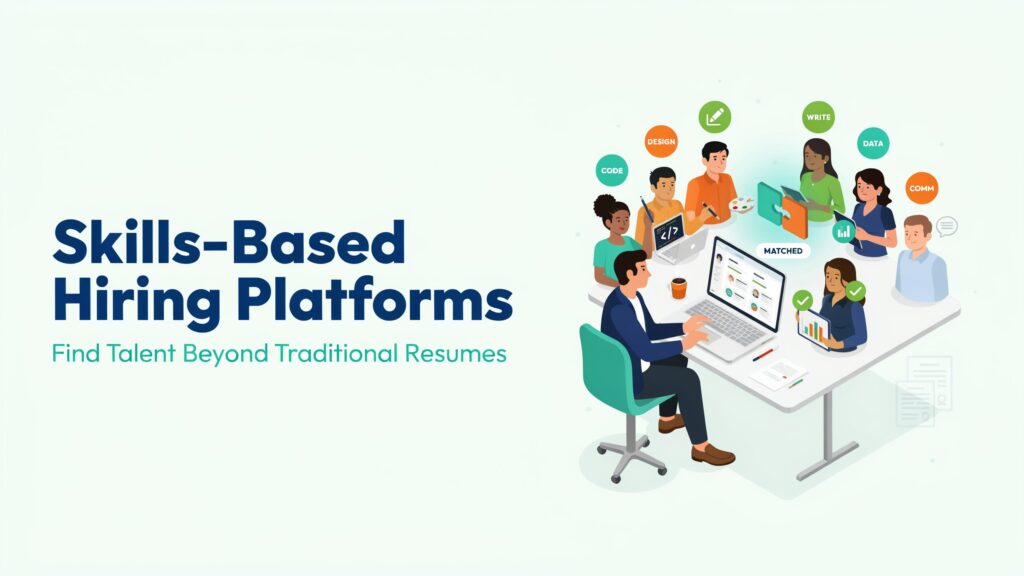
Skills-based hiring is no longer experimental in 2026. High-growth tech and product companies increasingly use structured assessments and AI interviews because resumes have become weak signals. Candidates now generate tailored resumes with AI tools that match job descriptions almost perfectly, so keyword matching and pedigree screening predict little about actual performance. The right platform depends on whether you primarily hire technical roles, need broad skills coverage, or want a full talent intelligence layer that also supports internal mobility.
This guide recommends the leading platforms for skills-based hiring and shows which ones make sense for different team sizes and hiring volumes. Pure assessment tools still dominate most tech teams because they deliver clear, job-relevant signal without requiring a multi-year transformation. Full talent intelligence platforms matter more when you already have scale and need to map skills across external candidates and your existing workforce. Implementation effort, pricing opacity, and candidate drop-off remain real constraints. A platform that adds process without improving quality of hire or time-to-hire is not progress.
Most teams start with one high-volume role, measure results against actual performance, and expand only when the signal is clear. The difference between a useful tool and extra process often comes down to whether the assessment or interview mirrors the work and whether results flow cleanly into the ATS instead of creating a parallel workflow.
What Skills-Based Hiring Actually Requires in 2026
Moving beyond keyword matching on resumes is table stakes. In 2026 the bar is higher: validated assessments or work samples that predict on-the-job performance, structured interviews (including AI-assisted ones), and integration with the existing ATS so recruiters are not forced to manage two systems. Pure resume screening continues to underperform because it measures writing ability and AI tool use more than job skill. Multiple studies and operator experience show that cognitive ability, work-sample performance, and structured interview scores correlate more strongly with later performance than education or prior employer brand.
The practical requirements are straightforward. First, the evaluation must produce signal that hiring managers trust enough to change a decision. Second, candidate experience has to stay reasonable—long, poorly designed, or repetitive assessments drive drop-off that costs more than the bad hires they prevent. Third, results need to reach the ATS automatically so the process does not slow down. Fourth, the approach should reduce bias by focusing on demonstrated skill rather than proxies, though no tool eliminates bias on its own; human review of structured evidence still matters.
Teams that treat skills-based hiring as “add a test and automate the rest” usually see completion rates fall and quality of hire stay flat. Teams that start with realistic work samples or role-specific simulations for one or two roles, integrate the results, and keep a human structured interview tend to see clearer improvements in signal quality and fewer late-stage mismatches. Speed and candidate experience are not secondary; they determine whether the platform is used consistently or abandoned after a pilot.
Recommended Platforms by Use Case
CodeSignal
Best overall for teams that want validated skills assessments across technical and non-technical roles, with AI interview capabilities.
CodeSignal has evolved into an agentic skills intelligence platform. It still offers strong, I-O psychologist-validated assessments for both engineering and business roles, plus live technical interviews in a cloud IDE. Its AI Interviewer runs structured, conversational screens that score against role-specific rubrics and produce transcripts and skills reports. Newer agentic features evaluate real work from systems such as GitHub, Salesforce, or Gong rather than relying only on self-reported or resume data, and the platform includes learning tools that can close identified skills gaps.
Strengths: Broad coverage of technical and business skills in one place; AI interviews that reduce early recruiter time; assessments designed as work samples rather than pure multiple-choice; SOC 2 Type II and other compliance certifications available; integrations with major ATS tools.
Limitations: Credit-based pricing means unused credits still represent cost, and higher-volume or enterprise use moves to custom quotes. Implementation of the newer skills-intelligence features requires connecting internal systems and defining what “real work” evidence looks like. Candidate familiarity is lower than pure coding platforms for engineering-only roles.
Pricing character: Self-serve tiers exist (Build starts around $79 per month billed annually with a limited annual credit pool; Grow is substantially higher). Extra credits cost roughly $20 each. Enterprise and full agentic skills intelligence are quote-based.
When to choose it: You hire a mix of technical and business roles and want one platform for assessments plus AI-assisted screening. Growth-stage or mid-size teams that need better signal without immediately building a full internal talent marketplace often start here. Larger organizations already using CodeSignal for hiring can extend it into internal skills measurement.
HackerRank
Best for pure technical/engineering hiring at scale. Strong coding assessments and live interviews.
HackerRank remains the default for many engineering teams because of its large question library, candidate brand recognition, and support for both asynchronous assessments and live pair-programming interviews. It now includes an AI interviewer (Chakra) and agentic IDE features that let candidates work with AI assistance while the system records the process. Scoring is largely automated, and the platform integrates with common ATS tools on higher tiers.
Strengths: Extensive library of coding challenges across languages and difficulty levels; high candidate familiarity, which can reduce anxiety and improve completion; live interview environment that feels closer to real collaboration; AI interviewer options for first-round screening at volume.
Limitations: Heavily weighted toward technical roles; stock library questions can be practiced in advance, so the signal sometimes reflects preparation more than novel problem-solving. Non-technical hiring is limited. Pricing is usage-based with annual attempt limits on self-serve plans, so high volume quickly moves to Pro or Enterprise.
Pricing character: Starter plans begin around $79 per month billed annually for a modest number of attempts (commonly 60 per year on recent public tiers); Pro scales higher. Extra attempts are priced separately. Full enterprise features are quoted.
When to choose it: You primarily hire software engineers at meaningful volume and want a platform candidates already know. Early- and growth-stage tech teams that screen dozens of engineers per quarter often get the best combination of speed and signal here, provided they rotate questions or use custom tasks to limit prep effects.
TestGorilla
Best for broader skills coverage (technical + cognitive + role-specific) with relatively accessible pricing and a free tier. Good starting point for many teams.
TestGorilla offers a large library of skills tests that span coding, cognitive ability, personality, and role-specific competencies for sales, marketing, operations, and other functions. It includes video questions, custom questions, and (on higher plans) AI interviews and job simulations. A free plan provides limited monthly credits and access to a handful of essential tests, which lets smaller teams experiment without a contract.
Strengths: One platform covers mixed hiring needs without forcing separate tools for engineers and everyone else; free tier lowers the barrier to a first pilot; assessments can be combined into batteries that hiring managers find interpretable; ATS integrations and reporting are available on paid plans.
Limitations: Technical assessments are less deep and less research-backed than dedicated engineering platforms for senior or specialized coding roles. Credit consumption varies by module (AI interviews cost more than basic skills tests), and long batteries can hurt completion rates. Scientific validation and legal defensibility documentation are lighter than pure psychometric vendors.
Pricing character: Free plan with limited monthly credits. Paid Core plans start in the low-to-mid hundreds of dollars per month billed annually (exact floors vary with credit volume); Plus adds custom tests, fuller AI interview libraries, and more seats. Enterprise is quoted.
When to choose it: You hire a mix of roles, have modest volume, and want to test skills-based screening without a large upfront commitment. Smaller or growth-stage teams with mixed technical and non-technical needs often start on the free or Core tier, prove value on one or two roles, then expand. It is less ideal when engineering hiring volume is high enough that a specialized coding platform delivers clearer signal.
Codility
Best for engineering teams that want rigorous, research-backed technical assessments.
Codility focuses on structured, deterministic coding assessments and live interviews with strong anti-cheating controls, including task leakage protection that removes compromised questions from the library. Scoring follows fixed criteria set before the assessment is released, and the platform provides detailed performance analytics. Newer features include AI Copilot modes that let candidates use AI assistance while the system captures how they used it, plus tools for building tasks from an organization’s own codebase.
Strengths: Emphasis on fairness, explainability, and research-backed design; clean reporting that hiring managers can audit; support for realistic engineering tasks rather than only algorithm puzzles; ability to evaluate AI-tool use rather than pretend candidates will not use it.
Limitations: Narrowly focused on technical roles. Entry pricing and seat limits can feel high for very small teams. Question library is smaller than HackerRank’s, so teams that rely heavily on off-the-shelf problems may need more custom work. Non-technical coverage is minimal.
Pricing character: Entry plans begin around $1,200 per year for a limited number of invites and users; growth and enterprise tiers scale with volume and are often quoted. Full ATS, SSO, and advanced features typically require higher tiers.
When to choose it: Engineering leadership wants assessments whose scoring and design can be defended internally or externally, and the team is willing to invest in realistic tasks. Mid-size or larger tech organizations that already run structured technical hiring and need stronger analytics or AI-use visibility often prefer Codility over broader or more brand-driven alternatives.
HireVue
Best for high-volume hiring where structured video interviews and AI screening are the priority.
HireVue is built for organizations that process large numbers of applicants and need consistent, structured evaluation at the top of the funnel. It offers on-demand video interviews, a conversational AI Interviewer that asks follow-up questions and scores responses against role-specific criteria, game-based assessments, and Virtual Job Tryouts that simulate actual work without relying on AI. The company emphasizes that its AI scores transcripts of what candidates say rather than facial expressions or tone, and it publishes explainability materials and audit statements. Results are designed to flow into ATS systems so recruiters can review scores, transcripts, and flags without leaving their existing workflow.
Strengths: Mature tools for high-volume structured interviewing; combination of video, games, and job simulations that can be tailored by role; strong emphasis on validation science and defensibility documentation; fraud-detection features (identity checks, liveness, process monitoring) that have become more important as candidates use generative AI.
Limitations: Primarily an enterprise product with opaque pricing and a sales-led buying process. Candidate experience can feel impersonal, and poorly designed interview batteries drive drop-off. It is less focused on deep technical coding assessments than dedicated engineering platforms. Implementation requires defining rubrics and calibrating AI scoring with human review.
Pricing character: Enterprise and quote-based. No meaningful self-serve public pricing. Cost scales with volume, modules (AI Interviewer, games, Virtual Job Tryouts), and support level.
When to choose it: You hire at high volume across multiple functions (customer service, sales, early-career, operations) and need structured screening that reduces recruiter time while remaining auditable. It fits larger companies more than early-stage teams. Pair it with human structured interviews rather than treating AI scores as the final decision.
Eightfold
Best for larger organizations that want AI-driven skills inference for both external hiring and internal mobility/workforce planning.
Eightfold is a talent intelligence platform rather than a pure assessment tool. It uses deep learning trained on more than a billion career profiles to infer skills, identify likely and missing skills, and match people to roles. The same underlying skills graph supports external recruiting, internal mobility marketplaces, workforce planning, and resource allocation. Recent expansions include AI agents for recruiting workflows and continued government adoption (including expanded access across U.S. defense organizations). Skills data can be enriched by assessments, but the core value is continuous inference and matching across the workforce, not one-off tests.
Strengths: Unified view of external candidates and internal employees; strong skills inference and adjacent-skill mapping that supports internal mobility and succession; scales to large, multi-entity organizations; FedRAMP and other enterprise compliance options for regulated buyers.
Limitations: Enterprise pricing and implementation complexity. Skills inference is powerful but still requires governance—teams must decide how much weight to give inferred versus validated skills. It is overkill for a growth-stage company that simply needs better external screening. Rollout typically involves data integration, change management, and process redesign beyond the recruiting team.
Pricing character: Fully enterprise and opaque. Expect multi-year contracts scoped to modules (talent acquisition, talent management, workforce planning) and data volume. No meaningful self-serve entry point.
When to choose it: You are a mid-to-large enterprise (or public-sector organization) that wants skills-based decisions for both hiring and internal talent movement, and you have the resources to implement a broader talent intelligence layer. Most smaller tech teams should start with assessment platforms and consider Eightfold only after volume and internal mobility needs justify the investment.
iMocha
Best for companies that need a large library of technical and non-technical assessments plus skills intelligence features.
iMocha positions itself as a skills and work intelligence platform with one of the broader assessment libraries in the market—covering technical, functional, cognitive, soft skills, and job-role batteries across thousands of skills. It includes coding environments, live and asynchronous interviews, whiteboarding, advanced proctoring, and skills analytics that can support both external hiring and internal skills inventories. Integrations reach major ATS and HCM systems (including SuccessFactors, Workday, and Oracle). AI features include conversational interviews and tools for measuring AI readiness.
Strengths: Breadth of content (technical plus non-technical) in a single platform; support for custom assessments and benchmarking; proctoring and integrity tools; skills taxonomy and gap-analysis features that go beyond pure hiring; enterprise-oriented integrations.
Limitations: Pricing is largely quote-based or starts at higher self-serve floors than the most accessible tools; limited free trial. Validation depth and candidate brand recognition are generally lower than specialized psychometric or pure coding platforms. Implementation effort rises when teams try to use both the assessment and skills-intelligence modules simultaneously.
Pricing character: Mix of published lower-tier annual plans (often starting in the hundreds to low thousands of dollars per year for limited users) and custom enterprise pricing. Most meaningful deployments involve a sales conversation.
When to choose it: You need wide assessment coverage across technical and business roles and want skills intelligence capabilities without immediately moving to a full talent marketplace platform like Eightfold. It fits mid-market and enterprise buyers that value library size and internal skills mapping more than the lowest possible entry price.
SHL (and similar validated psychometric platforms)
Best when legal defensibility, benchmarking, and scientifically validated assessments matter most (often regulated or enterprise environments).
SHL remains a reference point for scientifically validated psychometric assessments. Its catalog includes cognitive ability tests, personality and behavioral instruments, situational judgment tests, skills simulations, and video interviews, all supported by extensive research, norm groups, and documentation that can be used for adverse-impact analysis and compliance. The platform integrates with a large number of ATS systems and is frequently used by large employers, professional services firms, and organizations that must defend hiring decisions. Similar platforms in this category emphasize validity evidence, global norms, and auditability over rapid self-serve setup.
Strengths: Strongest documentation of predictive validity and fairness research among mainstream vendors; broad, job-relevant assessment types; global norming and benchmarking; mature enterprise support and ATS connectivity; useful when legal or regulatory scrutiny is high.
Limitations: Buying and implementation are sales-led and relatively heavy. Public pricing is essentially nonexistent. The experience can feel more traditional than modern work-sample or AI-interview platforms, and pure technical coding depth is usually lower than specialized engineering tools. Time-to-value is longer because of content selection, norming, and stakeholder alignment.
Pricing character: Fully opaque and enterprise. Contracts are scoped by volume, roles, languages, and modules. Expect a formal procurement process.
When to choose it: Legal defensibility, benchmarking against large norm groups, or regulatory requirements are primary concerns. Large or regulated employers often combine SHL-style instruments with more modern work-sample tools rather than relying on psychometrics alone. Early-stage or high-growth tech teams rarely start here.
How to Choose by Stage and Hiring Need
Early- and growth-stage tech teams that hire mostly engineers should start with HackerRank, Codility, or CodeSignal. HackerRank offers the highest candidate familiarity and a practical entry price for moderate volume. Codility is preferable when the engineering team prioritizes deterministic scoring, leakage protection, and the ability to evaluate how candidates use AI. CodeSignal makes sense if the same team also needs AI interviews or occasional non-technical assessments in one system.
Teams hiring mixed roles at lower volume usually get the best results from TestGorilla. The free tier lets them pilot on one or two roles without a contract, and the library covers cognitive, role-specific, and basic technical skills without forcing a separate engineering platform.
High-volume or multi-function hiring (customer-facing, operations, early-career, or sales) points toward HireVue or CodeSignal. HireVue is stronger when structured video interviews and validated job simulations at scale are the main requirement. CodeSignal is stronger when the organization wants AI interviews plus deeper work-sample assessments across both technical and business roles.
Enterprises that need internal skills mapping and mobility should look at Eightfold or comparable talent intelligence platforms. These systems infer skills continuously and support both external hiring and internal opportunity matching. iMocha sits in a middle ground for organizations that want a large assessment library plus lighter skills intelligence without a full marketplace transformation. SHL or equivalent psychometric platforms are the right choice when validity documentation and legal defensibility outweigh speed of setup.
A simple decision matrix helps:
- Role type mostly technical + moderate volume → HackerRank / Codility / CodeSignal.
- Mixed roles + smaller team → TestGorilla.
- High volume + multi-function → HireVue or CodeSignal.
- Need internal skills mapping + enterprise scale → Eightfold (or iMocha for a lighter entry).
- Regulatory or defensibility priority → SHL-style validated instruments.
Most teams over-index on feature lists and under-index on implementation effort and candidate drop-off. The platform that produces usable signal inside the existing ATS workflow with acceptable completion rates is almost always better than the one with the longest feature list.
Practical Tips for Implementing Skills-Based Hiring
Start with one or two high-volume roles rather than every job at once. Pick roles where bad hires are expensive and where a realistic work sample or structured assessment can be defined in days, not months. Measure quality of hire and time-to-hire against a baseline; completion rates alone do not prove value.
Prioritize work samples or realistic assessments over pure multiple-choice whenever possible. Coding tasks in a real IDE, role-play simulations, spreadsheet analyses, or short case exercises give hiring managers evidence they trust. Multiple-choice cognitive tests can still add signal, but they rarely replace a work sample for final decisions.
Integrate with the ATS so results, scores, and transcripts appear in the existing candidate record. Parallel workflows create extra process and lower adoption. Watch candidate drop-off carefully—assessments longer than 60–90 minutes or that feel disconnected from the job reduce conversion more than they improve signal.
Combine platform data with structured human interviews. Use the assessment or AI interview to raise the quality of the shortlist, then have interviewers probe the same skills with behavioral questions and a shared rubric. Fully automated decisions increase risk and reduce candidate trust. Track the metrics that matter (quality of hire at 6–12 months, time-to-hire, offer acceptance, and diversity of the hired slate) rather than vanity metrics such as number of assessments completed.
Conclusion
The best platforms for skills-based hiring in 2026 depend on what you are hiring for and how mature your process is. Most tech teams start with strong assessment tools such as CodeSignal, HackerRank, or TestGorilla because they deliver clearer signal than resumes with manageable implementation effort. Larger organizations often add talent intelligence platforms such as Eightfold when they need continuous skills mapping and internal mobility, or validated psychometric systems such as SHL when defensibility is non-negotiable.
The goal is better signal with less bias and faster decision-making—not more tools for their own sake. Teams that treat the platform as a way to generate job-relevant evidence, integrate it into existing workflows, and keep humans in the loop on final decisions see the largest reductions in bad hires. Those that add assessments without changing how decisions are made usually add process and cost with little improvement in outcomes.
FAQs
What’s the best platform for skills-based hiring?
There is no single best platform. For most mixed or technical teams that want validated assessments plus AI interviews, CodeSignal is a strong default. Pure engineering teams often prefer HackerRank or Codility. Smaller teams testing the waters start with TestGorilla’s free tier. The right choice depends on role mix, volume, and whether you also need internal skills mapping.
Is TestGorilla good enough for technical roles?
It is good enough for screening junior or generalist technical roles and for teams that also hire non-technical staff. For senior or specialized engineering roles, dedicated platforms such as HackerRank, Codility, or CodeSignal usually produce stronger, more realistic signal.
Should we use HackerRank or CodeSignal?
Choose HackerRank if engineering hiring is the clear majority of your volume and candidate brand recognition matters. Choose CodeSignal if you want AI interviews, broader role coverage, or a path toward skills intelligence that extends beyond pure coding assessments.
Do AI interviews actually work for hiring?
They work well for structured early screening when the questions and rubrics are role-specific and humans review the outputs. They reduce recruiter time and increase consistency. They do not replace later human interviews, and poorly designed AI interviews hurt candidate experience and conversion. Used as one input among several, they improve signal; used as the sole decision-maker, they increase risk.
What’s the difference between skills assessments and talent intelligence platforms?
Skills assessments (CodeSignal, HackerRank, TestGorilla, Codility, HireVue) evaluate candidates on specific tasks or interviews and produce a score or report for a hiring decision. Talent intelligence platforms (Eightfold and similar) continuously infer skills from profiles, work data, and assessments across both external candidates and current employees so the organization can plan, develop, and move talent internally. Many companies use assessments first and add talent intelligence later.
How expensive are skills-based hiring tools?
Entry points range from free (TestGorilla limited tier) to roughly $80 per month billed annually for light technical use (HackerRank or CodeSignal self-serve). Mid-volume paid plans commonly run several hundred to a few thousand dollars per month. Enterprise talent intelligence and full psychometric suites are quote-only and often multi-year. Real cost includes credits consumed, implementation time, and candidate drop-off, not just the license fee.
Can small companies do skills-based hiring without big platforms?
Yes. Small teams can use free or low-cost tiers of TestGorilla, structured take-home work samples scored against a simple rubric, and standardized interview questions. The critical elements are realistic tasks and consistent evaluation, not the size of the vendor.
Does skills-based hiring reduce bias?
It reduces the impact of resume proxies (school, employer brand, name) that have well-documented bias. Structured assessments and interviews produce more consistent evidence. Bias is not eliminated—question design, norm groups, and human review still matter—but the overall process is usually less biased than unstructured resume screening plus unstructured interviews.
When should a company move beyond resume screening?
As soon as resumes stop predicting performance, which for most technical and product roles is already true in 2026. Start when you have at least one role with meaningful volume and the ability to measure quality of hire afterward. Waiting for a perfect platform usually means continuing to hire on weak signals.
What’s the biggest mistake companies make with skills-based hiring tools?
Adding the tool without changing the decision process. The most common failure is running assessments, then ignoring the results in favor of the same unstructured interviews and gut feel that existed before. The second biggest mistake is launching long or irrelevant assessments that drive high candidate drop-off and erode the talent pipeline.